
Criminal vs. Civil Cases: Why the Difference Matters
Learn how criminal and civil cases differ in purpose, process, burdens of proof, penalties, and your rights in each type of courtroom.
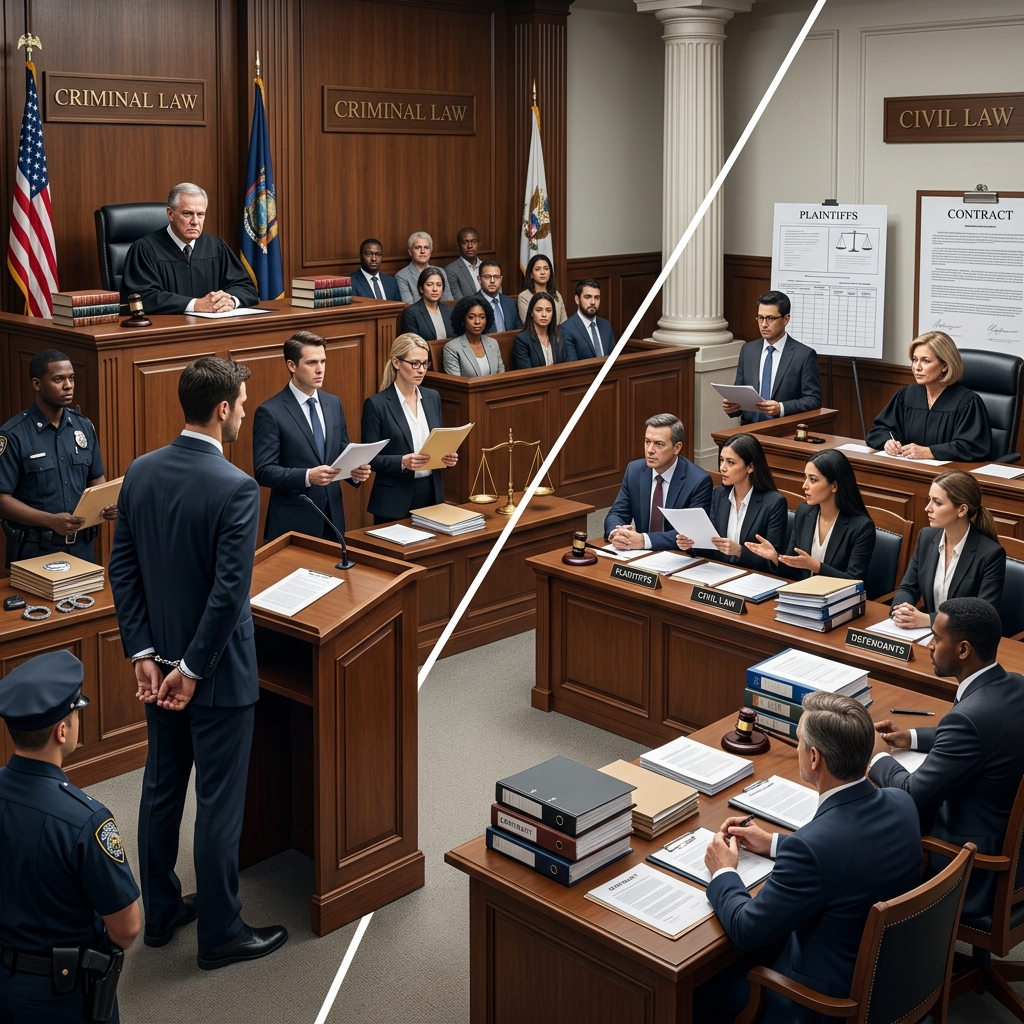
People often hear that a situation is a “civil matter” or that someone is facing “criminal charges,” but the practical difference between criminal and civil cases can be enormous for everyone involved. Understanding those differences helps you better evaluate risk, decide when to contact a lawyer, and know what outcomes are realistically on the table.
This guide explains, in plain language, how criminal and civil cases differ in purpose, procedure, burdens of proof, consequences, and the rights available to each side. It is general information, not legal advice for any specific case.
Big-Picture Difference: What the Case Is Trying to Do
At the highest level, criminal cases focus on punishing violations of laws that protect the public, while civil cases resolve disputes and compensate those who have been harmed.
- Criminal law addresses offenses considered wrong against society as a whole (even if a specific person is the immediate victim), such as theft, assault, or fraud.
- Civil law governs disputes between individuals, businesses, or organizations about money, property, obligations, or personal rights, such as contracts, injuries, or family issues.
This difference in purpose drives almost every other distinction between criminal and civil cases—from who starts the case to how much proof is required, and what the court can order in the end.
Who Brings the Case and Why
The first major distinction is who actually files the case and what they are asking the court to do.
| Feature | Criminal Case | Civil Case |
|---|---|---|
| Who starts the case? | Government prosecutor (city, state, or federal). | Private party (individual, business, or sometimes a government entity acting as a plaintiff). |
| What is the goal? | Protect the public, punish wrongdoing, and deter future crimes. | Resolve a dispute and compensate or otherwise remedy harm to the plaintiff. |
| Case names | Often written as “State vs. Defendant” or “United States v. Defendant.” | Written as “Plaintiff v. Defendant,” e.g., “Smith v. Jones.” |
In a criminal case, even if a victim does not want to proceed, the government may still go forward if prosecutors believe the public interest requires it. In civil cases, the plaintiff usually controls whether to file, settle, or dismiss the case.
What Is at Stake for the Parties
Another crucial difference is what each side could lose or gain at the end of the case.
Potential Outcomes in Criminal Cases
Because crimes are seen as offenses against society, the consequences can be severe. Courts can impose:
- Incarceration (jail or prison), which involves a loss of liberty and is considered the harshest common penalty.
- Fines payable to the government.
- Probation with conditions such as counseling, classes, or community service.
- Other sanctions such as restitution to victims, mandatory treatment, or restrictions on activities.
Because liberty is at stake, criminal defendants receive more procedural protections, such as the presumption of innocence and the right to counsel in many cases.
Potential Outcomes in Civil Cases
In civil litigation, courts do not send people to jail for the underlying dispute. Instead, the focus is on remedies such as:
- Money damages to compensate for losses like medical bills, lost wages, or property damage.
- Non-economic damages in some cases, such as pain and suffering or emotional distress.
- Injunctions, which are court orders telling a party to do something or to stop doing something (for example, stop infringing a patent or comply with a contract).
- Declaratory judgments that clarify the rights and obligations of the parties.
The aim is to make the injured party whole as much as money or a court order can, not to punish in the criminal-law sense.
Different Standards of Proof
Because the stakes are so different, the legal system uses different burdens of proof in criminal and civil cases.
Criminal: “Beyond a Reasonable Doubt”
In criminal court, the prosecution must prove the defendant’s guilt beyond a reasonable doubt. This is the highest standard in the legal system and reflects how serious it is to send someone to jail or brand them with a criminal record.
- The defendant is presumed innocent until proven guilty.
- The prosecution carries the burden of proof throughout the case.
- If jurors have a reasonable doubt about guilt after considering all the evidence, they must find the defendant not guilty.
Civil: “Preponderance of the Evidence” (and Sometimes More)
Most civil cases use the standard of preponderance of the evidence, meaning the plaintiff must show that their version of events is more likely true than not—often explained as more than 50% likely.
- This is a much lower bar than beyond a reasonable doubt.
- Some special civil matters, such as certain fraud claims, may use a middle standard called clear and convincing evidence, which is higher than preponderance but lower than criminal proof.
The difference in standards means it is entirely possible for a person to be acquitted in a criminal trial and still be found liable in a civil lawsuit arising out of the same events, because the civil plaintiff has less to prove.
Key Players and Their Roles
Although both kinds of cases may involve a judge, jury, lawyers, and witnesses, their roles and obligations differ depending on whether the case is criminal or civil.
Participants in a Criminal Case
- Judge manages the trial, rules on legal issues and evidence, and in many systems sentences the defendant if they are found guilty.
- Prosecutor represents the government and is responsible for proving the charges beyond a reasonable doubt.
- Defendant is the person accused of a crime and has specific constitutional rights.
- Defense attorney defends the accused; if the defendant cannot afford one and prison is a possible outcome, the court may appoint a lawyer at government expense in many jurisdictions.
- Victim is a witness and the person harmed; they may have certain participation and notification rights but are not a formal party like the prosecutor and defendant.
Participants in a Civil Case
- Plaintiff is the person or entity who claims to have been harmed and files the lawsuit.
- Defendant is the person or entity alleged to be responsible for the harm.
- Lawyers represent each side if they choose to hire counsel, but there is generally no right to a free lawyer in ordinary civil disputes.
- Judge oversees the case and may decide the facts if there is no jury.
- Jury (when used) decides liability and the amount of damages or other relief.
How Cases Move Through the System
The path from start to finish also differs significantly between criminal and civil cases, even though both involve filings, hearings, and possibly a trial.
Typical Stages in a Criminal Case
- Investigation and arrest by law enforcement after suspected criminal activity.
- Charging decision by prosecutors who determine which crime, if any, to charge based on the evidence.
- Initial appearance and bail where the court informs the accused of the charges and may consider release conditions.
- Plea negotiations where most cases are resolved without trial through guilty pleas or other agreements.
- Trial (if there is no plea) where the prosecutor must prove guilt beyond a reasonable doubt to a jury or judge.
- Sentencing if the defendant is convicted, and appeals in some cases.
Typical Stages in a Civil Case
- Filing a complaint by the plaintiff outlining claims and requested relief.
- Service of process notifying the defendant.
- Answer and motions where the defendant responds and may ask the court to dismiss or narrow the case.
- Discovery, the evidence-gathering phase that may include documents, written questions, and depositions.
- Settlement discussions and possibly mediation; many civil disputes resolve without trial.
- Trial if no settlement is reached, leading to a judgment for or against the defendant.
- Enforcement and appeals to collect a judgment or challenge legal rulings.
Rights and Protections for Defendants
Because criminal cases can involve loss of liberty and a serious stigma, defendants in those cases are granted extensive protections under constitutional and statutory law. Civil defendants have important rights as well, but fewer automatic safeguards.
Additional Protections in Criminal Cases
- Presumption of innocence until the prosecution proves guilt beyond a reasonable doubt.
- Right to counsel, including court-appointed counsel for many defendants who cannot afford an attorney and face possible incarceration.
- Right against self-incrimination (the right to remain silent) and protection from being forced to testify against oneself.
- Right to confront witnesses through cross-examination and to present evidence and witnesses in one’s defense.
- Right to a jury trial in many serious cases.
Rights in Civil Cases
- Notice and opportunity to be heard before the court can enter judgment.
- Right to present evidence and to challenge the other side’s evidence under the rules of civil procedure.
- Discovery tools to gather information from the other party and third parties.
- Possible right to a civil jury, depending on the jurisdiction and type of claim.
- No general right to appointed counsel in ordinary disputes; parties must usually hire their own lawyer or represent themselves.
Real-World Overlap: When One Event Leads to Both Cases
Many real-life incidents can generate both a criminal prosecution and a civil lawsuit—for example, a serious car crash, an assault, or corporate misconduct. In such situations:
- The criminal case is brought by the government to punish and deter the wrongful conduct.
- An injured person or business may separately bring a civil case seeking compensation for medical bills, lost income, or other damages.
- The two cases proceed in different courts or different divisions of the same court system, potentially on different timelines.
- Outcomes can differ because of the different burdens of proof and legal standards.
Defendants in this situation must manage both tracks carefully, often with different lawyers or at least different strategies for the criminal and civil sides.
Practical Tips for Non-Lawyers
If you are trying to figure out whether a situation is more likely to be a criminal matter, a civil dispute, or both, the following questions can help guide you:
- Is there a statute making the conduct a crime? Acts like theft, assault, or drunk driving are typically criminal.
- Is someone seeking compensation or a court order, rather than punishment? That is a hallmark of a civil case.
- Who is involved? If the government is the party bringing charges, it is a criminal case; if the dispute is between private parties, it is usually civil.
- What are the potential consequences? Risk of jail or a criminal record indicates criminal law; money judgments or injunctions indicate civil law.
In any serious situation—particularly where there could be criminal exposure or significant financial liability—speaking with a qualified attorney in your area is the safest way to understand your options.
Frequently Asked Questions
Can a person be sued in civil court after a criminal case?
Yes. The same set of facts can lead to both a criminal prosecution and a civil lawsuit. Because the standards of proof and purposes differ, a criminal acquittal does not automatically prevent a civil court from finding the person liable under the lower civil standard.
Can the government bring a civil case too?
In some areas, such as consumer protection or environmental law, government agencies can use civil lawsuits to seek fines, injunctions, or other remedies without pursuing criminal charges. These actions are still civil in nature because they do not seek incarceration.
Do I get a free lawyer in a civil case?
Generally, no. While the government must provide counsel in many criminal cases if you cannot afford one, there is no broad right to a free lawyer in ordinary civil disputes. Some legal aid organizations and pro bono programs may offer help to eligible people, but it is not guaranteed.
Is a traffic ticket criminal or civil?
Minor traffic offenses are often treated as infractions or quasi-criminal matters, and the exact classification depends on the jurisdiction. Serious driving offenses like driving under the influence are commonly criminal, while disputes over insurance or property damage from a crash are civil.
What if I ignore a civil lawsuit?
If you are properly served with a civil complaint and do nothing, the court may enter a default judgment against you, granting the plaintiff what they requested, within legal limits. While you will not be sent to jail just for owing money, the judgment can lead to wage garnishment, liens, or other collection efforts.
Can I go to jail in a civil case?
Civil courts do not send people to jail as a punishment for the underlying lawsuit itself. However, in rare situations a person may be jailed for contempt of court if they deliberately disobey a court order, such as refusing to testify after being ordered to do so or failing to comply with an injunction.
References
- Understanding the Differences Between Civil and Criminal Law — Grand Canyon University (GCU) Blog. 2021-04-21. https://www.gcu.edu/blog/criminal-justice-government-and-public-administration/civil-criminal-law
- Criminal vs. Civil Law: What’s the Difference? — St. Francis School of Law. 2022-08-15. https://stfrancislaw.com/blog/criminal-law-vs-civil-law/
- What Is the Difference Between Civil and Criminal Law? — U.S. Chamber Institute for Legal Reform. 2023-03-30. https://instituteforlegalreform.com/blog/civil-vs-criminal-law/
- The Difference Between a Civil and Criminal Case — The Mississippi Bar. 2019-01-01. https://www.msbar.org/for-the-public/consumer-information/the-difference-between-a-civil-and-criminal-case/
- The Differences between Criminal Court and Civil Court — LawHelp.org. 2018-06-01. https://www.lawhelp.org/resource/the-differences-between-criminal-court-and-ci
- Civil or Criminal: Do You Understand the Difference? — U.S. District Court, Middle District of Florida. 2014-05-01. https://www.flmd.uscourts.gov/civil-or-criminal-do-you-understand-difference
Similar Articles








Read full bio of medha deb




