
Sixth Amendment: 7 Rights Every Criminal Defendant Should Know
Understand how the Sixth Amendment protects people accused of crimes with fundamental trial and defense rights.
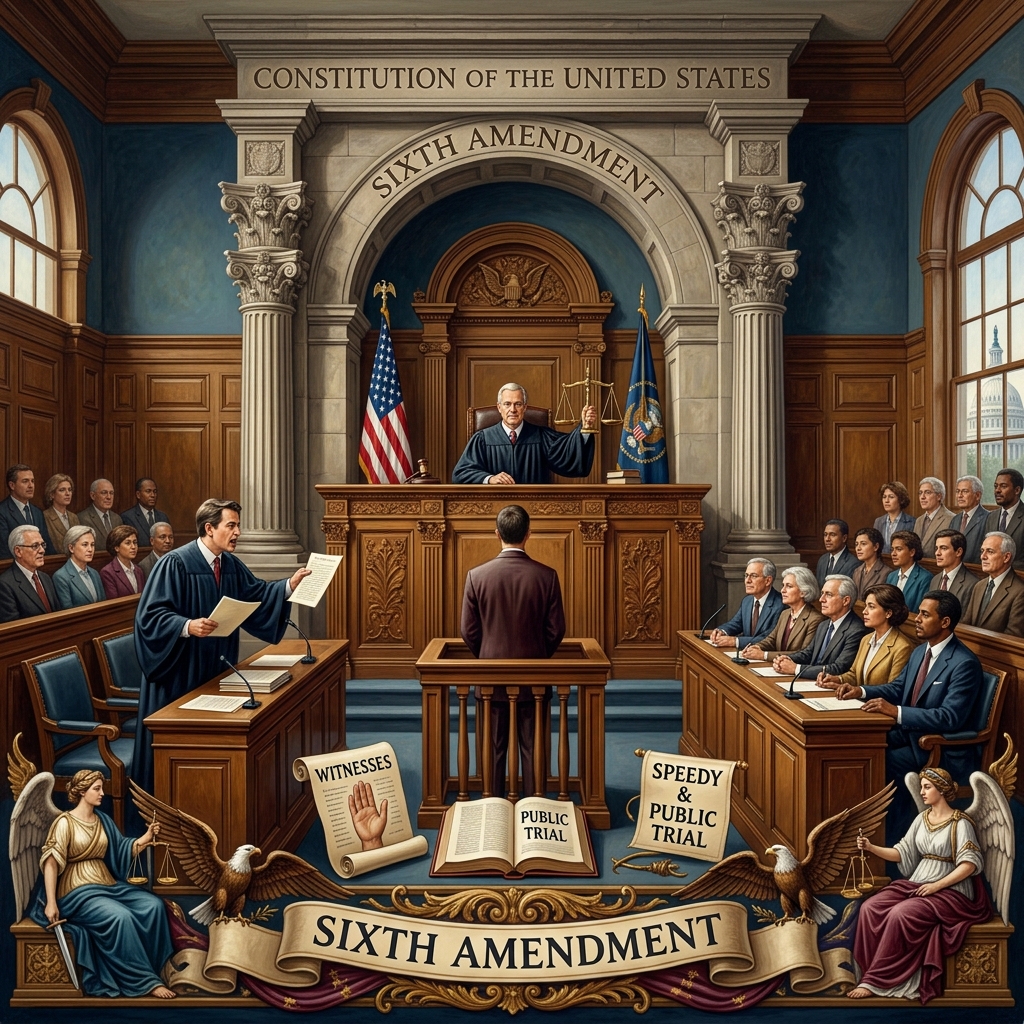
The Sixth Amendment to the United States Constitution is a cornerstone of criminal justice, guaranteeing essential protections to anyone accused of a crime in federal and state courts. These protections ensure that criminal prosecutions are fair, transparent, and guided by due process rather than government power alone.
At its core, the amendment promises several key rights: a speedy and public trial, an impartial jurynature and cause of the accusation, the right to confront witnessescompulsory processassistance of counsel Together, these rights form a framework designed to keep criminal proceedings fair and to prevent abuses of government authority.
Overview: What the Sixth Amendment Says
The text of the Sixth Amendment applies to “all criminal prosecutions” and spells out multiple distinct rights in one sentence. In simplified terms, it guarantees that:
- The accused is entitled to a trial that is not excessively delayed.
- The trial must generally be open to the public.
- The case is heard by an impartial jury from the state and district where the crime was alleged to have occurred.
- The defendant receives clear information about the charges.
- The defendant may face and question the prosecution’s witnesses.
- The defendant can call witnesses in their favor and use legal tools to compel their appearance.
- The defendant has the right to the assistance of a lawyer at critical stages of the prosecution, even if they cannot afford to pay one.
Each of these protections operates together. A fair trial is not only about having a lawyer or a jury; it is also about having adequate time, access to evidence, and the ability to challenge the government’s case.
Speedy Trial: Preventing Harmful Delay
The promise of a speedy trial is meant to prevent prosecutors and courts from leaving people accused of crimes in legal limbo for long periods. Excessive delay can harm the defendant in several ways: evidence can grow stale, witnesses’ memories can fade, and the accused may remain in custody or under restrictive conditions while awaiting trial.
Courts analyze whether a delay violates the speedy trial right by looking at factors such as:
- Length of delay – How much time passed between formal charges and trial.
- Reasons for delay – Whether the postponement was caused by the government, the defense, or neutral factors.
- Assertion of the right – Whether the defendant objected to the delay or requested a speedy trial.
- Prejudice to the defendant – Whether the delay harmed the defense or imposed unnecessary hardship.
A speedy trial does not mean a rushed trial. Courts must balance the need for promptness with the need to prepare adequately, gather evidence, and ensure that both sides can present their cases fairly.
Public Trial: Transparency and Accountability
The Sixth Amendment also protects the right to a public trial. Public proceedings help ensure the fairness of criminal trials by allowing members of the community, the press, and interested observers to see how justice is administered. Transparency discourages misconduct, secret evidence, and unfair practices.
While public access is the default rule, courts may limit access in narrow circumstances, such as:
- Protecting the safety or privacy of particularly vulnerable witnesses, including minors.
- Addressing serious concerns about national security or sensitive intelligence.
- Managing courtroom space or security issues.
Any restrictions on public access must be carefully justified and narrowly tailored. The goal is to balance transparency with privacy, safety, and practical realities in the courtroom.
Impartial Jury and Local Venue
Another central protection is the right to be tried by an impartial jury drawn from the community in the state and district where the alleged crime occurred. This protects defendants from being judged by a jury handpicked to favor the prosecution or drawn from far away, where community norms and knowledge differ.
| Jury Requirement | Purpose |
|---|---|
| Impartial jurors | Ensures jurors decide based on evidence and law, not bias or prejudice. |
| Local state and district | Guarantees the jury comes from the place where the crime was allegedly committed. |
| Representative cross-section | Promotes juries reflecting the community, not excluding groups based on race, gender, or other protected traits. |
During jury selection, both sides participate in questioning potential jurors. Courts can remove jurors for cause (such as clear bias) and allow limited peremptory challenges. Constitutional doctrine prohibits making jury selections based on race or similar protected characteristics, because doing so undermines impartiality and fairness.
Notice of the Nature and Cause of the Accusation
Fairness requires that a person know exactly what they are accused of. The Sixth Amendment guarantees the accused the right to be informed of the nature and cause of the accusation.
In practice, this means the charging document—often an indictment or criminal information—must:
- Identify the specific criminal offense alleged.
- State the essential elements of the crime.
- Provide enough detail so the accused can prepare a defense.
- Allow the accused to raise double jeopardy if the same charges are brought again later.
Without adequate notice, the defense cannot effectively investigate, challenge evidence, or raise appropriate legal arguments. Clear charges are therefore fundamental to due process and to the adversarial nature of criminal trials.
Confrontation: Facing and Questioning Adverse Witnesses
The Sixth Amendment includes a Confrontation Clause, which provides the right “to be confronted with the witnesses against” the defendant. This right is a major safeguard against unreliable testimony and secret evidence.
Confrontation generally includes:
- The defendant’s presence in the courtroom when witnesses testify.
- The opportunity for the defense to cross-examine those witnesses.
- Limits on the use of out-of-court testimonial statements unless certain conditions are met.
Modern case law has refined how courts handle hearsay and other out-of-court statements, especially when a witness is unavailable. However, the core idea remains: the prosecution should not be able to secure a conviction with testimony that the defendant has no opportunity to challenge in front of the jury.
Compulsory Process: Securing Favorable Witnesses
The Sixth Amendment also promises the right to “have compulsory process for obtaining witnesses in his favor.” This ensures that defendants can do more than simply react to the prosecution’s case; they can actively present their own evidence.
Compulsory process usually involves the ability to use court-issued subpoenas and other legal tools to require witnesses to appear and testify. Key aspects include:
- The ability to call witnesses whose testimony supports the defense theory of the case.
- The right to secure documents or physical evidence through appropriate court orders.
- Protection against arbitrary denial of defense efforts to present relevant, admissible evidence.
While courts may exclude evidence based on rules of relevance, reliability, or privilege, they cannot unjustifiably stop a defendant from presenting a meaningful defense through lawful compulsory process.
Assistance of Counsel: The Right to a Lawyer
The final clause of the Sixth Amendment guarantees the right “to have the Assistance of Counsel” for the defense. Courts have recognized this as one of the most critical rights, because a lawyer’s assistance is often necessary to understand and assert all the others.
Key components of the right to counsel include:
- Right at trial and critical stages: Defendants are entitled to legal assistance at trial and at other critical points, such as formal charging, certain pretrial hearings, and plea negotiations.
- Appointment of counsel for indigent defendants: If a defendant cannot afford an attorney, the government must provide one in prosecutions that can lead to imprisonment.
- Effective assistance of counsel: The lawyer must provide reasonably competent representation. Serious errors that prejudice the defense can be grounds for challenging a conviction.
The importance of this right is recognized in the Criminal Justice Act and various state systems, which provide for publicly funded defense services when individuals are financially unable to hire counsel. These structures exist to make the formal constitutional promise workable in practice.
How Sixth Amendment Rights Work Together
Although the Sixth Amendment lists separate rights, they interact closely in real cases. Consider how these protections reinforce one another:
- A speedy, public trial before an impartial jury ensures that the fact-finding process is fair and seen to be fair.
- Notice of charges and confrontation of witnesses allow the defendant to know and challenge the government’s case.
- Compulsory process and assistance of counsel enable the defendant to build and present a defense rather than simply contest what the prosecution offers.
These combined rights provide a structure that limits governmental power, encourages accuracy in fact-finding, and protects individual liberty.
Practical Tips for Defendants and Families
Anyone facing criminal charges, or supporting a loved one who is, should be aware of how Sixth Amendment rights show up in practice. While specific advice must come from a licensed attorney, general awareness can help people understand what to expect.
- Ask about timing: If delays become lengthy, discuss with counsel whether a speedy trial motion is appropriate.
- Track access to information: Defendants should receive clear information about the charges and evidence; if something seems unclear, they can ask their lawyer for clarification.
- Observe public proceedings: Family and community members often may attend hearings and trials, reinforcing transparency.
- Support defense investigation: Sharing information about potential witnesses or evidence with defense counsel can help use compulsory process effectively.
- Communicate with counsel: Honest, timely communication helps lawyers provide effective assistance and make strategic decisions about jury selection, motions, and trial tactics.
Frequently Asked Questions About the Sixth Amendment
Does the Sixth Amendment apply to all crimes?
The Sixth Amendment applies to “all criminal prosecutions,” which covers a broad range of offenses from misdemeanors to serious felonies. Some specific protections, such as the right to a jury trial, may depend on the potential punishment and are interpreted in light of other constitutional provisions and case law.
Can a defendant waive Sixth Amendment rights?
Many Sixth Amendment rights can be waived, but the waiver must be knowing, voluntary, and intelligent. For example, a defendant may choose to plead guilty and forgo a jury trial, or decide to represent themselves instead of having counsel. Courts take care to ensure that such decisions are made with full understanding of the consequences.
Is a public defender considered “assistance of counsel”?
Yes. Public defenders and other court-appointed lawyers are fully recognized as providing “assistance of counsel” under the Sixth Amendment. Their work is guided by professional standards, and defendants represented by appointed counsel have the same constitutional protections as those who hire private attorneys.
What happens if the right to a speedy trial is violated?
If a court finds that a defendant’s speedy trial right has been violated, possible remedies include dismissal of the charges or other relief tailored to the case. The outcome depends on the extent of the delay, the reasons behind it, and how it affected the defendant’s ability to mount a defense.
Does the Sixth Amendment apply in plea bargaining?
The right to counsel extends to many stages before trial, including plea negotiations. Effective legal representation is crucial when considering plea offers, because these decisions often determine whether a case goes to trial and what potential penalties a defendant faces.
References
- Sixth Amendment — Legal Information Institute, Cornell Law School. 2023-01-01. https://www.law.cornell.edu/constitution/sixth_amendment
- U.S. Constitution, Amendment 6 — Constitution Annotated, Library of Congress. 2022-01-01. https://constitution.congress.gov/constitution/amendment-6/
- Sixth Amendment to the United States Constitution — Encyclopedic overview based on primary sources. 2021-01-01. https://en.wikipedia.org/wiki/Sixth_Amendment_to_the_United_States_Constitution
- Sixth Amendment – Rights of Accused in Criminal Prosecutions — Justia U.S. Constitution Annotated. 2020-01-01. https://law.justia.com/constitution/us/amendment-06/
- The Sixth Amendment Initiative — Center for Justice Innovation. 2016-01-01. https://www.innovatingjustice.org/sixth-amendment/
- Sixth Amendment — Annenberg Classroom. 2018-01-01. https://www.annenbergclassroom.org/sixth-amendment/
- The Sixth Amendment guarantees the rights of criminal defendants — U.S. District Court, Northern District of Georgia (CJA Introduction). 2015-01-01. https://www.gand.uscourts.gov/sites/gand/files/CJA_Intro_to_Website.pdf
Similar Articles








Read full bio of Sneha Tete




