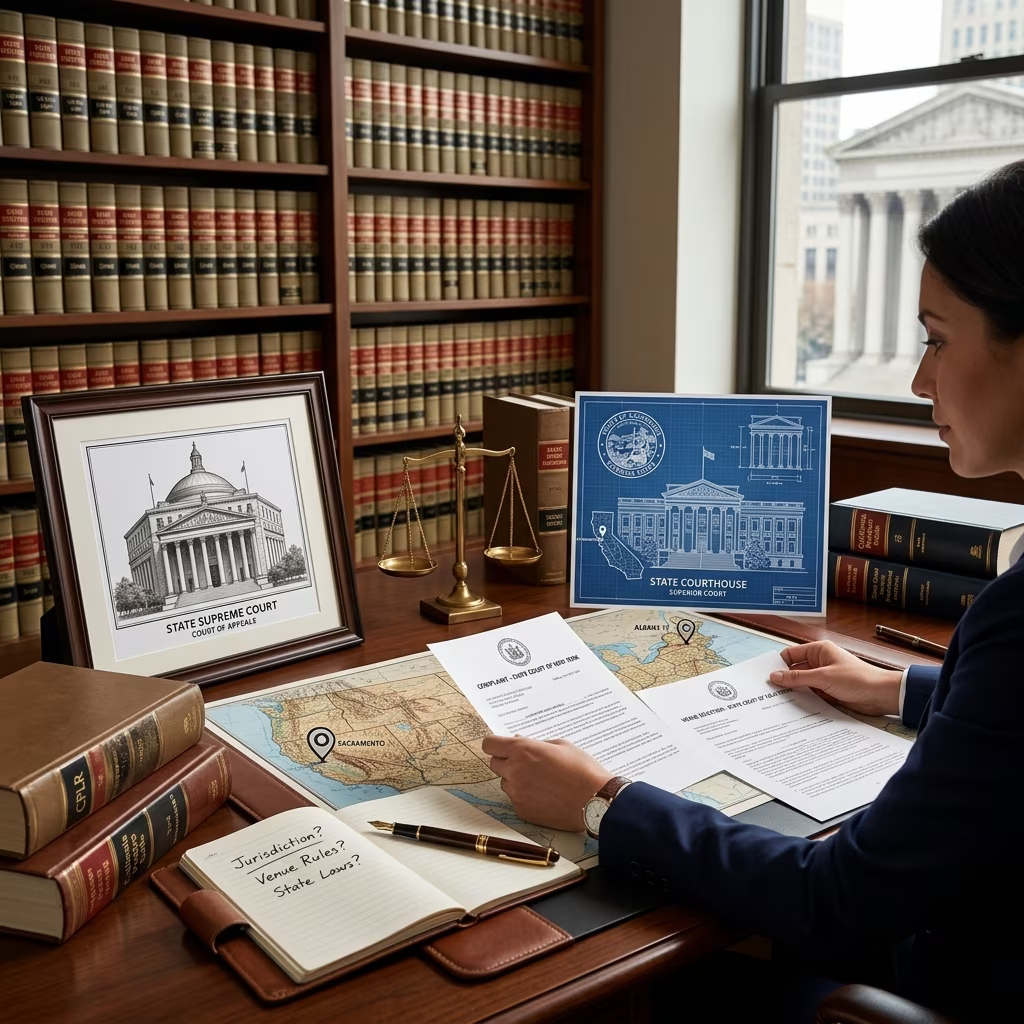
When you decide to bring a lawsuit, one of the first and most important questions is wherejurisdictionvenue
Big Picture: How State Court Cases Are Assigned
Every state operates its own court system under that state’s constitution and laws. Within those systems, several questions must be answered before a case is filed:
- Which level of court hears the case (trial court, specialty court, or appellate court)?
- Which type of court has authority over the subject (civil, criminal, family, probate, traffic, etc.)?
- Which geographic court may exercise power over the parties (personal jurisdiction) and the dispute (subject‑matter jurisdiction)?
- Which county or district is the proper venue for filing?
You generally cannot choose any court you want. The court must have legal authority over both the people and the type of claim, and it must be in a location the law recognizes as appropriate.
The Basic Structure of State Courts
Although details vary by state, most state court systems follow a similar three‑tier pattern:
- Trial courts – where cases start, evidence is presented, and judges or juries reach verdicts.
- Intermediate appellate courts – review trial court decisions for legal errors.
- State high court – usually called the supreme court, serving as the court of last resort on issues of state law.
Some states add specialized courts of limited jurisdiction, such as small‑claims courts, municipal courts, traffic courts, or family courts, that handle particular categories of cases. These smaller courts often feed into a general trial court for more serious matters or appeals.
| Level | Main Function | Example Types of Cases |
|---|---|---|
| Limited‑jurisdiction trial courts | Handle specific case types or lower‑value disputes | Traffic offenses, small claims, municipal code violations |
| General trial courts | Primary courts for most civil and criminal trials | Serious criminal charges, major civil lawsuits, family cases |
| Intermediate appellate courts | Review trial court judgments for legal error | Appeals from district or county courts |
| State high court | Final word on state law; may review selected appeals | Cases raising significant legal or constitutional issues |
Jurisdiction: A Court’s Legal Power to Hear a Case
Jurisdiction describes a court’s legal authority to decide a dispute. A court that lacks jurisdiction can be ordered to dismiss the case, and any judgment it issues may be invalid. In state court, two major forms of jurisdiction must be satisfied:
- Subject‑matter jurisdiction – does this court have power over this kind of case?
- Personal jurisdiction – does this court have authority over the parties involved?
Subject‑Matter Jurisdiction: Matching the Case to the Court
Subject‑matter jurisdiction concerns the type of dispute and, in some instances, the amount of money involved. States create courts of both general and limited jurisdiction:
- Court of general jurisdiction – empowered to hear a wide range of civil and criminal matters unless a statute directs otherwise.
- Court of limited jurisdiction – may only hear specific categories of cases (such as traffic, landlord‑tenant, or probate) or disputes below a certain dollar amount.
For example, a court that hears only traffic violations cannot take a bankruptcy case, and a small‑claims court usually cannot decide a multi‑million‑dollar commercial dispute. In many states, statutes set financial thresholds that divide responsibility between lower courts and general trial courts.
Key features of subject‑matter jurisdiction include:
- It is defined by constitutions and statutes and cannot be created by agreement between the parties.
- Court authority is usually interpreted strictly; if a statute does not grant power over a type of case, the court must reject it.
- Objections to subject‑matter jurisdiction can be raised at any time, including on appeal.
Personal Jurisdiction: Power Over the People Involved
Personal jurisdiction is the court’s authority to bind specific parties with its rulings. A state court usually has personal jurisdiction over individuals who live or are found in that state, and over businesses that do business there. The analysis focuses on the defendant, because the plaintiff chooses to appear in that court.
Common bases for personal jurisdiction include:
- Residence or presence – suing someone where they live or where they can be served with legal papers.
- Business activities – suing a company where it is incorporated, has its principal place of business, or carries out significant operations.[10]
- Minimum contacts – suing an out‑of‑state defendant whose contacts with the forum state show it is fair and lawful for that state’s courts to exercise authority.
Some courts have what is called general personal jurisdiction over entities that are at home in the state (such as corporations incorporated or headquartered there), meaning they can be sued there on almost any claim.[10] In other situations, courts have specific personal jurisdiction, limited to claims arising from the defendant’s contacts with the state.[10]
Venue: Choosing the Right Location Within the State
Jurisdiction answers the question, “Which state and which court may hear this case?” Venue answers, “Which county or local court should hear it?” Venue rules distribute cases geographically within the state for fairness and efficiency.
Typical venue statutes list several proper filing locations, such as:
- The county where the defendant lives or does business.
- The county where the events giving rise to the lawsuit occurred, such as an accident location.
- The county where a contract was signed, performed, or allegedly breached.
- The county where real estate at issue is located, for property‑related claims.
In some situations, more than one county may be a proper venue. When this happens, the plaintiff may have some strategic choice about where to file, often called forum selection or “forum shopping.”
Forum Shopping: Strategic Choices Within the Rules
As long as jurisdiction and venue requirements are satisfied, a plaintiff may choose among several acceptable courts. Lawyers sometimes consider factors such as:
- Convenience – travel distance to the courthouse, especially if many hearings are expected.
- Local rules and procedures – variations in filing requirements, motion practice, or scheduling.
- Historical case outcomes – some venues develop reputations as more plaintiff‑friendly or defendant‑friendly.
- Court workload – busier courts may take longer to reach trial.
Courts can transfer cases if venue is improper or unfair. A defendant who believes the plaintiff chose an inconvenient or legally incorrect venue may file a motion challenging that choice.
Civil vs. Criminal: Different Paths Through the State Courts
State courts hear both civil and criminal cases, but the rules and pathways differ in important ways.
Civil Cases
Civil cases involve disputes between private parties or between individuals and government entities over rights, obligations, or money. Examples include contract disputes, personal‑injury claims, employment claims, and family‑law matters.
Key features of civil case filing include:
- Venue is typically based on where the defendant resides, where the dispute arose, or where the property or contract is located.
- Lower‑value claims may go to small‑claims or limited‑jurisdiction courts, while higher‑value or complex matters go to general trial courts.
- Parties can often agree to a particular court or location through a forum selection clause in a contract, within limits.
Criminal Cases
Criminal cases are prosecutions brought by the state against individuals or entities accused of crimes. Venue often lies where the alleged offense occurred, ensuring local jurors and witnesses are available.
Common criminal‑court features include:
- Lower courts handling misdemeanors and preliminary hearings.
- General trial courts handling felony prosecutions and serious offenses.
- Appeals from convictions going through the state’s appellate system based on claims of legal error.
Appeals: Moving Up Through the Court System
Once a trial court issues a final judgment, the losing party may have a right to appeal to a higher court. Appeals do not start a new trial; they ask an appellate court to review whether the law was applied correctly.
In many states, the path looks like this:
- Appeal from limited‑jurisdiction court – may go to a general trial court or directly to an intermediate appellate court, depending on state rules.
- Appeal from general trial court – typically goes to an intermediate appellate court.
- Further appeal – the state high court may selectively review cases that present important questions of law.
After the highest state court has ruled, a party generally cannot pursue more state‑level appeals. In rare circumstances involving federal law or constitutional issues, a case may be taken to the federal court system for further review.
How State and Federal Courts Interact
Most lawsuits between private parties begin and end in state courts. However, the U.S. Constitution and federal statutes give federal courts authority over certain types of cases, such as those involving federal law, disputes between states, or diversity of citizenship with a sufficient amount in controversy.
Important interaction points include:
- You cannot sue the federal government in state court; such actions must be brought in federal court under specialized rules.
- Some cases may be filed in either state or federal court, depending on the legal issues and parties involved, creating concurrent jurisdiction.
- State court decisions on federal questions can sometimes be reviewed by federal appellate courts, including the U.S. Supreme Court.
Practical Steps for Determining Where Your Suit Will Be Heard
If you are considering a lawsuit, use the following practical framework to identify the proper court:
- Step 1 – Identify the nature of your claim
Is it civil or criminal? Does it involve family law, probate, property, or a contract? The answer points toward the appropriate type of court. - Step 2 – Check subject‑matter limits
Look at whether statutes require certain claims to be brought in specific courts (for example, small‑claims or probate courts) and whether the amount in controversy exceeds any monetary thresholds. - Step 3 – Analyze personal jurisdiction
Determine where the defendant lives, works, does business, or has significant contacts, and where relevant events took place. - Step 4 – Choose an appropriate venue
From the courts that have jurisdiction, identify which counties or districts are legally proper venues and compare convenience and strategic factors. - Step 5 – Consider federal versus state options
If federal law or diversity of citizenship is involved, discuss with counsel whether federal court might be available or preferable.
Because jurisdiction and venue rules can be complex and are enforced strictly, it is usually wise to consult a qualified attorney before filing. Filing in the wrong court can delay your case and, in some instances, cause claims to be lost if deadlines expire while you correct the mistake.
Frequently Asked Questions
How do I know if my case belongs in a limited‑jurisdiction or general trial court?
Check your state’s statutes and court websites for monetary limits and case‑type assignments. Many states specify that small‑claims courts and similar bodies can only hear disputes under a certain dollar amount or only specific issues such as evictions or traffic offenses. Larger or more complex cases typically go to the general trial court.
Can the parties agree to give a court jurisdiction if it otherwise would not have it?
Parties can sometimes agree on venue or choose between courts that already have jurisdiction, but they cannot create subject‑matter jurisdiction where the law does not grant it. Courts must follow constitutional and statutory limits regardless of the parties’ preferences.
What happens if a court lacks personal jurisdiction over the defendant?
If a court does not have personal jurisdiction, the defendant can ask for the case to be dismissed or transferred. The plaintiff may then need to refile in a court that has authority over that defendant. This is one reason why establishing the defendant’s residence, business location, and contacts with the state is crucial before filing.
Is venue always where the defendant lives?
No. Venue may also be proper where the events occurred, where a contract was signed or performed, or where property at issue is located. Many venue statutes allow more than one permissible filing location, providing some flexibility.
Can I appeal any decision in my case?
Most final judgments can be appealed at least once, but there are deadlines and procedural requirements. Interlocutory or mid‑case rulings are harder to appeal and may require special permission from an appellate court. An attorney can advise you on whether you have a right to appeal and the odds of success.
References
- State Jurisdiction Laws USA: Why They Matter — NexLaw Blog. 2023-09-15. https://www.nexlaw.ai/blog/usa-jurisdiction-laws-state-guide/
- Procedures: Personal and Subject Matter Jurisdiction — National Agricultural Law Center. 2022-05-01. https://nationalaglawcenter.org/procedures-personal-and-subject-matter-jurisdiction/
- Jurisdiction and Venue: Where to File a Case — Judicial Council of California. 2021-08-10. https://selfhelp.courts.ca.gov/jurisdiction-and-venue-where-file-case
- State Court Cases: How To Determine Where Your Suit Will Be Heard — FindLaw. 2020-11-05. https://www.findlaw.com/litigation/legal-system/state-court-cases-how-to-determine-where-your-suit-will-be-heard.html
- Texas Courts and Court Rules Guide — Texas Tech University School of Law Library. 2023-02-01. https://libguides.law.ttu.edu/txcourts
- Personal Jurisdiction Landscape — State Bar of Texas. 2021-04-01. https://www.texasbar.com/AM/Template.cfm?Section=articles&Template=/CM/HTMLDisplay.cfm&ContentID=56939