
How At-Will Employment Evolved in U.S. Law
Explore the origins, evolution, and modern limits of at-will employment and what they mean for workers and employers today.
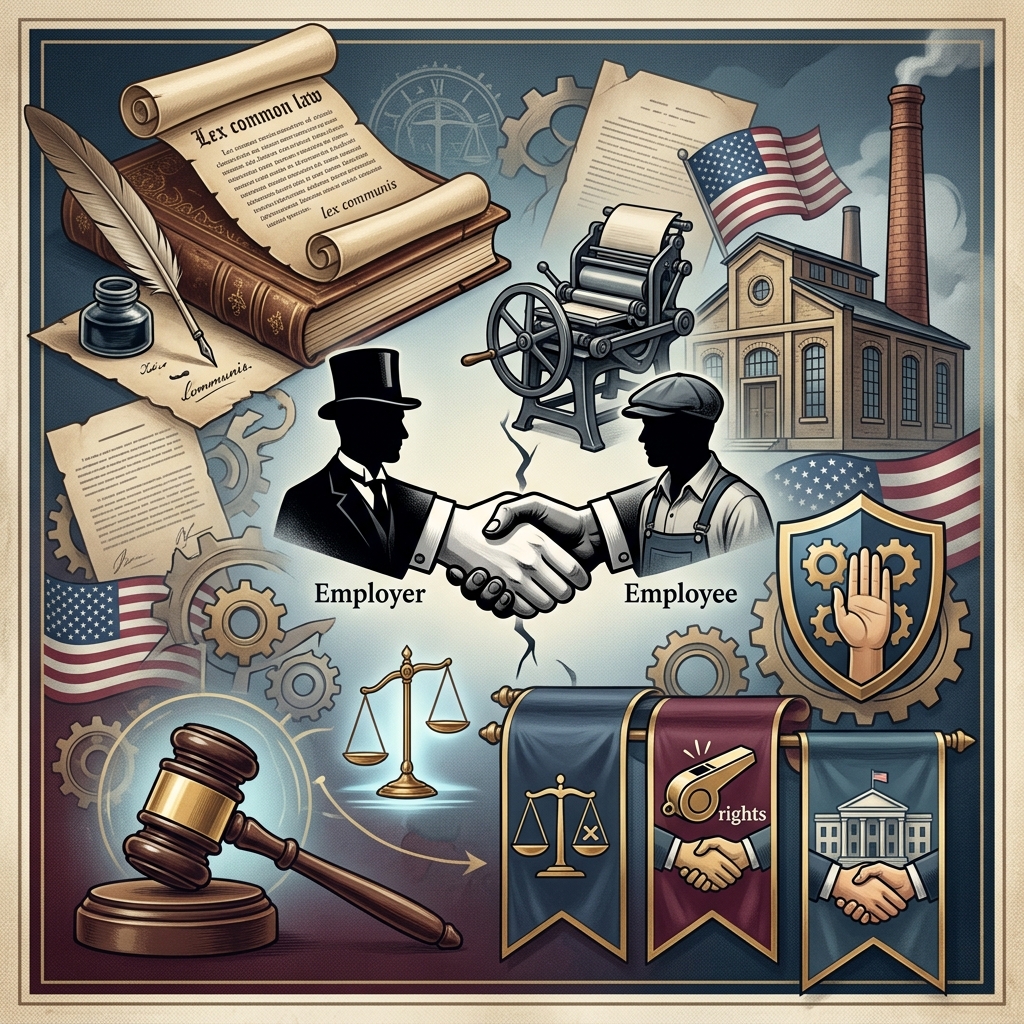
In the United States, most private-sector workers can be fired or can quit for almost any reason, or no reason at all. This framework, known as at-will employment, has deep historical roots and has been steadily narrowed by courts and legislatures over the last century. Understanding how the doctrine arose and how it has changed is essential for employers, employees, and anyone interested in workplace rights.
From Fixed-Term Service to At-Will Work
Modern at-will employment did not appear overnight. It grew out of earlier systems where employment was typically for a fixed term, often one year, and governed by statutes or local custom. As the U.S. economy industrialized in the nineteenth century, courts began adapting contract principles to a more fluid labor market, where both employers and employees wanted the flexibility to end relationships without long notice periods.
A key turning point was an 1877 legal treatise that interpreted American employment relationships as terminable by either party at any time, rather than bound by the English rule of year-long hiring. Courts later cited this treatise as authority, helping transform at-will employment from an idea into a widely accepted legal presumption.
Industrialization and Changing Labor Markets
The rise of factories, railroads, and mass production fundamentally changed the nature of work. Employers needed the ability to rapidly adjust their workforce to economic cycles, technological change, and fluctuating demand. Workers increasingly moved between jobs rather than staying with a single employer for life.
In this context, courts saw at-will employment as consistent with freedom of contract: both parties were presumed to bargain as equals and could define (or end) their relationship as they wished. According to historical analyses, economic pressures and judicial ideology combined to push the common law toward a default rule of at-will employment by the late nineteenth century.
Core Features of At-Will Employment
Although details vary by state, the central features of at-will employment in the U.S. are relatively consistent.
- Termination without cause: Either employer or employee may end the relationship at any time, for almost any reason, or for no stated reason.
- No advance notice required: The law does not generally require formal notice periods, unless a contract or policy imposes one.
- Unilateral changes to terms: In many situations, employers can change job duties, schedules, or compensation prospectively, provided they do not violate other laws.
- Presumed default rule: In the absence of an express agreement saying otherwise, courts presume the relationship is at-will in every U.S. state except Montana.
| Feature | At-Will Employment | Just-Cause Employment |
|---|---|---|
| Reason needed for termination | Generally no reason required, unless an exception applies | Employer must show legitimate, job-related reasons |
| Source of protection | Limited protections from specific statutes and common-law doctrines | Protection arises from contracts, union agreements, or civil service rules |
| Typical workplaces | Most private-sector, non-union jobs | Unionized jobs, many public-sector roles, and individual written contracts |
| Ability to change terms | Employer has broad latitude, subject to other laws | Changes generally subject to bargaining or contractual limits |
Judicial Endorsement and Early Acceptance
By the late nineteenth and early twentieth century, courts and commentators largely treated at-will employment as settled law. During the so-called Lochner era, the U.S. Supreme Court often struck down labor regulations as violations of freedom of contract, reinforcing a legal environment favorable to employer discretion.
Over time, state courts increasingly presumed that an employment relationship without a fixed term was at-will, unless the parties clearly agreed otherwise. This presumption was not created by legislation; it grew organically through case law and legal commentary, making it a cornerstone of American employment doctrine.
The Slow Erosion of Pure At-Will Employment
Despite its dominance, at-will employment has never been absolute. Starting in the mid-twentieth century, both courts and legislatures began to recognize that unrestrained employer power could lead to unjust or discriminatory terminations. The result was a gradual but significant erosion of pure at-will rules.
Rise of Statutory Protections
Beginning in the 1930s and accelerating after the 1960s, federal and state laws created explicit limits on when and why employees can be fired.
- Union and collective activity: The National Labor Relations Act protects employees against discharge for union membership, organizing, or other protected concerted activity.
- Anti-discrimination laws: Title VII of the Civil Rights Act, the Age Discrimination in Employment Act, and similar statutes prohibit firing based on race, color, religion, sex, national origin, age (for covered workers), and other protected traits, as well as retaliation for asserting those rights.
- Pension and benefits rights: ERISA bars terminating employees solely to prevent them from vesting in pension benefits.
- Additional protections: Other laws limit termination for reasons such as wage garnishment, whistleblowing in certain sectors, or filing workers’ compensation claims.
These statutory protections do not abolish at-will employment, but they carve out important categories of unlawful discharge, transforming at-will from a simple rule into a more qualified framework.
Common-Law Exceptions Recognized by Courts
Courts also developed their own exceptions to at-will employment through case-law. By the late 1950s, judges began to recognize that certain terminations violated fundamental public values and contractual expectations.
Public Policy Exception
The public policy exception prevents employers from firing workers when doing so would contravene important public policies embodied in statutes or constitutional principles. This exception is now recognized, in some form, in most states.
Common examples include termination for:
- Refusing to commit an illegal act, such as perjury or fraud.
- Reporting unlawful practices to authorities or internal channels (whistleblowing).
- Performing civic duties, such as jury service or military reserve obligations.
- Exercising statutory rights, like filing a workers’ compensation claim.
Implied Contract Exception
The implied contract exception arises when employer statements, handbooks, or practices create a reasonable expectation that employees will only be terminated for cause, even if no formal written contract exists.
For instance, courts in many states have treated detailed disciplinary policies or assurances of job security as evidence that the employer promised to follow a just-cause standard. As of the early 2000s, implied contracts were recognized in 41 states and the District of Columbia, though the burden of proof can be substantial.
Implied Covenant of Good Faith
A smaller number of jurisdictions recognize an exception based on an implied covenant of good faith and fair dealing in employment relationships. Under this theory, employers may be liable if they terminate employees in bad faith to avoid obligations such as paying earned bonuses, commissions, or retirement benefits.
This exception has not been adopted universally and is often applied cautiously. Still, it illustrates a broader judicial willingness to limit employer discretion when terminations are used to exploit contractual loopholes.
Montana’s Unique Approach
While every U.S. state presumes employment is at-will, Montana stands out as a notable exception. The Montana Wrongful Discharge From Employment Act (WDEA) altered the default rule by providing a statutory cause of action for employees terminated without good cause after completing a probationary period.
Under this law:
- Pure at-will rules apply only during the probationary period identified in the employer’s written agreement.
- After probation, employers must have good cause for discharge.
- Employees can challenge terminations they believe violate the statute’s standards.
Montana’s model demonstrates that legislatures can replace the at-will presumption with a just-cause regime. However, similar statewide reforms have not yet been adopted elsewhere, despite ongoing debates about fairness and economic efficiency.
Practical Implications for Today’s Workplace
Even with the many exceptions and statutory protections, at-will employment remains the dominant framework in the United States. Both employers and employees need to understand what it does—and does not—allow.
What Employers Should Keep in Mind
- Document legitimate reasons: Although employers can often terminate without giving a formal explanation, having a clear, documented business reason helps defend against claims of unlawful discrimination or retaliation.
- Review handbooks and policies: Poorly drafted policies may unintentionally create implied promises of just-cause employment. Including clear at-will disclaimers, consistent with state law, can reduce ambiguity.
- Train managers on legal limits: Supervisors should understand that at-will status does not permit firing workers for protected activities or characteristics.
- Consider morale and reputation: Even lawful terminations can harm workplace culture or public perception if they appear arbitrary or unfair.
What Employees Should Understand
- Know your status: Review offer letters, contracts, and handbooks to determine whether you are at-will or covered by a union agreement, civil service rules, or an individual contract.
- Recognize protected activities: Laws may shield you from termination for engaging in certain conduct, such as reporting legal violations or exercising statutory rights.
- Track employer promises: Written or verbal assurances about job security, promotion tracks, or disciplinary procedures may be relevant if a dispute arises.
- Seek legal advice when in doubt: Because exceptions vary by state and case law can be complex, consulting an employment attorney is often wise when facing termination or major changes to employment terms.
Frequently Asked Questions About At-Will Employment
Is every job in the United States at-will?
No. Many jobs are covered by union contracts, civil service laws, or individual agreements that require just cause for termination. However, in the absence of such protections, the default rule in all states except Montana is that employment is at-will.
Can an employer fire someone for a bad reason under at-will employment?
Employers generally may terminate employees for reasons that seem unfair, unwise, or arbitrary, but not for reasons that violate specific statutes or recognized common-law exceptions—such as discrimination based on protected traits, retaliation for exercising legal rights, or requiring employees to break the law.
Does a performance review or promotion change at-will status?
Positive performance reviews, raises, or promotions do not automatically convert an at-will relationship into just-cause employment. Only clear contractual commitments, union agreements, or legally recognized implied promises are likely to alter the default rule.
What role do employee handbooks play?
Handbooks can be crucial. If they explicitly state that employees will only be fired for cause and outline detailed procedures, courts in many states may treat them as implied contracts. Conversely, clear at-will disclaimers can help preserve the at-will presumption.
Is at-will employment common outside the United States?
No. The U.S. is one of a small number of countries where at-will employment is prevalent. Many other jurisdictions require just cause or follow statutory dismissal procedures, making American rules comparatively employer-friendly.
References
- Brief At-Will Employment – Overview — National Conference of State Legislatures. 2019-12-20. https://www.ncsl.org/labor-and-employment/at-will-employment-overview
- The employment-at-will doctrine: three major exceptions — U.S. Bureau of Labor Statistics, Monthly Labor Review. 2001-01-01. https://www.bls.gov/opub/mlr/2001/01/art1full.pdf
- At-will employment — Research Starters, EBSCO. 2018-01-01. https://www.ebsco.com/research-starters/law/will-employment
- At-will employment — Wikipedia (summary of U.S. legal doctrine; primary sources therein). 2024-03-01. https://en.wikipedia.org/wiki/At-will_employment
- “At-Will” Employment Rule: Overview & History of the Rule — Cunningham Dalman, P.C. 2017-06-15. https://cunninghamdalman.com/employment-law/the-at-will-employment-rule/
- Hear Us: Cities Are Working to End Another Legacy of Slavery — “At Will” Employment — National Employment Law Project. 2022-06-16. https://www.nelp.org/cities-are-working-to-end-another-legacy-of-slavery-at-will-employment/
Similar Articles








Read full bio of medha deb




