
Recording Real Estate Documents: A Practical Guide
Learn how, where, and why to record deeds, mortgages, and other real estate documents to protect your property rights.
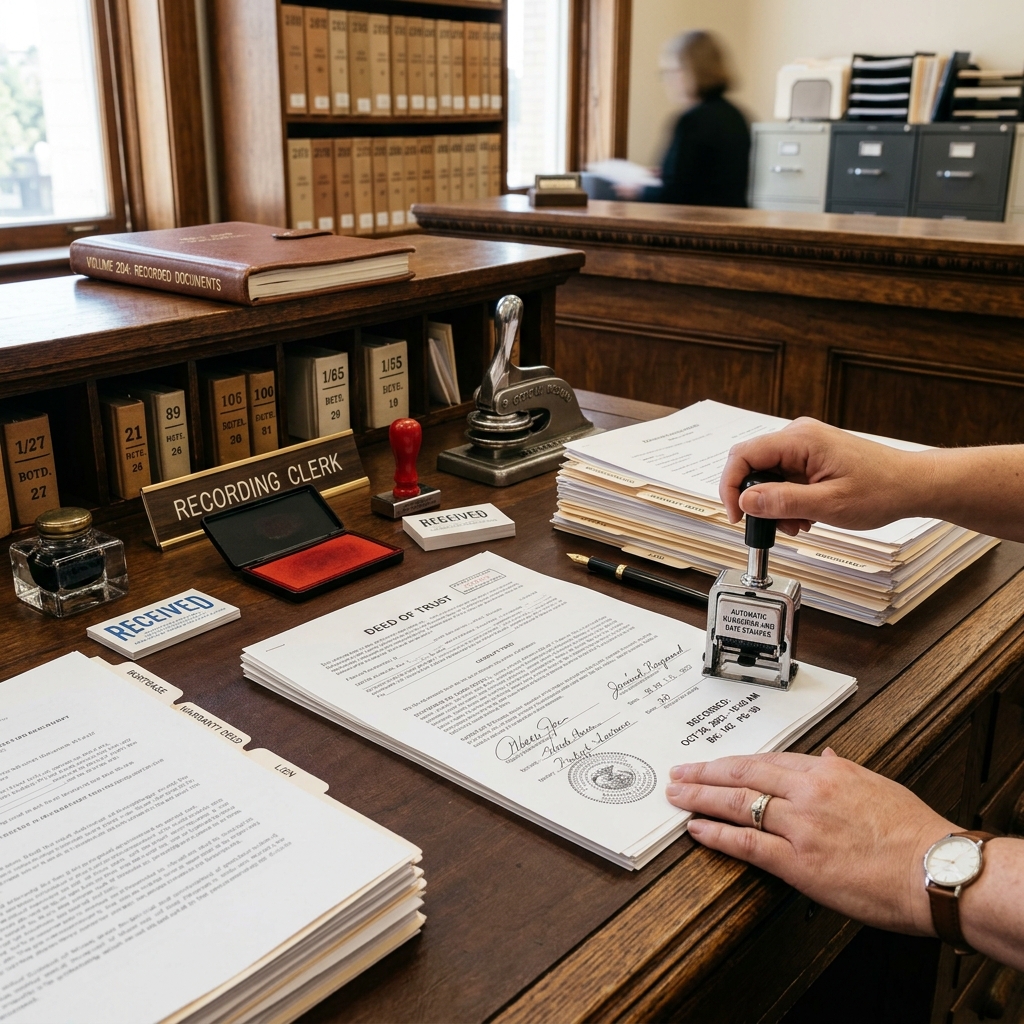
Recording real estate documents is a foundational step in owning, financing, or transferring property. It turns private paperwork into public evidence of rights, ensuring that buyers, lenders, and future owners all understand who owns what and when those rights arose. Proper recording can determine who wins in a dispute, whether a mortgage is enforceable, and if a buyer’s ownership is secure against later claims.
What Does “Recording” Real Estate Documents Mean?
In real property law, recording is the formal process of filing a deed, mortgage, lien, or similar document with a local government office so it becomes part of the official public record. The office may be called a county recorder, registrar of deeds, or clerk-recorder, depending on the jurisdiction.
Once a document is recorded:
- It is indexed and stored by the recording office.
- It becomes available for public inspection.
- It provides legal notice of the rights or interests described in the document.
Recording generally occurs in the county or local jurisdiction where the property is located. This localization ensures that anyone researching property in that area can find relevant documents tied to a specific parcel.
Why Recording Matters for Property Rights
Recording is not just administrative; it has direct legal consequences. Recording statutes adopted by each state establish when a recorded interest will prevail over unrecorded claims. Although the details differ among states, several core benefits are common.
Key Purposes of Recording
- Preserves evidence of ownership – Recording deeds and related instruments provides an official, time-stamped record of who owns the property and how ownership changed over time.
- Provides legal notice to others – Once recorded, a document gives “constructive notice” to the public, meaning everyone is legally treated as if they knew about the recorded interest, even if they never checked the records.
- Helps resolve disputes – In conflicts between competing buyers or creditors, courts often look to recorded documents to decide whose rights are superior under the relevant recording act.
How Recording Can Protect You
Consider a situation where two different buyers claim the same property. In many states, including those that follow a notice recording system, the buyer who pays value and records first (without notice of earlier claims) is likely to prevail. Proper recording after closing can therefore make the difference between secure ownership and a costly lawsuit.
Similarly, lenders rely on recording to establish enforceable security interests in property. A recorded mortgage or deed of trust typically takes priority over later liens or encumbrances that are filed after it. Failure to record may leave a lender or buyer vulnerable if someone later acquires an interest without knowledge of the earlier, unrecorded document.
Common Types of Real Estate Documents That Are Recorded
Although specific rules vary, most jurisdictions recognize several categories of real estate documents that can or must be recorded.
- Deeds – Instruments transferring ownership, including warranty deeds, quitclaim deeds, and special-purpose deeds.
- Mortgages and deeds of trust – Documents granting a lender a security interest in the property to secure repayment of a loan.
- Liens – Statutory liens such as tax liens, mechanics’ liens, and judgment liens that claim an interest based on debts or obligations.
- Easements and covenants – Documents that grant limited rights over another’s property or impose restrictions on its use.
- Assignments and releases – Instruments showing that a mortgage or other interest has been transferred or satisfied.
Recording these documents creates a transparent chain of title, allowing title companies, buyers, and courts to trace ownership and encumbrances over time.
Where and How Recording Takes Place
Recording is performed by an official local office, typically at the county level. Names vary—county recorder, clerk-recorder, registrar of deeds—but their basic functions are similar.
| Office Name (Example) | Role in Recording |
|---|---|
| Recorder / Clerk-Recorder | Accepts documents, checks compliance with legal and formatting requirements, collects fees and taxes, and records instruments. |
| Registrar or Register of Deeds | Maintains official land records and indexes documents so they can be searched by name, date, or property description. |
| Land Records Division or Department | Specialized division within a court or county office responsible for land records intake and storage. |
Recording can usually be done in person, by mail, or, in many areas, through electronic recording (e-recording) using approved vendors or systems. E-recording has become increasingly common, offering faster turnaround times and reducing errors associated with physical documents.
Typical Requirements for a Recordable Document
Before a document can be recorded, it must meet the technical and legal standards set by the jurisdiction’s recording laws. While exact rules differ, several common requirements appear in many areas.
Formal and Legal Requirements
- Proper execution – Documents must be signed by the appropriate parties, such as grantors on a deed or borrowers on a mortgage.
- Notarization or acknowledgment – Most real estate instruments must be acknowledged before a notary public or authorized official to be accepted for recording.
- Authorized to be recorded – The document must be of a type that is recognized by law as recordable, such as deeds, mortgages, and liens.
- Adequate legal description – The property must be clearly identified, using a legal description sufficient to locate and distinguish it from other parcels.
Formatting and Administrative Requirements
- Legibility – Text, seals, and signatures must be clear enough to produce a readable photographic or digital record.
- Standard page size and margins – Many offices require standard page sizes (often 8.5 x 11 inches) and reserve space on the first page for official recording information and return addresses.
- Return information – The document must state who is requesting recording and where the original should be mailed after processing.
- Required cover sheets and forms – Some jurisdictions require intake sheets or preliminary change-of-ownership forms to calculate taxes and properly index documents.
Failure to meet these requirements can delay recording or result in rejection, which may leave the parties temporarily unprotected until the defects are corrected.
Recording Fees, Transfer Taxes, and Related Costs
Recording typically involves both administrative fees and, in many cases, taxes related to property transfer. These charges vary by jurisdiction but share similar structure.
- Recording fees – A base fee per document or per page is usually charged to cover indexing, storage, and administrative processing.
- Transfer taxes – Some states and localities impose a tax on transfer instruments based on the consideration paid or property value.
- Recordation taxes – In jurisdictions with separate recordation taxes, these may apply to both deeds and mortgages, often calculated using a statutory formula.
Payment methods commonly include checks, money orders, and, increasingly, debit or credit cards for in-person services. Accurate completion of intake sheets and tax forms helps ensure that the correct amounts are charged and that any exemptions are properly applied.
Overview of the Recording Process
Although every jurisdiction has its own detailed procedures, the recording process generally follows several main steps.
- Prepare the document
Draft or complete the deed, mortgage, or other instrument, making sure it includes all required elements, such as legal descriptions, signatures, and notarization. - Gather supporting paperwork
In many areas, you must prepare intake sheets, change-of-ownership forms, or lien certificates to calculate taxes and verify outstanding obligations. - Calculate and pay fees and taxes
Determine the recording fees and applicable transfer or recordation taxes, then provide payment in an accepted form. - Submit the document for recording
Present the original document (and required copies) in person, by mail, or electronically, along with any cover pages and forms. - Clerk or recorder review
An examiner checks the document to confirm that it complies with legal, formal, and formatting requirements, then either accepts it for recording or returns it for correction. - Indexing and return of originals
Once recorded, the instrument is assigned a recording number, indexed under names and property descriptions, and the original is returned to the designated party.
In many jurisdictions, the transfer of ownership is considered legally effective when the deed is recorded, rather than when it is merely signed. This is one reason why prompt recording immediately after closing is standard practice.
Recording Acts and Priority of Interests
State recording acts govern how recorded and unrecorded interests are prioritized in disputes. These laws determine whether earlier or later purchasers or creditors prevail, especially when not all interests have been recorded.
Notice, Race, and Race-Notice Systems
While details vary, three broad models are often used:
- Notice jurisdiction – A later purchaser who pays value and has no notice of an earlier unrecorded interest can prevail over that earlier interest. Recording provides constructive notice, so failing to record may cause the earlier interest to lose priority.
- Race jurisdiction – Priority goes to the party who records first, regardless of whether they knew about other interests, as long as they are otherwise eligible under the statute.
- Race-notice jurisdiction – A later purchaser must both lack notice of the earlier interest and record first to gain priority.
Texas, for example, follows a notice system. Under its property code, a conveyance of real property is void as to certain creditors and subsequent purchasers for value without notice unless the instrument has been properly acknowledged and filed for record. This framework strongly incentivizes prompt recording and careful attention to documentation.
Risks of Failing to Record Properly
Not recording, or recording incorrectly, can create significant legal and financial risks.
- Loss of priority – An unrecorded deed or mortgage may be subordinated to later recorded interests by bona fide purchasers or creditors.
- Disputes and litigation – Ambiguous or incomplete records invite conflicts over who owns the property, what liens exist, and which encumbrances take precedence.
- Problems in refinancing or selling – Title companies and lenders rely on clear public records; unrecorded interests and defects may delay or prevent closing.
- Questionable enforceability – Some statutes make certain rights ineffective against third parties unless recorded, limiting the ability to enforce them in court.
To reduce these risks, property owners and professionals typically record instruments immediately after closing, verify indexing, and correct errors quickly.
Best Practices for Property Owners and Buyers
Although lawyers, title companies, or closing agents often handle recording, understanding best practices helps owners protect their interests.
- Record promptly – Do not delay recording deeds or mortgages after closing. Prompt filing establishes your rights and provides constructive notice to others.
- Confirm accuracy – Check that names, property descriptions, and signatures are complete and correct before submission.
- Verify indexing – After recording, confirm that the document appears under the correct names and property description in the public index.
- Keep certified copies – Retain certified copies of recorded documents for your records and future transactions.
- Use qualified professionals – For complex transactions, consult a real estate attorney or title professional to ensure compliance with state-specific recording rules.
Frequently Asked Questions (FAQs) About Recording Real Estate Documents
Is recording required to transfer ownership of real estate?
In many jurisdictions, signing a deed creates rights between the parties, but recording is necessary to protect that ownership against later purchasers or creditors and to make the transfer effective in the public record. Some states expressly treat the transfer as effective upon recording for certain purposes.
How long does recording take?
Processing times vary by office and method of submission. Recording in person can sometimes be completed the same day, while mailed documents may take days or weeks to be reviewed, recorded, and returned. E-recording often speeds up these timelines.
Do I need a lawyer to record a deed?
Some states encourage or require deeds to be prepared or supervised by attorneys, particularly for complex transactions. Even where not legally required, consulting a real estate lawyer or experienced title professional can help avoid mistakes that could affect ownership or priority.
What happens if the recorder rejects my document?
If a document does not meet legal or formatting requirements, the recording office may reject it and return it with instructions or notes. You will need to correct the deficiencies—such as adding missing signatures, fixing margins, or providing required forms—and resubmit.
Can I see recorded documents for a property?
Yes. Recorded documents are public records. Most offices allow in-person searches, and many provide online databases where you can search by name, document type, or property description.
References
- Recording — Legal Information Institute, Cornell Law School. 2023-01-01. https://www.law.cornell.edu/wex/recording
- Steps for Recording a Maryland Real Estate Deed — People’s Law Library of Maryland. 2022-06-01. https://www.peoples-law.org/steps-recording-maryland-real-estate-deed
- Recording Requirements — Los Angeles County Registrar-Recorder/County Clerk. 2023-05-01. https://www.lavote.gov/home/recorder/property-document-recording/recording-requirements
- Recording Documents — Multnomah County Recorder. 2023-04-01. https://multco.us/info/recording-documents
- Recording Real Estate — Office of the County Clerk-Recorder, Santa Clara County. 2022-09-01. https://clerkrecorder.santaclaracounty.gov/recording-documents/recording-real-estate
- Deed Recording Overview & Process — Study.com. 2021-01-01. https://study.com/academy/lesson/recording-title-documents-process-requirements.html
- The Texas Recording Act: How Filing or Failing to File Documents Can Make or Break Your Property Rights — Barsalou Law Firm. 2023-03-01. https://www.barsalou-law.com/the-texas-recording-act-how-filing-or-failing-to-file-documents-can-make-or-break-your-property-rights
Similar Articles








Read full bio of Sneha Tete


