
Managing Community Property in California
A practical guide to understanding, tracking, and protecting marital assets and debts in California.
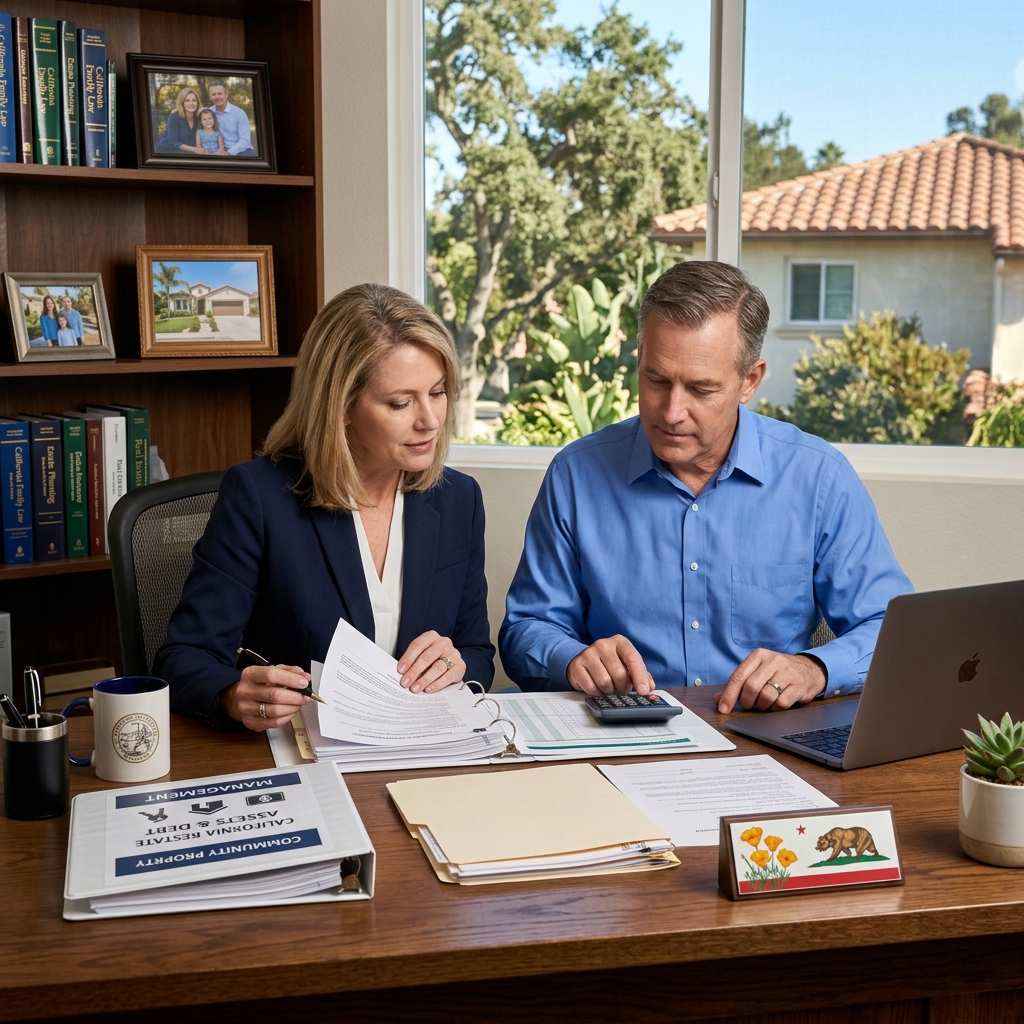
California law treats marriage as a financial partnership, which means many assets and debts acquired during the marriage are generally shared by both spouses. That basic rule affects day-to-day money management, ownership records, and divorce planning. It also means couples need to think carefully about how they title property, document contributions, and keep inherited or premarital assets distinct from shared funds.
The law does not require spouses to split every item physically in half while they are married. Instead, the bigger question is how property is classified, how it is managed, and whether the couple can prove what belongs to the marital estate and what remains separate. For many households, the most important step is not waiting until separation or divorce, but keeping clear records from the start.
How California classifies property during marriage
California is a community property state. In practical terms, this means that property acquired by either spouse during marriage is usually presumed to belong to both spouses equally, unless an exception applies. Courts also generally divide community assets and debts equally when the marriage ends, absent an agreement or another legal basis for a different result.
This presumption can reach much more than the family home. It often includes wages, bonuses, vehicles bought during marriage, retirement contributions made while married, and debts taken on before separation. The label on a title or account does not always control; the timing and source of the property often matter more.
| Property type | Usually treated as | Why it matters |
|---|---|---|
| Income earned during marriage | Community property | Both spouses typically share the value |
| House bought during marriage | Community property, unless proven otherwise | Purchase timing and funding source are key |
| Gift or inheritance to one spouse | Separate property | May stay individual property if kept distinct |
| Debt taken on during marriage | Community debt | Liabilities can be shared just like assets |
What usually counts as separate property
Separate property is generally property owned before marriage, property acquired after separation, and gifts or inheritances received by one spouse individually. California courts also recognize that property bought with separate funds may remain separate if the owner can trace the money clearly.
That tracing requirement is where many disputes begin. If a spouse receives an inheritance and deposits it into a joint account used for groceries, rent, and household bills, it can become difficult to prove which portion, if any, still belongs to that spouse alone. The same problem can arise when premarital savings are mixed with marital income or when a separate investment account is used for shared expenses.
For that reason, separate property is not protected merely because a spouse says it is separate. It is protected when there is documentation showing where it came from, how it was handled, and why it should not be treated as part of the community estate.
Why recordkeeping matters from the start
The simplest way to reduce conflict is to keep clean records. Good records help spouses show what they owned before marriage, what they acquired together, and how money moved between accounts over time. This can be especially important for homes, retirement accounts, business interests, and large purchases.
- Keep copies of bank and brokerage statements from before the marriage.
- Save deeds, closing documents, and loan records for any home purchased before or during marriage.
- Track inheritance and gift funds in a separate account when possible.
- Document the source of down payments, loan payments, and major renovations.
- Preserve retirement account statements showing contribution dates and balances.
- Store written agreements about ownership, reimbursement, or gifting in a safe place.
These records do more than protect property in divorce. They also help spouses make informed decisions during the marriage, such as whether to refinance a house, invest in a side business, or use separate savings to support a shared goal.
Commingling and transmutation can change ownership
One of the most important risks in California marital property law is commingling. Commingling happens when separate and community funds are mixed so thoroughly that it becomes hard to identify which dollars came from which source. Once that happens, the burden may fall on the spouse claiming separate ownership to prove it with records.
Another important concept is transmutation, which refers to changing the character of property. Spouses can sometimes agree to turn separate property into community property, or vice versa, but that kind of change usually requires clear proof and, in many cases, a writing that shows the intent to change ownership.
In everyday life, these issues often appear in simple transactions. A spouse may use an inherited account to help pay for a jointly owned house, or one spouse may sign a document saying a vehicle should be treated as shared property. Without careful documentation, these actions can create disputes over whether the property remained separate or became part of the marital estate.
Managing shared debts during marriage
Property is only part of the picture. Debts incurred during marriage may also be treated as community obligations, which means the couple can share responsibility for credit cards, personal loans, auto loans, or other liabilities created while they were married.
That makes debt management just as important as asset management. Couples often assume that a bill in one spouse’s name belongs only to that spouse, but California law may look to when the debt was incurred and whether it supported the marital household. A credit card used for family expenses, for example, may be treated differently from a debt tied to a clearly separate purpose.
- Review account statements regularly to see whether new charges are family-related or individual.
- Keep separate records for any debt tied to premarital property or separate business activity.
- Avoid using one spouse’s separate funds to pay a joint debt without written documentation.
- Check whether refinancing or consolidation changes the ownership or repayment structure.
Couples who communicate about debt early are less likely to face surprise liabilities later. Even if spouses trust each other financially, documentation still matters because creditors and courts may not rely on informal understandings.
Practical ways couples can manage property during marriage
Managing community property does not require legal sophistication, but it does require consistency. The goal is to keep the financial picture understandable. That makes it easier to pay bills now and to prove ownership later if the marriage ends or a dispute arises.
Some couples use separate accounts for premarital assets while also maintaining a joint account for shared household expenses. Others create a simple monthly system where each spouse contributes to one household account and keeps individual savings apart. These methods are not mandatory, but they can reduce confusion.
- Use one account for shared expenses and another for clearly separate funds.
- Label transfers with notes explaining their purpose.
- Save receipts for major purchases made with separate property.
- Ask before using inherited money for joint improvements or family debt.
- Consider a written agreement before making a major transfer between separate and shared assets.
Spouses should also be cautious about assuming that fairness and legal ownership are the same thing. A person may feel entitled to reimbursement for using separate money to benefit the household, but the law may require proof of the contribution and the parties’ intent before granting that result.
When agreements can help
Married couples in California can sometimes shape their property rights through written agreements. These agreements may address how a home, investment account, business interest, or debt will be treated if the couple later separates. Properly drafted agreements can reduce uncertainty and make future ownership questions easier to resolve.
Agreements are especially useful when one spouse brings significant separate assets into the marriage or when one spouse expects to receive an inheritance. They may also help couples who run a family business, own rental property, or plan to use one spouse’s earnings to support the other’s education or career changes.
However, informal promises are not the same as enforceable agreements. If spouses want to alter the default property rules, the terms should be put in writing clearly enough to show what was intended.
How separation changes the analysis
In California, the date of separation is an important dividing line. Generally, income and property acquired before separation remain part of the community estate, while earnings and acquisitions after separation are typically treated as separate property.
This can create disputes when spouses are still living in the same home but are no longer functioning as a marital unit. It can also create timing issues for bonuses, retirement contributions, stock awards, and real estate purchases made around the end of the relationship. The closer the transaction is to the separation date, the more important it becomes to document what happened and when.
Because separation can be fact-specific, couples who are unsure about the timing should preserve records and avoid making assumptions about ownership based only on when an item was paid for or delivered.
Common mistakes that create avoidable disputes
Many property conflicts are caused by habits that seem harmless in the moment. A spouse may move inherited money into a joint checking account, use one credit card for every household and personal expense, or sign a title without understanding the legal effect. Later, these choices can make it difficult to determine who owns what.
- Mixing separate and shared money without tracking transfers.
- Failing to save statements from the beginning of the marriage.
- Assuming the name on the account controls ownership.
- Using inheritance funds for home repairs without written proof.
- Ignoring debt because it was incurred in only one spouse’s name.
Small financial habits can become major legal issues if the marriage ends. The best protection is a combination of records, communication, and a basic understanding of the community property system.
Frequently asked questions
Does California always split marital property 50/50?
In general, California aims for an equal division of community property and community debts, though the exact method can vary depending on the assets involved and any valid agreement between the spouses.
Is property in one spouse’s name automatically separate?
No. Property title matters, but it does not automatically control classification. If property was acquired during marriage with community funds, it may still be community property even if only one spouse’s name appears on the account or deed.
Can a gift or inheritance become shared property?
Yes, if it is mixed into community assets or treated in a way that makes tracing difficult. Keeping inherited or gifted property separate is the safest way to preserve its individual character.
What is the safest way to protect separate property?
Maintain clear records, keep separate accounts when possible, and avoid mixing separate funds with marital funds unless there is a deliberate and documented reason to do so.
Can spouses agree to treat property differently?
Yes. Spouses can sometimes use written agreements to change how particular assets or debts will be treated, but the agreement should be clear and properly documented.
References
- California Community Property Law Explained — WF Law. n.d. https://www.wf-lawyers.com/orange-county/california-community-property-law-explained/
- California Community Property Laws – FindLaw — FindLaw. n.d. https://www.findlaw.com/state/california-law/california-marital-property-laws.html
- Property and debts in a divorce — California Courts Self Help Guide. n.d. https://selfhelp.courts.ca.gov/divorce/property-debts
- Explaining California’s Community Property System — My SoCal Lawyer. 2024-09. https://www.mysocallawyer.com/blog/2024/september/explaining-california-s-community-property-syste/
- California Community Property Law and Division in Divorce Cases — Joseph Camenzind Law. n.d. https://www.josephcamenzindlaw.com/blog/california-community-property-law-and-division-divorce-cases/
- How California’s Community Property Laws Impact Divorce … — Marmolejo Law. 2025-10. https://www.marmolejolaw.com/blog/2025/october/how-california-s-community-property-laws-impact-/
Similar Articles








Read full bio of Sneha Tete


