
Baltimore City Rental Dwelling License Guide
Understand how Baltimore’s rental licensing rules protect tenants and shape landlord responsibilities, from registration to rent collection and enforcement.
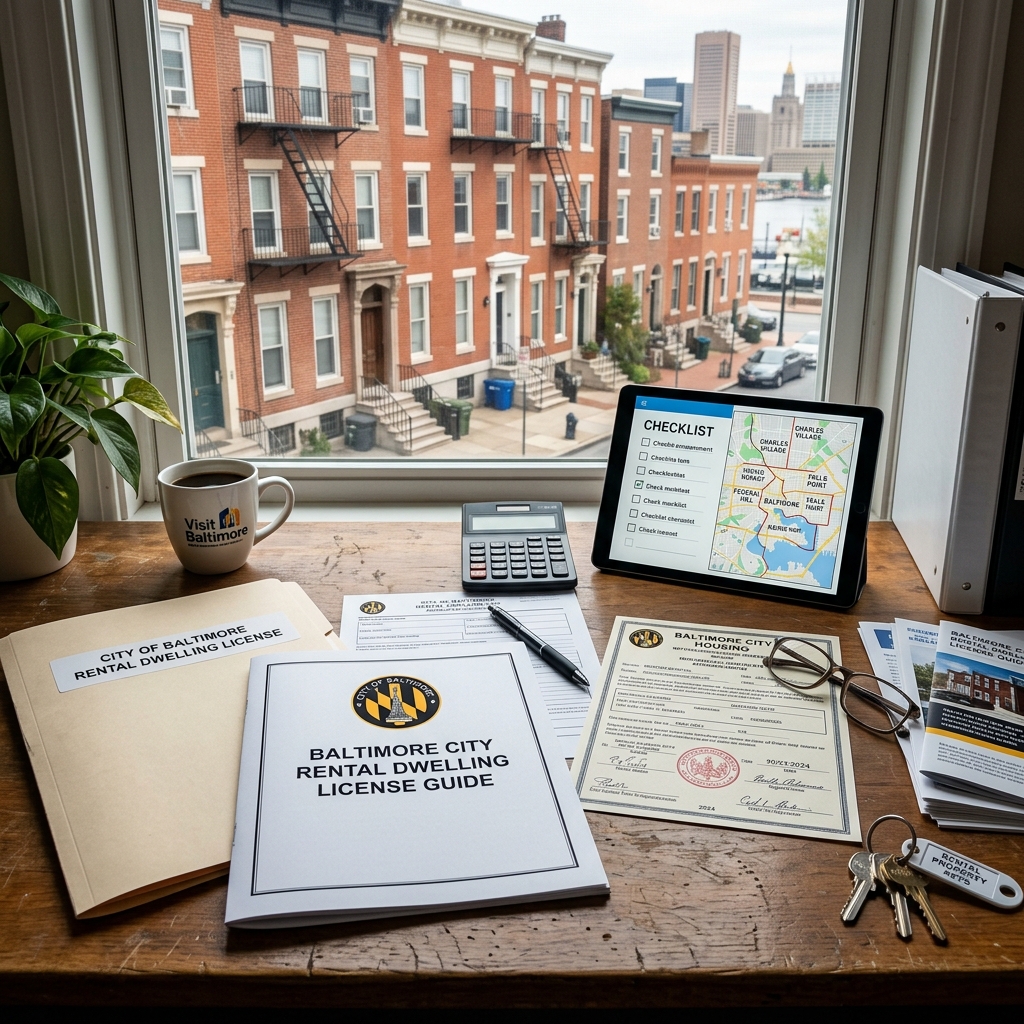
Baltimore City’s rental dwelling license law is designed to ensure that rental housing is safe, habitable, and properly monitored by local authorities. The law links a landlord’s ability to collect rent and file eviction cases to their compliance with registration, inspection, and licensing requirements, giving tenants a powerful tool to insist on basic health and safety standards.
1. Why Baltimore Requires Rental Licenses
The core purpose of the rental dwelling license law is to make sure that non–owner-occupied housing meets minimum standards for health, safety, and habitability before and during a tenancy. By tying the right to collect rent and pursue evictions to possession of a valid license, the city encourages landlords to maintain properties and follow public health, building, and lead safety rules.
From an enforcement perspective, licensing gives the Department of Housing & Community Development (DHCD) a centralized record of rental properties and operators. This record supports targeted inspections, complaint response, and code enforcement actions when a landlord violates housing regulations.
- Public safety: Licensed units must meet basic safety standards, such as working smoke detectors, adequate heat, and structurally sound conditions.
- Health protection: Properties built before 1978 must comply with Maryland’s lead risk reduction requirements to prevent lead poisoning in children and adults.
- Accountability: Licensing gives the city clear authority to fine, penalize, or prosecute noncompliant landlords.
2. Which Properties Must Be Registered and Licensed
Baltimore’s rental licensing framework covers most non–owner-occupied housing units in the city. Over time, the law expanded from multi-family structures and rooming houses to include small rental properties such as single-family homes and two-unit dwellings.
2.1 Properties Covered by the Law
In general, the law applies to non–owner-occupied rental dwellings, regardless of whether there is one unit or multiple units on the property.
- Single-family homes rented to tenants (where the owner does not live there).
- Two-family dwellings (duplexes) occupied by tenants.
- Multi-family buildings, including apartment buildings with three or more units.
- Rooming houses and similar shared housing arrangements.
2.2 Key Exemptions
Some properties are exempt from licensing requirements, although they may still be subject to other rules:
- Owner-occupied one- or two-family dwellings: If the owner lives in the unit and the property is suitable for one or two families, the rental license requirement does not apply to the owner’s occupied portion.
- Housing Authority of Baltimore City: Rental dwellings owned and operated by the Housing Authority are specifically exempt from the licensing requirement under the city code.
2.3 Registration vs. Licensing
The law distinguishes between property registration and rental licensing:
| Requirement | What It Does | Who It Applies To |
|---|---|---|
| Property Registration | Creates a record of all non–owner-occupied properties in city databases and requires annual updates. | All non–owner-occupied properties, whether rented, vacant, or not producing income. |
| Rental Licensing | Certifies that a dwelling has passed required inspections and may legally be rented for occupancy. | Non–owner-occupied properties used as rental housing. |
3. Steps Landlords Must Take to Obtain a License
To legally rent a dwelling in Baltimore City, landlords must complete several steps, each designed to confirm that the property is known to the city, safe to occupy, and in compliance with environmental regulations.
3.1 Property Registration with DHCD
Registration is handled by the DHCD and must be renewed annually, usually by January 1. The owner files a registration statement for each non–owner-occupied dwelling unit, including properties that are vacant or not generating income.
- Submit an online or paper registration form to the Housing Commissioner.
- Pay applicable registration fees and any interest or late fees if past due.
- Update registration within a short period (often 10 days) after a transfer of ownership.
3.2 Compliance with Lead Safety Laws
For housing built before 1978, Maryland’s Reduction of Lead Risk in Housing law imposes additional obligations. Landlords must:
- Register affected properties with the Maryland Department of the Environment (MDE).
- Meet lead paint risk reduction standards, including addressing peeling paint and friction surfaces.
- Provide tenants with required educational materials about lead hazards and testing.
- Obtain a lead inspection and certification from a qualified inspector before licensing.
3.3 Inspection by a Qualified Home Inspector
The property must pass an inspection conducted by a state-licensed home inspector who is registered with Baltimore City. The inspection typically examines:
- Basic safety features (smoke detectors, carbon monoxide detectors where required, secure handrails).
- Structural soundness (floors, walls, ceilings, roofs free from serious defects).
- Plumbing and electrical systems for hazards and functional operation.
- Heating systems able to maintain safe indoor temperatures.
Only after passing this inspection can the landlord proceed to apply for a rental license.
3.4 Applying for the Rental License
Once registration, lead compliance, and inspection are complete, the landlord applies for a rental license through DHCD, often via an online portal.
- Provide property registration details and proof of inspection.
- Submit lead certification, if applicable.
- Pay the licensing fee and any associated charges.
Initial rental licenses are typically issued for two years, while renewals may be for one, two, or three years depending on the property’s maintenance record and history of violations.
4. Legal Consequences of Renting Without a License
Baltimore’s law takes the position that operating a rental dwelling without a license is not just a regulatory issue—it affects the landlord’s fundamental rights under the lease.
4.1 No License, No Rent
The city code states that, except for exempt properties such as Housing Authority dwellings, no person may rent or offer to rent a dwelling without a currently effective license. Likewise, the landlord may not charge, accept, retain, or attempt to collect rent or other compensation for occupancy unless they were licensed both when they offered the dwelling and when they provided the occupancy.
Tenant advocacy groups summarize this rule as “no license, no rent”, meaning that if a landlord lacks a valid rental license, rent is not legally due and attempts to collect it may be subject to challenge in court.
4.2 Effect on Eviction Proceedings
Because the landlord’s right to collect rent is tied to licensing, an unlicensed landlord may face obstacles in eviction court proceedings such as “Failure to Pay Rent” or “Tenant Holding Over.” Tenant organizations report that, in practice, courts may dismiss or scrutinize eviction actions when the landlord cannot prove that the property was licensed at the relevant times.
As of recent updates, advocacy materials indicate that landlords who are not currently licensed may be barred from bringing certain eviction cases at all, strengthening tenants’ leverage to insist on safe and compliant housing.
4.3 Criminal and Civil Penalties
Violating the rental dwelling license law can carry criminal consequences. A person who violates any provision of the licensing law or related regulations may be guilty of a misdemeanor and, upon conviction, subject to a fine of up to $1,000 for each offense. Additional civil penalties, including administrative fines or orders to correct violations, may also apply.
5. Tenant Tools: Checking Your Landlord’s License
Tenants are not expected to guess whether a landlord is licensed. Several practical steps allow renters to verify compliance and use that information to protect their rights.
5.1 Using Online Records
DHCD maintains an online property registration and licensing database that allows users to search by address. Many tenant advocacy organizations direct renters to this tool so they can confirm whether a property has a current rental license.
- Enter your rental address into the city’s property registration or licensing search tool.
- Review the list of records associated with your address.
- Look specifically for entries labeled with rental licensing information and check status, expiration dates, and any notes.
5.2 Obtaining Confirmation from DHCD
If online records are unclear or appear outdated, tenant groups recommend visiting DHCD’s Property Registration and Licensing office for a printed confirmation.
- Bring a copy of your lease, identification, or other proof that you reside at the property.
- Request written verification of whether the dwelling is licensed and, if so, for what period.
- Use this documentation in court or negotiations if questions arise regarding the landlord’s compliance.
5.3 How Tenants Can Use License Status
Knowing whether a landlord is licensed can shape how tenants respond to disputes:
- Nonpayment claims: In a Failure to Pay Rent case, tenants may present proof of non-licensing to argue that rent was not legally due.
- Habitability complaints: If a licensed property falls below code standards, tenants can file complaints with DHCD, which may inspect and enforce corrections.
- Negotiation leverage: License status can be a factor in negotiating repairs, rent reductions, or settlements.
6. Policy Developments and Closing Loopholes
Since the major expansion of Baltimore’s rental licensing requirements around 2018–2019, city officials and advocates have worked to close loopholes that allow landlords to sidestep the law.
Local news coverage reports that the City Council has considered amendments to address situations where landlords exploit technicalities, such as transferring properties or reclassifying arrangements, to avoid licensing while continuing to collect rent.[10] These policy efforts aim to ensure consistent protection for tenants and to prevent bad actors from undermining the intent of the law.
7. Practical Tips for Landlords
For landlords, staying compliant is not only a legal obligation but also a practical way to avoid costly disputes and penalties. The following strategies can help maintain licensing status and good standing with DHCD.
- Calendar renewals: Track registration and license expiration dates and renew well before deadlines to avoid lapses.
- Document inspections: Keep detailed records of home inspections, repairs, and lead certifications.
- Respond promptly to violations: If DHCD issues a notice of violation, correct issues quickly and provide proof of remediation.
- Communicate with tenants: Let tenants know when inspections will occur and how they can raise concerns about safety or habitability.
8. Frequently Asked Questions (FAQs)
8.1 Do I have to pay rent if my landlord is not licensed?
Under Baltimore’s law, a landlord generally cannot legally charge, accept, or retain rent for a dwelling if they did not hold a valid license at both the time they offered the unit and the time they provided occupancy. Tenant advocates summarize this principle as “no license, no rent,” and courts may treat license status as a critical factor in rent disputes.
8.2 How can I tell if my building is supposed to be licensed?
If you live in a non–owner-occupied property, whether a single-family home, duplex, apartment, or rooming house, the building is likely subject to registration and licensing requirements. Owner-occupied one- or two-family dwellings and Housing Authority properties are major exceptions.
8.3 What should I do if online records do not show a license?
If your address does not appear in the online licensing database or if the status is unclear, tenant groups recommend visiting the DHCD Property Registration and Licensing office to request a printed confirmation. You may need to provide proof of residence, such as a lease or identification.
8.4 Can a landlord be prosecuted for renting without a license?
Yes. A person who violates the licensing law or related regulations may be guilty of a misdemeanor and, if convicted, subject to fines up to $1,000 per offense. Administrative actions and civil penalties may also be imposed.
8.5 Are vacant properties required to be registered?
Yes. The city code requires registration of non–owner-occupied dwellings even if they are vacant, not producing revenue, or not habitable at the time. This helps the city monitor housing stock and plan enforcement.
References
- Baltimore City Rental Dwelling License Law — Maryland State Bar Association / People’s Law. 2019-01-01. https://www.peoples-law.org/baltimore-city-rental-dwelling-license-law
- How Do You Get a Baltimore City Rental Property License? — Maryland Business Litigation Lawyer Blog. 2019-02-13. https://www.marylandbusinesslitigationlawyerblog.com/how-to-get-baltimore-city-rental-property-license/
- Article 13, Subtitle 5-4: License Required — City of Baltimore Law Library. 2018-08-01. https://codes.baltimorecity.gov/us/md/cities/baltimore/code/13/5-4
- Property Registration and Rental Licensing — Baltimore City Department of Housing & Community Development. 2023-01-01. https://www.baltimorecity.gov/dhcd/our-work/permit-inspections/property-registration
- No License, No Rent — Baltimore Renters United. 2023-10-01. https://www.baltimorerentersunited.org/no-license-no-rent
- Baltimore City Rental Property Registration and Licensing Law — Economic Action Center. 2022-06-01. https://econaction.org/tenant-advocacy-and-renters-rights/baltimore-city-rental-property-registration-and-licensing-law/
- Baltimore Seeks to Close Loopholes in Rental Licensing Rules — WBAL-TV. 2023-11-08. https://www.wbaltv.com/article/rental-licensing-rules-loopholes-in-2019-law-baltimore/70483753
Similar Articles








Read full bio of Sneha Tete


