
Small Claims vs. Large Claims: A Practical Guide
Understand when a dispute belongs in small claims or a larger civil court.
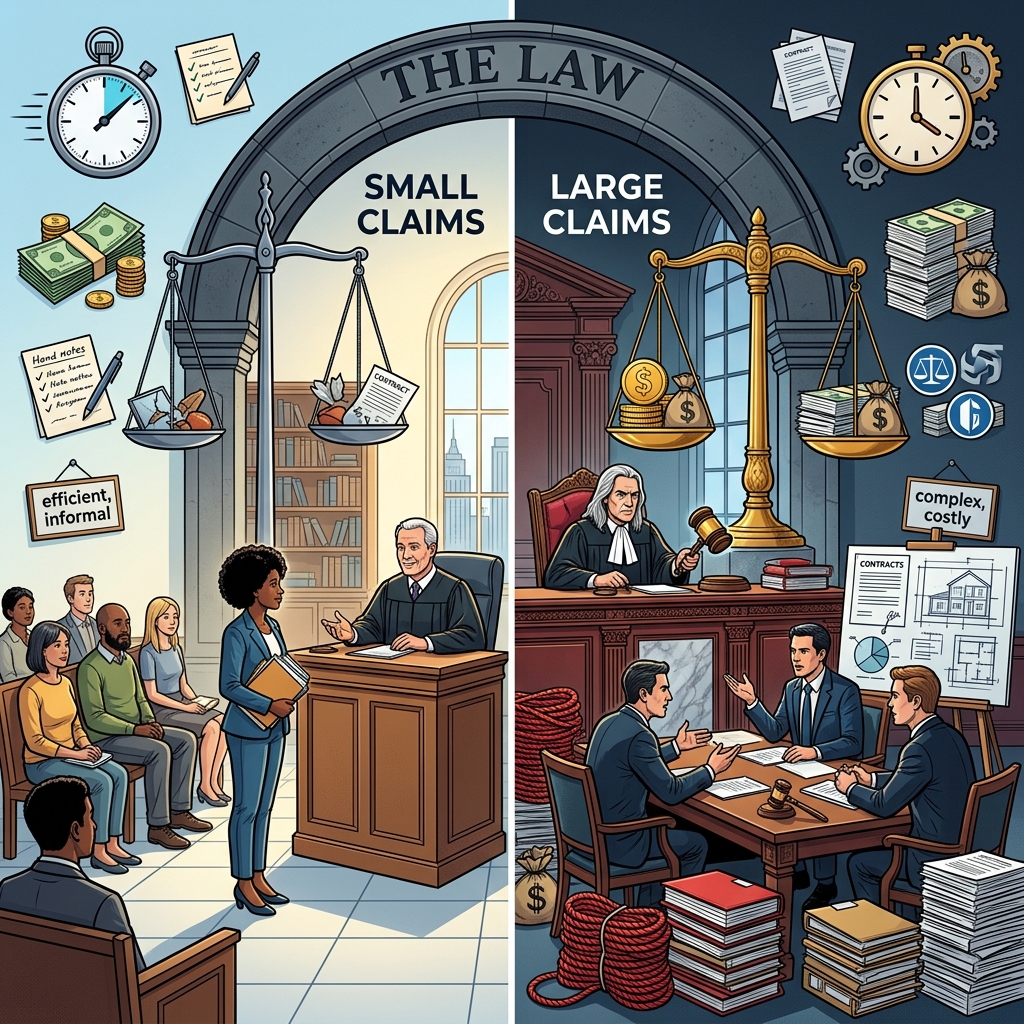
Choosing the right court is one of the most important early decisions in a civil dispute. The amount of money involved, the kind of relief you want, and the level of procedure you can handle all influence whether a case belongs in small claims court or in a larger civil court. Small claims courts are designed for simpler disputes and faster resolution, while large claims courts handle higher-value cases and more formal litigation.
This guide explains how the two systems differ, what each is designed to do, and how to think through the choice before you file. Because state rules vary, the exact dollar limits and procedures depend on the court system where the case is filed, but the overall structure is similar across jurisdictions.12
What distinguishes the two court tracks?
The main dividing line is usually the amount in controversy. Small claims court generally handles lower-value money disputes, while large claims or limited civil courts handle cases above that threshold.123 In many states, small claims limits fall somewhere around a few thousand dollars to roughly ten thousand dollars, though the exact ceiling varies by location and by the type of claim.127
But money is not the only difference. Small claims courts are also meant to be simpler, faster, and less formal. They often limit motion practice, discovery, and the use of attorneys at the hearing. Larger civil courts allow a fuller litigation process, including more extensive procedures, formal pleadings, and legal representation.2568
When small claims court is the better fit
Small claims court is usually the right place for disputes that are straightforward and relatively modest in value. Typical examples include unpaid loans, minor property damage, unpaid deposits, or simple contract disagreements where the main issue is a specific amount of money.157
It is often attractive because it reduces the cost and complexity of suing. The process is usually designed so ordinary people can present their own cases without hiring a lawyer. That can make it a practical option when the amount at stake would not justify the expense of full-scale litigation.279
- Faster process: Small claims matters are often scheduled and resolved more quickly than larger civil lawsuits.19
- Lower filing burden: The paperwork and procedural requirements are usually simpler than in higher courts.25
- No or limited attorney use: In many places, parties either cannot bring lawyers to the hearing or do not need them.27
- Direct presentation: Cases are often decided by a judge rather than a jury, and parties present their own evidence directly.567
When a larger civil court is more appropriate
Large claims courts are used when the amount of money in dispute exceeds the small claims threshold or when the case is too complex for the simplified small claims process. This includes many breach of contract cases, business disputes, employment-related disputes, and property or personal injury claims that exceed the small claims cap.34
These courts are more suitable when the facts are contested, the legal issues are detailed, or the case requires discovery, depositions, expert testimony, or formal motion practice. They are also the right choice when a party needs a remedy that goes beyond a simple money judgment, depending on the jurisdiction’s rules.258
Large claims litigation can take more time and cost more, but it offers a fuller process. That can matter when the amount in dispute is significant or when the legal and factual issues need careful development before trial.13
Comparison of the two options
| Feature | Small Claims | Large Claims / Limited Civil |
|---|---|---|
| Typical dispute size | Lower-dollar claims | Higher-dollar claims |
| Procedure | Simple and informal | More formal and rule-driven |
| Lawyers | Often limited or not allowed at hearing | Allowed and often used |
| Discovery | Usually restricted | More extensive discovery is available |
| Decision maker | Usually a judge or magistrate | Judge, and sometimes a jury depending on the case |
| Speed | Usually quicker | Usually slower |
This comparison is general only. Local rules can differ significantly, especially in states that separate small claims, limited civil, and general civil dockets in different ways.258
What filing in small claims really means
Filing in small claims court is not just a simpler version of a regular lawsuit. It is a different procedural lane with its own limits. In many states, a small claims plaintiff can only seek money or a narrowly defined remedy, and the court will not award more than the court’s statutory cap even if the dispute is worth more.27
That means the filing decision has strategic consequences. If you sue for less than the full amount you believe you are owed, you may give up the right to recover the excess later from the same dispute in some jurisdictions. If the amount matters enough, it may be worth using a court that can hear the full claim.37
Small claims courts also tend to limit formal discovery, which is the process of exchanging documents, questions, and testimony before trial. That simplicity can be helpful for routine disputes, but it can also be a disadvantage if you need evidence from the other side to prove your case.26
What makes large claims cases more demanding?
Large claims cases are not just bigger versions of small claims cases; they are more procedurally demanding. The court expects more detailed pleadings, stricter compliance with deadlines, and more familiarity with civil procedure. Parties may need to file responses, participate in discovery, attend hearings on motions, and prepare for a longer path to trial.123
For many people, the biggest difference is representation. A large claims case often makes legal help more valuable because the rules of evidence, motion practice, and settlement negotiations can materially affect the result. Even when a lawyer is not required, the stakes and complexity often make one useful.127
- More paper work: Pleadings and responses are usually more detailed.
- More evidence management: Documents, witnesses, and testimony often require careful planning.
- More case management: The court may set multiple deadlines and hearings.
- More cost: Litigation expenses often rise with time and complexity.
How to decide which court to use
The best choice usually starts with three questions. First, how much money do you want to recover? Second, do you need only a payment judgment, or do you need something more specific? Third, can you prove the case with limited evidence and a simple hearing, or does it require more formal preparation?258
If the dispute is under the small claims limit and the facts are relatively simple, small claims court may save time and money. If the claim exceeds the cap, or if the dispute is complicated enough that you need discovery or broader legal tools, large claims court is likely the better route.137
It is also wise to check whether the court allows the type of case you have. Some jurisdictions allow certain eviction, property, or consumer-related matters in small claims court, while others restrict small claims to money-only cases.358
Common mistakes people make
One common mistake is focusing only on the filing fee and ignoring the court limit. A cheaper filing does not help if the court cannot award the amount you actually want.27
Another mistake is filing in small claims court when the dispute needs more procedure than that forum allows. If the other side is likely to challenge facts aggressively, if records are in dispute, or if multiple legal issues are involved, the simplified process may be too narrow.16
People also sometimes overlook how difficult it can be to enforce a judgment. Winning a case is only one step; collecting the money may require additional action. In some cases, choosing the right court can affect how efficiently that process moves forward.19
Frequently asked questions
Can I choose large claims court even if my case is small?
Yes, in some jurisdictions a claimant may choose a higher-level civil court, but that may increase cost, complexity, and the need for legal procedures.25
Can I file a bigger claim in small claims court and just accept a lower amount?
Sometimes, yes. But doing so may mean giving up the amount above the court’s limit, depending on local rules and the nature of the claim.37
Do I need a lawyer in small claims court?
Often no. Small claims court is designed so people can represent themselves, although local rules vary and some businesses may have different requirements.258
What if I do not know the exact value of my claim?
Estimate carefully based on documents, receipts, contracts, repair estimates, or other proof. If the case may exceed the small claims limit, it is safer to check the higher court rules before filing.13
Are small claims hearings always informal?
They are usually less formal than regular civil trials, but they are still court proceedings and require preparation, organized evidence, and respectful presentation.57
Practical preparation tips before filing
Regardless of the court you choose, preparation makes a major difference. Gather documents, identify witnesses, organize receipts or contracts, and write a clear timeline of events. If the dispute is about money, calculate the amount carefully and keep supporting records.58
It is also important to name the correct defendant. Suing the wrong person or using the wrong business name can cause delay or dismissal. For business disputes, confirm the exact legal name before filing.58
Finally, think about settlement before trial. Many disputes resolve once both sides understand the evidence and the likely outcome. A well-prepared claim can make settlement easier, even before the hearing starts.19
References
- When Small Claims Become Major Cases: Know Your Court Options — FandW Law. 2024-01-01. https://www.fandwlaw.com/articles/when-small-claims-become-major-cases-know-your-court-options
- Deciding between small claims and limited civil — California Courts Self-Help Guide. 2026-01-01. https://selfhelp.courts.ca.gov/small-claims-or-limited-civil
- Large Claims v. Small Claims In Civil Lawsuits — Anderson O’Brien. 2024-01-01. https://www.andlaw.com/large-claims-v-small-claims-in-civil-lawsuits/
- Small Claims | Maryland Courts — Maryland Judiciary. 2026-01-01. http://www.mdcourts.gov/legalhelp/smallclaims
- An Overview of Small Claims Court — Michigan Legal Help. 2026-01-01. https://michiganlegalhelp.org/resources/money-debt-and-consumer-issues/overview-of-small-claims-court
- Small Claims — Virginia Judicial System Court Self-Help. 2026-01-01. https://selfhelp.vacourts.gov/page/11/small-claims
- Understanding small claims court — National Center for State Courts. 2026-01-01. https://www.ncsc.org/resources-courts/understanding-small-claims-court
Similar Articles








Read full bio of Sneha Tete


