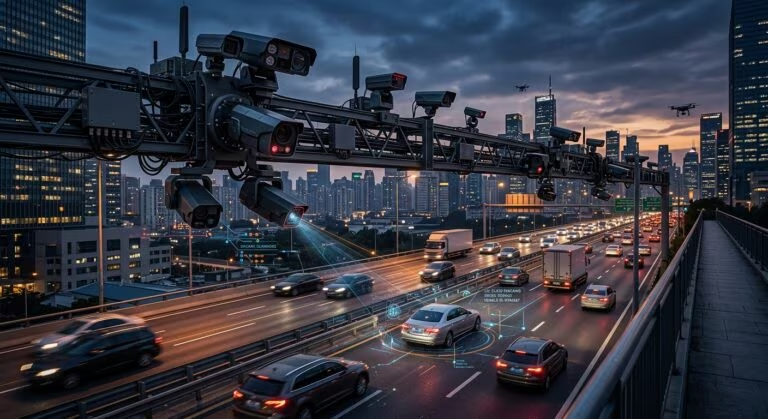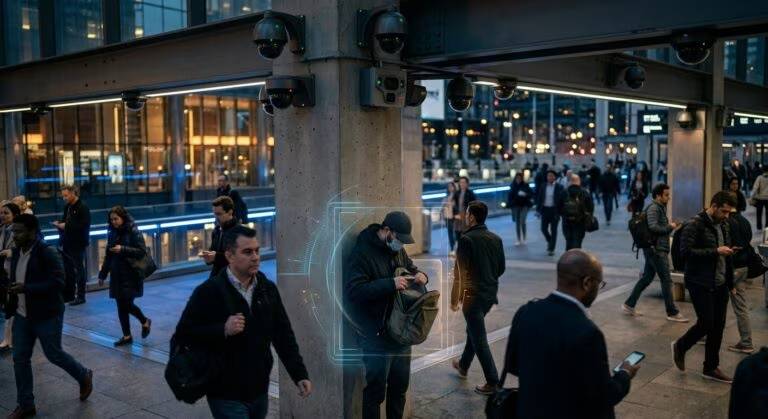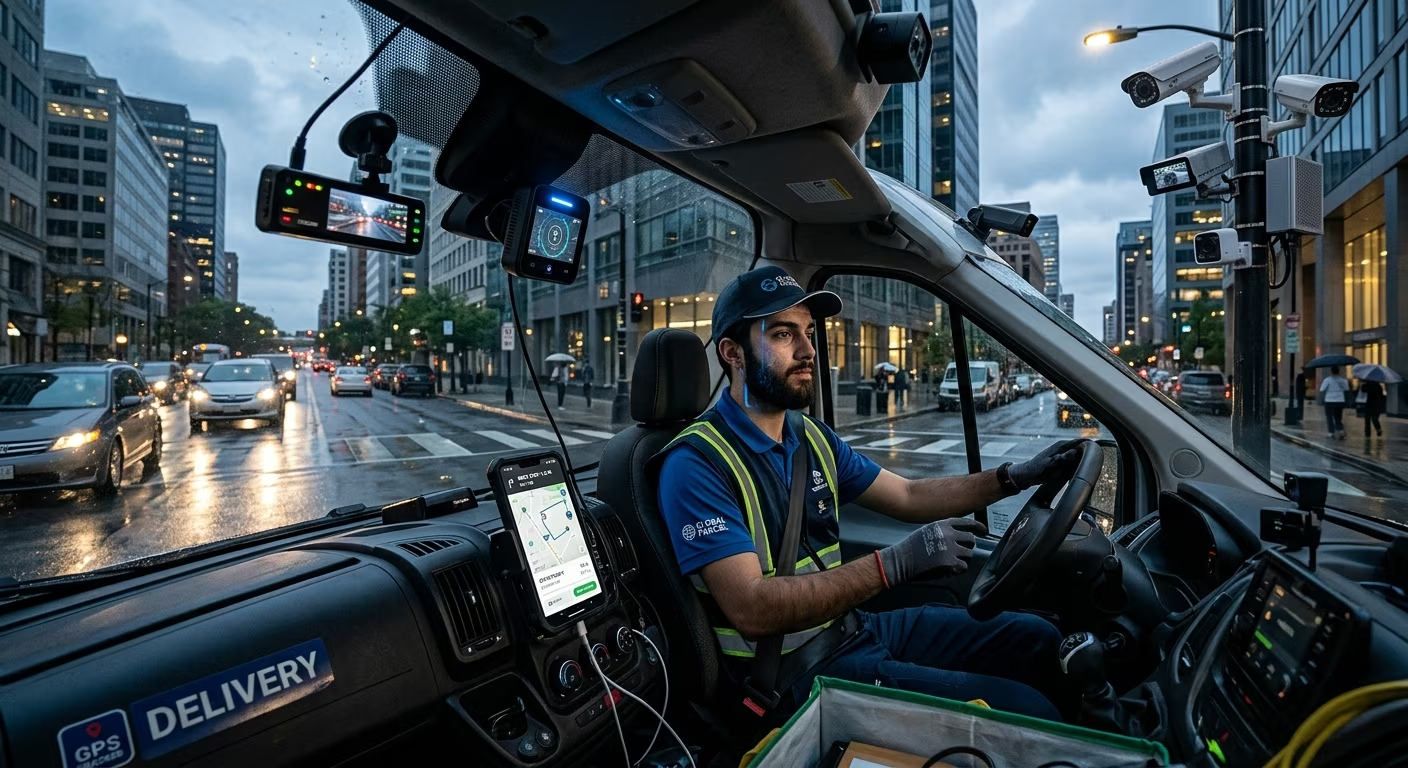
Modern logistics networks serve as the vital arteries of global commerce, moving millions of packages daily with a level of speed and efficiency that was unimaginable just a generation ago. Behind this seamless delivery ecosystem lies an increasingly complex web of workplace technology. In recent years, the industry has witnessed a profound shift in how drivers are monitored, transitioning from basic location tracking to comprehensive, real-time algorithmic management. At the center of this transformation is the deployment of Artificial Intelligence (AI) powered biometric dashcams within commercial delivery vehicles.
These sophisticated systems do much more than record the road ahead. They are designed to monitor the driver’s physical state, analyzing facial expressions, eye movements, and body language to detect signs of fatigue, distraction, or unsafe driving practices. While proponents argue that these technologies are essential for improving road safety and reducing accidents, labor advocates and privacy experts warn of a deeply invasive paradigm shift. The integration of continuous, machine-driven observation into the driver’s seat raises urgent questions regarding worker autonomy, algorithmic bias, psychological well-being, and the fundamental right to privacy in the modern digital workplace.
The Transformation of the Commercial Vehicle Cabin
For decades, the cabin of a commercial delivery vehicle offered a unique working environment. Despite the demanding nature of the job, drivers enjoyed a degree of independence once they left the dispatch center. Traditional monitoring was largely limited to rudimentary telematics—GPS systems that tracked vehicle location, speed, and hard braking. These tools provided managers with retrospective data regarding a driver’s route efficiency and adherence to basic traffic laws, but they could not peer inside the cabin to observe the driver’s behavior in real-time.
The advent of edge computing and advanced computer vision has fundamentally altered this dynamic. Today’s AI-equipped camera systems represent a leap from passive tracking to active, continuous surveillance. High-definition lenses are pointed directly at the driver for the duration of their shift, feeding live visual data into onboard algorithms. These algorithms are programmed to recognize specific biometric markers and behaviors, such as a driver averting their eyes from the road for too long, handling a mobile device, failing to wear a seatbelt, or even yawning excessively. When the system detects a perceived infraction, it often triggers immediate in-cab audio alerts, correcting the driver in real-time and logging the event for managerial review.
Behind the Lens: The Mechanics of Modern Fleet Surveillance
Understanding the implications of this technology requires an examination of its underlying mechanics. Modern AI dashcams operate using a combination of edge computing, machine learning, and advanced sensor fusion. Unlike older cameras that merely recorded video onto an SD card or streamed it blindly to a server, these new systems process visual data locally within the vehicle. This “edge computing” capability allows the AI to make instantaneous decisions without relying on a constant cellular connection.
The software relies on complex neural networks trained on vast datasets of human faces and driving behaviors. It maps the topography of the driver’s face to track gaze direction and head position. By fusing this internal visual data with external telemetry—such as radar-assisted following distance, vehicle speed, and lane departure sensors—the system creates a comprehensive, second-by-second profile of the driver’s performance. The transition from legacy systems to AI surveillance is stark, as illustrated below:
| Feature | Traditional Telematics | AI Biometric Surveillance |
|---|---|---|
| Primary Data Source | GPS and vehicle engine diagnostics. | Inward and outward-facing HD cameras. |
| Processing Method | Batch uploading data at the end of a shift. | Real-time edge computing and live alerts. |
| Behavioral Focus | Vehicle metrics (speeding, hard braking). | Driver biometrics (eye tracking, yawning, posture). |
| Feedback Loop | Retrospective coaching by human managers. | Instant automated audio cues and scoring. |
The Psychological Toll of the “Invisible Supervisor”
The continuous presence of an inward-facing camera fundamentally alters the psychological landscape of the job. Occupational health researchers have long studied the impacts of intense workplace monitoring, noting that constant observation can lead to chronic stress, anxiety, and fatigue. In the context of commercial driving, this phenomenon is magnified. Drivers report feeling trapped in a digital panopticon, where every micro-movement is scrutinized by an unblinking, algorithmic supervisor that lacks human empathy or contextual understanding.
The pressure to perform flawlessly for the camera often leads to hyper-vigilance. Drivers describe an overwhelming fear of triggering false alerts, forcing them to adopt unnatural postures or suppress natural human behaviors. A simple act like scratching an itch, adjusting a radio dial, or checking a side mirror for an extended second can trigger an automated reprimand. Over the course of a ten- or twelve-hour shift, this relentless micromanagement compounds the baseline stress of navigating heavy traffic, meeting tight delivery windows, and dealing with unpredictable weather conditions. The psychological burden of proving one’s innocence to a machine takes a measurable toll on driver morale and long-term mental health.
Systemic Flaws and Algorithmic Bias in the Driver’s Seat
A critical point of contention surrounding AI surveillance is the fallibility of the algorithms themselves. Machine learning models are only as objective and accurate as the data upon which they are trained. Independent audits of commercial computer vision systems have repeatedly demonstrated vulnerabilities to algorithmic bias, particularly concerning facial recognition and analysis across different demographic groups. If an AI dashcam’s training dataset disproportionately featured lighter-skinned individuals, the system may struggle to accurately map the facial features of drivers with darker skin tones, especially in low-light conditions.
Furthermore, AI systems are notoriously poor at interpreting context. An algorithm might flag a driver as “distracted” for looking down, failing to recognize that the driver is scanning their instrument panel or checking a company-mandated routing device. Sunglasses, heavy shadows, and personal protective equipment can also confuse the sensors, generating false positives. When driver compensation, route assignments, or employment status are tied to automated safety scores, these false positives cease to be mere technical glitches; they become direct threats to a worker’s livelihood. The rigid nature of algorithmic management often shifts the burden of proof onto the driver, forcing them to spend unpaid time disputing erroneous flags generated by a flawed system.
Privacy at Work: The Erosion of Boundaries
The deployment of inward-facing cameras ignites fierce debates over workplace privacy. While employers have a legitimate interest in ensuring the safety of their fleets and the public, the continuous collection of biometric data pushes the boundaries of acceptable monitoring. The legal landscape governing employee privacy in the United States is highly fragmented, leaving many workers vulnerable to invasive data practices.
Key concerns revolve around data retention, sharing, and consent. Where does the video footage go once it is recorded? How long is it stored on corporate servers? Is the biometric data sold or shared with third-party insurance companies? In jurisdictions with stringent privacy laws, such as Illinois under the Biometric Information Privacy Act (BIPA), companies face strict requirements regarding the collection and storage of facial geometry. However, in regions without robust legislative frameworks, drivers are often forced to sign broad consent waivers as a condition of employment, effectively trading their biometric privacy for a paycheck. This take-it-or-leave-it approach to consent highlights the inherent power imbalance between large logistics corporations and individual workers.
Shifting the Burden: Safety vs. Productivity
Logistics companies universally market the adoption of AI dashcams as a commitment to safety. They point to statistics showing reductions in distracted driving incidents and harsh braking events following the implementation of visual monitoring. However, labor advocates argue that this narrative obscures a more complex reality. The push for automated safety enforcement often occurs alongside a simultaneous demand for ever-increasing productivity and faster delivery times.
A paradox emerges when drivers are heavily penalized by an AI camera for rushing or driving aggressively, yet are concurrently evaluated by management based on route completion times that are nearly impossible to meet safely. In this scenario, the algorithmic surveillance system serves to shield the corporation from liability. If an accident occurs, the company can point to the AI-generated safety alerts as proof that the driver violated protocol, rather than acknowledging that systemic pressures—such as unrealistic delivery quotas and algorithmic route optimization—created the unsafe conditions in the first place. Meaningful safety improvements require addressing these systemic pressures, rather than simply pointing a camera at the driver and demanding perfection in an imperfect environment.
The Future of Labor in the Age of Algorithmic Management
The integration of AI surveillance in delivery vehicles is not an isolated phenomenon; it is a leading indicator of how algorithmic management is spreading across the blue-collar workforce. As the technology becomes cheaper and more advanced, its application will likely expand beyond logistics into warehousing, manufacturing, and service industries. The challenge facing policymakers, unions, and civil rights advocates is how to balance the legitimate safety benefits of technology with the fundamental rights and dignity of workers.
Pushback is already occurring. Labor unions are increasingly bringing algorithmic transparency and data privacy to the collective bargaining table, demanding limits on how surveillance data can be used in disciplinary proceedings. At the governmental level, frameworks like the White House’s Blueprint for an AI Bill of Rights have explicitly called out the dangers of unchecked workplace surveillance, advocating for continuous oversight, data minimization, and the protection of workers from abusive monitoring practices. The path forward requires comprehensive legislation that grants workers insight into how algorithms evaluate them, provides clear avenues for disputing automated decisions, and establishes firm boundaries on the collection of biometric data in the workplace.
Frequently Asked Questions (FAQs)
What is algorithmic management?
Algorithmic management refers to the use of software algorithms and artificial intelligence to monitor, evaluate, and direct the workforce. In the logistics sector, this includes automated route planning, productivity tracking, and AI-powered cameras that assess driver safety and behavior in real-time, often replacing functions traditionally performed by human supervisors.
How do AI dashcams differ from traditional GPS tracking?
While traditional GPS tracking monitors a vehicle’s location, speed, and braking patterns, AI dashcams use inward-facing lenses and computer vision to monitor the driver’s physical state. They analyze facial expressions, eye movements, and body posture to detect distraction, fatigue, or policy violations like cell phone usage, generating real-time alerts based on these biometric observations.
Can employers legally record drivers continuously?
In many jurisdictions, employers are legally permitted to record employees within company-owned vehicles, as the vehicle is considered a workplace where there is a reduced expectation of privacy. However, laws vary significantly by region. Some states have strict biometric privacy laws that regulate how facial recognition data can be collected, stored, and used, requiring explicit informed consent from the worker.
What are the main risks of AI surveillance for workers?
The primary risks include increased psychological stress from constant monitoring, potential job loss due to flawed automated evaluations or false positives, algorithmic bias that may disproportionately affect certain demographics, and the erosion of personal privacy through the unregulated collection and storage of biometric data.
References
- Blueprint for an AI Bill of Rights — The White House Office of Science and Technology Policy. 2022-10-04. https://www.whitehouse.gov/ostp/ai-bill-of-rights/
- Algorithmic Management and the Workplace — International Labour Organization (ILO). 2022-03-15. https://www.ilo.org/global/topics/future-of-work/publications/WCMS_838634/lang–en/index.htm
- Commercial Motor Vehicle Driver Fatigue, Long-Term Health, and Highway Safety — National Academies of Sciences, Engineering, and Medicine. 2016-05-15. https://nap.nationalacademies.org/catalog/21921/commercial-motor-vehicle-driver-fatigue-long-term-health-and-highway-safety
- Exclusive: Amazon expands use of AI cameras in delivery vans — Reuters. 2021-02-18. https://www.reuters.com/article/technology/exclusive-amazon-expands-use-of-ai-cameras-in-delivery-vans-idUSKBN2AI1J0/