
Accessory vs. Accomplice: Understanding Criminal Liability
Learn how criminal law distinguishes accessories from accomplices, why the timing and level of help matters, and how these roles affect charges and penalties.
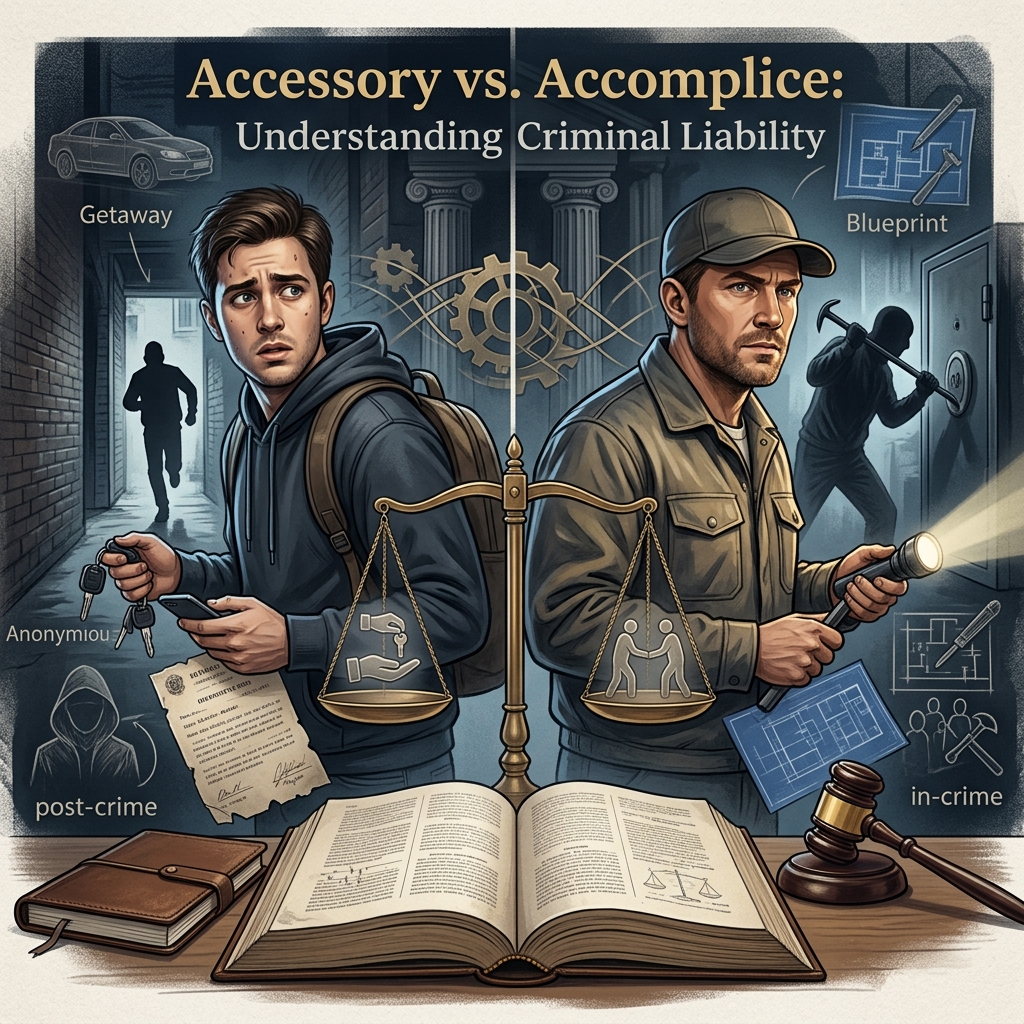
Criminal law does not only focus on the person who directly commits a crime. It also reaches those who help, encourage, or protect that person. Two common labels for such participants are accomplice and accessory, and although they sound similar, they describe very different types of involvement and carry different legal consequences.
Knowing how the law draws the line between an accomplice and an accessory can affect how a case is charged, the possible penalties, and the defenses available. This article explains those differences in clear, practical terms and highlights what prosecutors must prove when they claim someone helped a crime happen or helped the offender escape justice.
Core Distinction: Direct Participation vs. After-the-Fact Assistance
At the broadest level, criminal law distinguishes between people who help commit a crime and those who help after a crime has already been completed.
- Accomplice: Intentionally assists, encourages, or participates in the commission of the crime itself, often before or during the offense.
- Accessory: Provides help related to the crime after it has been committed, typically by helping the principal offender avoid arrest, trial, or punishment.
This difference in timing and level of involvement is the foundation for how the legal system treats these roles.
Key Legal Concepts: Principals, Accomplices, and Accessories
To understand accomplices and accessories, it helps to know how criminal law classifies participants in general.
- Principal: The main actor who directly commits the crime. For example, the person who physically takes money during a robbery.
- Accomplice (often called an aider and abettor): Someone who intentionally helps or encourages the principal to carry out the crime, even if they do not personally perform the main criminal act.
- Accessory after the fact: Someone who knows a serious crime (usually a felony) has been completed and then helps the offender evade detection, arrest, or prosecution.
In many jurisdictions, accomplices are treated almost identically to principals, whereas accessories after the fact face separate, often lesser, charges.
Comparing Accomplices and Accessories
| Feature | Accomplice | Accessory |
|---|---|---|
| Timing of assistance | Before or during the crime | After the crime has been completed |
| Typical presence at crime scene | Usually present or directly involved in planning or execution | Usually not present at the crime scene |
| Type of conduct | Planning, providing tools, acting as lookout, encouraging the act | Hiding the offender, destroying evidence, providing false alibi |
| Intent requirement | Intent that the crime be committed and succeed | Knowledge the crime occurred, intent to help avoid justice |
| Typical punishment | Often the same as the principal’s punishment | Generally lower than principal and accomplice |
Who Is an Accomplice? Legal Definition and Elements
Most legal sources describe an accomplice as someone who intentionally helps another person commit a crime. Even if the accomplice never touches the victim or property, their assistance can make them just as legally responsible as the principal.
To prove that a defendant is an accomplice, prosecutors generally must show:
- Criminal intent: The person knew the principal intended to commit a crime and wanted to help that crime succeed.
- Active assistance or encouragement: The person did something that aided the commission of the offense, such as providing tools, information, or moral support.
- Connection to the crime’s planning or execution: Often, the accomplice participated in planning or was present during the offense, though physical presence is not always required.
In many jurisdictions, this concept is codified under “aiding and abetting” statutes, which treat accomplices as if they were principal offenders.
Common Examples of Accomplice Conduct
- Driving the getaway car with knowledge of a planned robbery.
- Supplying weapons or tools specifically for a burglary.
- Acting as a lookout during a crime and warning the principal about approaching police.
- Helping plan the details of a fraud scheme with the intention that it be carried out.
Each of these acts both supports the crime and reflects the accomplice’s desire for the illegal plan to succeed, which is central to accomplice liability.
Who Is an Accessory? Legal Definition and Elements
In contrast, an accessory is generally someone who offers post-crime assistance to the principal offender. The classic description is an “accessory after the fact” – a person who helps a felon avoid arrest or prosecution once the criminal act is complete.
To convict someone as an accessory after the fact, prosecutors usually must show:
- Knowledge of the crime: The person knew that a crime, often a felony, had been committed.
- Intent to obstruct justice: The person intended to help the offender escape detection, arrest, trial, or punishment.
- Assistance provided after completion of the offense: The help came after the crime was over, not during its planning or execution.
Because this assistance occurs after the fact, the accessory is not treated as having participated in the core criminal conduct itself.
Typical Accessory Behaviors
- Allowing a person who just committed a felony to hide in one’s home, with knowledge of the crime.
- Destroying or concealing evidence, such as hiding stolen goods or weaponry.
- Providing a false alibi to law enforcement or in court.
- Helping arrange transportation or funding for the offender to flee the jurisdiction.
These acts do not change the completed crime but interfere with the justice system’s ability to respond to it.
Why Penalties Differ: Policy Reasons Behind the Law
Many jurisdictions punish accomplices as harshly as principals because accomplice conduct helps the crime occur in the first place. Without planners, lookouts, and suppliers, many offenses would be harder to carry out, so the law treats accomplice participation as equally serious.
Accessories, on the other hand, generally face separate and lower penalties. They are not blamed for the original harm, but for obstructing justice after the fact. The legal system considers that less serious than causing the underlying criminal harm, though still punishable.
Under some state codes, an accomplice can be charged with the exact same offense as the principal, while an accessory after the fact faces a distinct crime with its own sentencing range.
Presence at the Crime Scene: Important but Not Decisive
Whether a person is physically present during the crime often aligns with the accomplice–accessory divide, but presence is not the only factor.
- Accomplices are often at the scene or closely involved in planning and execution.
- Accessories typically are not present at the offense and only become involved afterward.
However, the law focuses more on intent and timing of the assistance than mere physical location. Someone who helps plan an offense but stays away from the scene can still be an accomplice, while someone who only helps hide the offender afterward is an accessory, even if they live near the crime location.
Aiding and Abetting Statutes: How Accomplices Are Charged
Many U.S. states use “aiding and abetting” provisions to define accomplice liability. These laws typically specify that any person who aids, encourages, or advises the commission of a crime may be prosecuted and punished as if they committed the crime themselves.
Important features of these statutes include:
- No separate offense titled “accomplice”; instead, the accomplice is charged with the underlying crime.
- Conduct can include encouragement, advice, or minor supportive actions, as long as there is intent to help the crime succeed.
- Equal exposure to the full range of penalties for the principal offense, including fines and imprisonment.
This approach emphasizes the idea that criminal responsibility is based on intentional participation, not on who performs which specific physical act.
Accessory After the Fact: Distinct Liability and Lesser Punishment
By contrast, state laws often create a separate offense for being an accessory after the fact. This offense focuses on the period following the crime and the efforts to shield the offender from consequences.
Typical features include:
- Requirement that the underlying offense be a felony, reflecting the seriousness of the crime supported.
- Explicit focus on harboring, concealing, or otherwise assisting the offender to avoid law enforcement.
- Penalties that are lower than those for the principal offense and for accomplice liability.
This legal structure reinforces the view that hindering justice is serious, but distinct from making the crime happen in the first place.
Practical Scenarios: Applying the Concepts
The line between accomplice and accessory becomes clearer when applied to real-world patterns of behavior. The following scenarios illustrate how the law might classify different actions.
Scenario 1: Planning and Execution of a Theft
- A person helps choose a target, secure tools, and design an escape route, knowing the plan is to steal valuable property.
- On the day of the crime, they drive the principal to the location and wait nearby as the theft occurs.
Here, the helper is an accomplice, because they actively plan and facilitate the offense before and during its commission with the intent that it succeed.
Scenario 2: Shelter After a Felony
- After hearing that a friend has committed a felony, a person lets that friend stay in their home to avoid police.
- They know about the crime and purposely withhold information from law enforcement.
In this case, the host is an accessory after the fact, because their involvement begins after the crime and aims to help the offender avoid arrest.
Scenario 3: Destroying Evidence
- A person agrees to burn clothing and wipe fingerprints from a car used in a serious crime.
- This takes place after the crime and is done to prevent law enforcement from linking the offender to the scene.
This person would likely be treated as an accessory after the fact, because the conduct is directed at hiding evidence once the offense has ended.
Frequently Asked Questions (FAQs)
Is a witness to a crime automatically an accomplice?
No. Merely watching a crime happen does not make someone an accomplice. To be an accomplice, the person must intentionally aid, encourage, or otherwise support the crime’s commission. Passive presence without assistance or encouragement is not enough.
Can someone be both an accomplice and an accessory?
In theory, a person could participate in the planning and execution of a crime (accomplice) and later help the offender avoid arrest (accessory). However, many jurisdictions treat the pre-crime and during-crime assistance as part of accomplice liability, and any later conduct may be charged separately as an accessory after the fact.
Does physical presence matter for accomplice liability?
Physical presence at the crime scene is common but not legally required. Someone who helps plan a crime, provides essential tools, or gives instructions can be an accomplice even if they stay away while the offense is carried out, as long as they intend for the crime to succeed.
Are accessories always punished less than accomplices?
Generally, accessories after the fact face lesser penalties than accomplices and principals, reflecting their later involvement. However, exact sentencing rules vary by jurisdiction, and the seriousness of the underlying crime can significantly influence the punishment.
Why does the law punish someone who did not commit the crime?
Criminal law focuses on intentional contribution to wrongdoing. An accomplice helps make the crime possible and thus shares responsibility for the harm. An accessory interferes with the justice system’s response to that harm. Both forms of assistance undermine legal order, so both are punishable, though often to different degrees.
What to Do If Accused as an Accomplice or Accessory
Because accomplice and accessory liability can carry significant consequences, especially for serious felonies, anyone accused of either role should seek qualified legal advice. An attorney can examine whether the prosecution can prove intent, timing, and the specific assistance required for these charges, and whether the alleged conduct was closer to passive presence or misunderstanding rather than active support.
Understanding the legal definitions can help individuals recognize potential exposure and avoid becoming involved in situations that might be interpreted as supporting criminal activity.
References
- Accessory vs. Accomplice: What’s the Difference in Criminal Law? — FindLaw Editorial Team. 2023-06-14. https://www.findlaw.com/criminal/criminal-law-basics/accessory-vs-accomplice-whats-the-difference-in-criminal-law.html
- Accomplices, Accessories, Aiders, and Abettors — Carelon Wellbeing (Home Depot EAP). 2022-05-10. https://hd.carelonwellbeing.com/hd/find-legal-support/resources/criminal-law/legal-assist/accomplices-accessories-aiders-and-abettors
- Principal Liability vs. Aiding and Abetting vs. Accessory After the Fact — Los Angeles Criminal Lawyer. 2021-11-03. https://www.losangelescriminallawyer.pro/principal-liability-vs-aiding-and-abetting-vs-accessory-after-th.html
- Difference Between an Accomplice and an Accessory — EG Attorneys. 2022-08-18. https://www.egattorneys.com/accomplice-and-accessory
- Accomplices – Common Law Classifications — LawShelf Educational Media. 2020-09-09. https://www.lawshelf.com/coursewarecontentview/accomplices-common-law-classifications/
Similar Articles








Read full bio of Sneha Tete




