
Motions to Change Venue in Criminal Trials
How and why criminal cases are moved to different courts to protect the constitutional right to a fair and impartial trial.
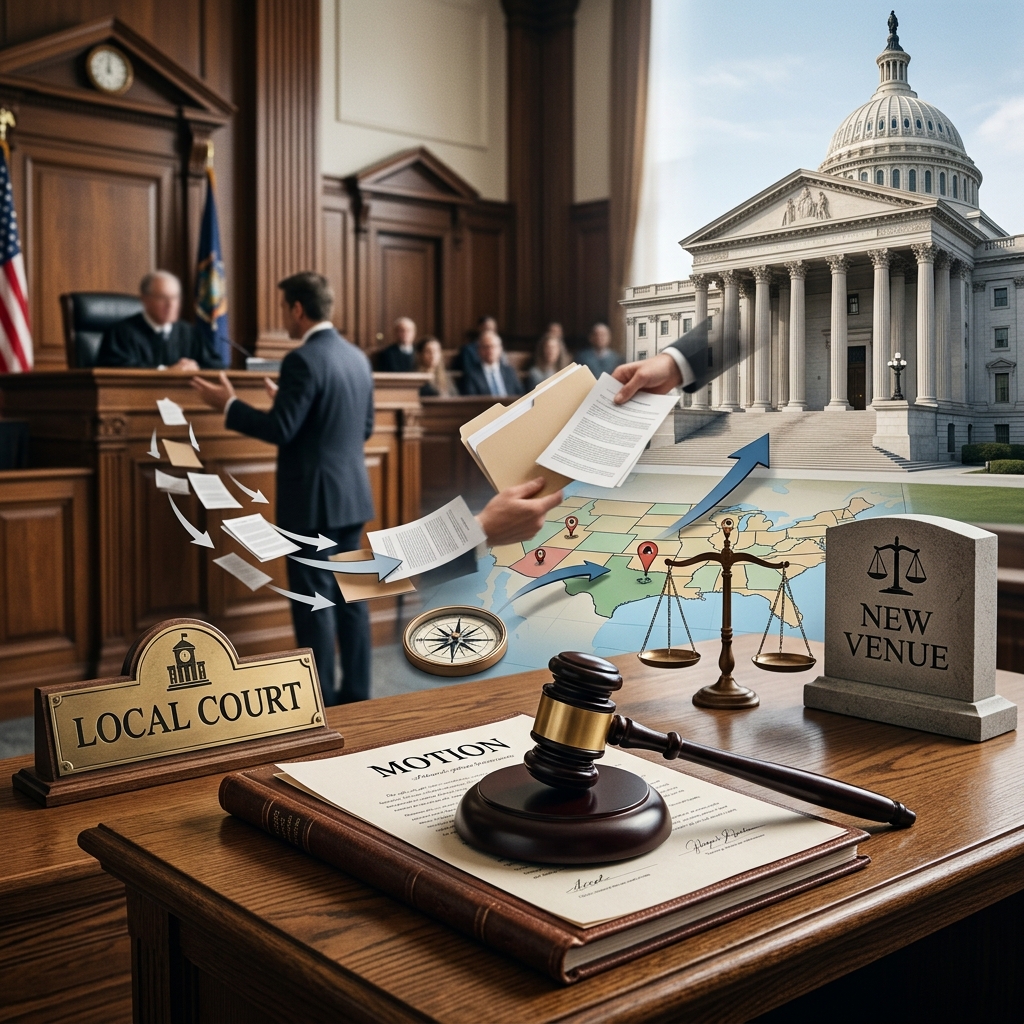
In criminal law, a motion to change venue is a formal request to move a case from one court location to another in order to safeguard the defendant’s right to a fair and impartial trial. Although criminal charges are typically prosecuted in the county or district where the offense occurred, courts may relocate proceedings when local conditions make fairness doubtful.
This article explains what a change of venue is, why it matters, when courts grant it, and how defense attorneys typically pursue such motions. It also examines practical effects of a venue transfer and provides answers to common questions that arise in high-profile or highly publicized cases.
Understanding Venue in Criminal Cases
Venue refers to the specific geographic location—usually a county or judicial district—where a criminal case is tried. Venue is distinct from jurisdiction: jurisdiction concerns whether a court has legal authority over the type of case and parties involved, while venue focuses on which particular court is the proper place for trial within that system.
- Default rule: Most states require that criminal prosecutions occur in the county where the alleged crime was committed.
- Change of venue: A relocation of the trial to another court within the same state or judicial system when justice requires a different location.
- Purpose: To reduce or eliminate local prejudice, intense publicity, or other conditions that make it hard to seat an impartial jury.
Venue rules are grounded in both constitutional principles and statutory provisions. While the ability to request a change of venue is closely tied to the constitutional right to a fair trial, many jurisdictions treat venue transfer as a procedural privilege rather than an absolute constitutional right in itself.
Why Courts Allow Changes of Venue
Courts are obligated to protect the defendant’s right to a fair trial before an impartial jury. When local circumstances undermine that right, judges may order the case moved to another location. The underlying rationale is simple: justice must not only be done, it must be seen to be done.
Key Reasons for Venue Transfers
- Intense pretrial publicity: Widespread, sensational, or biased media coverage can influence prospective jurors and make it difficult to find a panel uninformed or untainted by strong opinions.
- Community hostility or undue excitement: In some communities, a crime may spark anger, fear, or outrage so pronounced that jurors cannot remain neutral.
- Local events affecting impartiality: Highly publicized investigations, protests, or prior related cases can create an atmosphere where the defendant is presumed guilty.
- Security, logistics, or court capacity: In rare cases, venue may be changed because the original court lacks adequate facilities to handle a complex, lengthy, or high-security trial.
The overarching question for the court is whether an impartial jury can realistically be assembled in the original venue. If that is unlikely, a change of venue becomes a tool to restore confidence in the fairness of the proceedings.
Legal Standards Governing Change of Venue Motions
While specific rules vary by jurisdiction, common legal standards appear across federal and state systems. Statutes, court rules, and case law collectively define when a change of venue is appropriate and what the moving party must show.
Federal Standard: Rule 21
In federal criminal cases, Federal Rule of Criminal Procedure 21 governs transfer for trial. It allows defendants to seek transfer when local prejudice or other grounds make a fair and impartial trial unlikely. The rule recognizes two types of motions:
- Transfer for prejudice: When so great a prejudice exists in the original district that a fair trial cannot be obtained.
- Transfer for convenience: In some situations, transfer may be allowed based on convenience for parties and witnesses, though this is more limited.
State-Level Standards
States use a variety of formulations, but the core requirement is similar: the moving party must demonstrate a reasonable likelihood that a fair trial cannot be had in the current venue. A brief overview illustrates common approaches.
| Jurisdiction | Who May Move | Standard | Key Requirement |
|---|---|---|---|
| Tennessee | Defendant (or court with consent) | Fair trial unlikely due to undue excitement or other cause. | Affidavits showing facts of prejudice or excitement. |
| Michigan | Either party | “Good cause” shown that a fair and impartial trial cannot be had. | Proof that pretrial publicity has influenced prospective jurors. |
| California | Defendant | Reasonable likelihood of inability to receive a fair trial in the county. | Motion filed within statutory deadline (often before trial). |
Courts often require more than mere exposure to media reports. Defendants typically must show that prospective jurors have actually been influenced by publicity or that the publicity is so pervasive and inflammatory that prejudice should be presumed.
Procedural Steps to Seek a Change of Venue
A motion to change venue is usually made early in the case, often before trial or at arraignment. Failure to raise venue issues in time can result in waiver, limiting the defendant’s ability to challenge venue later, including on appeal.
Typical Components of a Venue Motion
- Written motion: A formal filing identifying the legal basis for transfer (statute, rule, or constitutional principle) and the specific relief requested.
- Affidavits: Sworn statements describing the facts supporting the claim of prejudice, such as the extent of media coverage, community hostility, or specific incidents showing bias.
- Supporting evidence:
- Copies of news articles, broadcasts, or social media posts.
- Survey data or expert testimony about community attitudes.
- Examples of threats or demonstrations indicating hostility.
- Legal argument: Citations to statutes, court rules, and cases that describe when venue transfer is appropriate, applied to the facts of the case.
After the motion is filed, the prosecution has an opportunity to respond, often by arguing that publicity has been balanced or that jurors can be screened effectively during voir dire to weed out bias.
Hearing and Judicial Evaluation
Courts ordinarily hold a hearing on the motion. At the hearing:
- Defense presentation: Defense counsel presents affidavits, evidence, and legal arguments to demonstrate that the risk of prejudice is substantial.
- Prosecution’s response: The prosecution may present counter-affidavits or evidence suggesting that publicity is not unduly prejudicial or that safeguards like careful juror questioning are sufficient.
- Judicial findings: The judge assesses the seriousness and reach of publicity, the size and demographics of the jury pool, and whether alternative measures short of transfer can ensure fairness.
In some jurisdictions, courts prefer to attempt jury selection in the original venue first, deferring a ruling on the motion until voir dire reveals whether an impartial jury can be seated.
Time Limits and Waiver of Venue Challenges
Timeliness is critical. Many states require that motions to change venue be filed within a set time frame, often at or before arraignment or within a specified period after indictment. Missing these deadlines can result in waiver.
- Early filing requirement: For felony cases in some jurisdictions, venue motions must be made at or before arraignment or within a defined number of days after indictment.
- Pretrial deadline: Other rules require that applications for change of venue be submitted at least a certain number of days before trial.
- Consequences of waiver: A defendant who fails to move for change of venue during the designated stage often loses the ability to challenge venue on appeal.
Because the stakes are high and the rules technical, defense counsel must evaluate venue issues early and act promptly if the case presents significant risks of local prejudice.
What Happens When Venue Is Changed?
Once the court grants a motion to change venue, the case is transferred to a different court, usually in another county that is not affected by the prejudicial conditions. The goal is to find a location where jurors have had less exposure to inflammatory coverage or community sentiment.
Practical Consequences of Transfer
- New jury pool: Jurors will be drawn from the new county or district, potentially reducing the influence of local media and community pressure.
- Logistics: Parties, witnesses, and court staff must travel to the new location, which may increase costs and coordination challenges.
- Scheduling adjustments: Courts must rearrange calendars, secure appropriate courtroom space, and address security and administrative needs, especially in complex trials.
- Local counsel considerations: While primary defense counsel usually continues representation, attorneys may collaborate with lawyers familiar with the new venue’s practices.
In large, high-profile California cases, for example, the transfer process may involve the Judicial Council assessing which courts have suitable facilities, manageable workloads, and capacity to accommodate the trial without undue burden.
Strategic Considerations for Defendants and Lawyers
Motions to change venue are strategic decisions as much as legal ones. Defense lawyers must weigh both the risks of local prejudice and the potential downsides of moving the case to unfamiliar territory.
Factors Defense Counsel Commonly Evaluate
- Extent and tone of media coverage: Is reporting sensational and one-sided, or relatively balanced?
- Community size and diversity: In larger, more diverse jurisdictions, even widespread publicity may not taint an entire jury pool.
- Alternative remedies:
- Extended voir dire to probe juror attitudes.
- Juror questionnaires regarding exposure to publicity.
- Admonitions and instructions to disregard media reports.
- Impact on witnesses: Will relocation make it harder for key defense witnesses to attend or testify?
- Perceptions of the new venue: Some counties may be perceived as more prosecution-friendly or defense-friendly, although such perceptions must be balanced against the overriding need for impartial jurors.
Because venue motions often involve complex factual showings, expert testimony and statistical analysis can play an important role in supporting the claim that a fair trial cannot be held in the original location.
Common Grounds and Evidentiary Showings
Courts expect concrete proof, not speculation. Successful motions typically marshal multiple forms of evidence to demonstrate actual or presumed prejudice.
Typical Evidence Used to Support Venue Motions
- Media documentation: Articles, TV reports, podcasts, and online coverage showing inflammatory language, repeated mention of damaging facts, or references to inadmissible information.
- Public opinion surveys: Polls conducted by experts testing whether residents have formed fixed opinions about the case.
- Prior jury experiences: Evidence that earlier trials or proceedings involving the same case or defendant led to highly publicized outcomes.
- Community incidents: Protests, threats, or community meetings evidencing hostility toward the defendant.
Judges have discretion to determine whether this evidence meets the applicable legal standard. In rare cases, courts may presume prejudice when publicity is so pervasive and sensational that neutrality is practically impossible.
FAQs: Change of Venue in Criminal Trials
Is the right to change venue a constitutional right?
The ability to seek a change of venue is closely tied to the constitutional right to a fair trial, but many jurisdictions treat venue transfer as a procedural privilege rather than a standalone constitutional right. This means defendants usually must invoke it through timely motions, or the issue may be deemed waived.
Can the prosecution request a change of venue?
In some states, either party may seek a change of venue upon good cause. Other jurisdictions explicitly recognize that both the state and the defendant are entitled to a fair trial, allowing judges to grant venue changes even on the state’s motion, sometimes based on the court’s inherent authority.
What if the judge denies the motion?
If the motion is denied and the defendant is later convicted, the denial can be reviewed on appeal. Appellate courts typically examine whether the trial judge abused discretion and whether the defendant actually suffered prejudice, such as demonstrably biased jurors or an atmosphere incompatible with fairness.
Does mere media coverage guarantee a venue change?
No. Courts repeatedly hold that mere exposure to publicity is not enough. The moving party must show that the coverage has influenced the jury pool or is so extreme that prejudice should be presumed. Balanced or routine reporting usually does not justify transfer.
Can venue be changed more than once?
Multiple transfers are possible but uncommon. Courts generally aim to select a venue that will resolve fairness concerns in a single move, and additional changes are reserved for exceptional situations, such as unforeseen developments that renew concerns about impartiality.
When should I talk to a lawyer about venue issues?
Anyone facing serious criminal charges in a highly publicized or emotionally charged case should consult a criminal defense attorney as early as possible. Because venue challenges are time-sensitive and evidence-intensive, prompt legal advice is essential to protect the right to a fair trial.
References
- Rule 21. Transfer for Trial — Legal Information Institute, Cornell Law School. 2023-01-01. https://www.law.cornell.edu/rules/frcrmp/rule_21
- Rule 21: Change of Venue — Tennessee Rules of Criminal Procedure, Tennessee Administrative Office of the Courts. 2022-07-01. https://www.tncourts.gov/courts/rules-criminal-procedure/rules/rules-criminal-procedure-rules/rule-21-change-venue
- Motion to Change Venue — Michigan Courts Criminal Proceedings Benchbook. 2021-09-01. https://www.courts.michigan.gov/4903d5/siteassets/publications/benchbooks/criminal/crimpttresponsivehtml5.zip/Crim_PTT/Ch_2_Jurisdiction_and_Venue/Motion_to_Change_Venue.htm
- Change of Venue in a Criminal Case — Nolo Legal Encyclopedia. 2023-06-15. https://www.nolo.com/legal-encyclopedia/change-venue-criminal-case.html
- Change of Venue in California — California Courts Newsroom. 2020-02-01. https://newsroom.courts.ca.gov/branch-facts/change-venue-california
- Change of Venue or Judge — Indiana Court Rules, Rule 2.4. 2022-01-01. https://rules.incourts.gov/Content/criminal/rule2-4/current.htm
- Challenges and Motions to Change Venue — NC PRO, School of Government at the University of North Carolina. 2021-05-01. https://ncpro.sog.unc.edu/manual/102-2
Similar Articles








Read full bio of medha deb




