
Who Must Pay U.S. Taxes? A Practical Guide for Immigrants
Understand when immigrants, visa holders, and international visitors must file U.S. tax returns and report worldwide or U.S.-source income.
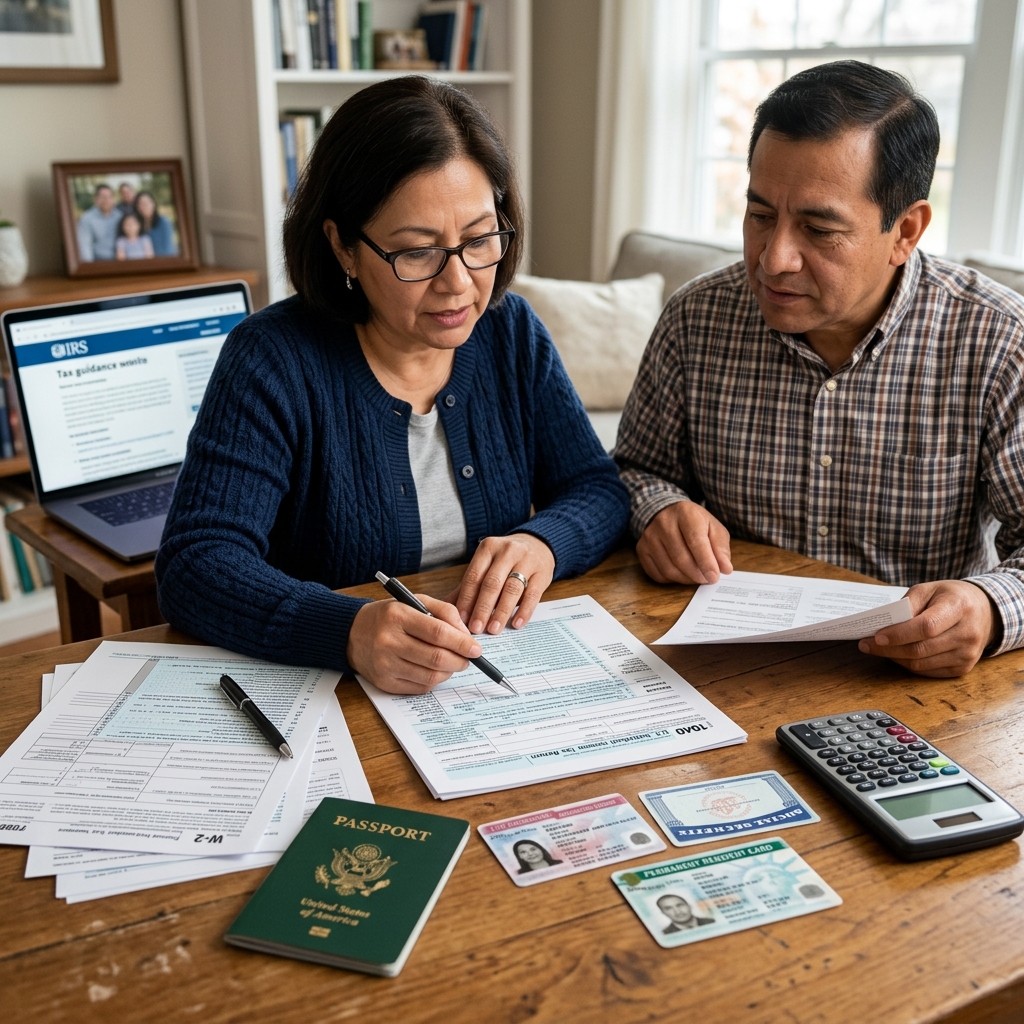
Many people assume that only U.S. citizens owe U.S. taxes, but the rules are broader and more complex. Federal law assigns tax obligations based on tax residency, not on citizenship alone, so immigrants, long-term visitors, and even some foreign students may need to file U.S. tax returns and pay tax on certain income.
This article explains who is considered a U.S. tax resident, who is treated as a nonresident, and how different immigration statuses affect your duty to report worldwide income or only U.S.-source income. It is designed for immigrants, visa holders, and anyone living or working in the United States who wants a clear, organized overview of U.S. tax rules.
Tax Residency vs. Immigration Status: Why the Distinction Matters
U.S. immigration status and U.S. tax status often overlap, but they are not identical concepts. The Internal Revenue Service (IRS) uses different tests and definitions than immigration agencies when deciding if someone is a tax resident or nonresident alien.
- Immigration status determines whether you can enter, live, or work in the United States (for example, as a citizen, green card holder, or temporary visa holder).
- Tax residency status determines how the IRS taxes your income and whether you must report worldwide income or only U.S.-source income.
Because tax rules follow their own definitions, someone may be a temporary visitor under immigration rules yet still be treated as a resident for tax purposes if they meet certain presence tests.
Who Is a U.S. Tax Resident?
Under U.S. law, there are three main groups who are usually treated as tax residents:
- U.S. citizens
- Lawful permanent residents (green card holders)
- Certain foreign nationals who meet the substantial presence test
U.S. Citizens
U.S. citizens are generally tax residents no matter where they live in the world. The IRS expects citizens to file U.S. tax returns and report their income from all countries, not just income earned in the United States.
According to IRS guidance, citizens living abroad are subject to the same filing rules as those living in the U.S.; income, filing status, and age determine whether a return is required. This means that moving abroad does not by itself end your U.S. tax obligations.
Green Card Holders (Lawful Permanent Residents)
Individuals who hold a U.S. green card are treated as resident aliens for tax purposes and are generally taxed like citizens. They must file U.S. tax returns and report worldwide income if they meet income thresholds.
Key implications for green card holders:
- They are U.S. tax residents, even if they live abroad, until the green card is formally abandoned or revoked.
- They are required to report income from all sources worldwide, including foreign employment, business, and investment income.
- They may have additional reporting requirements for foreign bank accounts and foreign financial assets.
Foreign Nationals Who Meet the Substantial Presence Test
Noncitizens who do not have a green card can still become U.S. tax residents if they spend enough time physically present in the United States. The IRS uses the substantial presence test to decide this.
In simple terms, you are typically considered a tax resident if you:
- Spend 31 or more days in the U.S. during the current year, and
- Spend a weighted total of 183 or more days in the U.S. over the current year and the two prior years (using specific day-count rules applied by the IRS).
If you meet this test (and no exception applies), you are treated as a resident alien for tax purposes and are expected to report worldwide income, similar to citizens and green card holders.
Who Is a Nonresident Alien for Tax Purposes?
A nonresident alien is a foreign national who does not meet the substantial presence test and does not have a green card. These individuals are usually taxed only on certain income connected to the United States, rather than on their worldwide income.
Tax Rules for Nonresident Aliens
According to IRS guidance, nonresidents are generally taxed on:
- U.S.-source income (for example, wages earned for work performed physically in the United States)
- Income that is effectively connected with a U.S. trade or business (such as operating a business in the U.S.)
They are not usually required to report income earned solely outside the United States unless the income is effectively connected with a U.S. business.
International students and scholars who are treated as nonresidents often must file specialized forms, such as Form 8843 plus a nonresident return, to document their status and report any U.S.-source income.
Worldwide Income vs. U.S-Source Income
The central difference between tax residents and nonresidents is the scope of income that must be reported.
| Tax Status | Income That Must Be Reported | Typical Examples |
|---|---|---|
| U.S. citizen | Worldwide income from all sources. | Salary in the U.S. and abroad, foreign investment income, foreign rental income. |
| Resident alien | Worldwide income, same rules as citizens. | Wages earned in the U.S., wages from foreign employers, foreign bank interest. |
| Nonresident alien | U.S.-source income and income effectively connected with a U.S. trade or business. | U.S. wages, U.S. rental income, income from a business operated in the U.S. |
Common Immigration Situations and Tax Obligations
Immigrants and visitors often fall into recurring categories. Understanding which category matches your situation makes it easier to determine whether you must pay U.S. taxes and file returns.
New Immigrants Becoming Permanent Residents
When someone moves to the United States and obtains lawful permanent residence, they become a U.S. tax resident. IRS guidance for new immigrants emphasizes that tax residents are taxed like citizens on worldwide income, whether they are inside or outside the country.
Typical obligations for new permanent residents:
- File annual federal income tax returns if income exceeds filing thresholds.
- Report income from employment, self-employment, investments, and foreign assets.
- Comply with reporting rules for foreign accounts if balances or asset values exceed specified limits.
Temporary Workers and Long-Term Visitors
Foreign nationals working in the U.S. on employment visas (such as certain temporary worker categories) may become tax residents if they meet the substantial presence test. Once they do, their obligations are similar to those of citizens and permanent residents.
Those who do not meet the test are typically nonresident aliens and report only U.S.-source income, such as wages earned in the U.S. or income from U.S. investments.
International Students and Scholars
International students and academic visitors often arrive on specific visa types. Many are initially treated as nonresident aliens, which means they report U.S.-source income and file specialized nonresident forms.
The Dartmouth Office of Visa and Immigration Services notes that nonresident students and scholars must file an income tax return if they have U.S.-source income and also file Form 8843 to substantiate their nonresident status, even if they have no income.
Undocumented Immigrants
Individuals without authorized immigration status can still have tax obligations. When they live, work, and make purchases in the United States, they contribute to federal, state, and local revenue through payroll and consumption taxes.
Research by the Institute on Taxation and Economic Policy shows that undocumented immigrants pay billions of dollars in state and local taxes each year, mainly through sales, excise, property, and income taxes. Many also file income tax returns using individual taxpayer identification numbers (ITINs) to report earnings.
Key Forms, Identification Numbers, and Reporting Requirements
Understanding the main tax forms and identification requirements can help immigrants and visitors meet their obligations without confusion.
Taxpayer Identification Numbers (SSN and ITIN)
To file a U.S. tax return, you generally need a taxpayer identification number (TIN). For most citizens and permanent residents, this is a Social Security Number (SSN).
For individuals who are not eligible for an SSN, the IRS issues an Individual Taxpayer Identification Number (ITIN). Tax guides for immigrants explain that ITINs are used for filing tax returns and sometimes for claiming exemptions and dependents when allowed.
Core Income Tax Forms
- Form 1040: Main individual income tax return used by U.S. citizens and resident aliens.
- Form 1040-NR: Return for nonresident aliens who must report U.S.-source income.
- Form 8843: Statement for certain nonresident aliens, such as students and scholars, used to document nonresident status even when no income exists.
Reporting Foreign Income and Assets
Tax residents who have income or assets outside the United States may have extra reporting obligations in addition to their main tax return.
- Foreign bank accounts above certain thresholds may require separate reporting.
- Specified foreign financial assets can trigger reporting on specialized IRS information forms.
Green card holders and citizens are often reminded that these rules apply even if the foreign accounts earn little or no income.
Credits, Relief, and Double Taxation Concerns
Immigrants and U.S. tax residents frequently worry about paying tax twice on the same income, once in the U.S. and once abroad. U.S. law includes mechanisms to reduce or offset double taxation.
Foreign Tax Credit
Resident taxpayers who pay income tax to another country on the same income may be able to claim a foreign tax credit. Guidance for new citizens and immigrants explains that this credit can help offset U.S. tax liability when foreign taxes are paid on foreign income.
Education and Family-Related Credits
Some immigrants qualify for general tax benefits that are available to all taxpayers meeting certain requirements, such as:
- Education credits for eligible higher education expenses (for example, American Opportunity Credit or Lifetime Learning Credit).
- Child-related credits for qualifying children, which can reduce overall tax liability.
When Do You Have to File? Income Thresholds and Practical Rules
Citizens and resident aliens must generally file a U.S. tax return when their income exceeds threshold amounts that vary by filing status, age, and income type. These thresholds change periodically, so it is important to check the current IRS table for the tax year in question.
Basic steps to decide if you must file:
- Determine whether you are a tax resident or nonresident (using citizenship, green card status, and substantial presence rules).
- Calculate your gross income from all sources (worldwide if resident, U.S.-source if nonresident).
- Compare your income to the filing thresholds for your filing status and age.
Practical Tips for Immigrants Navigating U.S. Tax Rules
While U.S. tax law can be complex, immigrants and visitors can take practical steps to stay compliant and avoid common mistakes.
- Track days spent in the United States if you are a foreign national without a green card; your day count affects the substantial presence test and, therefore, your tax residency.
- Keep detailed records of income both inside and outside the U.S., along with documentation of taxes paid in other countries.
- Use official IRS resources (forms, publications, and online guidance) for up-to-date rules and filing instructions.
- Seek qualified assistance from tax professionals or volunteer programs when needed. Some programs, such as Volunteer Income Tax Assistance, provide free help to individuals with moderate incomes.
FAQs: U.S. Taxes for Immigrants and International Visitors
Do immigrants have to pay U.S. taxes?
Immigrants generally have to pay U.S. taxes if they are tax residents or if they earn U.S.-source income above certain levels. Tax residents (including citizens and permanent residents) must report worldwide income; nonresidents usually report only U.S.-source income.
If I live abroad but hold a U.S. green card, do I still owe U.S. taxes?
Yes. Green card holders are treated as tax residents and must file U.S. returns reporting worldwide income until their lawful permanent residence status is formally ended, even if they live in another country.
How are international students taxed?
Many international students are initially treated as nonresident aliens. They must file an income tax return if they have U.S.-source income and file Form 8843 to confirm their nonresident status, even when they have no income.
What is the difference between U.S.-source and foreign-source income?
U.S.-source income is generally income earned from activities, property, or employment in the United States. Foreign-source income comes from work or investments outside the U.S. Tax residents report both; nonresidents typically report only U.S.-source income and income effectively connected with a U.S. business.
Can I reduce double taxation on income earned abroad?
Yes. The foreign tax credit allows eligible taxpayers to offset U.S. tax on foreign income by accounting for income taxes paid to other countries, within certain limits.
Where can immigrants find reliable tax information?
The IRS website provides official forms and detailed guidance for both residents and nonresidents. Additionally, reputable tax guides from organizations focusing on immigrants can help interpret these rules in a more accessible way.
References
- Tax information and responsibilities for new immigrants to the United States — Internal Revenue Service. 2024-01-04. https://www.irs.gov/individuals/international-taxpayers/tax-information-and-responsibilities-for-new-immigrants-to-the-united-states
- U.S. citizens and residents abroad filing requirements — Internal Revenue Service. 2024-01-05. https://www.irs.gov/individuals/international-taxpayers/us-citizens-and-residents-abroad-filing-requirements
- Green Card Tax Filing Requirements: Filing Rules and Obligations — 1040 Abroad. 2024-10-31. https://1040abroad.com/blog/green-card-us-taxes-filing-requirements-for-holders/
- Tax Obligations for New Citizens — One Percent for America. 2023-09-12. https://www.onepercentforamerica.org/the-guide/tax-obligations-new-citizens
- A Guide to Taxes for Immigrants and Expats — H&R Block. 2023-02-15. https://www.hrblock.com/tax-center/filing/personal-tax-planning/taxes-for-immigrants/
- Filing U.S. Taxes — Dartmouth College, Office of Visa and Immigration Services. 2024-03-01. https://ovis-intl.dartmouth.edu/taxes-legal/taxes/filing-us-taxes
- Tax Payments by Undocumented Immigrants — Institute on Taxation and Economic Policy. 2024-03-07. https://itep.org/undocumented-immigrants-taxes-2024/
Similar Articles








Read full bio of medha deb




