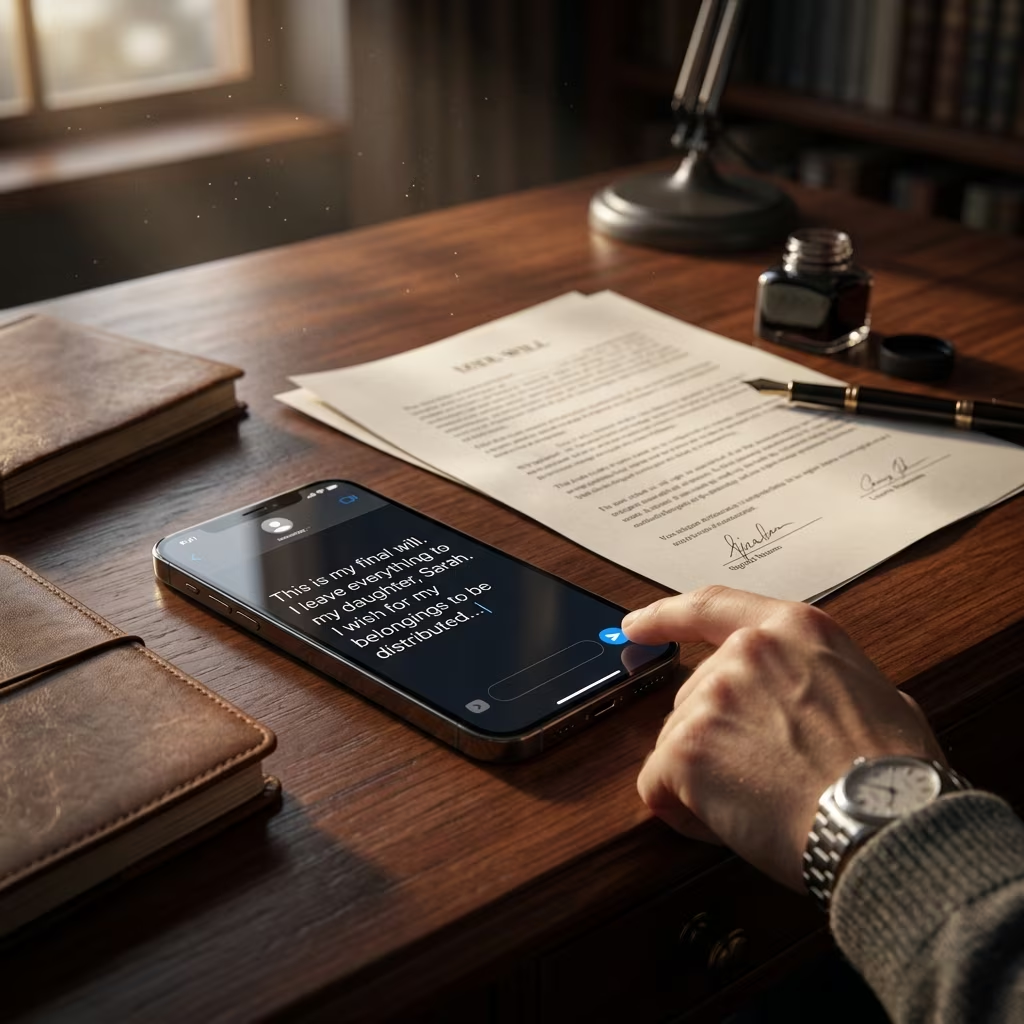
In a world where people share their most personal thoughts by phone, it is unsurprising that final wishes sometimes end up in text messages rather than on paper. A striking example emerged from Queensland, Australia, where a court accepted an unsent text message found on a deceased man’s phone as his valid last will and testament. That decision captured global attention, raising a crucial question: can an informal, electronic note really determine who receives your property after you die?
This article explains how courts approach informal or electronic wills, why an unsent text was accepted as a will in one Australian case, and why most people should still rely on conventional estate planning instead of casual digital messages.
Why the Unsent Text Case Matters
The Queensland decision, often discussed in relation to the case Re Nichol; Nichol v Nichol, is notable because the document the court treated as a will was:
- Typed as a text message on a mobile phone.
- Never sent to the intended recipient.
- Not witnessed in any traditional way.
- Discovered only after the man’s death on his phone.
Despite these features, the court concluded that the text message expressed the deceased’s final testamentary wishes and should be admitted to probate as his will. That outcome shows how flexible some succession laws can be when trying to honour a person’s genuine intentions, even where formal requirements are not met.
Traditional Requirements for a Valid Will
Most jurisdictions still rely on clear formal rules for wills to minimize disputes and fraud. While details vary, typical requirements include:
- The will must be in writing.
- The person making the will (the testator) must have testamentary capacity, meaning they understand the nature of the document and its consequences.
- The will must be signed by the testator at the end.
- The signing must occur in the presence of two witnesses, who also sign in the testator’s presence.
Some places also recognize special forms of wills, such as handwritten holograph wills, but even these have specific requirements, like being entirely in the testator’s handwriting and signed.
Informal and Electronic Wills: A Growing Legal Challenge
As communication moves into digital formats, courts increasingly face texts, emails, notes apps, and even social media posts that appear to express final wishes. Legal systems have responded in different ways:
- Some Australian jurisdictions, including Queensland and Victoria, give courts power to validate a document as a will even if it does not meet formal requirements, provided certain tests are met.
- Other jurisdictions, such as Florida, continue to insist on strict compliance with formal execution requirements and will not accept an unsent text as a will.
- Many regions are experimenting with specific rules on electronic wills, but acceptance varies widely and is often limited.
The core tension is between respecting genuine intent and maintaining reliable procedures that reduce the risk of fraud, mistake, or coercion.
How Queensland Law Allowed an Unsent Text to Be a Will
Queensland’s Succession Act 1981 contains a provision (section 18) that allows a court to dispense with the usual formalities under certain conditions. Instead of insisting on strict adherence to signing and witnessing rules, the court can declare that a document is a valid will if it is satisfied that:
- There is a document—which can include electronic records.
- The document contains the testamentary intentions of the deceased.
- The deceased intended the document to operate as his or her will.
These three questions formed the basis for the decision to accept the unsent text. The court examined not just the content of the message but also the circumstances in which it was created.
Key Factors the Court Considered
In concluding that the unsent text was a valid will, the judge looked at several specific factors:
- The text was drafted when the man was clearly contemplating his own death.
- His phone, containing the unsent text, was found with him after he died.
- The message dealt in detail with how his assets should be divided among particular individuals.
- The text used language such as “my will” that signaled he was expressing formal instructions about his estate.
- There was no evidence of any later, conflicting testamentary intentions.
Although the message was never sent, the court accepted an explanation for that: the deceased likely did not want to alert the recipient to the fact that he was about to end his life, rather than intending to abandon the will-like instructions.
Comparing Jurisdictions: Why Some Courts Say “No”
| Jurisdiction | Approach to Unsent Text Wills | Key Legal Reference |
|---|---|---|
| Queensland (Australia) | May accept unsent texts as valid wills if court is satisfied they embody testamentary intent and were meant to operate as a will. | Succession Act 1981 (Qld), s.18 |
| Victoria (Australia) | Similar power to recognize informal wills, including electronic documents, under strict tests of intention. | Wills Act 1997 (Vic), s.9 |
| Florida (USA) | Requires formal execution; unsent text messages cannot qualify as valid wills. | Florida Statutes § 732.502 |
| Alberta (Canada) | Recognizes formal wills and holograph wills; text messages are generally not accepted as wills, though informal documents may be considered in rare cases. | Wills and Succession legislation (Alberta) |
This comparison demonstrates that the outcome in Queensland is far from universal. In places like Florida, an unsent text cannot satisfy statutory requirements for a valid will, and courts treat such messages as legally ineffective regardless of apparent intent.
Risks of Relying on Unsent Texts or Informal Messages
Although the Queensland case showcases a flexible, intent-based approach, relying on casual messages to manage your estate is highly risky. Some major concerns include:
- Uncertainty: It may be unclear whether the message was a draft, a spontaneous thought, or a final decision.
- Disputes among family members: Informal documents often trigger litigation, as relatives argue over whether the text should count as a will.
- Variation across jurisdictions: A message that might be recognized in one region will be invalid in another, especially where strict formal rules apply.
- Evidentiary problems: Screenshots or device records can be challenged, and digital evidence may be incomplete or manipulated.
- No professional guidance: Informal texts rarely address tax implications, guardianship, business interests, or other complex issues that lawyers ordinarily manage.
Even where courts have powers to validate informal wills, litigation is often expensive, slow, and emotionally taxing for surviving relatives.
What Courts Look For in Informal Digital Wills
In jurisdictions that do allow courts to accept informal documents, judges typically focus on surrounding circumstances rather than the document alone.
Common Considerations
- Timing: Was the document created when the person was contemplating illness, death, or a significant risk?
- Content: Does the message clearly describe beneficiaries and how specific assets should be distributed?
- Language: Does the text use phrases like “my will” or other wording that signals a formal intention rather than a casual remark?
- Consistency: Is the message consistent with earlier statements or documents, or does it conflict with a formal will?
- Device context: Was the document stored in a way suggesting importance, such as saved drafts or a note labeled with will-related terms?
Courts also consider whether there is a plausible reason the text remained unsent, such as the desire not to alarm the recipient, rather than evidence that the person changed their mind.
Practical Advice for Individuals
Most people should avoid relying on texts or notes as their primary estate planning strategy. Practical steps include:
- Prepare a formal will with a qualified lawyer who understands local succession rules.
- Consider electronic will options only if your jurisdiction specifically recognizes them and provides clear procedures.
- Update your will regularly after major life events such as marriage, divorce, births, or significant asset changes.
- Communicate clearly with family about the existence and location of your formal will, rather than relying on ambiguous digital messages.
- Avoid casual estate promises in texts or emails that may cause confusion or conflict later.
Even in regions that allow courts to validate informal wills, relying on judicial discretion instead of following simple formal steps is generally a poor strategy.
Guidance for Lawyers and Advisors
Legal practitioners can use the unsent text case as a teaching tool and a cautionary tale.
- Educate clients about the dangers of informal wills and the importance of proper execution.
- Explain jurisdictional differences so clients understand that digital communications may not be treated the same way if they move or hold assets in multiple regions.
- Collect comprehensive evidence when disputes arise, including metadata from digital devices, witness testimony, and earlier documents.
- Use the flexibility of informal will provisions cautiously, focusing on cases where clear intent would otherwise be defeated by technical defects.
The unsent text case underscores how courts balance strict rules with fairness, but it does not replace the need for disciplined estate planning.
Frequently Asked Questions
Can an unsent text message be a valid will everywhere?
No. In some places, such as Queensland and certain other Australian jurisdictions, courts have legal power to recognize informal documents, including unsent texts, as wills under strict intention-based tests. In other jurisdictions, such as Florida, unsent texts cannot meet statutory requirements and are invalid as a matter of law.
Does using the words “my will” in a text automatically make it a will?
Using phrases like “my will” can be strong evidence of testamentary intent, but it is not decisive on its own. Courts still examine the circumstances, content, and whether the person intended the specific document to operate as their final will.
What happens if there is a formal will and a later text message?
Courts generally look at which document represents the most recent, valid expression of the testator’s wishes under local law. A formal will properly executed will usually carry substantial weight, and an informal text may or may not be able to override it depending on the jurisdiction and evidence of intention.
Can emails, notes apps or social media posts be treated like the unsent text?
Potentially, in jurisdictions that recognize informal wills. Courts have considered a range of electronic records as possible testamentary documents, but only when they clearly show intent and satisfy statutory tests. In stricter jurisdictions, these will still fail if they do not meet formal execution requirements.
Should I rely on texts or notes instead of writing a formal will?
No. Even in regions with flexible rules, informal digital communications are a last resort and often lead to disputes. Writing a formal will that complies with local law and is prepared with professional advice is the safest and most reliable approach.
References
- AUSTRALIAN COURT HOLDS THAT UNSENT TEXT MESSAGE CAN ACT AS VALID WILL — HSF Kramer Notes. 2017-11-01. https://www.hsfkramer.com/notes/pwtd/2017-11/australian-court-holds-that-unsent-text-message-can-act-as-valid-will
- How an unsent text message became a Will — Mullins Lawyers. 2017-10-20. https://www.mullinslawyers.com.au/resources/how-an-unsent-text-message-became-a-will/
- Is an unsent text message a valid Will? — Hall & Wilcox. 2017-10-13. https://hallandwilcox.com.au/news/is-an-unsent-text-message-a-valid-will/
- Can a text message be a valid will in Florida? — Richert Quarles. 2018-03-01. https://richertquarles.com/probate-litigation/can-text-message-valid-will-florida/
- Can A Text Message Count As A Will? Pitfalls In Estate Planning — Solution Law. 2023-04-10. https://www.solutionlaw.ca/can-a-text-message-count-as-a-will-modern-pitfalls-in-estate-planning/
- Can an unsent text message be a valid will? Which case won? — Stacks Law Firm. 2019-08-15. https://stacklaw.com.au/wcw/can-an-unsent-text-message-be-a-valid-will-which-case-won