
Undefined Presidential Pardons: 4 Key Clemency Powers Explained
A clear guide to how presidential pardons work, their limits, and why they matter.
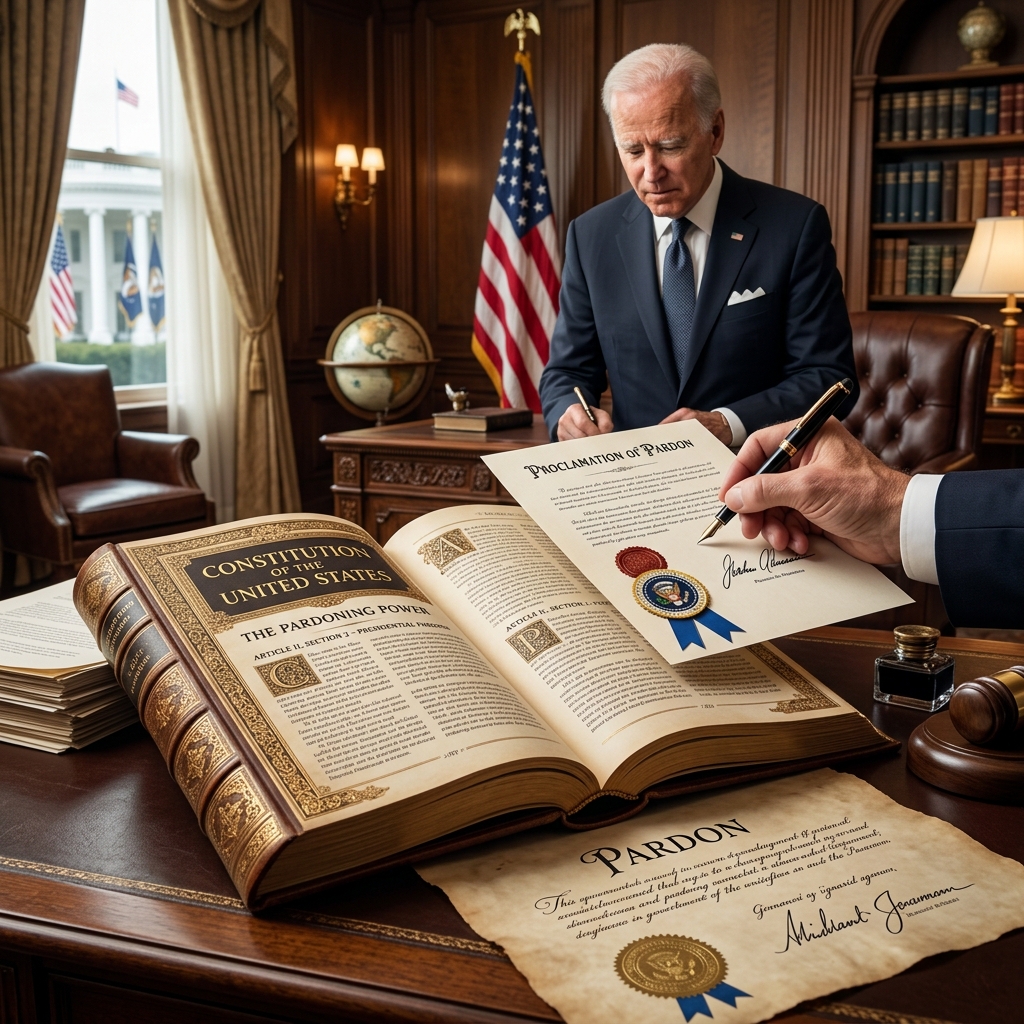
What a Presidential Pardon Really Does
A presidential pardon is one of the most significant powers in the U.S. Constitution. It allows a president to forgive a federal offense and remove some of the legal consequences that follow a conviction. Although the term is often used loosely in public debate, a pardon has a specific legal effect and is only available in federal matters.
Because the power sits inside Article II of the Constitution, it is part of the president’s core authority rather than a power created by Congress. That makes clemency a constitutional tool with deep historical roots and continuing political importance.
Where the Power Comes From
The Constitution gives the president power to “grant Reprieves and Pardons for Offenses against the United States, except in Cases of Impeachment.” Scholars and historians trace this authority back to English legal tradition, where rulers could forgive offenses as an act of mercy or public policy.
The framers did not treat the power as symbolic. They understood it as a practical mechanism that could ease harsh punishments, resolve exceptional cases, and sometimes serve the public good after crises or conflicts. The Supreme Court has also described the power as broad, or “plenary,” meaning it is not easily narrowed by Congress.
The Main Forms of Clemency
Presidential clemency is not limited to a single action. It includes several different forms of relief, each with a different legal effect.
| Type of clemency | What it does | Typical effect |
|---|---|---|
| Pardon | Forgives the offense | Removes punishment and may restore civil rights |
| Commutation | Reduces a sentence | Shortens prison time or lowers the punishment |
| Reprieve | Delays punishment | Postpones a sentence or execution |
| Amnesty | Extends forgiveness to a group | Covers a class of people rather than one individual |
A pardon is the best-known form of clemency, but commutations and reprieves are just as important in practice. A commutation does not erase the conviction; it only reduces the punishment. A reprieve is temporary and usually delays the carrying out of a sentence.
Who Can Receive a Pardon
The president may pardon people for federal offenses, not state crimes. That distinction matters because the United States has two separate criminal justice systems: federal and state. A president cannot forgive a state conviction, even if the case has received national attention.
The Constitution also says pardons cannot be used in cases of impeachment. That means the president cannot wipe away the political judgment of Congress if a federal official has been impeached. The impeachment clause creates a constitutional boundary even though the pardon power is otherwise very broad.
Another important point is timing. The Supreme Court has long recognized that a pardon may be granted after the offense is committed but before formal charges, during proceedings, or after conviction and judgment. In other words, a pardon is not limited to people who have already been sentenced.
Why Presidents Use Clemency
Presidents have used pardons and other forms of clemency for a wide range of reasons. Some acts are intended to correct individual hardship, while others are meant to address broader national concerns. Historical examples show that clemency has been used after wartime conflict, during moments of national healing, and to reward cooperation or remorse.
Executive clemency can also serve a systemic role. It can soften punishments that later appear excessive, account for rehabilitation, or recognize changed circumstances that the courts cannot easily revisit. In that sense, the pardon power functions as a safety valve inside the criminal justice system.
How Broad Is the Power?
The pardon power is unusually strong compared with many other presidential powers. Courts have repeatedly treated it as a constitutional authority that cannot be tightly controlled by ordinary legislation. Once a case involves a federal offense and is not an impeachment matter, the Constitution leaves the final decision to the president.
That breadth is why pardons can be controversial. Critics may see a pardon as overly generous, politically motivated, or unfair to victims and prosecutors. Supporters, by contrast, view it as a necessary remedy for exceptional cases where the normal legal process cannot provide enough flexibility.
Historic Uses That Shaped Public Debate
Presidents have used pardons in landmark ways throughout American history. George Washington’s pardon authority was exercised early in the Republic, and later presidents used clemency in moments tied to war, unrest, or political transition. The power became especially famous when President Gerald Ford pardoned Richard Nixon after the Watergate scandal, an act that remains one of the most debated decisions in presidential history.
Recent presidents have also used clemency in large numbers. Public reporting based on Justice Department data shows that President Biden granted more acts of clemency than any prior president on record, which illustrates how active the power can become in modern administrations. Those figures do not, by themselves, explain each decision, but they show that clemency remains a live presidential tool rather than a rarely used relic.
What a Pardon Does Not Do
A pardon is powerful, but it is not unlimited. It does not erase the past or rewrite the facts of a case. In most settings, the conviction still happened; the pardon simply forgives the offense and removes or eases legal consequences.
A pardon also does not reach state prosecutions, private lawsuits, or impeachment proceedings. It is therefore not a universal shield against every kind of accountability. For that reason, a person who receives federal clemency may still face other legal, financial, or reputational consequences depending on the circumstances.
Why the Constitution Leaves So Much Discretion to One Person
The framers gave this authority to the president rather than Congress because they wanted speed, consistency, and a single decision-maker capable of acting in extraordinary situations. The power was seen as useful when the law produced outcomes that were technically correct but politically unstable or morally harsh.
That design reflects a deliberate tradeoff. A broad pardon power can correct injustice and promote mercy, but it can also create concern about favoritism or abuse. The Constitution answers that risk only in limited ways, mainly through the impeachment exception and through the political accountability of the president himself.
Key Takeaways for Readers
- Pardons apply only to federal offenses.
- The president cannot pardon impeachment cases.
- Clemency includes pardons, commutations, reprieves, and amnesty.
- A pardon may be issued before or after conviction.
- The power is broad and largely immune from congressional restriction.
Common Questions About Presidential Pardons
Can a president pardon someone before trial?
Yes. Supreme Court precedent has recognized that clemency may be granted after a federal offense is committed, even before charges are filed or a sentence is imposed. That is why the power is often called “preemptive” in public discussion.
Does a pardon erase a conviction?
Not exactly. A pardon forgives the offense and can remove many legal consequences, but it does not change the historical fact that the conviction occurred. The practical effect depends on the legal context.
Can Congress limit the president’s pardon power?
Not in any ordinary way. The Supreme Court has treated the pardon power as constitutionally broad, and decisions such as Ex parte Garland and United States v. Klein are commonly cited for the idea that Congress cannot narrow it by statute.
Can a president pardon state crimes?
No. The presidential pardon power applies to offenses against the United States, which means federal offenses only. State offenses are handled under state law and state executive clemency systems.
Why the Topic Still Matters Today
Presidential pardons continue to draw attention because they sit at the intersection of law, politics, mercy, and public trust. Each major clemency decision raises the same basic questions: Was the punishment too severe? Was the process fair? Is forgiveness being used responsibly?
Those questions are likely to remain part of American public life because the Constitution gives the president a power that is both flexible and difficult to supervise. That combination makes clemency unique: it is at once a legal remedy, a political act, and a symbol of executive mercy.
References
- The History of the Pardon Power — White House Historical Association. 2024. https://www.whitehousehistory.org/the-history-of-the-pardon-power
- Executive clemency and presidential pardons — Ballotpedia. 2026. https://ballotpedia.org/Executive_clemency_and_presidential_pardons
- ArtII.S2.C1.3.2 Historical Background on Pardon Power — Congress.gov. 2026. https://constitution.congress.gov/browse/essay/artII-S2-C1-3-2/ALDE_00013317/
- Biden granted more acts of clemency than any prior president — Pew Research Center. 2025-02-07. https://www.pewresearch.org/short-reads/2025/02/07/biden-granted-more-acts-of-clemency-than-any-prior-president/
- The pardon power and original intent — Brookings Institution. 2017. https://www.brookings.edu/articles/the-pardon-power-and-original-intent/
- Clemency Statistics — U.S. Department of Justice, Office of the Pardon Attorney. 2026. https://www.justice.gov/pardon/clemency-statistics
Similar Articles








Read full bio of Sneha Tete




