
How Interest Rates Shape Your Debt Burden
Understand how changing interest rates transform your monthly payments, total borrowing costs, and long‑term financial health.
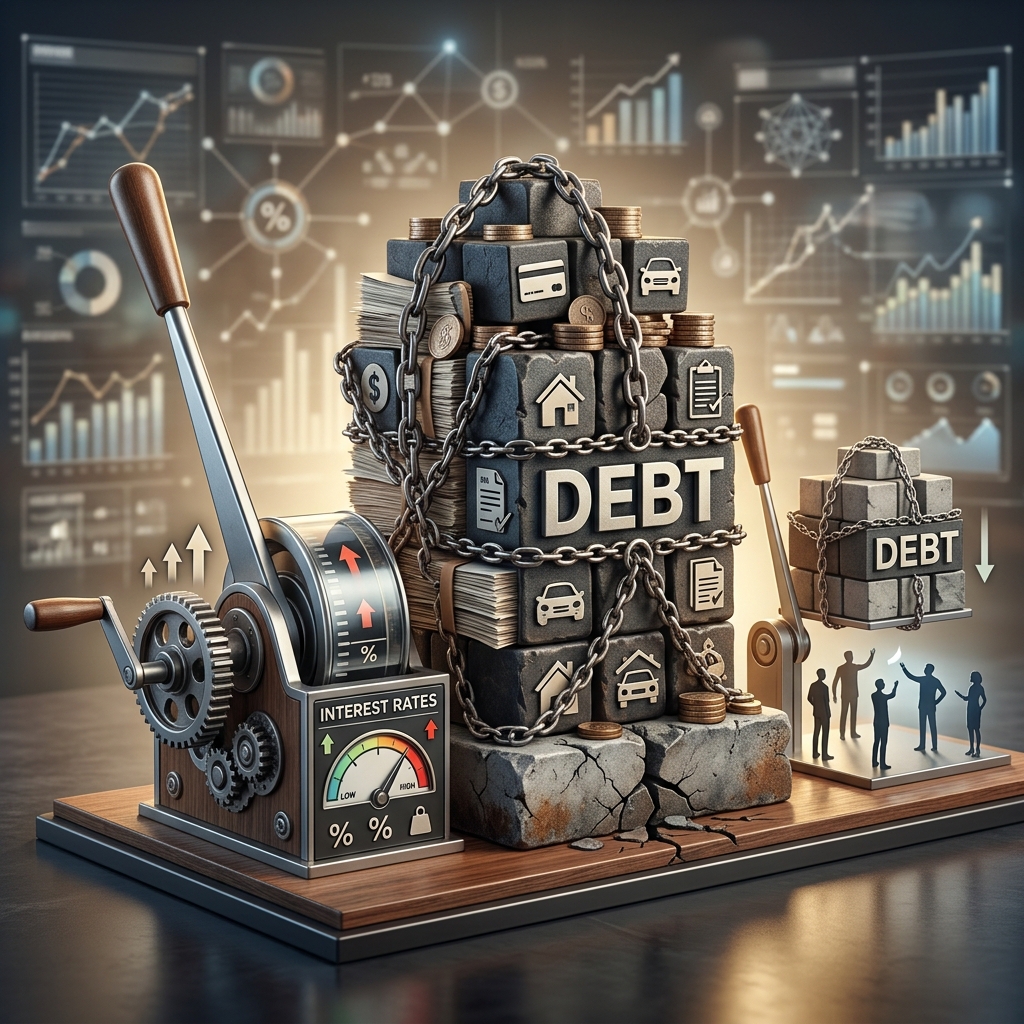
Interest rates sit at the center of almost every borrowing decision you make. They determine how much your debt costs, how fast balances grow, and how long it takes to become debt-free. Understanding how rates work can help you decide when to borrow, which type of loan to choose, and how aggressively to pay down what you owe.
What Interest Rates Really Mean for Your Debt
In personal finance, interest is the price you pay to use someone else’s money. The interest rate is the percentage that tells you how much that borrowing will cost per year, expressed as a portion of the amount you owe.
For consumers, interest rates affect debt in two main ways:
- Monthly payment size — Higher rates mean larger payments on new or variable-rate debts.
- Total cost of borrowing — Over time, even small changes in rates can significantly increase how much interest you pay over the life of a loan.
Rates also influence how much lenders are willing to let you borrow, since higher payments raise your debt-to-income ratio and may reduce your approved loan amount.
Key Types of Interest Rates You’ll Encounter
Not all interest rates behave the same way. The type of rate linked to your debt determines how quickly your costs can change.
Fixed vs. Variable Rates
| Rate Type | How It Works | Main Impact on Debt |
|---|---|---|
| Fixed interest rate | Stays the same for the entire loan term. | Predictable payments; rate hikes in the broader economy do not change your monthly obligation. |
| Variable interest rate | Moves up or down based on a benchmark rate such as the prime rate or a central bank policy rate. | Payments can rise quickly when market rates increase, making your debt more expensive. |
Simple vs. Compound Interest
Interest can also be calculated in different ways, which affects how fast your debt grows:
- Simple interest — Calculated only on the original principal you borrowed.
- Compound interest — Calculated on your principal plus previously added interest, so debt can grow faster if you carry a balance.
Most credit cards and many lines of credit use compound interest, which is why leaving balances unpaid can cause them to balloon over time.
How Rate Changes Affect Different Kinds of Debt
When benchmark rates rise or fall, different debts respond in different ways. Recognizing which accounts are most sensitive helps you choose where to focus your repayment efforts.
Credit Cards and Other Revolving Balances
Credit cards, store cards, and many personal lines of credit usually carry variable rates. They often move with the prime rate, which itself responds to changes in the central bank’s policy rate.
- When rates rise: Your card’s annual percentage rate (APR) can increase, raising the interest portion of each payment and making it harder to reduce your balance.
- When rates fall: You may pay less interest per month, and more of your payment will go toward principal reduction.
Because revolving debt tends to have higher rates than other borrowing options, it is often the most expensive place to carry long-term balances.
Installment Loans: Auto, Personal, and Student Loans
Installment loans require you to make regular payments over a set term. They can be fixed-rate or variable-rate products.
- Fixed-rate auto or personal loans: Your monthly payment and total interest cost are locked in when you sign the contract, regardless of later rate movements.
- Variable-rate loans: Payments can adjust with the underlying benchmark rate, causing your cost to rise or fall over time.
Secured loans, such as those backed by a vehicle, may experience smaller rate swings than unsecured personal loans because the collateral lowers risk for the lender.
Mortgages, Home Equity Loans, and HELOCs
Home-related borrowing is especially sensitive to rate changes because the amounts involved are large and the terms are long.
- Fixed-rate mortgages offer stability, shielding you from future rate hikes.
- Adjustable-rate mortgages and home equity lines of credit (HELOCs) usually track benchmark rates closely, so payment amounts can change as broader interest rates move.
Even a one-percentage-point increase in mortgage rates can noticeably raise monthly payments and total interest costs on a typical home loan.
The Bigger Picture: Interest Rates, Debt and the Economy
Interest rates are not set in isolation. They reflect broader economic conditions and policy decisions that influence both households and governments.
Central Banks, Policy Rates and Your Debt
Most countries have a central bank that sets a key short-term interest rate, often called the policy rate or overnight rate. This rate influences the cost of borrowing for commercial banks, which in turn affects the rates they offer on loans, mortgages, and credit cards.
- When policy rates increase, borrowing becomes more expensive, and households feel this through higher payments on variable-rate debt.
- When policy rates decrease, borrowing is cheaper, which can support spending and refinancing activity.
Official projections and assessments show that large and persistent increases in public-sector debt tend to put upward pressure on long-term interest rates, which can raise borrowing costs across the economy.
Debt Service Burden and Household Spending
Interest rate changes alter the debt service burden — the share of your income used to pay interest and principal on existing loans. When variable rates rise, indebted households have less cash available for everyday spending.
Research on household finances finds that rate hikes typically reduce cash-on-hand and lower consumption, while rate cuts encourage increased spending and borrowing, often supported by rising asset prices like home values.
High Interest Rates and the Hidden Cost of Carrying Debt
High interest rates make all forms of borrowing more expensive, but their impact is most acute for debts that compound and for balances that are not paid down quickly.
Why High-Rate Debt Grows So Fast
A high interest rate magnifies the total cost of your debt. Combined with compound interest, it can cause balances to grow even when you are making only minimum required payments.
- Making only minimum payments on credit cards may barely reduce the principal and could allow interest charges to keep your balance near its original level or even higher over time.
- New purchases added to existing high-rate balances can accelerate growth, because each transaction adds to the principal being compounded.
Signals that Interest Costs Are Becoming Risky
You may be facing an unsustainable interest burden if:
- A significant portion of your monthly income goes toward interest rather than reducing principal.
- Your balances remain similar month after month despite regular payments.
- Rate increases cause you to miss payments or rely on new debt to cover old obligations.
Smart Strategies to Manage Debt in a Changing Rate Environment
Even if you cannot control market interest rates, you can manage how they affect your personal debt through deliberate decisions and repayment strategies.
Prioritize High-Rate Balances
One effective approach is to target your most expensive debts first.
- Debt avalanche method: Rank your debts by interest rate and focus extra payments on the highest-rate account while paying at least the minimum on all others.
- Once the top-rate debt is paid off, apply the freed-up payment amount to the next highest-rate debt, and repeat the process.
This method can reduce total interest paid over time and help you become debt-free more efficiently.
Pay More Than the Minimum
Where possible, paying more than the minimum required amount is one of the simplest ways to limit interest costs.
- Extra payments lower your principal faster, which reduces future interest charges.
- Even modest additional amounts each month can significantly shorten the time needed to fully repay a balance.
Use Consolidation Carefully
Debt consolidation allows you to combine multiple high-rate debts into a single new loan, ideally with a lower interest rate and clearer payoff schedule.
- Consolidation can simplify repayment and decrease overall interest if the new rate is substantially lower and fees are reasonable.
- However, extending the repayment term can sometimes increase total interest costs even at a lower rate, so it is important to compare scenarios before committing.
Refinancing When Rates Fall
When market interest rates decline, refinancing existing loans can reduce your monthly payments or shorten your repayment horizon.
- Homeowners may refinance mortgages to secure lower fixed rates, lowering long-term interest costs.
- Borrowers with variable-rate loans could switch to fixed-rate products for stability if they expect rates to rise in the future.
Strengthen Your Borrowing Profile
Lenders set rates partly based on the perceived risk that a borrower might not repay. Improving your financial profile can help you qualify for better rates.
- Maintain a strong payment history and avoid late payments.
- Keep your overall debt levels reasonable compared with your income.
- Monitor your credit reports to ensure information is accurate and up to date.
Higher credit quality often translates into lower interest rates on new borrowing, which reduces your future debt burden.
Balancing Borrowing and Saving When Rates Move
Interest rate changes do not only affect your debt; they also influence how much you earn on savings and investments.
- When rates are high, the cost of borrowing increases, but interest-bearing savings accounts and fixed-income investments may offer better returns.
- When rates are low, borrowing is cheaper, yet returns on cash savings decline, which may encourage more borrowing and investment in other asset classes.
Balancing these effects can help you decide whether to prioritize paying down debt or increasing savings at different points in the interest rate cycle.
Frequently Asked Questions About Interest Rates and Debt
Do higher interest rates always mean I should avoid new debt?
Not necessarily. Higher rates do make borrowing more expensive, so discretionary or non-essential debt may be less attractive. However, some borrowing — such as a reasonably priced mortgage or education loan — may still be worthwhile if the long-term benefits exceed the added interest cost. The key is to understand the rate, term, total cost, and your ability to repay without strain.
How quickly will my credit card rate change when the central bank raises rates?
Many credit cards adjust their rates relatively soon after central bank policy rate changes cascade into higher prime rates. The timing depends on your card issuer’s policies and how frequently they review and adjust APRs, but variable-rate cards usually respond within one or a few billing cycles.
Is it better to choose a fixed-rate or variable-rate loan?
Fixed-rate loans provide payment stability, which can be helpful if you prefer predictable budgeting or expect interest rates to rise. Variable-rate loans may offer lower initial rates, but payments can increase if benchmark rates go up. The right choice depends on your risk tolerance, financial flexibility, and expectations about future rate movements.
Can lowering my debt really protect me from rate hikes?
Reducing your overall debt, especially on variable-rate accounts, helps limit how much your payments and interest costs can rise when rates increase. Smaller balances mean lower interest charges at any given rate, so aggressive repayment is one of the most reliable ways to reduce vulnerability to future rate changes.
Do interest rates affect my investments as much as my debt?
Yes. Interest rates influence both borrowing costs and investment returns. Rising rates often reduce bond prices and can pressure stock markets, while improving yields on savings accounts and short-term fixed-income investments. Understanding this connection can help you adjust both your debt strategy and your investment mix when rates move.
References
- Interest Rates and How They Impact Your Finances — Canadian Investment Regulatory Organization (CIRO). 2023-05-10. https://www.ciro.ca/office-investor/investing-basics/interest-rates-and-how-they-impact-your-finances
- Interest Rates: Types and What They Mean to Borrowers — Investopedia. 2024-01-15. https://www.investopedia.com/terms/i/interestrate.asp
- How Interest Rate Changes Affect Debt — Bankrate. 2023-08-02. https://www.bankrate.com/loans/personal-loans/how-interest-rates-affect-debt/
- How Interest Rate Changes Affect Loans and Savings — Ion Bank. 2023-07-20. https://ionbank.com/blog/financial/how-interest-rate-changes-affect-loans-and-savings/
- How Interest Rates Affect Investments — U.S. Bank. 2023-09-12. https://www.usbank.com/investing/financial-perspectives/investing-insights/how-interest-rates-affect-investments.html
- How to Manage and Pay Off High-Interest Debt — Equifax. 2023-04-05. https://www.equifax.com/personal/education/debt-management/articles/-/learn/manage-high-interest-rate/
- How Interest Rates Affect Spending: Household Debt and the Role of Asset Prices — Centre for Economic Policy Research (CEPR). 2024-02-19. https://cepr.org/voxeu/columns/how-interest-rates-affect-spending-household-debt-and-role-asset-prices
Similar Articles








Read full bio of Sneha Tete




