
Understanding the Missouri Divorce Process
A practical, plain‑language guide to the steps, rules, and decisions involved in getting a divorce in Missouri from start to finish.
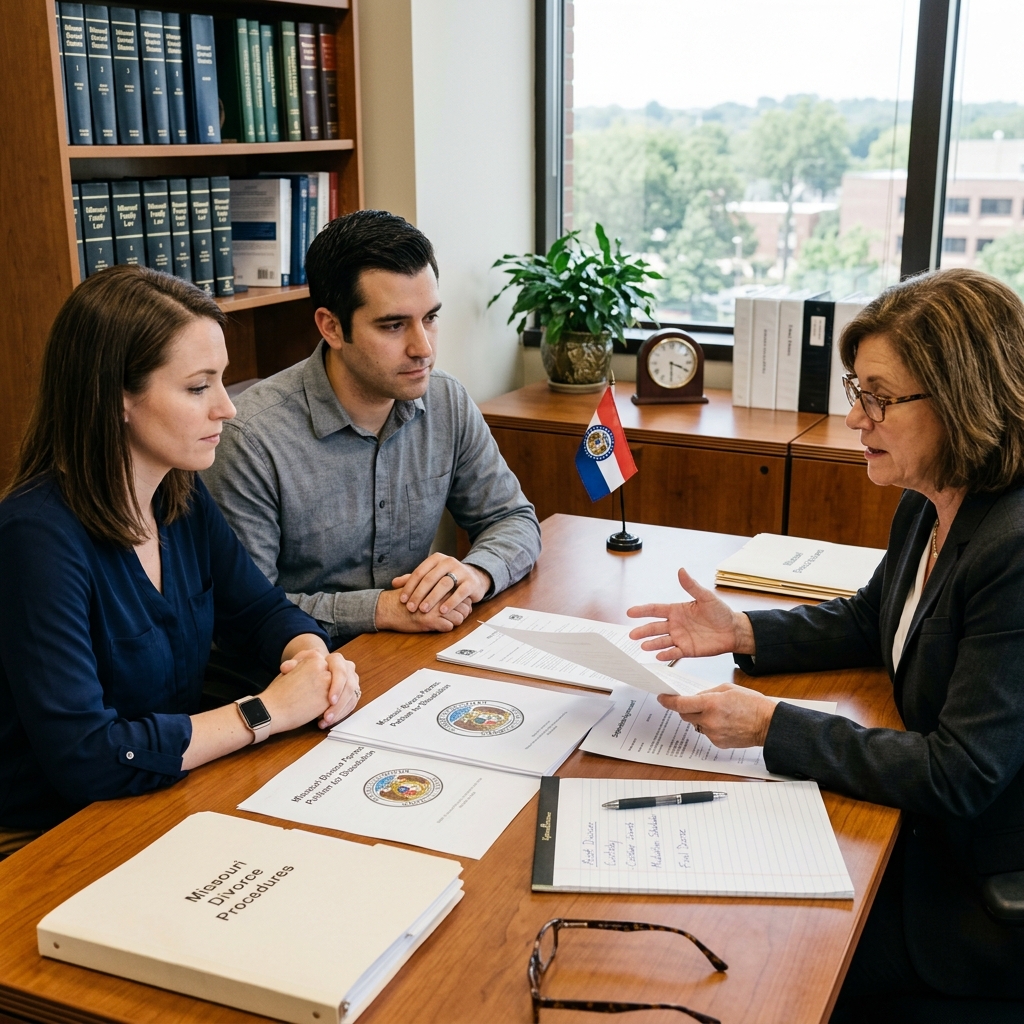
Ending a marriage is never just an emotional decision; it is also a legal process with specific rules and timelines. In Missouri, divorce is formally called a dissolution of marriage, and it follows a structured path from filing your petition to receiving a final judgment from a judge. This guide walks you through that path in clear, practical terms.
Big Picture: How Divorce Works in Missouri
Before you focus on forms or court dates, it helps to understand a few core principles that shape every divorce in Missouri:
- No-fault system: You generally do not need to prove your spouse did anything wrong. It is enough to state that the marriage is irretrievably broken, meaning there is no reasonable chance it can be saved.
- Judge, not jury: Divorce cases in Missouri are decided by a judge. There is no right to a jury trial in a dissolution of marriage case.
- Residency requirement: At least one spouse must have lived in Missouri (or been stationed here as military) for at least 90 days before filing.
- Minimum waiting period: You cannot be legally divorced until at least 30 days after filing your petition with the court.
- Contested vs. uncontested: Your case will move faster and cost less if you and your spouse agree on all major issues. Disagreements typically lead to a contested case with more hearings and a longer timeline.
Key Legal Requirements Before You File
Missouri law sets out basic eligibility rules you must satisfy before the court can grant a divorce.
Residency and Where to File
To start a divorce in Missouri, one of the following must be true:
- Either spouse has lived in Missouri for at least 90 days immediately before filing, or
- A spouse is a military member stationed in Missouri for at least 90 days before filing.
You generally file your case in the circuit court for the county where you, the filing spouse (the “petitioner”), live. The court’s clerk accepts your paperwork and opens the case.
No-Fault Grounds: “Irretrievably Broken”
Missouri is a no-fault divorce state. The standard basis for divorce is that the marriage is “irretrievably broken” and there is no reasonable likelihood it can be preserved.
In practice, this means:
- You do not need to prove adultery, abuse, abandonment, or other specific wrongdoing.
- One spouse can move forward even if the other disagrees that the relationship is over, although the court may require additional findings if the other spouse contests this point.
The Mandatory Waiting Period
Missouri law requires that at least 30 days elapse after filing before the court can enter a final judgment of dissolution. In most cases, this period functions as both:
- a “cooling-off” time for the parties, and
- time for the other spouse to respond and for attorneys to negotiate terms.
Step-by-Step: From Filing to Final Judgment
Although every case is unique, most Missouri divorces follow a common sequence of steps.
Step 1: Preparing Your Documents
Divorce starts with paperwork. Missouri courts provide standardized family law forms, though many people work with an attorney to complete them accurately. Typical documents include:
- Petition for Dissolution of Marriage (the main document that opens the case)
- Income and Expense Statement detailing your earnings and monthly costs
- Statement of Property and Debt listing what you own and what you owe
- Parenting Plan (required if you have minor children)
- Filing Information Sheet and related cover sheets used by the court
- Proposed Judgment of Dissolution of Marriage, which the judge may sign if acceptable
Gathering financial records early—such as tax returns, bank statements, retirement account statements, mortgage documents, and credit card bills—will help you complete these forms accurately.
Step 2: Filing the Petition
Once you complete the forms, you file them with the circuit court clerk and pay a filing fee (fee amounts vary by county). At this point:
- You become the petitioner.
- Your spouse is the respondent.
- The court assigns a case number and officially opens your divorce case.
Step 3: Serving Your Spouse
After filing, you must give your spouse official notice of the case—this is called service of process. Common options include:
- Service by a sheriff or other authorized process server
- Service by certified mail in some circumstances
- Your spouse signing an Entry of Appearance and Waiver of Service, voluntarily acknowledging receipt of the documents (common in uncontested cases)
Once served, the respondent usually has about 30 days to file a written answer or response to your petition.
Step 4: Response and Case Type
How your spouse responds largely determines what path your case will follow:
| Situation | Type of Case | What Usually Happens Next |
|---|---|---|
| Spouses agree on all major issues and cooperate on paperwork | Uncontested divorce | File a written settlement; brief hearing or none; divorce often completed close to the minimum waiting period. |
| Spouses disagree on one or more issues (property, custody, support, etc.) | Contested divorce | Negotiations, possible mediation, discovery, and one or more court hearings or a trial. |
| Respondent does not respond by the deadline | Potential default case | Petitioner may ask the court to proceed without the respondent’s active participation (subject to court approval). |
Step 5: Sorting Out the Major Issues
Every divorce must address several core topics, which the judge will review whether you agree or not. The key areas are:
- Division of property and debts (who gets what, and who pays what)
- Child custody and parenting time (if you have minor children)
- Child support
- Spousal maintenance (alimony), in some cases
Spouses who reach a comprehensive settlement on these topics usually record it in a written agreement and/or proposed judgment for the judge to review.
Step 6: The Court Hearing and Final Judgment
After the minimum 30‑day waiting period, and after your paperwork is in order, the court schedules a hearing or reviews your documents. Depending on the complexity of your case:
- In an uncontested case, you may only attend a brief hearing where the judge asks basic questions to confirm your understanding and agreement.
- In a contested case, the court may hold multiple hearings, and possibly a trial, where both sides can present evidence and testimony before the judge issues a decision.
Once the judge signs the Judgment of Dissolution of Marriage, your marriage is legally ended.
Uncontested vs. Contested Divorce in Missouri
Whether a divorce is contested or uncontested has a major impact on cost, time, and stress.
Uncontested Divorce
An uncontested divorce happens when you and your spouse agree on all essential issues, including property division, debt allocation, child-related matters, and any support obligations.
Typical features of an uncontested case include:
- Jointly prepared or coordinated paperwork
- A written settlement agreement and detailed parenting plan (if applicable)
- No need for extensive discovery or multiple court appearances
- A timeline often close to the 60–90 day range after filing, depending on the court’s schedule and completeness of documents
Contested Divorce
A divorce becomes contested when spouses disagree about one or more issues and cannot resolve them informally. Common points of conflict include:
- How to divide the marital home and retirement accounts
- Legal and physical custody of children
- Whether one spouse should pay maintenance (alimony), and if so, how much and for how long
Contested cases often involve:
- Formal discovery (interrogatories, document requests, depositions)
- Mediation or settlement conferences ordered by the court
- Multiple hearings over several months
- A final trial if settlement discussions fail
Because contested cases are more complex, they frequently last six months to a year or more, depending on the issues and local court backlog.
Handling Property, Debts, and Support
Missouri follows the general principle of equitable distribution, meaning the court divides marital property and debts in a way it considers fair, which may or may not be strictly 50/50.
Property and Debt Division
The court distinguishes between:
- Marital property – typically property acquired during the marriage, regardless of whose name is on the title
- Non-marital (separate) property – items owned before the marriage, gifts, or inheritances kept separate
Courts consider various factors, such as the economic circumstances of each spouse and each person’s contributions to acquiring and maintaining property. Agreements by the parties, if reasonable, are usually approved.
Child Custody and Child Support
When children are involved, the court must focus on the best interests of the child. Parenting plans typically specify:
- Legal custody (decision-making authority)
- Physical custody (where the child lives)
- Parenting time schedules, holidays, and transportation
Missouri courts also apply state child support guidelines that account for each parent’s income and the child’s needs; parents can suggest an agreed amount, but the judge must confirm that it is appropriate.
Spousal Maintenance (Alimony)
Not every divorce includes spousal maintenance. Courts may award it when one spouse needs financial support and the other has the ability to pay. Judges assess factors such as the length of the marriage, each spouse’s earning capacity, and the standard of living established during the marriage.
Timeline Expectations for a Missouri Divorce
The length of a divorce varies widely, but general patterns are:
- Uncontested divorce: Often finalized between 60 and 90 days after filing, assuming the court’s calendar allows and paperwork is complete.
- Contested divorce: Can take six months to a year or more if there are complex financial issues, disputes over custody, or heavy court dockets.
Regardless of how simple your case is, the statutory 30‑day waiting period after filing always applies.
Practical Tips for Navigating the Process
While every situation is different, these general strategies can help you move through the Missouri divorce process more smoothly:
- Stay organized: Keep a folder for all court papers, financial records, and correspondence related to your case.
- Know your deadlines: Mark response dates and hearing dates on a calendar to avoid missing important steps.
- Consider mediation: If you are stuck on specific issues, mediation can often help couples reach agreement without a full trial.
- Focus on long-term outcomes: Property division and parenting arrangements can affect your life for years; try to evaluate options with a long-term perspective, not just short-term emotions.
- Seek legal advice: Even if you plan to represent yourself, a consultation with a Missouri family law attorney can help you understand your rights and obligations under state law.
Frequently Asked Questions About Missouri Divorce
Do I really have to live in Missouri for 90 days before filing?
Yes. Missouri law requires that at least one spouse be a resident of Missouri—or a military member stationed in the state—for at least 90 days immediately before filing for divorce. If you file earlier, the court may lack jurisdiction to grant the divorce.
Is there any way to skip the 30-day waiting period?
No. The 30-day waiting period is built into Missouri law and applies to all divorce cases. Even if you agree on everything and file all paperwork promptly, the court cannot enter a final judgment before that time passes.
Do I need a lawyer to get divorced in Missouri?
The law does not require you to have a lawyer, and some people represent themselves, especially in simpler uncontested cases. However, divorce involves significant legal and financial decisions, so many people choose to consult an attorney to understand their rights and avoid costly mistakes.
What if my spouse refuses to sign anything?
Your spouse’s refusal to sign does not automatically block a divorce. If they are properly served and fail to respond, you may be able to proceed by default. If they contest the divorce, the court will schedule hearings and potentially a trial to resolve disputed issues.
Can the court change our agreements later?
Some parts of your divorce judgment—such as property division—are generally final. However, orders related to child custody, parenting time, and child support can often be modified later if there is a substantial change in circumstances, subject to Missouri law and court approval.
References
- Missouri Courts: Divorce Forms and Instructions — Supreme Court of Missouri. 2024-01-01. https://www.courts.mo.gov/page.jsp?id=10580
- Divorce in Missouri — Legal Services of Eastern Missouri. 2023-06-01. https://www.lsmo.org/page/487/divorce-missouri
- Missouri Divorce FAQ — Cordell & Cordell. 2024-03-01. https://cordellcordell.com/resources/missouri/missouri-divorce-questions/
- Missouri Divorce — WomensLaw.org. 2024-02-01. https://www.womenslaw.org/laws/mo/divorce
- Understanding Missouri’s No-Fault Divorce Process — David Shuler Law. 2025-11-01. https://www.davidshulerlaw.com/blog/2025/november/understanding-missouris-no-fault-divorce-process/
- Missouri Divorce Timeline: How Long Does It Take? — Olathe Lawyer. 2025-10-01. https://www.olathe-lawyer.com/2025/october/missouri-divorce-timeline-how-long-does-it-take/
Similar Articles








Read full bio of medha deb


