
Understanding Maryland Rental License Rules
Learn how Maryland rental licensing works, why it matters, and how tenants and landlords can check compliance in different counties and cities.
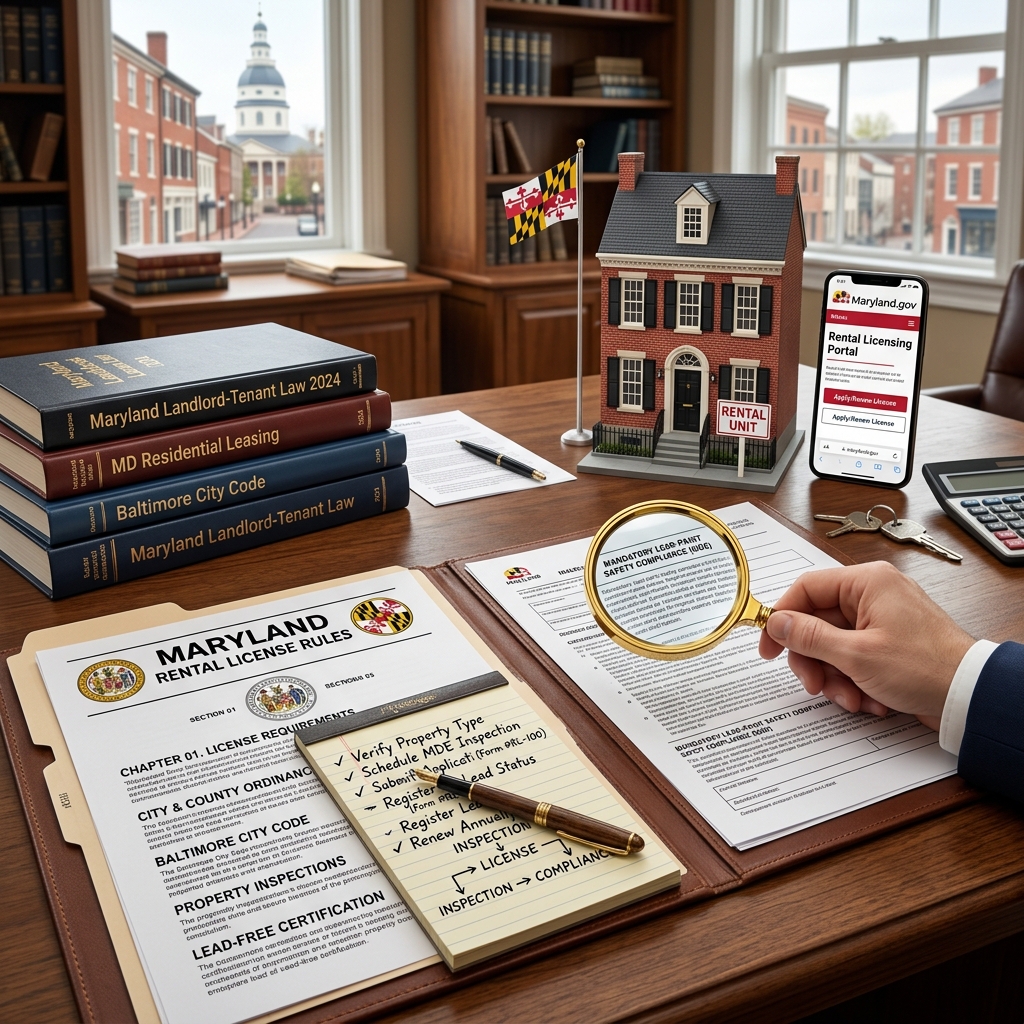
Across Maryland, many counties and municipalities require landlords to obtain a rental housing license or registration before they can legally rent out residential property or pursue tenants for unpaid rent in court. These local rules are designed to ensure safe, habitable housing and to give enforcement agencies tools to address substandard rental conditions.
This guide explains how rental licensing works in Maryland, how requirements differ by location, what licensing means for rent collection and eviction, and how both landlords and tenants can verify whether a property is properly licensed.
1. Why Rental Licenses Exist in Maryland
Rental licensing is primarily a local requirement: Maryland does not have a single statewide rental license, but many local governments regulate rental housing through licenses, registrations, or permits.
Common goals of these programs include:
- Health and safety – Ensuring that rental homes meet basic standards for structural integrity, utilities, fire protection, and sanitation.
- Habitability enforcement – Providing a mechanism to inspect properties and require repairs when serious code violations are found.
- Accountability – Identifying owners and managers responsible for rental units and establishing a point of contact for notices and court process.
- Tenant protection – In several jurisdictions, landlords lose the right to collect rent or file certain court actions if they operate without a license.
Because licensing is tied to safety and habitability, many localities require inspections, lead paint compliance, and other documentation before a license is issued.
2. Where Rental Licensing Rules Apply
Not every Maryland jurisdiction has a rental license program, but a growing number of counties and cities require registration or licensing for residential rentals. Examples include:
| Jurisdiction | Type of Requirement | Key Features |
|---|---|---|
| Baltimore City | Rental dwelling license | License required for most non-owner-occupied dwellings; unlicensed landlords cannot collect rent. |
| Baltimore County | Rental license | Licensing with inspections; consequences for renting without a license, including fines and rent disputes. |
| Howard County | Rental housing license | Detailed application with ownership, agent, and building information through Maryland OneStop. |
| Montgomery County | Rental housing license | Annual license required for apartment and multi-family properties; license must be displayed.[10] |
| Takoma Park (City) | Rental housing license | All rental housing must be licensed; includes landlord certification and lead compliance. |
| Cumberland (City) | Rental license program | Annual licensing and inspection, including units occupied by non-rent paying family members. |
Some jurisdictions license only certain types of units (for example, multi-family dwellings), while others cover nearly all non-owner-occupied rentals, including single-family houses and duplexes.
3. Core Concepts: License, Registration, and Inspection
Although terminology varies, most programs involve three key elements:
3.1 Rental License or Registration
A rental license is formal authorization issued by a local government to operate a dwelling unit as rental housing. A rental registration typically records basic information about the property and owner but may also be tied to licensing requirements.
- Usually issued for a fixed term (often one or two years) and must be renewed.
- May be required for each separate unit, building, or complex.[10]
- Often associated with fees based on the number or type of units.
3.2 Inspection Requirements
Before issuing or renewing a license, many jurisdictions require inspections to confirm that the property meets housing code standards.
Typical inspection items include:
- Functioning heat, plumbing, and electrical systems.
- Smoke detectors and, in some cases, carbon monoxide alarms.
- Safe stairways, handrails, doors, and windows with proper locks.
- Absence of serious hazards, such as exposed wiring or structural instability.
3.3 Lead Paint Compliance
Maryland’s Reduction of Lead Risk in Housing law requires owners of many pre-1978 rental properties to meet specific lead safety standards, register units with the Maryland Department of the Environment, and obtain lead certificates.
Several jurisdictions make lead certification a condition for issuing or renewing a rental license, especially for older buildings where lead-based paint is likely to be present.
4. Impact on Rent Collection and Court Actions
One of the most important aspects of rental licensing in Maryland is its effect on a landlord’s ability to collect rent or file certain court cases against tenants.
4.1 Failure to Pay Rent Actions
In jurisdictions where a rental license is required, a landlord who does not have a license may be barred from bringing a failure to pay rent action in District Court. This means an unlicensed landlord might not be able to use expedited eviction procedures based on nonpayment of rent until they obtain a license.
4.2 Limits on Collecting Rent
Baltimore City goes even further: landlords must have an effective rental dwelling license to rent out non-owner-occupied units and to charge, accept, or retain rent.
In Baltimore City:
- Non-owner-occupied rental dwellings must be licensed.
- Landlords generally cannot collect rent unless licensed at both the time of offering the dwelling and the time of providing occupancy.
- Operating without a license can undermine claims for unpaid rent and expose landlords to enforcement actions.
Other jurisdictions may also impose financial or legal consequences if landlords rent without the required license, including fines or restrictions on court remedies.
5. How Landlords Obtain a Rental License
Although procedures differ across counties and cities, most licensing processes follow similar steps. The example of Baltimore City illustrates a typical sequence.
5.1 Typical Steps
- Register the property with the local housing authority or department.[10]
- Comply with lead paint rules if the property is covered by Maryland’s lead law, including registration with the Maryland Department of the Environment and obtaining the appropriate lead certificate.
- Schedule a qualified inspection by an approved home inspector or code official to verify compliance with local housing codes.
- Submit a license application that includes ownership details, authorized agent information, unit descriptions, and building characteristics as required locally.
- Pay licensing fees based on the number and type of units.
For instance, Howard County requires owners to file an application through Maryland’s OneStop system, providing detailed information about the property, owner, authorized Maryland agent, and building systems such as heating and smoke detectors.
5.2 Renewal and Ongoing Compliance
Licenses are not permanent. Landlords generally must:
- Renew licenses on a regular cycle (e.g., annually or biennially).[10]
- Maintain current lead certificates where required.
- Address violations identified by inspectors or code officials before renewal.
- Update registration information after property transfers or changes in ownership.
Failure to renew or maintain compliance can result in license suspension, fines, or loss of the ability to lawfully rent or collect rent.
6. Tenant Tools: Checking Whether a Property Is Licensed
Because licensing affects both safety and legal rights, tenants benefit from knowing whether their rental is properly licensed. Local governments often provide ways to verify license status.
6.1 How Tenants Can Verify a License
- Contact the local government – Tenants can call or email the county housing department or municipal licensing office and ask if a specific address has an active rental license.
- Use online search tools – Some jurisdictions offer online databases where users can look up rental registrations or licenses by address or license number.[10]
- Check posted licenses – In certain areas, landlords must display the rental license or registration in a common area of the building or make it available on request.[10]
6.2 Why License Status Matters to Tenants
Knowing whether a property is licensed can help tenants:
- Understand whether the unit has passed required inspections or lead safety checks.
- Assess potential leverage in disputes over serious repair issues or unsafe conditions.
- Determine whether the landlord may face limits on rent collection or certain court actions if they are operating without a license in a jurisdiction that ties licensing to legal remedies.
7. Examples of Local Rental Licensing Rules
To illustrate how regulations differ, the following brief examples highlight key features in several Maryland jurisdictions. These summaries are not exhaustive and do not replace local code or official guidance.
7.1 Baltimore City
Baltimore City has one of the more comprehensive rental licensing frameworks in Maryland.
- Most non-owner-occupied dwellings, including single-family units and small multi-unit buildings, must be licensed.
- Landlords cannot lawfully rent or collect rent without a license.
- Licensing is linked to registration, lead paint compliance, and third-party inspections.
The city’s Department of Housing & Community Development (DHCD) manages registration and licensing, and tenants can verify license status through DHCD resources.
7.2 Baltimore County
Baltimore County requires rental licenses for many residential properties and emphasizes inspections and ongoing compliance.
- Different categories may apply to single-family homes, small multi-unit buildings, and large apartment complexes.
- Approved inspectors assess key building systems and general property condition.
- Renting without a license can lead to fines, rent disputes, and possible court action.
7.3 Montgomery County
Montgomery County requires apartment and multi-family property owners to obtain and display annual rental housing licenses for all rented units.[10]
- Licenses cover all units in a building or complex that are rented.[10]
- Owners must renew licenses each year and comply with housing standards enforced by county agencies.[10]
7.4 Howard County
Howard County requires a rental housing license for dwelling units that are rented or leased, with the application handled through the state’s OneStop licensing system.
- Applications must identify owners, managers, authorized agents, and basic building details.
- Owners must certify that association fees are not significantly overdue for properties in common ownership communities.
7.5 Takoma Park and Other Municipalities
Several municipalities within larger counties have their own rental licensing rules. Takoma Park, for example, requires all rental housing to be licensed and imposes landlord certification and lead compliance requirements.
Other cities and towns, such as Cumberland, operate separate rental license programs with specific fee structures and inspection schedules.
8. Practical Tips for Landlords
Landlords who own or plan to acquire rental property in Maryland can reduce risk by proactively addressing licensing requirements.
- Confirm local rules early – Before renting a property, check whether the county or city requires a rental license, registration, or inspection program.
- Complete licensing before offering units – Especially in jurisdictions like Baltimore City, do not advertise or rent units until required licenses and inspections are completed.
- Maintain documentation – Keep copies of licenses, inspection reports, and lead certificates readily accessible for tenants and inspectors.
- Plan for renewal timelines – Track license expiration dates and begin renewal steps well in advance to avoid gaps in coverage.
- Address violations promptly – If inspectors identify problems, resolve them quickly to prevent license denial or suspension.
9. Common Questions About Maryland Rental Licensing
Q1: Does every Maryland landlord need a rental license?
Answer: No. Rental licensing is imposed by counties and municipalities, not statewide. Some jurisdictions require licenses or registrations for most rentals, while others have no such program or limit licensing to certain property types. Landlords must check local rules where the property is located.
Q2: What happens if a landlord rents without a license?
Answer: Consequences vary by jurisdiction. In some places, landlords may face fines or enforcement actions and may not be able to bring certain court cases, such as failure to pay rent actions, until they are licensed. In Baltimore City, landlords generally cannot lawfully rent or collect rent for non-owner-occupied dwellings without a license.
Q3: How can a tenant find out if their home is licensed?
Answer: Tenants can contact the county or municipal housing or licensing office, check any posted license at the property, or use online license lookup tools where available.[10] Providing the full street address usually helps staff locate the correct record.
Q4: Are inspections always required for a rental license?
Answer: Most Maryland jurisdictions that issue rental licenses require inspections either by government inspectors or approved private inspectors to ensure basic housing code compliance. However, the scope and frequency of inspections differ from one locality to another.
Q5: How do lead paint rules interact with rental licensing?
Answer: Maryland’s lead law requires many pre-1978 rental properties to be registered with the Maryland Department of the Environment and to obtain lead certificates. Several local rental licensing programs make current lead certificates a prerequisite for issuing or renewing licenses, particularly for older buildings.
References
- Rental License Requirements — Maryland People’s Law Library. 2024-06-01. https://www.peoples-law.org/rental-license-maryland-county-city-municipality-town-search
- Maryland Counties With Rental Registration/Licensing Requirements — Econ Action. 2025-03-15. https://econaction.org/tenant-advocacy-and-renters-rights/maryland-counties-with-rental-registration-licensing-requirements/
- Baltimore City Rental Dwelling License Law — Maryland People’s Law Library. 2024-05-20. https://www.peoples-law.org/baltimore-city-rental-dwelling-license-law
- How Do You Get a Baltimore City Rental Property License? — Maryland Business Litigation Lawyer Blog. 2023-09-10. https://www.marylandbusinesslitigationlawyerblog.com/how-to-get-baltimore-city-rental-property-license/
- Rental Housing Licensing — City of Takoma Park, MD. 2026-01-05. https://takomaparkmd.gov/1595/Rental-Housing-Licensing
- Rental Housing License Details (Howard County) — Maryland OneStop. 2025-11-01. https://onestop.md.gov/licenses/rental-housing-license-5d1540ca54f24d03e9998b65
- Licensing and Registration — Montgomery County Department of Housing and Community Affairs. 2024-04-18. https://www.montgomerycountymd.gov/department-housing-community-affairs/information-landlords/licensing-registration
Similar Articles








Read full bio of Sneha Tete




