
Understanding Maryland Overtime Pay Rules
Clear guidance on Maryland overtime rights, exemptions, calculation rules, and enforcement options for workers and employers.
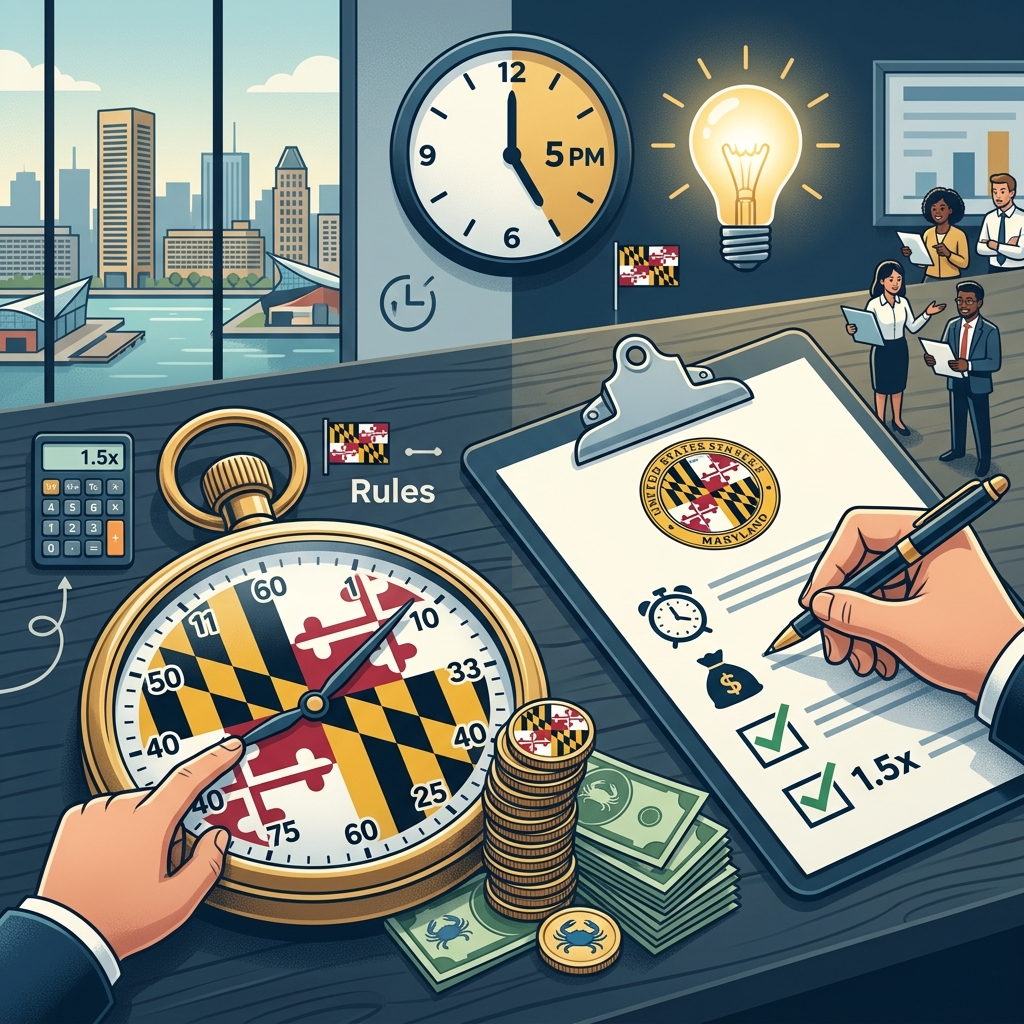
Maryland employers and employees alike must navigate a detailed set of rules that govern when overtime pay is owed, how it is calculated, and which workers are exempt. Although Maryland relies heavily on federal standards, the state also has its own minimum wage and overtime regulations that add important protections and exceptions.
This article explains the core principles of overtime in Maryland, highlights common exemptions, addresses special treatment for certain industries, and outlines practical steps workers can take if they believe they have been denied overtime wages.
Core Rule: When Overtime Is Required in Maryland
Under Maryland law, most covered employees are entitled to overtime pay when they work more than 40 hours in a single workweek. A workweek is typically defined as a fixed seven-day period, and overtime is based on the number of hours worked in that period, not per day.
- Standard threshold: Overtime generally starts after 40 hours worked in a seven-day week.
- Overtime rate: The required overtime rate is 1.5 times the employee’s regular hourly wage for each hour above 40.
- Hours actually worked: Only hours actually spent working count toward the 40-hour threshold; paid leave such as vacation or sick time does not count.
Maryland does not recognize a general daily overtime rule. An employee who works more than eight hours in a day but does not exceed 40 hours in the week usually is not entitled to overtime solely on that basis.
Interaction With Minimum Wage and Federal Law
Overtime requirements operate alongside both Maryland’s minimum wage law and the federal Fair Labor Standards Act (FLSA). Maryland sets its own minimum wage, and most employees must be paid at least the state minimum plus overtime when eligible.
- Minimum wage baseline: Most workers must receive at least the Maryland minimum wage for all hours worked, and time-and-a-half for hours over 40.
- FLSA coverage: Many Maryland employers are also subject to federal overtime rules, which generally match the time-and-a-half requirement after 40 hours per week.
- Higher standard applies: When state and federal law differ, employers must follow the rule that is more favorable to the employee. This often means complying with the higher minimum wage while also applying federal overtime standards.
Because both state and federal agencies can enforce overtime rules, workers may have more than one path to recover unpaid wages.
How to Calculate Overtime Pay
Correctly calculating overtime requires identifying the employee’s regular rate of pay, counting hours actually worked during the workweek, and applying the 1.5 multiplier to hours above the threshold.
Standard Overtime Calculation
- Determine total hours worked during the seven-day workweek.
- Subtract 40 hours (or the applicable threshold for special occupations).
- Multiply overtime hours by 1.5 times the regular hourly rate.
For example, if a worker earns $15 per hour and works 45 hours in a week, the 5 overtime hours are paid at $22.50 per hour, resulting in $112.50 in overtime pay.
Effect of Different Job Types and Schedules
Maryland’s rules emphasize the weekly total rather than daily fluctuations. Working split shifts or multiple roles for the same employer does not change the basic formula: all hours worked for that employer in the workweek are combined to assess overtime eligibility.
Some occupations have modified thresholds, such as agricultural workers who only qualify for overtime after 60 hours in a week. These differences are addressed in more detail below.
Who Is Covered and Who Is Exempt?
Although most employees in Maryland are entitled to overtime, both state and federal law carve out specific categories that are exempt from overtime or from minimum wage and overtime requirements altogether.
Common Exempt Categories
Maryland’s minimum wage and overtime law lists several exemptions. Some workers are exempt from both minimum wage and overtime; others are exempt from overtime only but must still be paid at least the state minimum wage.
| Category | Minimum Wage | Overtime |
|---|---|---|
| Immediate family member of the employer | Exempt | Exempt |
| Certain agricultural employees | Exempt | Exempt or delayed threshold |
| Outside salespersons | Exempt | Exempt |
| Employees under 16 working < 20 hours/week | Exempt | Exempt |
| Taxicab drivers | Covered | Exempt from overtime only |
| Certain automobile and farm equipment sales/servicing staff | Covered | Exempt from overtime only |
| Seasonal amusement and recreation establishments | Covered (if criteria met) | Exempt from overtime only |
In addition, executive, administrative, and professional employees may be exempt under federal rules when they meet salary and duties tests, although those details are generally governed by the FLSA rather than Maryland-specific law.
Minimum Wage and Overtime Exemptions
Maryland identifies several categories exempt from both minimum wage and overtime, including:
- Immediate family members employed by a family-owned business.
- Certain agricultural workers.
- Volunteers for educational, charitable, religious, or nonprofit organizations.
- Employees under 16 years old working fewer than 20 hours per week.
- Outside salespersons and certain commissioned employees.
- Non-administrative workers at organized camps.
- Employees of specified food-and-drink establishments with low annual gross revenues.
- Drive-in theaters and certain initial processing plants for agricultural products.
Overtime-Only Exemptions
Other categories are exempt from overtime but must receive at least the state minimum wage rate. These include:
- Taxicab drivers.
- Certain employees who sell or service automobiles, farm equipment, trailers, or trucks.
- Staff for nonprofit concerts or theatrical events under specific conditions.
- Employers subject to certain federal railroad or motor carrier regulations.
- Seasonal amusement and recreational establishments that meet state criteria.
Because the line between exempt and non-exempt status can be complex, employees who are uncertain about their classification should consider consulting an attorney or contacting the Maryland Department of Labor.
Special Overtime Rules for Certain Industries
In addition to broad exemptions, Maryland adjusts overtime thresholds for some types of work. These rules change the point at which overtime begins rather than eliminating it entirely.
Agricultural Workers
Many agricultural employees in Maryland do not qualify for overtime until they work more than 60 hours in a workweek. This delayed threshold recognizes the seasonal and intensive nature of farm work but still reserves overtime rights once the 60-hour limit is exceeded.
Certain agricultural workers may be fully exempt from overtime or minimum wage if they fall into specific categories outlined by state law. Young workers or those employed by a parent or guardian on the same farm may also face different rules under federal law.
Bowling Alleys and On-Premise Care Facilities
Maryland adjusts overtime thresholds for some service and care industries. For instance, employees of bowling establishments and workers providing on-premise care (outside of hospitals) for elderly or disabled individuals may be entitled to overtime only after 48 hours in a workweek. Before this threshold, they receive their regular rate of pay.
Transportation and Seasonal Recreation
Transportation-related jobs, such as certain motor carrier positions, may be exempt from overtime due to federal regulations. Seasonal amusement and recreational establishments can also fall under overtime-only exemptions when they meet specific criteria regarding operating months and revenue.
Recordkeeping and Employer Responsibilities
To comply with Maryland overtime rules, employers must maintain accurate wage and hour records and apply the correct classification and overtime thresholds.
- Track hours: Employers should record all hours actually worked by each employee during every workweek.
- Apply correct threshold: For most workers, overtime applies after 40 hours; special occupations may have 48- or 60-hour thresholds.
- Use regular rate: Overtime is calculated at 1.5 times the employee’s regular hourly rate.
- Exclude leave: Paid leave time does not count toward overtime hours, although it must be compensated separately when earned.
Employers who misclassify employees as exempt or fail to pay required overtime may face back wage orders, penalties, or private lawsuits.
What Workers Can Do If Overtime Is Not Paid
Overtime rights cannot be waived simply because an employee signs a contract or agrees informally to work for a flat salary. If a worker believes they are owed overtime, several enforcement options are available.
Contacting Government Agencies
- Maryland Department of Labor: Workers can file a wage complaint with the Employment Standards Service, which investigates alleged violations of state wage and hour laws.
- U.S. Department of Labor: Employees covered by the FLSA may also file with the Wage and Hour Division, which enforces federal overtime rules.
These agencies can order employers to pay back wages and may impose additional remedies when they find violations.
Private Lawsuits and Damages
Many workers choose to pursue unpaid overtime through private civil actions. Under Maryland’s wage payment statutes, employees can seek not only the unpaid wages but, in some cases, additional damages equal to multiple times the amount owed. Legal counsel can help workers determine whether their situation supports enhanced remedies and which forum is most appropriate.
Practical Steps for Employees
Workers who suspect overtime violations should consider:
- Keeping copies of pay stubs and personal records of hours worked.
- Requesting clarification from the employer about classification and overtime policies.
- Consulting an employment lawyer or legal aid organization for advice.
- Contacting the Maryland Department of Labor if informal efforts fail.
Frequently Asked Questions About Maryland Overtime
Do salaried employees in Maryland receive overtime?
Being paid a salary does not automatically remove overtime rights. If a salaried worker does not meet the criteria for an executive, administrative, or professional exemption under federal law, they may still be entitled to overtime when they work more than 40 hours in a week.
Does working more than eight hours in a day guarantee overtime?
No. Maryland focuses on total hours worked in the seven-day workweek. An employee who works a long day but remains at or below 40 hours for the week usually is not owed overtime simply for daily overtime.
Are young workers treated differently?
Yes. Maryland allows certain exemptions and different minimum wage treatment for younger workers. For example, employees under 18 may be paid a percentage of the minimum wage, and those under 16 working fewer than 20 hours per week can be exempt from minimum wage and overtime requirements.
What counts as hours worked for overtime purposes?
Only time actually spent working is used to calculate overtime. Paid leave such as vacation, holidays, or sick days does not increase the overtime total, even though it must be paid according to employer policy or contract.
Can an employee agree to give up overtime rights?
No. Overtime protections are set by law and generally cannot be waived through private agreements. Employers who attempt to circumvent overtime obligations, even with employee consent, risk enforcement action and liability for back pay.
References
- Maryland Minimum Wage and Overtime Law — Maryland Department of Labor. 2024-01-01. https://labor.maryland.gov/labor/wages/wagehrfacts.shtml
- Overtime: In General — The Maryland Guide to Wage Payment and Employment Standards — Maryland Department of Labor. 2023-06-01. https://labor.maryland.gov/labor/wagepay/wpotgenl.shtml
- Md. Code Regs. 09.12.41.14 — Overtime Compensation — Maryland Office of the Secretary of State / COMAR. 2022-07-01. https://www.law.cornell.edu/regulations/maryland/COMAR-09-12-41-14
- Maryland Minimum Wage and Overtime Law (Poster) — Maryland Department of Labor. 2024-01-01. https://labor.maryland.gov/labor/wages/pdf/mwo.pdf
- Wage Laws — Maryland People’s Law Library. 2024-04-01. https://www.peoples-law.org/wage-laws
- Can My Employer Refuse to Pay Overtime in Maryland? — Freedman, Lorry & Co. 2023-09-15. https://www.freedlawfirm.com/blog/can-my-employer-refuse-to-pay-overtime-in-maryland
- Wage and Hour Law in Maryland — Smithey Law Group LLC. 2023-08-10. https://smitheylaw.com/what-employers-should-know-about-the-wage-and-hour-law-in-maryland/
Similar Articles








Read full bio of medha deb




