
Understanding Federal Criminal Restitution
A clear, practical guide to how restitution works in federal criminal cases and what victims and defendants should expect.
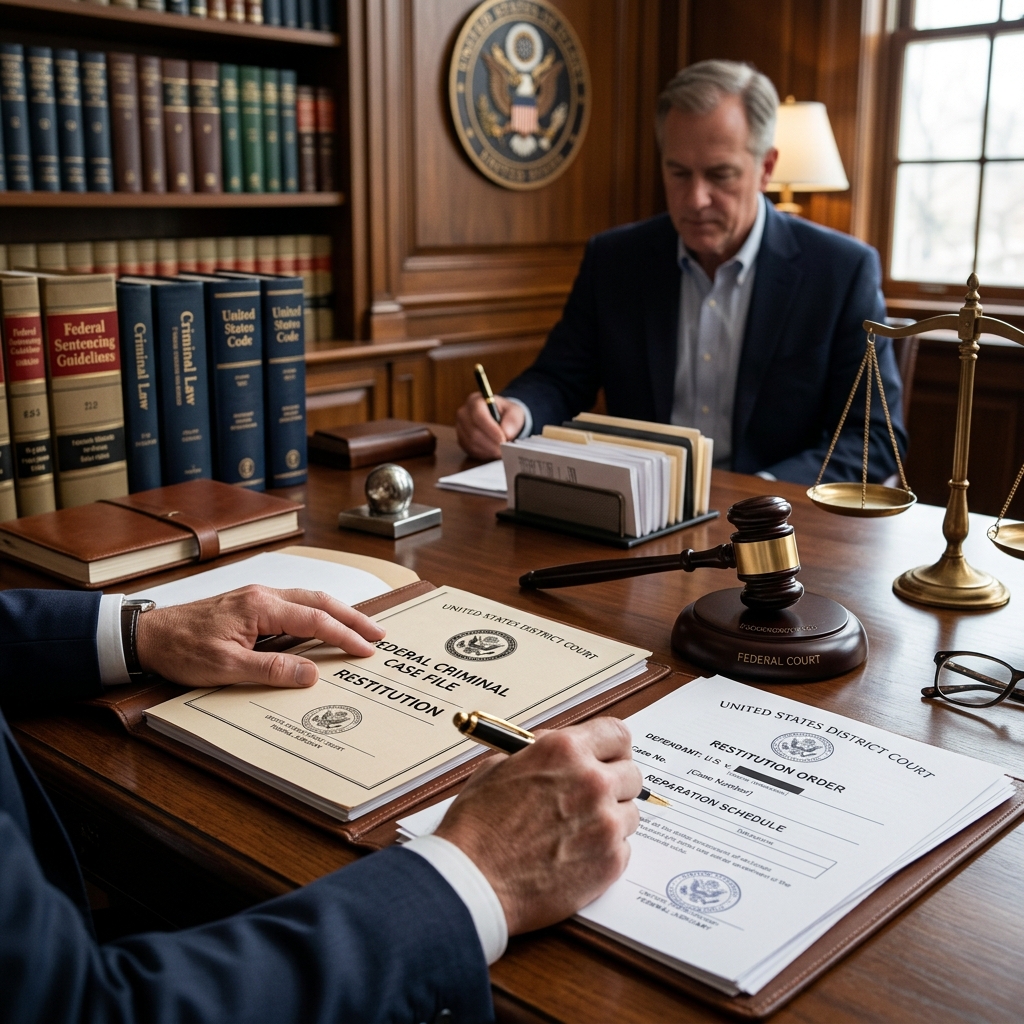
In the federal criminal justice system, restitution is a powerful tool designed to help crime victims recover financial losses caused by an offender’s unlawful conduct. Restitution orders can shape the experience of both victims and defendants long after a case ends, so it is essential to understand what restitution is, how it is determined, and how it is enforced.
Restitution in Federal Criminal Cases: Core Purpose
Restitution is a court-ordered financial obligation requiring a convicted offender to reimburse victims for monetary losses that stem directly from the crime of conviction. It is part of the criminal judgment, not a separate civil lawsuit.
Several key principles define federal restitution:
- Compensatory focus – The primary goal is to restore victims financially, not to punish defendants or generate revenue for the government.
- Crime-related losses only – Restitution addresses losses that were caused by, and sufficiently linked to, the offense of conviction.
- Separate from fines and fees – Fines punish the defendant; fees cover system costs. Restitution is distinct and directed to victims.
Because restitution is part of the sentencing process, it is ordered by the judge after a conviction by plea or trial.
Legal Framework: When Is Restitution Mandatory?
Federal courts rely on several statutes to govern restitution, including the Mandatory Victims Restitution Act (MVRA), codified at 18 U.S.C. §§ 3663A–3664. Under this law, restitution is mandatory for certain crimes and discretionary for others.
Mandatory vs. Discretionary Restitution
| Type of Restitution | When It Applies | Key Features |
|---|---|---|
| Mandatory restitution | Offenses against property (including many white-collar crimes) and certain crimes of violence, as defined by the MVRA. | Courts must order restitution for the full amount of victims’ losses and may not consider the defendant’s ability to pay. |
| Discretionary restitution | Other federal offenses where statutes authorize, but do not require, restitution. | Judges may choose to impose restitution, and they have more flexibility in tailoring orders. |
For many federal property and fraud offenses—such as mail and wire fraud, health care fraud, bank fraud, and securities fraud—the MVRA requires restitution to victims for the full amount of their quantifiable financial loss.
Who Qualifies as a “Victim” for Restitution?
Federal law defines a victim broadly as any person, organization, or entity directly and proximately harmed by the offense of conviction. This can include:
- Individuals who lost money, property, or income as a result of the crime.
- Businesses, financial institutions, or government agencies defrauded by the defendant.
- Family members who incurred funeral or medical expenses due to an offense resulting in death or injury.
Courts typically limit restitution to harms arising from conduct charged and proven in the case.The process commonly follows four analytical steps used by probation officers and courts:
- Determine whether restitution is mandatory or discretionary under the applicable statute.
- Identify the victims of the offense of conviction.
- Identify harms those victims suffered as a result of the offense.
- Determine which of those harms are compensable as restitution.
What Losses Can Be Covered by Restitution?
Restitution is limited to actual, measurable losses caused by the offense. These often include costs directly tied to financial, physical, or emotional harm.
Common Categories of Compensable Losses
- Property loss or damage – The value of property taken, destroyed, or not returned, measured at the higher of the date of loss or the date of sentencing under applicable statutes.
- Lost wages or income – Earnings victims could not obtain because they were injured, incapacitated, or required to attend legal proceedings.
- Medical and psychological treatment costs – Expenses for physical care, counseling, or therapy arising from the crime.
- Funeral and related expenses – When the offense results in death, certain burial and memorial costs may be compensable.
- Necessary participation costs – Verified child care, transportation, and similar costs that stem from participation in the investigation or prosecution.
Losses Typically Excluded
Not every expense can be recovered through restitution. Courts frequently exclude:
- Attorney’s fees for private counsel in most cases.
- Tax penalties or purely speculative damages.
- General pain and suffering or punitive damages, which belong in civil lawsuits rather than criminal restitution.
How Courts Determine the Restitution Amount
Calculating restitution is often one of the most complex parts of federal sentencing. There is no single standardized formula, and judges must exercise judgment based on evidence presented.
Evidence and Burden of Proof
To support a restitution order, the government typically submits documentation of victims’ losses, such as invoices, receipts, statements, and sworn declarations.
- The prosecution bears the initial burden to demonstrate the amount of loss by a preponderance of the evidence.
- Defendants may challenge the claimed amounts, argue that certain losses are not caused by the offense, or propose alternative calculations.
- The court ultimately decides the amount and scope of restitution based on the record.
Under the MVRA, courts must order restitution in the full amount of each victim’s losses as determined by the court, and they may not reduce that amount based on the defendant’s financial situation.
Ability to Pay and Payment Schedules
Although judges cannot lower the total restitution amount based on ability to pay, they can consider a defendant’s resources when setting a payment schedule.
- Courts may require lump-sum payment, periodic installments, or payment according to a schedule that begins in prison and continues on supervision.
- Compliance with the payment schedule often becomes a condition of probation or supervised release.
- Failure to make good-faith efforts can lead to sanctions, including potential revocation of supervision.
Duration and Legal Effect of Restitution Orders
Once entered, a federal restitution order is a binding part of the judgment and can have long-term consequences for the defendant.
- Length of enforceability – Federal law allows enforcement of restitution judgments for 20 years from the filing date of the judgment, plus any period of incarceration.
- Condition of supervision – Making restitution payments is commonly a condition of probation, supervised release, or parole.
- Not dischargeable in bankruptcy – Restitution is considered a criminal penalty and cannot be wiped out through bankruptcy proceedings.
Because the obligation can last decades and survive bankruptcy, defendants must treat restitution as a serious, long-term financial responsibility.
Who Enforces Federal Restitution Orders?
Several government actors share responsibility for enforcing restitution, both during and after a defendant’s sentence.
Financial Litigation Units and Probation
- Financial Litigation Unit (FLU) – Each U.S. Attorney’s Office has a unit dedicated to collecting criminal debts, including restitution. FLUs enforce restitution orders for 20 years from judgment plus incarceration or until the defendant’s death.
- United States Probation Office (USPO) – While the defendant is on supervision, probation officers monitor compliance with payment schedules and report noncompliance to the court.
Collection Tools Available to the Government
To collect unpaid restitution, the government may use civil enforcement mechanisms similar to those used for other federal debts.
- Wage garnishment – With court approval, wages can be garnished both while the defendant is incarcerated and after release.
- Seizure of assets – Bank accounts, real property, and non-exempt assets may be seized and liquidated to satisfy restitution obligations.
- Liens – The government can record liens against property, similar to tax liens, to secure its interest.
- Citation proceedings and similar actions – FLUs may initiate proceedings to discover assets and compel payment.
These tools ensure that restitution orders have real financial consequences and that victims have an opportunity to receive payment over time.
Restitution, Forfeiture, and Other Financial Penalties
Federal criminal cases frequently involve multiple financial consequences, including fines, forfeiture, and restitution. Understanding the differences is critical.
| Mechanism | Primary Purpose | Who Receives the Money? |
|---|---|---|
| Restitution | Compensate victims for financial harm caused by the crime. | Victims or entities legally identified as victims. |
| Criminal fines | Punish the defendant and deter future wrongdoing. | Paid to the government. |
| Asset forfeiture | Deprive criminals of ill-gotten gains and tools of the offense; disrupt criminal organizations. | Government retains or repurposes assets; sometimes used to satisfy restitution through restoration. |
While forfeiture and restitution are separate, the government may, in some cases, use forfeited assets to help pay restitution to victims through a process known as restoration.
Practical Guidance for Crime Victims
Victims often find the restitution process confusing and lengthy. Although every case is different, several practical steps may help.
Documenting Losses
- Keep copies of bills, receipts, insurance statements, and other records showing financial harm.
- Track missed work days and lost income resulting from injuries or court participation.
- Retain records of medical or counseling expenses related to the crime.
These documents help the prosecution and probation office present a complete and accurate picture of loss to the court.
Staying Informed About Enforcement
- Ask the victim-witness coordinator or the U.S. Attorney’s Office how restitution will be handled after sentencing.
- Provide current contact information so FLU can send notices about payments or enforcement activity.
- Understand that payments may be slow or partial; full recovery is not guaranteed, especially where defendants lack resources.
Considerations and Strategies for Defendants
For defendants, restitution obligations may extend far beyond incarceration. Proactive planning is important.
- Participate in loss calculations – Through counsel, review the government’s loss figures, raise legitimate objections, and provide alternative evidence where appropriate.
- Request a realistic payment schedule – Present accurate information about financial resources so the court can set a schedule that allows good-faith compliance.
- Maintain communication with probation and FLU – If circumstances change (job loss, illness), promptly inform supervising authorities rather than simply stopping payments.
- Avoid willful nonpayment – Intentional failure to pay can lead to enforcement actions and possible additional sanctions.
Frequently Asked Questions (FAQs)
Is restitution the same as a civil judgment?
No. Restitution arises from a criminal case and is ordered as part of sentencing, whereas a civil judgment results from a lawsuit between private parties. Restitution focuses on crime-related losses and is enforced by the government.
Can a judge reduce restitution because the defendant is indigent?
Under the MVRA, judges generally must order restitution for the full amount of victims’ losses without regard to the defendant’s economic circumstances. However, courts may tailor payment schedules to reflect ability to pay.
How long can the government collect restitution?
Federal law authorizes enforcement of restitution orders for 20 years from the date of judgment, plus any period of incarceration, or until the defendant’s death.
Can restitution be discharged in bankruptcy?
No. Restitution is treated as a criminal penalty and is not dischargeable in bankruptcy.
Does every victim receive full payment?
Not necessarily. Restitution orders state what the defendant legally owes, but collection depends on the defendant’s assets and income. Some victims may receive partial payments or, in rare cases, none, despite a valid order.
References
- Restitution Process — U.S. Department of Justice, Criminal Division. 2019-07-09. https://www.justice.gov/criminal/criminal-vns/restitution-process
- Understanding Restitution in Federal Court Sentencing — Best Lawyers. 2020-06-15. https://www.bestlawyers.com/article/managing-the-pitfalls-of-restitution/6123
- The Reality of Federal Restitution — Evergreen Attorneys. 2023-04-10. https://evergreenattorneys.com/restitution/the-reality-of-restitution/
- Imposition of Restitution in Federal Criminal Cases — U.S. Sentencing Commission. 1998-12-01. https://www.ussc.gov/sites/default/files/pdf/training/online-learning-center/supporting-materials/Imposition-of-Restitution-in-Federal-Criminal-Cases.pdf
- Fundamentals of Restitution in Federal Criminal Law — Federal Public Defender, Northern District of Texas (Beck). 2014-05-01. https://txn.fd.org/sites/txn/files/Fundamentals%20of%20Restitution%20(Beck).pdf
- Debunking Criminal Restitution — Michigan Law Review (Kelly). 2018-06-01. https://michiganlawreview.org/journal/debunking-criminal-restitution/
- Forfeiture and Restitution in Federal Criminal Cases — Federal Lawyer. 2021-03-05. https://federal-lawyer.com/forfeiture-and-restitution-in-federal-criminal-cases/
Similar Articles








Read full bio of Sneha Tete




