
Understanding DUI Stops and Checkpoints in Florida
A practical guide to Florida DUI stops and sobriety checkpoints, your rights, and what to expect when interacting with law enforcement.
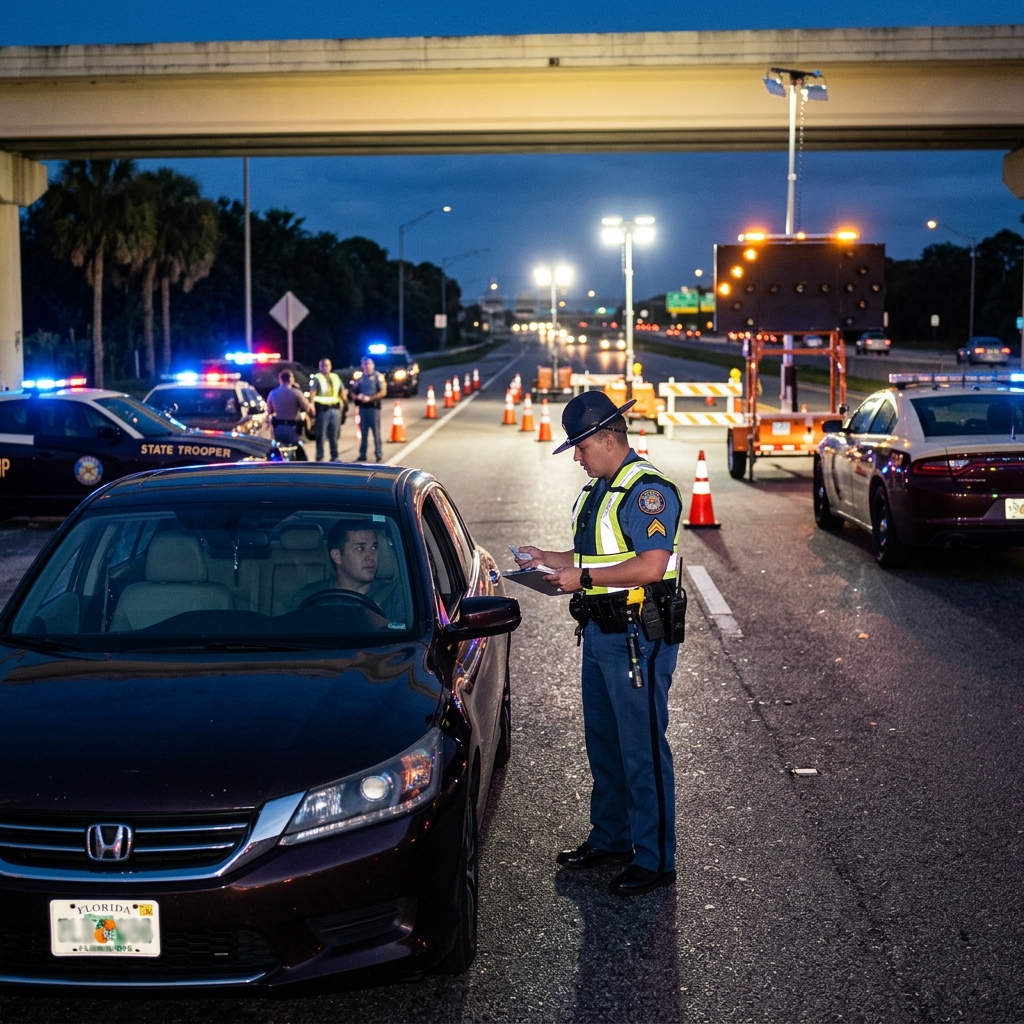
Driving after consuming alcohol or drugs in Florida can lead to serious legal consequences. Beyond criminal penalties, a driver stopped for suspected driving under the influence (DUI) faces immediate administrative sanctions and complex legal procedures. This guide explains how DUI stops and sobriety checkpoints operate in Florida, what officers are allowed to do, and what rights and obligations drivers have at each stage of the encounter.
Core Legal Framework for DUI in Florida
Florida law prohibits operating a motor vehicle while under the influence of alcohol, chemical substances, or controlled substances to the extent that a driver’s normal faculties are impaired, or with an unlawful alcohol concentration.
- Per se blood alcohol concentration (BAC): For most drivers, a BAC of 0.08 or higher is considered unlawful.
- Under 21 drivers: Florida applies a lower threshold of 0.02 or higher for administrative sanctions aimed at young drivers.
- Impairment standard: A driver can be charged even below 0.08 if evidence shows their normal faculties are impaired by alcohol or drugs.
In addition to criminal charges, Florida uses administrative license suspensions that apply immediately after certain test results or refusals, separate from the court case. These are handled by the Florida Department of Highway Safety and Motor Vehicles (FLHSMV).
When Police May Initiate a DUI Traffic Stop
Outside of checkpoints, Florida officers must meet constitutional standards before stopping a vehicle. A DUI investigation usually begins with a traffic stop based on observed behavior.
- Reasonable suspicion: To stop a vehicle, an officer must have specific and articulable facts suggesting a traffic violation or possible impairment, not just a hunch.
- Probable cause: To arrest for DUI, the officer must develop stronger evidence—such as admissions, test results, or clear indicators of intoxication—that would lead a reasonable person to believe a crime has occurred.
Common driving behaviors that may trigger a DUI stop include:
- Weaving within or outside the lane
- Unexplained abrupt braking or acceleration
- Failure to obey traffic signals or signs
- Driving significantly below the speed limit without reason
Once the vehicle is stopped, officers look for additional signs of impairment by observing the driver’s actions and appearance.
Indicators of Possible Impairment
Florida courts recognize various observable indicators that may justify further DUI investigation.
- Difficulty handling vehicle controls or parking properly
- Trouble exiting the vehicle or maintaining balance
- Fumbling with license, registration, or insurance documents
- Slow responses or repeated questions to the officer
- Odor of alcohol or other substances from the driver or vehicle
- Slurred speech, disorganized conversation, or confusion
- Glassy, bloodshot, or watery eyes
These factors, taken together with driving behavior, often lead officers to request field sobriety tests or a preliminary breath test.
DUI Sobriety Checkpoints in Florida
Unlike ordinary traffic stops, sobriety checkpoints—also called DUI checkpoints—allow police to briefly stop vehicles without individualized suspicion, provided specific constitutional and state-law requirements are met.
Legality and Frequency of Checkpoints
Florida is among the states that permit sobriety checkpoints as a tool to deter impaired driving.
- Legal status: Sobriety checkpoints are lawful in Florida, so long as they operate under structured guidelines and neutral criteria.
- Usage: Checkpoints are typically used multiple times per month statewide, often around holidays or weekends when impaired driving risk is higher.
Operational Requirements at Checkpoints
For a checkpoint to comply with constitutional standards, Florida law enforcement agencies generally follow protocols designed to limit arbitrary enforcement.
- Neutral stopping criteria: Officers must use systematic methods—for example, stopping every vehicle or every fourth vehicle—rather than targeting drivers based on appearance, vehicle type, or perceived demographics.
- Brief detention: Initial contact must be short, just long enough to check documents and look for signs of impairment.
- Traffic management: Some Florida jurisdictions apply rules limiting backup; if delays exceed a few minutes, officers adjust procedures to reduce congestion.
- Supervisory planning: Agencies typically create written plans specifying location, time, and screening methods, helping ensure checkpoints are not arbitrary.
If, during the brief contact, an officer notices indicators of intoxication, the stop can be extended into a full DUI investigation, which then requires additional justification beyond the mere fact of passing through the checkpoint.
Your Legal Duties at a DUI Checkpoint
When approaching a lawful checkpoint in Florida, drivers face mandatory and optional obligations. Understanding which actions are legally required and which are voluntary is crucial.
Actions You Must Take
- Stopping when directed: If an officer signals for you to stop at a checkpoint, you must pull over and comply. Refusing to stop or attempting to drive through can lead to charges such as evading law enforcement or other traffic offenses.
- Providing documents: You are legally required to present your driver’s license, vehicle registration, and proof of insurance on request.
Actions You May Decline
- Answering questions: Drivers are generally not required to respond to questions about where they are coming from, where they are going, or whether they have been drinking. Remaining silent beyond providing identification is typically within your rights.
- Field sobriety tests: You can usually refuse roadside coordination tests, such as walking a straight line or standing on one leg, though refusal may prompt further investigation or arrest.
While declining voluntary tests may avoid potentially damaging evidence, officers can rely on other indicators to decide whether to arrest or request evidentiary chemical testing.
Avoiding or Turning Away from a Checkpoint
Drivers sometimes encounter advance signs or see police activity ahead and wonder whether they may lawfully take an alternate route. Florida law distinguishes between legal avoidance and unlawful evasion.
Lawful Maneuvers
- Legal turn-offs: You may choose a different route, turn into a side street, or make a lawful U-turn before entering the checkpoint area, as long as you obey all traffic laws.
- No duty to approach: There is generally no legal requirement to proceed toward a checkpoint if you can safely and legally avoid it.
Unlawful Evasion
- Illegal U-turns or sudden maneuvers: Executing an illegal turn, crossing solid lines, or making abrupt moves that violate traffic rules can justify a traffic stop.
- Refusing to stop once in the checkpoint: After entering the checkpoint zone, failing to stop when directed can result in serious consequences, including charges related to fleeing or resisting law enforcement.
Even when a driver uses a technically lawful maneuver to avoid the checkpoint, officers may still observe and, if they see a separate violation or signs of impairment, they may initiate a standard traffic stop.
Chemical Testing and Implied Consent
Florida’s implied consent law plays a central role after a DUI arrest. By driving on Florida roads, most drivers are deemed to have agreed to submit to chemical testing under certain conditions.
Breath, Blood, and Urine Tests
- Post-arrest testing: After a lawful DUI arrest, officers may request an evidentiary breath test (commonly at a station or mobile unit), and in some situations blood or urine tests.
- Administrative consequences for high BAC: A first administrative suspension for a driver 21 or older with BAC of 0.08 or higher is typically six months; subsequent suspensions may last one year.
- Under 21 drivers: For younger drivers with BAC of 0.02 or more, Florida imposes similar administrative suspensions focused on public safety rather than criminal guilt.
Refusing a Chemical Test
Refusal to submit to an evidentiary chemical test carries separate penalties under implied consent rules, even if a criminal DUI conviction is not ultimately obtained.
- First refusal: Generally leads to a one-year administrative suspension of the driver’s license.
- Subsequent refusals: Can result in longer suspensions and may be charged as a misdemeanor.
- Checkpoint context: Refusing a blood or breath test requested after arrest at a checkpoint is treated similarly to refusals following a standard traffic stop.
These administrative suspensions begin shortly after the incident, sometimes before any court case is resolved, and can significantly affect a driver’s ability to maintain employment and other obligations.
Typical Penalties After a Florida DUI Conviction
If a driver is ultimately convicted of DUI, Florida imposes escalating penalties depending on offense history and aggravating factors. These are separate from implied consent suspensions.
| Conviction | Fine Range (Approx.) | License Revocation | Aggravating Factors |
|---|---|---|---|
| First DUI (no injury) | $500 to $1,000 | 180 days to 1 year | None |
| First DUI with high BAC (≥ 0.15) or minor in vehicle | $1,000 to $2,000 | Similar revocation ranges; courts may impose additional sanctions | Elevated BAC or minor passenger |
| Second DUI | $1,000 to $2,000 and higher for aggravated cases | Longer revocations, potentially multiple years | Prior conviction, possible mandatory jail time |
Higher offense levels and cases involving bodily injury or property damage can lead to longer revocations, increased fines, mandatory treatment programs, and in severe cases, felony charges.
What to Expect During a DUI Stop or Checkpoint Interaction
Although each encounter is unique, drivers can anticipate several common steps during a Florida DUI stop or checkpoint screening.
- Initial approach: Officer observes driving behavior or screens vehicles at the checkpoint and signals the driver to stop.
- Document check: Driver provides license, registration, and proof of insurance; officer may engage in brief conversation and observe demeanor.
- Observation phase: Officer looks for odors, speech patterns, eye appearance, and motor coordination, as discussed above.
- Request for tests: If impairment is suspected, officer may ask the driver to perform field sobriety exercises or submit to roadside breath testing.
- Arrest decision: Based on observed indicators, test results, and other evidence, officer may arrest for DUI or allow the driver to proceed.
- Post-arrest procedures: The driver is typically transported for evidentiary breath testing or other chemical tests under implied consent, with administrative suspensions applying in certain circumstances.
Practical Tips for Drivers in Florida
While this guide does not provide legal advice, several practical considerations can help drivers navigate DUI stops and checkpoints more effectively.
- Keep required documents organized and easy to reach to avoid fumbling.
- Remain polite and calm; confrontational behavior can escalate the situation.
- Know that you must stop and provide identification when directed, but you can generally decline to answer additional questions.
- Understand that refusing chemical testing after arrest has automatic consequences under implied consent laws.
- If arrested, consider seeking advice from a qualified Florida criminal defense attorney who regularly handles DUI cases.
Frequently Asked Questions About Florida DUI Stops
Are DUI checkpoints always legal in Florida?
DUI checkpoints are generally legal in Florida, but they must be conducted according to constitutional standards and neutral, pre-established guidelines. Arbitrary or poorly planned checkpoints can be challenged in court.
Can I avoid a checkpoint by turning around?
You may legally avoid a checkpoint by making a safe, lawful turn or choosing an alternate route before entering the checkpoint area. However, if you commit a traffic violation while turning or make an obviously evasive illegal maneuver, officers can stop you and investigate further.
Do I have to answer questions about drinking?
Beyond providing license, registration, and proof of insurance, you are typically under no legal obligation to answer questions about drinking, travel plans, or other personal details. You may politely decline, though officers might still proceed based on their observations.
What happens if I refuse a breath test after arrest?
Refusing an evidentiary breath test after a lawful DUI arrest usually results in an administrative suspension of your driver’s license. A first refusal may trigger a one-year suspension, and subsequent refusals can carry longer suspensions and potential misdemeanor charges.
Can I lose my license even if I am not convicted?
Yes. Administrative suspensions under Florida’s implied consent laws can apply based on test results or refusals regardless of the outcome of the criminal DUI case. These are handled separately by the licensing authority.
References
- Florida DUI and Administrative Suspension Laws — Florida Department of Highway Safety and Motor Vehicles (FLHSMV). 2023-05-01. https://www.flhsmv.gov/driver-licenses-id-cards/education-courses/dui-and-iid/florida-dui-administrative-suspension-laws/
- Does Florida Law Require You to Comply with Police at a DUI Checkpoint? — Musca Law. 2023-06-15. https://www.muscalaw.com/blog/does-florida-law-require-you-comply-police-dui-checkpoint
- Your Rights at DUI Checkpoints in Florida — Community Law Firm. 2022-11-10. https://www.communitylawfirm.com/blog/your-rights-dui-checkpoints-florida
- DUI Checkpoints Laws by State — FindLaw. 2022-08-30. https://www.findlaw.com/dui/arrests/dui-checkpoint-laws-by-state.html
- Florida DUI Traffic Stops — Karatinos Law, PLLC. 2023-03-20. https://www.flnotguilty.com/dui-bui/traffic-stops/
- What’s the Penalty for Avoiding a DUI Checkpoint in Florida? — The Law Place. 2023-02-14. https://www.thelawplace.com/faqs/whats-the-penalty-for-avoiding-a-dui-checkpoint/
- Your Rights at a DUI Checkpoint — The Law Offices of Timothy Hessinger (Tampa DUI Defenders). 2021-09-01. http://www.tampaduidefenders.com/DUI/Sobriety-Checkpoints.aspx
Similar Articles








Read full bio of Sneha Tete




