
Felony Arrest vs. Felony Charge Explained
Learn how a felony arrest differs from a felony charge and what happens next.
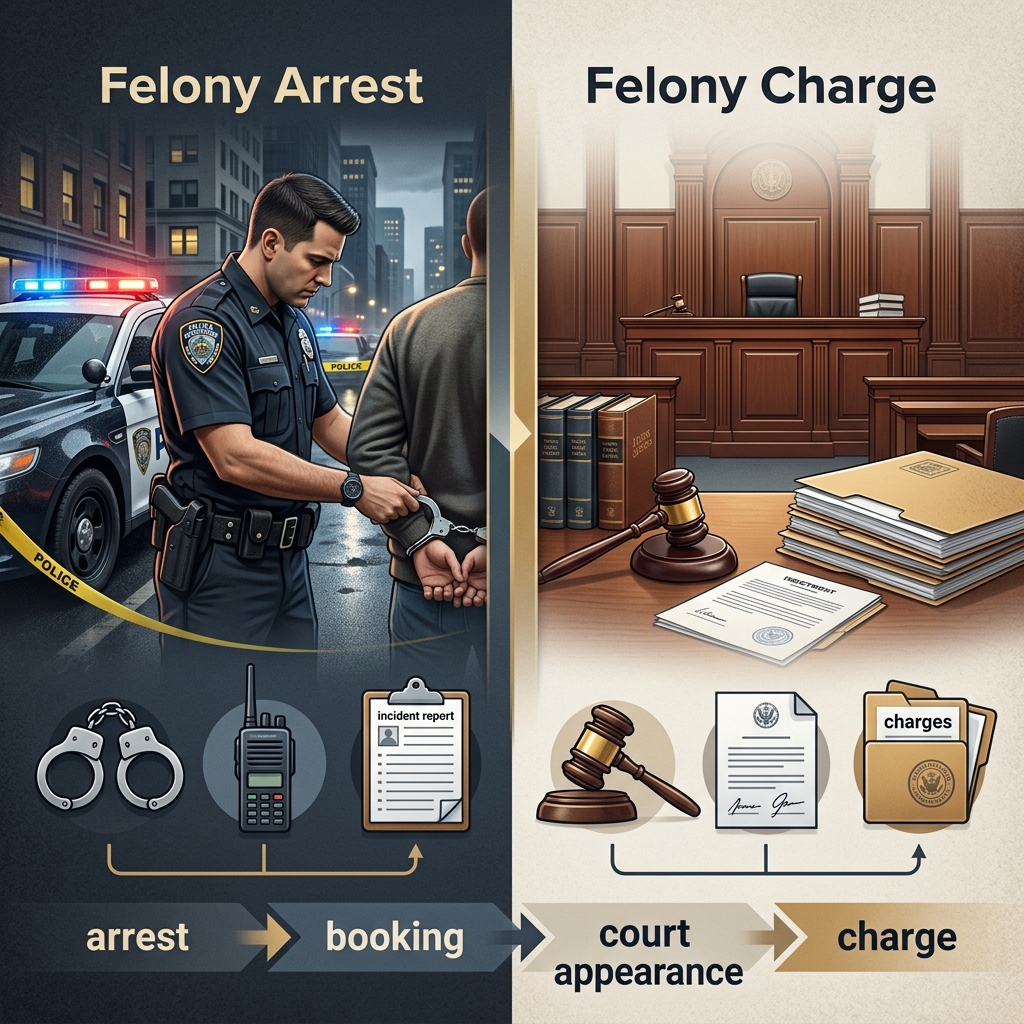
A felony arrest and a felony charge are related, but they are not the same thing. An arrest means police have taken a person into custody based on suspicion of a serious crime, while a charge means the government has formally accused that person in court or through a criminal filing.
Understanding the difference matters because the legal consequences, timing, and next steps are not identical. A person can be arrested and never charged, or charged after an arrest, depending on what the prosecutor decides and what the evidence supports.
The basic difference in plain language
A felony arrest is the beginning of a criminal case. It usually happens when officers believe a felony offense may have occurred and decide to detain someone for investigation or custody.
A felony charge is a formal accusation. It means the prosecutor, grand jury, or another authorized authority has decided the case is serious enough to proceed against the person in court.
| Issue | Felony arrest | Felony charge |
|---|---|---|
| Who acts | Police or arresting officers | Prosecutor, grand jury, or filing authority |
| Main purpose | Detain and investigate | Formally accuse and begin prosecution |
| Legal meaning | Suspicion of felony conduct | Official criminal allegation |
| Can it happen alone? | Yes | Yes, though often after arrest |
What makes an offense a felony
In general, felonies are treated as more serious crimes than misdemeanors. They often carry the possibility of imprisonment for more than one year, usually in a state or federal prison rather than a local jail.
Not every system uses the exact same labels, but the key idea is that felony offenses are reserved for more serious conduct. The seriousness of the harm, the value of property involved, and the presence of aggravating facts can all affect whether an offense is treated as a felony.
- More serious injury or danger to another person can point toward a felony.
- Larger property losses or significant destruction can support felony treatment.
- The use of force or a weapon can increase the seriousness of the allegation.
- Crimes involving children, older adults, or law enforcement officers may be treated more severely.
How a felony arrest usually happens
Police may make a felony arrest when they have probable cause to believe a felony was committed. That standard does not require proof beyond a reasonable doubt; it is a lower threshold used to justify custody and investigation.
After an arrest, the person may be booked, questioned, and held until a hearing or release decision is made. Depending on the jurisdiction, the person may be eligible for bail or may need to appear before a judge quickly after the arrest.
It is important to remember that an arrest is not a final determination of guilt. It is a procedural step that signals the government believes the case deserves further scrutiny.
Why an arrest does not automatically mean a charge
An arrest is based on police suspicion and immediate public-safety concerns. A charge, by contrast, requires a prosecutorial decision about whether there is enough evidence and whether filing the case is appropriate.
That means some arrests end without any charge at all. In other situations, police arrest first and prosecutors file charges later after reviewing reports, witness statements, and other evidence.
The prosecutor’s role is central here. According to county legal guidance, the prosecutor ultimately decides whether a person will be charged and what the charges will be.
What happens when a felony charge is filed
Once a felony charge is filed, the accused enters the formal criminal justice process. The person is then a defendant and must respond to the allegations in court.
The early stages may include an initial appearance, advice about rights, appointment or retention of counsel, and scheduling for future hearings.
In many jurisdictions, the court will also address custody issues, release conditions, and whether the defendant must remain under supervision while the case moves forward.
- The defendant may be told the exact charge or charges.
- The court may consider whether the defendant understands the case.
- A hearing date may be set for the next stage of the proceedings.
- Defense counsel may begin reviewing evidence and negotiating with the prosecution.
Why the distinction matters for defendants
The difference between arrest and charge affects timing, rights, and strategy. A person who has only been arrested may still have an opportunity to prevent a charge from being filed or to reduce the severity of the case.
Once a charge is filed, the defendant must focus on the formal criminal process, which can include motions, hearings, plea discussions, and possibly trial. Because felony cases can involve substantial prison exposure, the stakes are higher than in most misdemeanor matters.
Even before charges are filed, a person should be careful about statements made to police. Anything said during an investigation may later be used in the case if admissible under the rules of evidence.
Common examples of felony-related conduct
Felony allegations can arise from many kinds of conduct, including violent offenses, serious theft, certain drug crimes, fraud, and property offenses involving large losses or extensive damage.
The exact classification depends on the law in the relevant jurisdiction. A crime that is a felony in one place may be charged differently elsewhere, because states and the federal system define offenses and penalties in their own statutes.
That is why the same event can lead to different outcomes depending on facts such as the amount of loss, whether a weapon was used, or whether a victim suffered serious bodily injury.
Table of practical differences
| Stage | What it means | Typical result |
|---|---|---|
| Investigation | Police gather facts and assess suspicion | No public case yet |
| Arrest | Police take a person into custody | Booking and possible detention |
| Charging decision | Prosecutor decides whether to file the case | Formal criminal accusation or no charge |
| Court process | Defendant responds to the charge | Hearings, motions, plea, or trial |
Possible outcomes after an arrest
After a felony arrest, several things can happen. The prosecutor may file charges, file different charges than police expected, seek a grand jury indictment, or decide not to proceed.
If charges are filed, the case moves into the court system. If charges are not filed, the person may be released without a criminal case moving forward, although the arrest may still appear in records and may have separate consequences.
Because the arrest itself can affect employment, travel, reputation, and future interactions with the justice system, many people seek legal advice quickly after being taken into custody.
How felony severity affects the case
The more serious the alleged harm, the more likely the case is to be treated aggressively. Serious violence, major financial loss, and aggravating circumstances can increase charging severity and sentencing exposure.
Some legal systems also divide felonies into levels or classes, with harsher punishment for the most serious categories. Even when the exact category differs by state, the basic principle is the same: more serious felony allegations carry more serious penalties.
Frequently asked questions
Can someone be arrested without being charged?
Yes. An arrest is based on suspicion and custody, while a charge requires a formal prosecutorial decision.
Can someone be charged without being arrested first?
Yes. Prosecutors may file charges before an arrest, especially when police already have enough evidence to begin a criminal case.
Does a felony arrest mean a person will go to prison?
No. An arrest only means the person is being investigated or detained. Prison becomes a possibility only if charges are filed, the defendant is convicted, and the court imposes a prison sentence.
Why do lawyers focus so much on the difference?
Because the stages create different opportunities for defense. Before charges are filed, counsel may influence the prosecutor’s decision. After charges are filed, counsel focuses on dismissal, suppression, negotiation, or trial preparation.
What should someone do after a felony arrest?
The safest step is to remain respectful, avoid discussing the case without counsel, and contact a criminal defense lawyer as soon as possible. Early legal help can matter at both the bail stage and the charging stage.
Final thoughts for anyone facing a felony case
A felony arrest and a felony charge are not interchangeable. An arrest starts the process, but a charge is the formal legal accusation that brings the court into the picture.
For that reason, the period between arrest and charging can be critical. Evidence is still being reviewed, prosecutors are still making decisions, and the direction of the case may still change.
Anyone facing either step should treat the situation seriously, understand the distinction, and obtain legal advice early enough to protect rights and prepare a response.
References
- Felony Charge vs Felony Arrest — LegalMatch. n.d. https://www.legalmatch.com/law-library/article/difference-between-felony-arrest-and-felony-charge.html
- If you’re arrested for a felony — King County, Washington. n.d. https://kingcounty.gov/en/dept/dpd/courts-jails-legal-system/adult-defendant-resources/felony
- Misdemeanor vs Felony in Nevada: What’s the Difference? — Gallo Law NV. n.d. https://www.gallolawnv.com/misdemeanor-vs-felony-nevada
- Felony Or Misdemeanor — Supreme Court of Ohio. n.d. https://www.supremecourt.ohio.gov/docs/JCS/disputeResolution/resources/uma/felony_misdemeanor.pdf
- 18 U.S. Code § 3559 – Sentencing classification of offenses — U.S. House of Representatives, Office of the Law Revision Counsel. n.d. https://uscode.house.gov/view.xhtml?req=granuleid:USC-prelim-title18-section3559
- Criminal Procedure — U.S. Department of Justice. n.d. https://www.justice.gov/criminal/criminal-division/organization-charts/criminal-procedure
- Initial Appearance and Bail — Federal Judicial Center. n.d. https://www.fjc.gov/history/timeline/initial-appearance-and-bail
- Felony — Cornell Law School, Legal Information Institute. n.d. https://www.law.cornell.edu/wex/felony
Similar Articles








Read full bio of medha deb




