
Understanding Divorce in Florida: A Practical Guide
A clear, step‑by‑step overview of Florida divorce rules, processes, rights, and obligations for spouses ending a marriage.
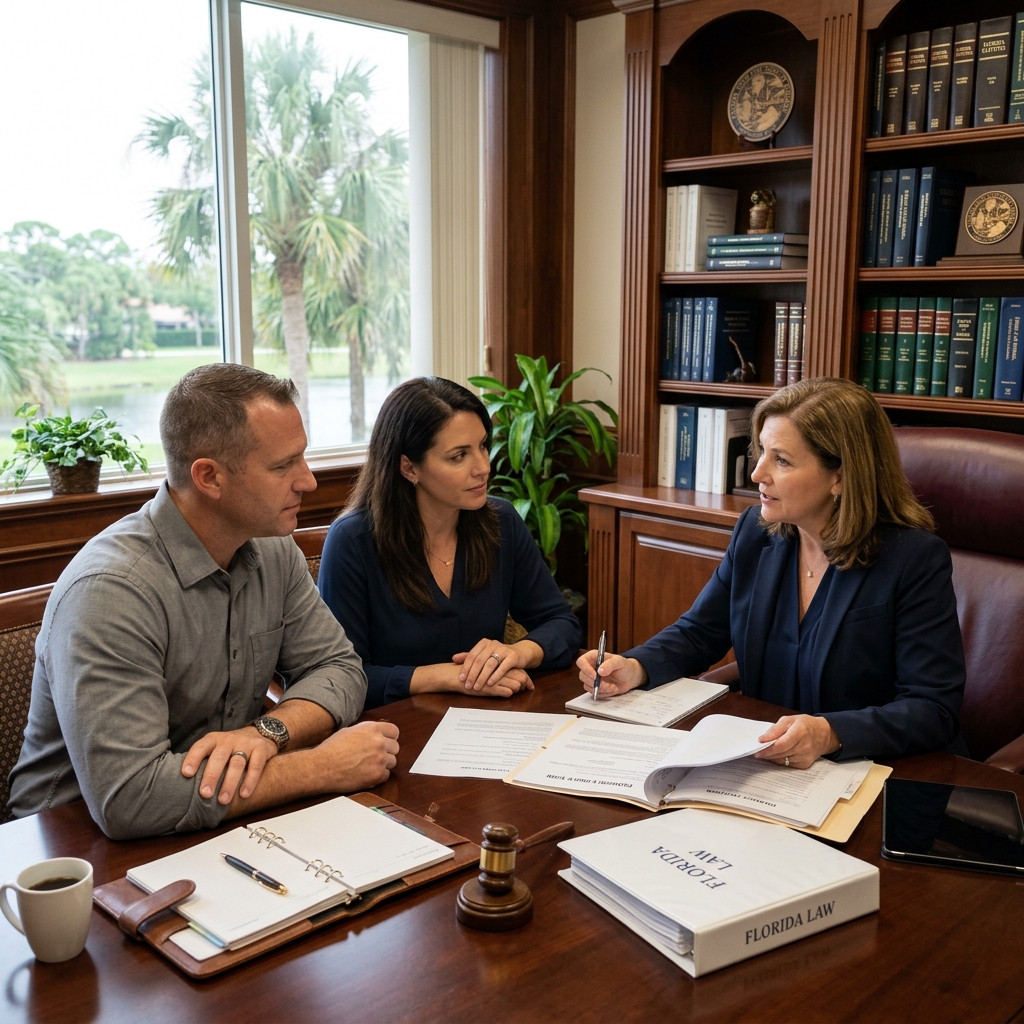
In Florida, divorce is legally known as a dissolution of marriage, and the law is designed to focus on ending the relationship rather than assigning blame for what went wrong. Florida follows a no‑fault approach, which means you do not need to prove adultery, cruelty, or other misconduct to obtain a divorce. This guide explains the key legal rules, the main types of divorce, and what to expect when a marriage ends in Florida, using plain language to help you plan your next steps.
Core Legal Foundations of Divorce in Florida
Residency: Who Can File in Florida?
Before a Florida court can grant a divorce, it must have authority over the case, called jurisdiction. One spouse must have lived in Florida for at least six months immediately before filing the petition for dissolution of marriage.
- Residency can be proven with a Florida driver’s license, state ID, voter registration, or the testimony of a witness familiar with your residence.
- Either spouse may file, as long as the residency requirement is met.
- The case is usually filed in the county where the spouses last lived together as a married couple or where either spouse currently resides.
Without meeting this residency rule, the court cannot legally dissolve the marriage, even if both spouses agree.
Grounds for Divorce: No‑Fault System
Florida has abolished traditional fault‑based grounds such as adultery or abandonment as a legal basis for divorce. Instead, the law recognizes two main grounds:
- Irretrievably broken marriage – the relationship has deteriorated to the point that it cannot be repaired.
- Mental incapacity – one spouse has been adjudicated mentally incapacitated by a court for at least three years before the petition is filed.
In most cases, spouses rely on the “irretrievably broken” ground. One spouse’s statement that the marriage cannot be saved is generally sufficient; the court does not require detailed proof of wrongdoing.
Two Main Paths: Simplified vs. Regular Dissolution
Overview Table
| Feature | Simplified Dissolution of Marriage | Regular Dissolution of Marriage |
|---|---|---|
| Children involved | No minor or dependent children; neither spouse pregnant. | Available even if there are minor children or a pregnancy. |
| Alimony requests | No alimony requested by either spouse. | Alimony can be requested and litigated. |
| Agreement on issues | Full agreement on division of property and debts. | Spouses may disagree; court will decide disputed matters. |
| Complexity | Generally faster and simpler process. | More formal pleadings, possible hearings and trial. |
| Who can use it? | Only couples meeting strict eligibility criteria. | Any married couple that meets residency and grounds requirements. |
Simplified Dissolution: When Divorce Is Straightforward
A simplified dissolution of marriage is a streamlined procedure for couples with uncomplicated circumstances and complete agreement on all issues.
To use this process, all of the following must be true:
- Both spouses agree that the marriage is irretrievably broken.
- There are no minor or dependent children of the marriage, and neither spouse is pregnant.
- At least one spouse meets the six‑month Florida residency requirement.
- The spouses have already agreed on how to divide all marital property and debts.
- No one is seeking alimony.
- Both spouses are willing to sign the necessary forms and appear in court together for the final hearing, if required.
Because the parties have resolved all financial and property matters in advance, simplified dissolution tends to be faster and less costly, although it still results in a formal court order ending the marriage.
Regular Dissolution: Handling Disputes and Complex Cases
A regular dissolution of marriage is the standard process and applies whenever the couple cannot meet the conditions for simplified dissolution or expects contested issues.
The regular process typically involves:
- Filing a Petition for Dissolution of Marriage in the appropriate circuit court.
- Official service of the petition and summons on the other spouse, often by a sheriff or private process server.
- A formal Answer by the responding spouse, usually within 20 days of service, admitting or denying allegations and raising counterclaims if necessary.
- Mandatory financial disclosure within 45 days, including income documents, tax returns, and statements of assets and debts.
- Potential mediation or settlement negotiations, followed by hearings or trial if disputes remain.
Regular dissolution gives the court authority to address alimony, parenting plans, child support, and complex property division when spouses do not agree.
Key Issues Decided in a Florida Divorce
Property and Debt: Equitable Distribution
Florida law requires courts to divide marital assets and liabilities fairly, which usually means an equitable distribution of property and debt acquired during the marriage. Equitable does not always mean an exact 50/50 split; the court looks at several factors, including contributions to the marriage, economic circumstances, and the duration of the relationship.
Recent legislative changes have clarified how property should be classified and valued:
- A clearer definition of fair market value for evaluating marital assets.
- More detailed rules on what counts as marital property versus non‑marital property, such as certain gifts or inheritances received by one spouse alone.
- Recognition that some property acquired through non‑spousal means can remain a separate, non‑marital asset.
Spouses are encouraged to list all assets and debts accurately in financial affidavits; failing to disclose property can lead to court sanctions and reopened settlements.
Alimony: Support After Separation
Alimony (spousal support) may be awarded when one spouse has financial need and the other has the ability to pay. Florida courts consider factors such as the length of the marriage, each spouse’s earning capacity, contributions to the household, and the standard of living during the marriage.
Significant reforms have recently changed alimony in Florida:
- Permanent (lifetime) alimony is no longer available in new cases.
- Courts can award several types of alimony, such as temporary support during the case, bridge‑the‑gap alimony to ease short‑term transition, rehabilitative alimony to support training or education, and durational alimony for a defined period.
- Alimony amounts are generally capped at the lesser of the recipient’s need or 35% of the difference in the parties’ net incomes.
Couples using the simplified dissolution procedure cannot request alimony; they must resolve financial support privately without court‑ordered payments.
Children: Parenting Plans and Child Support
When children are involved, Florida courts must address parenting time and child support. The law emphasizes the best interests of the child and encourages ongoing involvement from both parents.
Important points include:
- A growing presumption of shared time‑sharing, often starting from a 50/50 baseline, though the final plan can differ if specific circumstances warrant another arrangement.
- Requirement to develop a detailed parenting plan covering schedules, decision‑making authority, and communication between parents.
- Use of updated child support guidelines that factor in each parent’s income, childcare costs, health insurance, and certain extracurricular expenses.
Florida law makes clear that dissolving the marriage does not affect a child’s legal status; children of the marriage remain legitimate and retain all legal rights.
Procedural Steps: From Filing to Final Judgment
Starting the Case
The spouse who initiates the divorce is called the petitioner. To start a case, the petitioner typically:
- Prepares and files a Petition for Dissolution of Marriage, outlining basic facts about the marriage and requested relief.
- Files a civil cover sheet and other required forms, such as a financial affidavit and notice of Social Security number.
- Pays the filing fee or requests a fee waiver if eligible.
- Arranges official service of the petition and summons on the other spouse through the sheriff or a licensed process server.
Responding to the Petition
The spouse who receives the petition is called the respondent. After being served, the respondent usually must file a written Answer within 20 days.
- Failing to respond can result in a default, which allows the court to proceed and possibly grant relief largely as requested by the petitioner.
- The Answer may admit or deny specific allegations and can include a counter‑petition requesting relief in favor of the respondent.
Mandatory Financial Disclosure
Within 45 days after service, both parties are generally required to exchange specified financial documents and file a certificate confirming compliance.
- Typical documents include pay stubs, tax returns, bank statements, and records relating to real estate, investments, and major debts.
- These disclosures help the court make informed decisions on property division, alimony, and child support.
Negotiation, Mediation, and Trial
Many Florida divorce cases settle before trial through informal negotiation or mediation. When settlement is reached, the parties typically sign a Marital Settlement Agreement detailing property division, support, and parenting arrangements.
If disputes persist, the court can hold hearings and, ultimately, a trial where each side presents evidence. The judge then issues a Final Judgment of Dissolution of Marriage, legally ending the marriage and addressing all remaining issues.
Practical Tips for Navigating Divorce in Florida
- Confirm eligibility early: Check residency and grounds before filing so your case is not delayed or dismissed.
- Gather financial records: Organize income documents, account statements, and property records to comply with mandatory disclosure requirements.
- Consider simplified dissolution if eligible: When there are no children and full agreement, this path can reduce cost and conflict.
- Seek legal advice for complex cases: Alimony, business ownership, or high‑value assets often require professional guidance.
- Prioritize children’s needs: Courts focus on the best interests of the child; cooperative parenting and detailed planning will support favorable outcomes.
Florida Divorce FAQs
1. Do I have to prove my spouse did something wrong to get a divorce?
No. Florida is a no‑fault divorce state. You generally need only to state that the marriage is irretrievably broken, or that your spouse has been legally declared mentally incapacitated for at least three years.
2. How long do I need to live in Florida before filing for divorce?
At least one spouse must be a Florida resident for six months before filing the petition. Residency can be shown through documents like a driver’s license or other evidence accepted by the court.
3. Can we use the simplified dissolution process if we have children?
No. Simplified dissolution is available only when there are no minor or dependent children, neither spouse is pregnant, and both spouses agree on property division and waive alimony.
4. Is permanent alimony still allowed in Florida?
Florida courts no longer award new permanent (lifetime) alimony. Current law emphasizes temporary, rehabilitative, or durational alimony based on need and ability to pay, subject to statutory limits.
5. What happens if my spouse does not respond to the divorce papers?
If the respondent fails to file an Answer within the required time, the court may enter a default and proceed without their input, as long as the petitioner proves residency and grounds. The final judgment may closely reflect the requests in the petition.
6. Will divorce affect the legal status of our children?
No. Florida statutes explicitly state that a judgment of dissolution of marriage does not change the child’s status; children remain legitimate with full legal rights and protections.
References
- Florida Divorce — WomensLaw.org. 2023-08-01. https://www.womenslaw.org/laws/fl/divorce
- Consumer Pamphlet: Divorce in Florida — The Florida Bar. 2023-01-15. https://www.floridabar.org/public/consumer/pamphlet010/
- Divorce, Separation & Annulment — Florida Law Help. 2024-05-10. https://www.floridalawhelp.org/families-children/divorce-separation-annulment
- Florida Divorce Laws & FAQs: What to Know in 2026 — Cowhey+Ward. 2026-01-05. https://cowheyward.com/florida-divorce-laws-faqs-what-to-know-in-2026/
- Chapter 61 – Dissolution of Marriage; Support; Time-sharing — The 2025 Florida Statutes (Online Sunshine). 2025-07-01. https://www.leg.state.fl.us/Statutes/index.cfm?App_mode=Display_Statute&URL=0000-0099/0061/0061.html
- Florida Divorce Law FAQs — Cordell & Cordell. 2024-06-20. https://cordellcordell.com/resources/florida/florida-divorce-questions/
Similar Articles








Read full bio of Sneha Tete


