
U.S. Tax Court: How To File A Petition And Key Deadlines Guide
A practical, step‑by‑step guide to challenging IRS determinations in the United States Tax Court, from notice to final decision.
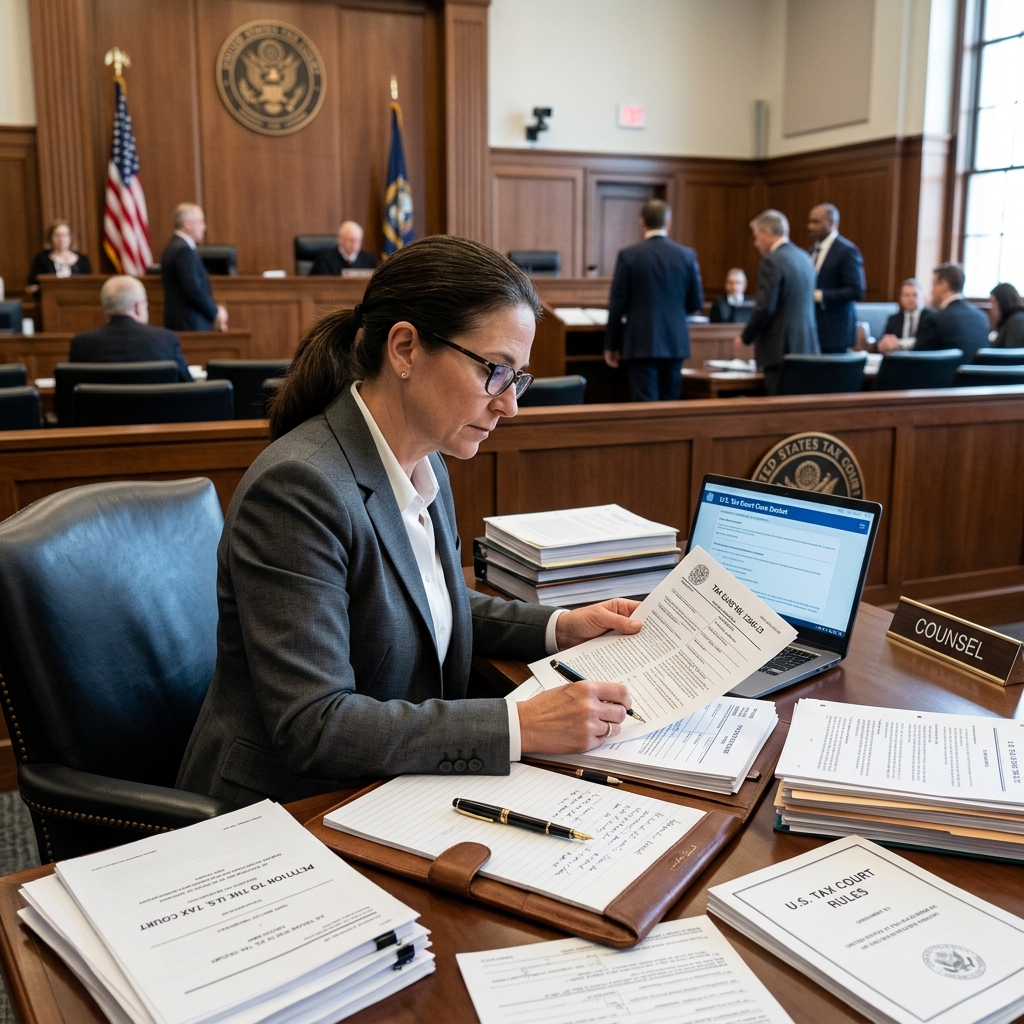
When you disagree with an Internal Revenue Service (IRS) determination, you may have the right to take your dispute to the United States Tax Court. This specialized federal court hears only tax cases and allows many taxpayers to challenge IRS assessments without first paying the amount in dispute. Understanding how a Tax Court case begins, what deadlines apply, and what happens at each stage can make the process far less intimidating.
Understanding the Role of the U.S. Tax Court
The U.S. Tax Court is a federal trial court of record that focuses exclusively on federal tax controversies between taxpayers and the IRS. Because it is a court of record, all proceedings are formally recorded, and decisions may be appealed to a federal Court of Appeals in most regular cases. The judges are experienced in tax law and apply the Internal Revenue Code, Treasury regulations, and relevant case law to resolve disputes.
| Feature | U.S. Tax Court |
|---|---|
| Type of court | Federal trial court of limited jurisdiction (tax only) |
| Prepayment of tax | Generally not required before filing a petition |
| Availability of jury | No jury trials; cases decided by Tax Court judges |
| Scope of cases | Disputes over IRS determinations, such as deficiencies, penalties, and certain collection actions |
| Procedural rules | Governed by the Tax Court Rules of Practice and Procedure |
Taxpayers often choose Tax Court because it allows them to contest an IRS deficiency before payment and because its judges specialize in tax matters.
When You Can Go to Tax Court
You generally obtain access to the U.S. Tax Court after the IRS issues a formal notice that gives you the right to petition the court. Common triggering documents include:
- Notice of Deficiency (often called a “90-day letter”), asserting that you owe additional tax and possibly penalties.
- Certain collection due process notices related to liens or levies (handled under different jurisdictional rules).
For a Notice of Deficiency, you must file your petition with the Tax Court by the deadline printed on the notice. According to IRS guidance, the timeframe is typically:
- 90 days from the date the Notice of Deficiency was mailed if you are in the United States, or
- 150 days if the notice is addressed to you outside the United States.
The Tax Court cannot extend these statutory deadlines. If you miss them, your case may be dismissed and you may lose the opportunity to contest the deficiency in Tax Court.
Key Deadlines and Why They Matter
Tax law is deadline-driven. Once you receive an IRS determination notice, it is crucial to track the exact date of mailing and the date listed as your last day to file in Tax Court.
Important timing principles include:
- Jurisdiction depends on timely filing: The Tax Court has authority (jurisdiction) over your case only if you file your petition on or before the statutory deadline.
- No extensions: The court expressly may not grant extensions of time to file the initial petition, even for hardship or mailing delays.
- Mailing rules and e-filing: Filing date rules differ slightly depending on whether you mail your petition or file electronically. Proper proof of timely mailing or e-submission can be critical.
Because missing the filing window can be outcome‑determinative, many taxpayers consult a tax professional as soon as they receive a Notice of Deficiency or similar IRS letter.
Choosing Among Tax Court and Other Federal Courts
Taxpayers with federal tax disputes usually have three main court options if they cannot resolve issues with the IRS:
- U.S. Tax Court
- U.S. District Court
- U.S. Court of Federal Claims
These courts differ in several important ways:
| Aspect | Tax Court | District Court | Court of Federal Claims |
|---|---|---|---|
| Payment of tax before suit | Prepayment generally not required | Prepayment of liability generally required | Prepayment of liability generally required |
| Jury trial availability | No jury trials | Jury trials available in many tax refund suits | No jury trials |
| Rules of procedure | Tax Court Rules of Practice and Procedure | Federal Rules of Civil Procedure | Rules of the U.S. Court of Federal Claims |
| Subject‑matter focus | Tax cases only | Broad range of federal civil and criminal matters | Primarily monetary claims against the United States |
The choice of forum can affect procedural options, evidentiary rules, and litigation strategy. The Tax Court is often preferred when the taxpayer wants to litigate before paying the disputed tax and benefit from judges who routinely handle tax issues.
Regular Tax Cases vs. Small Tax Cases
When you file in Tax Court, you may have the option to designate the matter as a small tax case (commonly referred to as an “S case”) if the amount in dispute does not exceed a specified monetary threshold. The U.S. Government Printing Office notes that separate procedures exist for regular and small tax cases in the Tax Court Rules of Practice and Procedure.
Key distinctions typically include:
- Simplified procedures in small tax cases, designed to make it easier for unrepresented taxpayers to present their disputes.
- More informal hearings than regular cases, although taxpayers must still present credible evidence and arguments.
- Limited appeal rights in many small tax cases, meaning the Tax Court’s decision may be final and not subject to review by a Court of Appeals.
Choosing between a regular case and a small tax case involves weighing procedural simplicity against the ability to appeal and the formality of proceedings. Reviewing the official Tax Court Rules can clarify the requirements and consequences of each designation.
Preparing to File Your Petition
Before you submit your petition to the Tax Court, careful preparation will help you meet the court’s requirements and present a coherent case. Preparation usually includes the following steps:
- Gather all IRS notices and correspondence
Keep copies of the Notice of Deficiency or other determination letters, as you will need to reference them and attach them to your petition. - Identify the tax years and issues in dispute
Clarify which tax periods and items (e.g., income adjustments, deductions, credits, penalties) you are challenging. - Review the Tax Court’s rules and forms
The official Tax Court website provides forms, instructions, and the Rules of Practice and Procedure. These materials explain what information your petition must contain. - Consider representation
Decide whether to hire a tax attorney or other qualified representative. Complex cases, or those involving large amounts or novel legal issues, often benefit from professional counsel. - Organize supporting documentation
Start compiling tax returns, bank statements, receipts, contracts, and other records that may support your position. Even though you will not submit all of these with the petition, early organization helps later stages.
How to File Your Petition: Methods and Logistics
The U.S. Tax Court accepts petitions electronically and in paper form. The IRS Taxpayer Advocate Service emphasizes the importance of filing a timely petition, noting that you must submit your petition by the date listed on your notice if you disagree with the IRS assessment.
Electronic Filing Through DAWSON
The Tax Court’s electronic filing and case management system is called DAWSON (Docket Access Within a Secure Online Network). Through DAWSON, you can:
- Complete an online petition form step by step.
- Upload relevant IRS notices as PDF or other accepted formats.
- Confirm your identity and pay the filing fee electronically.
- Receive your assigned docket number once the petition is submitted.
- Request a waiver of the filing fee if you cannot afford to pay it.
DAWSON provides user guides and instructions to assist petitioners, and the court offers support via a dedicated email address for technical questions.
Paper Filing by Mail or Hand Delivery
Petitions may also be filed in paper form:
- By mail: You may mail your petition to the United States Tax Court’s address in Washington, D.C., ensuring it is postmarked by the filing deadline.
- By hand delivery: The Tax Court building accepts petitions at a drop box when the court is open, generally between 8:00 a.m. and 4:30 p.m., Monday through Friday, excluding holidays.
When filing by mail, retaining proof of mailing date (such as a certified mail receipt) can be important if the timeliness of your petition later becomes an issue.
Filing Fee and Possible Waiver
The Tax Court charges a filing fee for petitions, which the IRS Taxpayer Advocate Service identifies as $60. This fee may be paid:
- Online via DAWSON,
- By mail with the paper petition, or
- In person when hand‑delivering documents.
If you cannot afford the filing fee, you may submit an Application for Waiver of Filing Fee, allowing the court to consider your financial circumstances and decide whether to waive the cost.
After You File: What Happens Next?
Once your petition is filed and docketed, several events occur:
- Docket number assignment: Your case receives a unique docket number used to track filings and hearings.
- Service on the IRS: The Tax Court typically serves the petition on the IRS (Commissioner of Internal Revenue), giving the agency formal notice of the dispute.
- IRS response: The IRS files an answer or other responsive pleading, stating its position on your allegations.
- Pretrial procedures: Depending on the case type, you may engage in informal exchanges of information, discovery, and pretrial conferences.
- Scheduling of trial or hearing: The court will schedule a trial session or hearing, which may occur in various cities where the Tax Court holds sessions.
Throughout the case, you are expected to follow the Tax Court Rules of Practice and Procedure, which cover pleadings, motions, evidence, and other aspects of litigation.
Understanding Court Procedure and Rules
The Tax Court operates under its own set of rules, published as the Rules of Practice and Procedure. These rules govern:
- How petitions and other documents must be formatted and filed.
- Time limits for responses, motions, and other procedural steps.
- Requirements for presenting evidence, witnesses, and legal arguments at trial.
- Standards for small tax cases versus regular tax cases.
Law library guides, such as those provided by Georgetown University and Marquette University, identify these rules as primary sources for understanding how matters are processed in the Tax Court. While some taxpayers manage small cases on their own, consulting these rules—or working with a professional familiar with them—is highly advisable.
Building and Presenting Your Case
To succeed in Tax Court, you must do more than assert that the IRS is wrong; you need to present facts and law supporting your position. Effective case preparation usually involves:
- Legal analysis
Identify the relevant Internal Revenue Code sections, regulations, and case law that apply to your situation. - Factual development
Gather documents and testimony demonstrating the accuracy of your income, deductions, credits, or other items in dispute. - Organized exhibits
Prepare organized, labeled exhibits so the judge and IRS counsel can easily follow your evidence. - Clear narrative
Construct a straightforward explanation of what happened, why the IRS’s determination is incorrect, and what outcome you seek. - Compliance with evidentiary rules
Ensure your evidence is admissible under the court’s standards, such as rules regarding hearsay, authentication of documents, and witness credibility.
On the day of trial or hearing, you will present your case to the judge. There is no jury; the judge evaluates the evidence and applies the law to issue a decision.
Working With a Tax Professional
Although taxpayers may represent themselves in Tax Court, many choose to hire a lawyer, certified public accountant, or other authorized representative. Professional assistance can be especially helpful if:
- The amount at stake is substantial.
- The legal issues are complex or unsettled.
- You are unfamiliar with court procedures and evidentiary rules.
- You anticipate the need for expert testimony or sophisticated legal arguments.
Experienced tax counsel will understand the nuances of Tax Court practice, including discovery limitations, motion practice, and strategies for settlement or trial.
Frequently Asked Questions (FAQs)
1. Do I have to pay the tax before going to the U.S. Tax Court?
In most deficiency cases, you do not need to pay the disputed tax before filing a petition in Tax Court. This prepayment advantage distinguishes Tax Court from District Court and the Court of Federal Claims, where tax liabilities are generally paid before suit.
2. How long do I have to file my petition after receiving an IRS Notice of Deficiency?
You typically have 90 days from the date the Notice of Deficiency was mailed, or 150 days if the notice is addressed to you outside the United States. The Tax Court cannot extend this deadline.
3. Can I file my petition online?
Yes. The Tax Court encourages electronic filing through its DAWSON system. You can complete the petition, upload IRS notices, confirm your identity, and pay the filing fee online.
4. What is the filing fee, and can it be waived?
The filing fee is $60 for a Tax Court petition, and you may request a waiver by submitting an Application for Waiver of Filing Fee if you cannot afford to pay.
5. Will my case be heard by a jury?
No. The U.S. Tax Court does not use juries. Cases are decided by Tax Court judges who specialize in tax law.
6. What is a small tax case, and should I choose that procedure?
A small tax case is available when the amount in dispute is below a specific threshold and generally uses more informal procedures. It may be easier for self‑represented taxpayers, but decisions in small tax cases are typically not appealable. Whether to choose this route depends on your priorities and the complexity of your matter.
7. Where can I find the official rules governing Tax Court proceedings?
The official Rules of Practice and Procedure are available on the U.S. Tax Court’s website. Legal research guides from academic law libraries, such as Georgetown and Marquette, also point to these rules and related interpretive resources.
References
- Guidance for Petitioners: About the Court — United States Tax Court. 2024-01-01. https://www.ustaxcourt.gov/petitioners-about/
- Court Information — United States Tax Court. 2023-11-15. https://www.ustaxcourt.gov/court-information/
- Filing a Petition with the United States Tax Court — Taxpayer Advocate Service, IRS. 2025-12-01. https://www.taxpayeradvocate.irs.gov/news/tax-tips/taxtips-filing-a-petition-with-the-united-states-tax-court/2025/12/
- Tax Court Rules of Practice and Procedure — United States Tax Court. 2024-02-01. https://www.ustaxcourt.gov/rules/
- US Tax Court Rules of Practice & Procedure — U.S. Government Publishing Office. 2023-06-01. https://bookstore.gpo.gov/catalog/us-tax-court-rules-practice-procedure
- Strategies for Dealing with the IRS: Going to Court — Jones Day. 2019-03-01. https://www.jonesday.com/en/insights/2019/03/going-to-court
- Rules of the U.S. Tax Court — Georgetown Law Library. 2022-09-01. https://guides.ll.georgetown.edu/c.php?g=320799&p=2146424
Similar Articles








Read full bio of medha deb




