
Workplace Grooming Rules and Employee Rights
A practical guide to workplace appearance rules, legal limits, and employee protections.
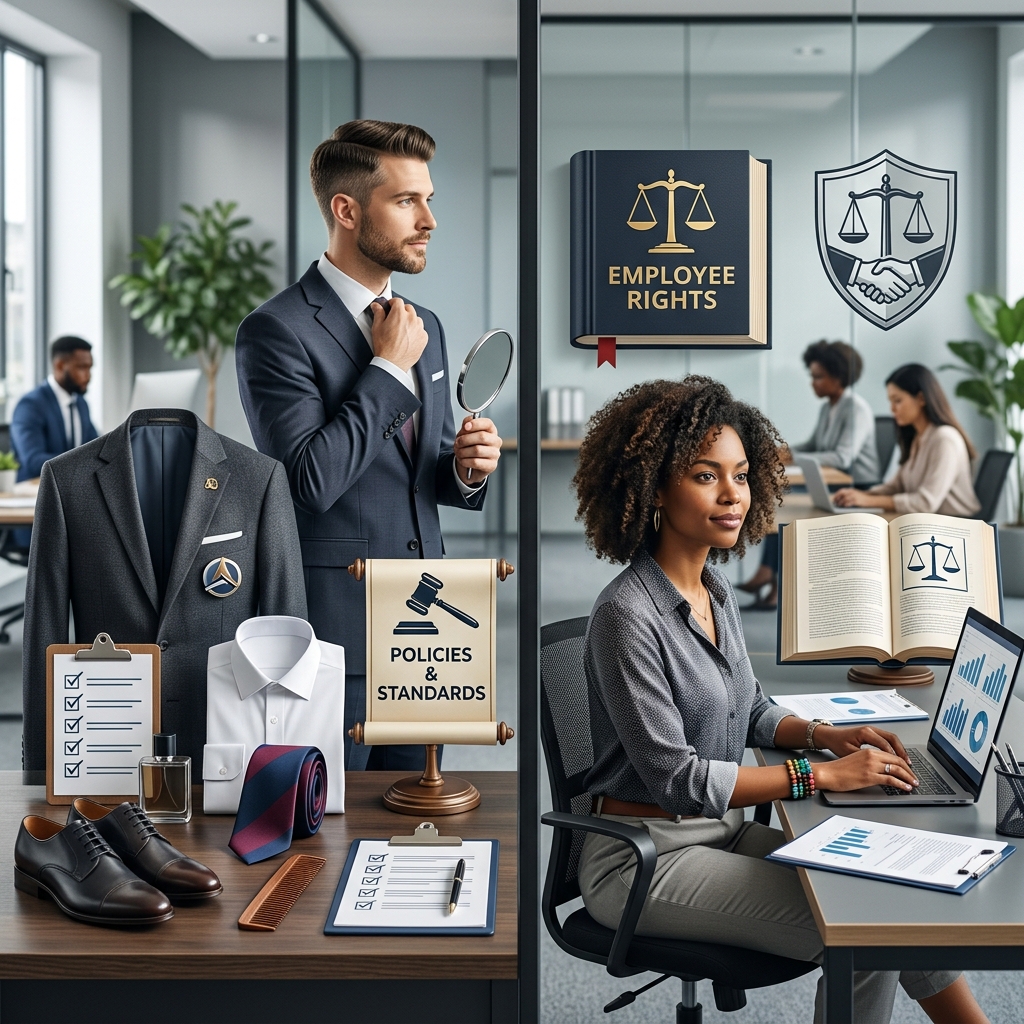
Employers often want workers to look neat, professional, and consistent with the company image. In many workplaces, that means rules about uniforms, hairstyles, facial hair, makeup, jewelry, or even hygiene. Those policies are usually lawful when they are applied fairly and tied to legitimate business needs. Problems arise when appearance rules single out protected groups, burden religious practice, or are enforced unevenly.
This article explains how grooming and appearance requirements work in the employment setting, what employers may usually require, and where discrimination law places limits on those rules. It also outlines common situations where a dress code may become unlawful and what employees can do if they believe a policy is being used unfairly.
Why employers set appearance standards
Appearance policies serve several practical purposes. A business may want to present a polished image to customers, promote safety, support hygiene, or ensure that workers are easily identified. In some jobs, such as hospitality, public safety, health care, or customer-facing retail work, the employer may place greater emphasis on a uniform look or tidy grooming because the work environment depends heavily on public trust and professional presentation.
Appearance standards can also help reduce confusion in the workplace. A uniform can make employees easier to recognize. Grooming rules may reduce risks from loose clothing, long hair near machinery, or jewelry that could interfere with equipment. In this way, a policy may be related not just to aesthetics, but also to operational concerns.
Common rules employers may lawfully impose
In general, an employer may require workers to follow a dress code, wear a uniform, or maintain a neat and professional appearance. A lawful policy may address the following:
- Clean and appropriate clothing
- Uniforms and dress standards for specific roles
- Hair length or hairstyle restrictions when tied to safety or business needs
- Limits on visible jewelry or accessories in certain jobs
- Rules about facial hair, makeup, or nail appearance
- Basic hygiene expectations, including clean clothing and personal cleanliness
Employers are also allowed to create different standards for different categories of employees when there is a reasonable business reason. For example, customer-facing staff may be held to a stricter appearance standard than back-office employees. A warehouse worker may face different clothing requirements than a receptionist if the job duties are different.
When appearance rules become a legal problem
A grooming or dress code can become unlawful when it treats employees differently because of a protected characteristic. Federal law, especially Title VII of the Civil Rights Act, prohibits employment discrimination based on race, color, religion, sex, and national origin. Title VII also protects workers from discrimination based on sexual orientation and gender identity. If an appearance rule is connected to one of these protected categories, it may violate the law.
The most common legal issues arise when a policy is not applied evenly, or when it places a special burden on one group of workers. Even a neutral-looking rule can be discriminatory if it is used selectively or if it operates in a way that harms a protected class without a strong business justification.
Sex-based grooming standards
Employers sometimes maintain separate appearance rules for men and women. Courts have often allowed different grooming standards if they are reasonable, consistently enforced, and grounded in business needs. For example, a company may require men to keep short hair while allowing women more flexibility with hair length. In some workplaces, women may be asked to wear makeup or more formal attire, while men are required to maintain a clean-shaven or neatly trimmed look.
These standards are not automatically unlawful, but they are closely watched. The key issue is whether the overall burden on employees is comparable and whether the policy reflects legitimate business interests rather than stereotypes. A rule that looks neutral in wording may still be discriminatory if it imposes an unequal burden on one sex or is enforced in a biased way.
Examples of potentially problematic sex-based policies include:
- A makeup requirement imposed only on women without a defensible business reason
- A strict hair-length rule enforced only against men for no operational purpose
- A grooming policy that targets one employee because of gender nonconformity
- Different disciplinary treatment for the same appearance violation based on sex
Religion and workplace appearance
Religious accommodation is another major limit on grooming rules. Employees may have beliefs that require certain hairstyles, head coverings, facial hair, or clothing. When a dress code conflicts with sincerely held religious practice, the employer generally must try to provide a reasonable accommodation unless doing so would create an undue hardship.
That means an employer cannot simply enforce a uniform policy without considering the employee’s request. If a worker needs to wear a hijab, yarmulke, turban, beard, or other religious garment, the employer should evaluate whether the item can be allowed safely and without major disruption. The legal question is not whether the employer prefers a uniform look, but whether the requested accommodation would cause significant difficulty or expense in light of the employer’s business.
A religious accommodation request is often strongest when the employee can explain the practice clearly and when the accommodation does not affect safety, sanitation, or essential job duties. If a policy prohibits the religious item, the employer should consider alternatives such as modified uniforms, badge placement changes, or reassignment away from a narrow safety issue.
Safety, hygiene, and job-related exceptions
Some grooming restrictions are easier to justify because they are tied to safety or sanitation. For example, long hair may need to be tied back near machinery. Loose jewelry may be prohibited where it could catch on equipment. Beard length may be limited where respirators must seal properly. Food service or medical jobs may require stronger hygiene standards than office work.
The more closely a rule is connected to the actual job, the more likely it is to be upheld. Employers generally have more discretion when the policy reduces risk, supports health standards, or prevents interference with work performance. Even so, the rule should still be specific, reasonable, and applied consistently.
| Policy type | Usually allowed when… | Potential legal issue |
|---|---|---|
| Uniform requirement | It supports branding, safety, or identification | It is enforced only against certain groups |
| Hair or beard rule | It relates to safety, hygiene, or equipment use | It is based on gender stereotypes |
| Religious clothing exception | The employer can accommodate without undue hardship | The employer refuses without considering accommodation |
| Makeup or presentation rule | It is reasonable and evenly imposed | It applies only to one sex with unequal burden |
Selective enforcement is a warning sign
Even a lawful policy can become unlawful if it is enforced in a discriminatory way. For example, a company may have a written rule about appearance but only discipline employees from a certain racial background, religion, or sex. In that situation, the problem is not only the policy itself but also how it is used.
Uneven enforcement can show up in several ways:
- One employee is punished for a hairstyle that others are allowed to wear
- Managers overlook violations by favored workers but not others
- A policy is announced as neutral but applied more harshly to a protected group
- Requests for exceptions are granted to some workers but denied to others without explanation
Documentation matters in these cases. Employees who believe they are being singled out should keep records of written warnings, emails, photos of comparable treatment, and any requests they made for exceptions or accommodations.
What employees can do if a policy seems unfair
An employee who believes a grooming rule is discriminatory should start by reviewing the written policy and any handbooks or workplace notices. It is often useful to compare the rule with how it is actually enforced. A policy may be lawful on paper but unlawful in practice.
Practical steps may include:
- Asking for the rule in writing
- Requesting a religious or medical accommodation if applicable
- Documenting conversations with supervisors
- Noting whether coworkers are treated differently
- Speaking with human resources about the concern
If internal complaints do not resolve the issue, the employee may consider filing a charge with the Equal Employment Opportunity Commission or the relevant state agency. In some cases, a lawyer can help determine whether the policy violates anti-discrimination law and what remedies may be available.
How employers can build safer, fairer appearance policies
Employers reduce legal risk by drafting policies that are specific, job-related, and consistently enforced. A strong policy should explain what is required, why the rule exists, and whether exceptions are allowed. It should also make clear that accommodations may be available for religious practice or disability-related needs when appropriate.
Good policy design usually includes the following elements:
- Clear written standards for uniforms and grooming
- Job-based reasons for safety restrictions
- Training for managers on equal enforcement
- A process for requesting accommodations
- Review of policies for sex, race, religion, and national origin issues
Employers should also avoid relying on outdated assumptions about professionalism. A requirement should be linked to the actual job, not to stereotypes about how a person should look because of gender or culture. That approach not only lowers legal risk but also helps create a more respectful workplace.
Frequently asked questions
Can an employer require a uniform?
Yes. Employers can generally require uniforms as long as the policy is lawful, applied fairly, and not used to discriminate against a protected group.
Can a company tell employees how to wear their hair?
Sometimes. Hair rules may be allowed when they are related to safety, hygiene, or a genuine business need. However, a rule that targets a protected group or creates an unequal burden may be illegal.
Does an employer have to allow religious clothing?
Usually, yes, unless the employer can show that an accommodation would create an undue hardship. The employer should consider reasonable alternatives before refusing the request.
Can men and women be held to different grooming standards?
In some circumstances, yes, but the standards must be reasonable, fairly enforced, and justified by business considerations. Unequal burdens or discriminatory motives can make the policy unlawful.
What if the dress code is applied only to one employee?
That may be a warning sign of discrimination. A rule applied only to one person, or only to members of a protected group, can support a legal claim depending on the facts.
Are makeup rules legal?
They can be, but they are closely scrutinized. A makeup requirement that applies only to women or places a one-sided burden on a protected group may raise sex discrimination concerns.
Key takeaways for workers and employers
Workplace grooming rules are not automatically illegal, and many businesses can set expectations for neatness, uniforms, and professional appearance. The law becomes important when those rules intersect with protected traits such as sex, religion, race, or national origin. Employers need to make sure their policies are clear, job-related, and evenly enforced. Employees, meanwhile, should know that they may have rights if an appearance rule conflicts with religious practice or is used in a discriminatory way.
When a grooming policy is questioned, the central issues are usually fairness, consistency, and business necessity. If an employer can explain the rule with a legitimate reason and applies it evenly, the policy is more likely to survive legal scrutiny. If not, it may cross the line from workplace management into unlawful discrimination.
References
- CM-619 Grooming Standards — U.S. Equal Employment Opportunity Commission. 2006-03-01. https://www.eeoc.gov/laws/guidance/cm-619-grooming-standards
- Title VII of the Civil Rights Act of 1964 — U.S. Equal Employment Opportunity Commission. 1964-07-02. https://www.eeoc.gov/statutes/title-vii-civil-rights-act-1964
- EEOC Enforcement Guidance on Harassment in the Workplace — U.S. Equal Employment Opportunity Commission. 2024-04-29. https://www.eeoc.gov/laws/guidance/enforcement-guidance-harassment-workplace
- Dress Codes and Grooming Standards — Texas Workforce Commission. 2024-01-01. https://efte.twc.texas.gov/dress_codes.html
- Title VII and Religious Accommodation — U.S. Equal Employment Opportunity Commission. 2023-06-01. https://www.eeoc.gov/religious-discrimination
Similar Articles








Read full bio of Sneha Tete




