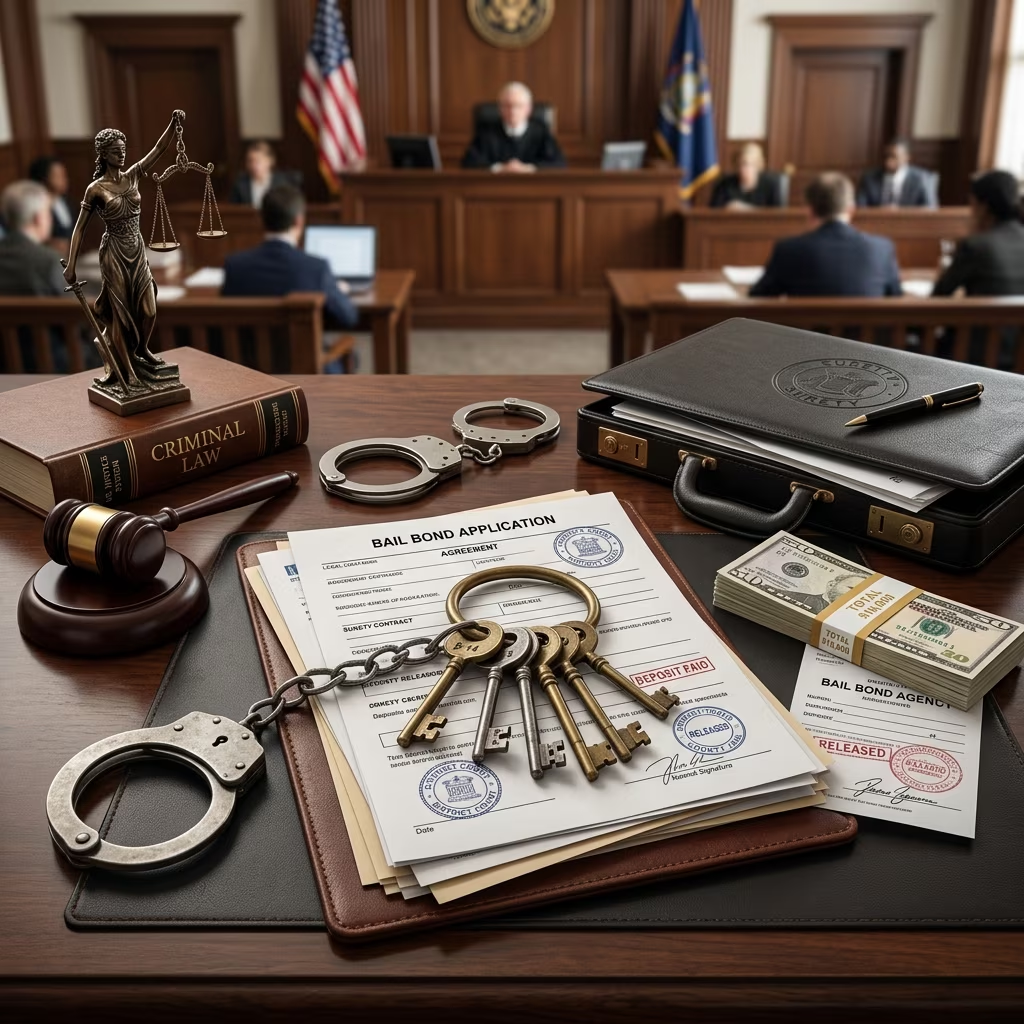
Bail and bail bonds play a crucial role in the pretrial phase of criminal cases in the United States. They determine whether a person accused of a crime remains in jail or is released while their case is pending. For many families, bail decisions are the first serious encounter with the justice system and can have major financial and personal consequences.
This guide explains what bail is, how bail bonds work, why they are used, and what options defendants and loved ones have. It is designed for non-lawyers who need a clear, practical overview of the bail process and its implications.
1. What Is Bail and Why Does It Exist?
Bail is a monetary or property-based guarantee used to secure the release of a defendant before trial, on the condition that they return to court as required. If the defendant appears at all hearings, the amount is typically refunded or the property is released; if they fail to appear, the bail can be forfeited.
1.1 Core Purposes of Bail
- Ensure court appearance: Bail acts as an incentive for defendants to return for hearings and trial.
- Allow pretrial liberty: It permits defendants to remain in the community rather than in jail while presumed innocent.
- Protect community safety: Modern laws sometimes allow detention or stricter conditions if a defendant is considered a danger or high flight risk.
Historically, bail in the United States evolved from a system based on personal pledges and sureties, where people promised to appear and risked financial penalties if they did not. Over time, cash deposits and commercial bail bonds became central features of the system.
1.2 Bail vs. Bond: Key Distinctions
The terms “bail” and “bond” are related but not identical:
- Bail: The money or property that may be forfeited if the defendant does not appear in court.
- Bond: A formal agreement that sets the conditions of release, which can include financial commitments or other obligations.
A bond can be secured with cash, property, or a third-party guarantee (such as a commercial bail bond company). In practice, people often use “bail” and “bond” interchangeably, but the distinction matters when discussing legal documents and responsibilities.
2. How Bail Is Set in Criminal Cases
After an arrest, bail is typically addressed at an initial appearance or bail hearing before a judge or magistrate. In many jurisdictions, there are standard amounts, but judges have wide discretion to increase, lower, or waive bail depending on the case.
2.1 Common Factors Judges Consider
- Seriousness of the charge (for example, violent felony vs. minor misdemeanor)
- Defendant’s criminal history, including prior failures to appear
- Risk of flight: ties to the community, employment, family, and housing stability
- Potential danger to others or the community
- Ability to pay, although some courts have faced criticism for insufficiently considering this factor
Judges may decide to:
- Set a specific monetary bail amount
- Release the defendant on their own recognizance (a promise to appear without paying money)
- Impose non-monetary conditions, such as supervision, electronic monitoring, or travel restrictions
- Order detention in serious cases where the law allows preventive detention
2.2 Bail Schedules and Discretion
Some jurisdictions use bail schedules, which list standard bail amounts for particular offenses. These schedules provide a starting point, but judges are usually permitted to adjust amounts based on individual circumstances. That discretion has been a focus of reform efforts, as advocates argue that high bail amounts can lead to prolonged detention for people who are legally presumed innocent but unable to pay.
3. Types of Bail and Bonds
There are several recognized types of bail and related bond arrangements. Understanding these options can help defendants and families decide how to proceed.
| Type | Who Pays or Pledges | Key Features |
|---|---|---|
| Full cash bond | Defendant or family pays total amount to court | Refundable if all court appearances are made; forfeited if defendant fails to appear |
| Deposit bond | Defendant pays a percentage (often about 10%) directly to court | Percentage is mostly refunded after case, with small administrative deduction; full amount owed if failure to appear |
| Surety bond (commercial bail bond) | Bail bond company guarantees full amount; defendant pays a nonrefundable fee | Fee usually around 10–15% of bail and is not returned; collateral may be required; company liable if defendant fails to appear |
| Property bond | Defendant or family pledges real property valued at full bail amount | Property may be forfeited if defendant fails to appear |
| Unsecured bond | Defendant signs a promise to pay if they miss court | No upfront payment; debt becomes enforceable if defendant fails to appear |
3.1 Own Recognizance Release
In many cases, especially for lower-level charges, a judge may release a defendant on their own recognizance, meaning the person promises to appear and follow conditions without paying money. This approach reflects the idea that detention should not depend solely on ability to pay.
4. How Commercial Bail Bonds Work
When bail is set higher than a defendant or family can afford, they may turn to a commercial bail bond company. The United States is one of the few countries where commercial bail bonding is widespread.
4.1 Basic Mechanics
- The court sets a bail amount (for example, $20,000).
- The defendant or family contacts a licensed bail bond agent.
- The agent charges a nonrefundable fee, commonly around 10–15% of the total bail (for a $20,000 bail, this might be $2,000–$3,000).
- The agent posts a surety bond with the court, promising to pay the full bail if the defendant does not appear.
- The defendant is released from jail once the bond is accepted.
Because the fee is nonrefundable even if the defendant attends all hearings and the case is dismissed or acquitted, commercial bail bonds can be expensive. Agents frequently require collateral such as a car, house, or other valuable property to secure their risk.
4.2 Responsibilities and Consequences
After a commercial bond is posted:
- The defendant must attend all court dates and comply with conditions of release.
- If the defendant fails to appear, the court may require the bond company to pay the full bail amount.
- The bond company may then use collateral to recover what it pays, which can result in loss of property for the defendant or family.
Some bond companies also monitor defendants, remind them of court dates, and may attempt to locate them if they miss a hearing. These practices reflect the financial risk they assume when posting surety bonds.
5. Financial and Social Impacts of Cash Bail
Cash bail and commercial bail bonds have far-reaching economic and social consequences. The median bail bond in some analyses reaches around $10,000, an amount that can equal several months of income for typical detained individuals. For families living paycheck to paycheck, obtaining bail money or paying bond fees can be extremely difficult.
5.1 Economic Burden
- Nonrefundable fees mean that even successful appearances lead to lasting financial losses.
- Collateral pledged for bonds can be at risk if something goes wrong—for example, property may be seized after a missed court date.
- Pretrial detention due to inability to pay can result in job loss, missed rent payments, and other cascading financial harms.
Research indicates that bail practices often have disproportionate effects on low-income communities and people of color. Studies have found that Black and Latino men, for similar alleged offenses, tend to receive higher bail amounts than white men. These disparities have driven calls for systemic reform.
5.2 Consequences of Staying in Jail Pretrial
- Defendants may feel pressure to plead guilty simply to get out of jail, even if they have viable defenses.
- Remaining detained can hinder the ability to work with counsel, gather evidence, and participate effectively in the defense.
- Time in pretrial detention can lead to loss of employment, housing instability, and family disruption.
These impacts have prompted courts, legislatures, and advocacy organizations to reconsider the role and structure of cash bail in the modern justice system.
6. Recent Trends and Reforms in Bail Practices
In recent years, several states and local jurisdictions have undertaken significant reforms to reduce reliance on cash bail, especially for lower-level offenses.
6.1 State-Level Changes
- Illinois adopted statewide legislation eliminating cash bail, fully taking effect in 2023, shifting toward non-monetary conditions and judicial assessments of risk.
- New Jersey moved away from traditional monetary bail by emphasizing risk-based assessments and alternative supervision, substantially reducing pretrial jail populations.
- New York implemented reforms reducing the use of bail for many misdemeanors and nonviolent felonies, requiring judges to consider non-monetary options.
Courts have also issued decisions stating that people cannot be detained solely because they cannot afford bail, reinforcing constitutional principles of due process and equal protection.
6.2 Risk Assessment and Non-Monetary Conditions
Some jurisdictions now use risk assessment tools, which assign scores based on factors like prior failures to appear and criminal history. These tools are controversial, but they are intended to help judges decide whether to release defendants, impose conditions, or detain them.
Alternative measures to money bail can include:
- Regular check-ins with pretrial services
- Text or phone reminders of court dates
- Electronic monitoring or home confinement
- Travel or contact restrictions
The overarching aim of these reforms is to balance public safety and court appearance with fairness and reduced reliance on wealth-based detention.
7. Practical Steps for Defendants and Families
If a loved one has been arrested and bail is set, the situation can be overwhelming. While the details vary by state and county, some general steps are helpful.
7.1 Immediately After Bail Is Set
- Obtain key information: the bail amount, the charges, the booking number, and the location of custody.
- Contact a defense attorney as soon as possible for case-specific advice.
- Ask the lawyer whether a bail reduction or recognizance release might be requested at a hearing.
- Discuss whether paying cash, using a deposit bond, or contacting a commercial bail agent is advisable in your situation.
7.2 Evaluating Commercial Bail Bonds
When considering a commercial bail bond, families should:
- Verify that the bail bond agent is properly licensed under state law.
- Understand the exact fee percentage and confirm that it is nonrefundable, regardless of case outcome.
- Review all collateral requirements and potential consequences if the defendant misses court.
- Keep copies of all contracts, receipts, and communication with the bond company.
7.3 Maintaining Compliance After Release
After a defendant is released on bail or bond, careful attention to conditions is essential:
- Record all court dates and set multiple reminders.
- Follow any travel restrictions, contact limitations, or reporting requirements.
- Stay in close communication with the attorney and inform them immediately of any problems.
- Notify the court and counsel if circumstances change (for example, a change of address), consistent with local rules.
Compliance protects both the defendant’s liberty and any money or property posted as bail.
8. Frequently Asked Questions (FAQs)
8.1 Do I get my bail money back?
If you posted bail directly to the court (as a full cash bond or deposit bond), the money is generally returned after the case is completed, as long as all court appearances were made. Courts may keep a small administrative fee in deposit bond arrangements. However, if you paid a commercial bail bond company a fee, that fee is usually nonrefundable.
8.2 Can bail be changed after it is set?
Yes. Defendants or their attorneys can request a bail review or reduction. The judge may consider new information about the defendant’s circumstances, risk level, or ability to pay and may adjust the amount or conditions. Outcomes depend on local law and the specifics of the case.
8.3 What happens if the defendant misses a court date?
A missed appearance can lead to a warrant, forfeiture of bail, and potential loss of any collateral posted. For commercial bonds, the bond company may be required to pay the full amount to the court and can seek to recover what it paid from the defendant or co-signers. It is critical to contact the attorney and court immediately if a hearing is missed because, in some circumstances, the court may reschedule rather than enforce forfeiture, but this is not guaranteed.
8.4 Is cash bail used everywhere in the United States?
No. While many jurisdictions still rely on cash bail, several states have reduced or eliminated its use for many offenses, instead using risk-based release decisions and non-monetary conditions. Practices vary widely across states and even within states, so local rules are important.
8.5 Are bail bonds available for all types of charges?
In most ordinary criminal cases, some form of bail or bond may be available. However, for certain serious offenses or where the law permits preventive detention, judges can order that the defendant remain in custody without bail if they are found to pose a significant danger or flight risk. Whether a commercial bail bond company will agree to post a bond also depends on its own risk assessment and policies.
References
- Bail in the United States — Wikipedia (summary of U.S. bail practices, with references to statutes and case law). 2023-09-18. https://en.wikipedia.org/wiki/Bail_in_the_United_States
- The Bail Bond System and Rule of Law — American Bar Association. 2021-08-01. https://www.americanbar.org/groups/public_education/publications/insights-on-law-and-society/volume-21/issue-3/the-bail-bond-system-and-rule-of-law/
- How Cash Bail Works — Brennan Center for Justice. 2021-02-23. https://www.brennancenter.org/our-work/research-reports/how-cash-bail-works
- Bail — Bureau of Justice Statistics, U.S. Department of Justice. 2019-06-01. https://bjs.ojp.gov/taxonomy/term/bail
- Bail System — EBSCO Research Starters, Law. 2018-01-01. https://www.ebsco.com/research-starters/law/bail-system
- Bail at the Founding — Harvard Law Review. 2023-01-01. https://harvardlawreview.org/print/vol-137/bail-at-the-founding/
- Bail vs. Bond: Is There a Difference? — The Bail Project. 2020-07-15. https://bailproject.org/learn/bail-vs-bond-is-there-a-difference/