
Search Warrants vs. Arrest Warrants: A Practical Legal Guide
Understand how search warrants and arrest warrants work, why they matter for your rights, and what to do if officers show up at your door.
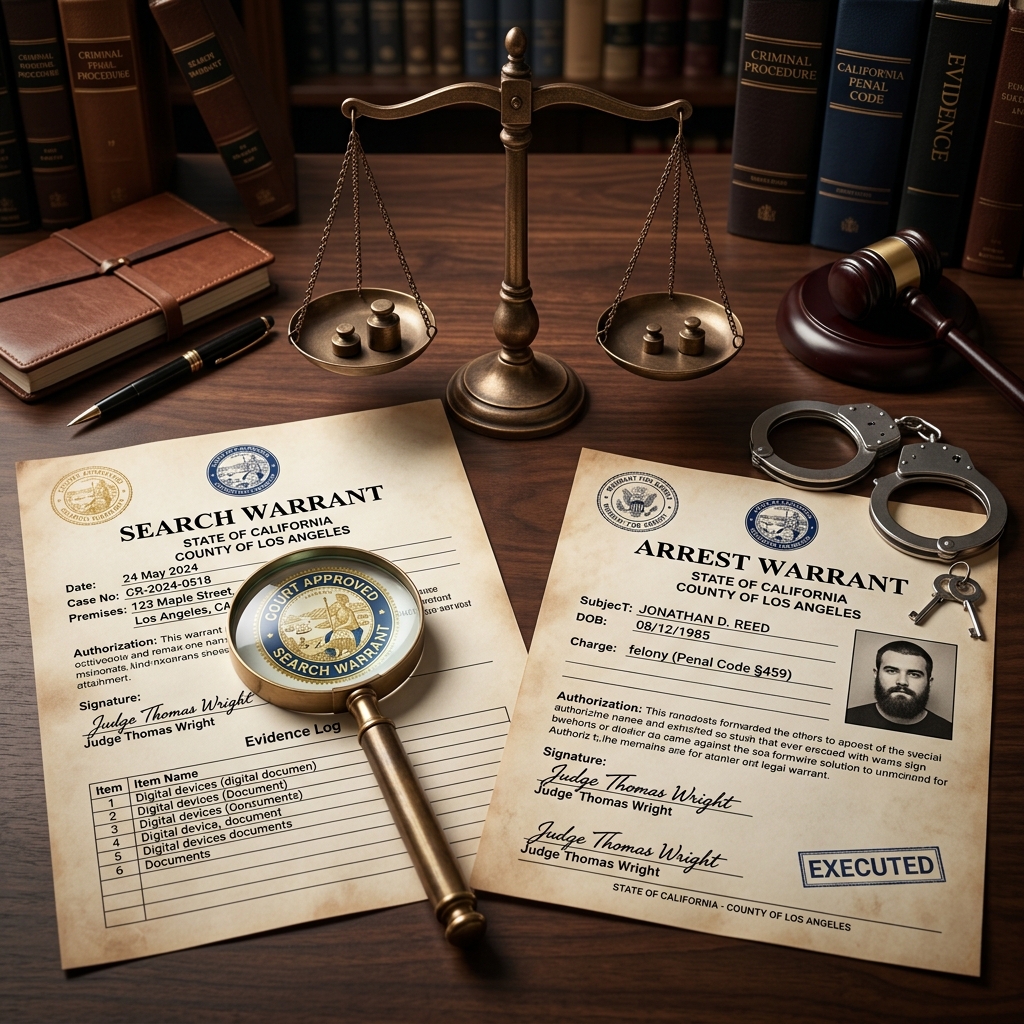
Warrants are among the most powerful tools in the criminal justice system because they authorize law enforcement to intrude on privacy and personal liberty under court supervision. Understanding the difference between a search warrant and an arrest warrant is crucial for anyone who may interact with police—whether as a suspect, a witness, or simply a homeowner whose property is being searched.
This guide explains what each type of warrant is, how they are obtained, how long they remain valid, and what rights you have when officers execute them, with a focus on U.S. law and the protections of the Fourth Amendment.
Foundations: What Is a Warrant?
At its core, a warrant is a written court order that authorizes law enforcement to take a specific action—typically to search for evidence or to arrest a person. The warrant must be issued by a judge or magistrate and is usually based on evidence demonstrating probable cause, meaning there is a reasonable basis to believe a crime was committed or that evidence of a crime can be found at a particular place.
- Judicial approval: A neutral judge or magistrate must review sworn statements before authorizing an arrest or search.
- Probable cause requirement: Officers must present facts supporting a reasonable belief that a crime occurred or that evidence is located in a particular place or that a specific person committed the crime.
- Written order: The warrant is typically a formal written document directing officers to carry out the authorized action.
These safeguards exist because the Fourth Amendment protects people against unreasonable searches and seizures and generally requires warrants for significant intrusions into privacy and liberty.
Search Warrants: Focus on Places and Things
A search warrant is a court order that authorizes law enforcement to search a clearly described location or person for specified evidence of a crime. The focus is on finding and seizing items, not on immediately arresting someone.
Key Features of Search Warrants
- Purpose: To search a particular place (such as a home, business, vehicle, or electronic device) for evidence related to a suspected crime.
- Scope: Must describe with reasonable particularity the location to be searched and the items to be seized, limiting what officers may do.
- Probable cause standard: The judge must find probable cause that evidence or the proceeds of a crime are likely present in the location specified.
- Time limits: Search warrants typically must be executed within a short period, often within about 10 days of issuance, or they expire.
- Result: Officers may seize evidence for use in criminal investigations and court proceedings if the search is properly conducted.
Fourth Amendment Protection and Particularity
The particularity requirement is central to search warrants. Officers are not given blanket authority to search anywhere they like; they are limited to the places and items described in the warrant.
For example, if a warrant authorizes the search of a home for stolen electronics, officers generally cannot rummage through areas that could not reasonably contain such items. This specificity protects privacy by preventing general exploratory searches.
Execution of Search Warrants
When executing a search warrant, officers must follow legal rules that can include knock-and-announce requirements, time-of-day restrictions, and procedures for documenting seized items. While there are exceptions, like exigent circumstances that may allow immediate entry, the basic principle is that searches should be planned and supervised under judicial oversight.
Arrest Warrants: Focus on People
An arrest warrant is a court order directing law enforcement to take a specific person into custody because there is probable cause that the individual committed a crime. Unlike a search warrant, which targets locations and objects, an arrest warrant targets an identifiable person.
Key Features of Arrest Warrants
- Purpose: To authorize the detention of a person suspected of committing a criminal offense.
- Focus: Identifies the individual by name (or sufficient description) and the alleged offense.
- Probable cause standard: The judge must find probable cause to believe the named individual committed the crime.
- Duration: Unlike most search warrants, arrest warrants typically remain valid until executed or recalled by the court.
- Result: The warrant leads to the person’s arrest, which in turn may lead to formal charges, court appearances, and potential pretrial detention.
Legal Basis for Arrest Warrants
Under the Fourth Amendment, an arrest is considered a seizure of a person, which ordinarily requires a warrant supported by probable cause, unless a recognized exception applies (such as an officer witnessing a crime or certain exigent circumstances).
Arrest warrants are typically issued before criminal proceedings formally begin and serve as the court’s directive to law enforcement to bring the accused before the judicial system.
Main Differences Between Search and Arrest Warrants
Although both types of warrants rely on probable cause and judicial authorization, they differ in purpose, scope, and practical impact.
| Feature | Search Warrant | Arrest Warrant |
|---|---|---|
| Main purpose | Locate and seize evidence or contraband related to a crime. | Detain a specific individual suspected of committing a crime. |
| Primary focus | Places and things (property, records, digital devices). | People (a named suspect). |
| Probable cause required | Evidence or proceeds of crime are at the location to be searched. | Person named in the warrant committed the alleged offense. |
| Time validity | Limited; often must be executed within a set period (e.g., about 10 days). | Generally remains in effect until executed or withdrawn by the court. |
| Impact on rights | Intrudes on privacy and property interests by allowing search and seizure. | Directly restricts personal liberty by authorizing detention. |
| Result of execution | Evidence collected for investigation and potential prosecution. | Suspect brought into custody for charging and court proceedings. |
How Warrants Are Obtained
The process for obtaining search and arrest warrants is similar in many respects, but differs in what the officer must prove to the judge.
Affidavits and Probable Cause
To secure either type of warrant, law enforcement officers prepare affidavits—sworn written statements describing the facts that support probable cause.
- Content of affidavits: May include the officer’s own observations, witness statements, information from informants, and physical or digital evidence.
- Oath requirement: Affidavits are made under oath, and false statements can expose the officer to legal consequences.
- Judicial review: A judge or magistrate examines the affidavit to determine whether the facts meet the probable cause standard.
In many jurisdictions, judges are available around the clock to review warrant applications, reflecting the importance of balancing law enforcement needs with constitutional rights.
Differences in the Showing Required
- For a search warrant: The affidavit must show why officers reasonably believe that evidence, contraband, or the fruits of a crime are located in the place to be searched.
- For an arrest warrant: The affidavit must support a reasonable belief that the individual named committed a specific crime.
While both rely on probable cause, judges scrutinize different aspects of the case depending on whether the request involves searching property or seizing a person.
Duration and Validity of Warrants
Another important difference between search and arrest warrants concerns how long they remain valid and under what conditions they can be used.
Search Warrant Time Limits
Search warrants commonly expire if not executed within a relatively short period after issuance. Some jurisdictions require execution within roughly ten days, after which officers must seek a new warrant if they still wish to search.
These limits help ensure that the information supporting probable cause is still fresh, reducing the risk that outdated facts support intrusive searches.
Arrest Warrant Longevity
Arrest warrants generally do not have fixed expiration dates. Once approved based on probable cause, they remain valid until officers execute them or the court cancels them.
Because the goal is to bring a person before the court, the warrant stays in effect until that objective is met, unless there’s a legal reason to withdraw or quash it.
Your Rights When Faced With a Warrant
Whether officers present a search or an arrest warrant, you retain important constitutional rights. Knowing these rights can help you respond calmly and lawfully while protecting yourself.
During a Search Warrant Execution
- Right to review the warrant: You may ask to see the warrant to confirm the location, items, and judge’s authorization.
- Right to remain silent: You are generally not required to answer questions that could incriminate you.
- Limited scope of search: Officers must stay within the areas and items described in the warrant, subject to specific legal exceptions.
- Documentation of seized property: Officers typically provide an inventory or receipt of items taken during the search.
During Execution of an Arrest Warrant
- Right to know the basis for arrest: Officers should inform you that they have a warrant and the general nature of the charges.
- Right to remain silent and to counsel: You retain the right not to answer questions and to request an attorney, especially after formal charges are filed.
- Protection against unreasonable force: The use of force must be reasonable and proportionate to the situation.
In both scenarios, asserting your rights respectfully and seeking legal counsel as soon as possible is typically the best course of action.
Common Misunderstandings About Warrants
People often misunderstand what warrants allow officers to do and when they are required. Some frequent misconceptions include:
- “Police always need a warrant to search” — In reality, there are exceptions, such as consent searches, searches incident to lawful arrest, and certain exigent circumstances.
- “A search warrant allows officers to arrest anyone present” — A search warrant primarily authorizes a search, not arrests, although officers may arrest someone if they have separate legal grounds.
- “An arrest warrant gives officers unlimited search authority” — Arrest warrants allow officers to detain the named person, but do not automatically authorize broad searches of property beyond what the law permits incident to arrest.
Practical Tips If Police Mention a Warrant
If officers say they have, or will seek, a warrant, consider the following practical steps:
- Stay calm and avoid physical confrontation.
- Politely ask whether they have a search warrant or an arrest warrant.
- Request to see the warrant if they claim to have one.
- Avoid consenting to additional searches beyond what the warrant authorizes.
- Exercise your right to remain silent if answering questions could incriminate you.
- Contact a qualified criminal defense attorney as soon as possible for advice.
FAQs About Search Warrants and Arrest Warrants
Do police always need a warrant to search my home?
Not always. The general rule under the Fourth Amendment is that officers need a warrant based on probable cause to enter and search a home, but there are exceptions, such as consent from an occupant or urgent circumstances involving safety or imminent destruction of evidence.
Can a search warrant become invalid if executed too late?
Yes. Many jurisdictions require that search warrants be executed within a limited period after issuance, often around ten days. If officers wait too long, the warrant may expire and they would need to seek a new warrant to lawfully search.
What happens after I am arrested on an arrest warrant?
After arrest, you are typically brought before a court for an initial appearance or arraignment, where you are informed of the charges, may be advised of your rights, and conditions of release or bail may be considered. The arrest warrant itself ceases to be the primary focus once formal proceedings begin.
Can evidence be suppressed if a warrant was defective?
Yes. If a court later finds that a warrant lacked probable cause, did not meet particularity requirements, or was executed unlawfully, evidence obtained through that warrant may be excluded from trial under the exclusionary rule, subject to certain exceptions like inevitable discovery.
Is there a difference between a bench warrant and an arrest warrant?
Yes, although both can lead to arrest. An arrest warrant typically follows a law enforcement request based on probable cause that a person committed a crime, while a bench warrant is issued directly by a judge, often when someone fails to appear in court or violates a court order.
References
- Differences Between Search Warrants and Arrest Warrants — LegalMatch Law Library. 2024-01-15. https://www.legalmatch.com/law-library/article/differences-between-search-warrants-and-arrest-warrants.html
- Understanding the Basics of Arrest Warrants and Search Warrants — My Rights Law Group. 2023-05-10. https://www.myrightslawgroup.com/blog/understanding-the-basics-of-arrest-warrants-and-search-warrants/
- 14.2 Warrants and Illegal Searches and Seizures — UNC School of Government Defender Manual. 2022-01-01. https://defendermanuals.sog.unc.edu/sites/default/files/pdf/14.2%20Warrants%20and%20Illegal%20Searches%20and%20Seizures.pdf
- CHAPTER 2: Search Warrants, Arrest Warrants, and Other Processes — Texas Municipal Courts Education Center Bench Book. 2022-01-01. https://www.tmcec.com/wp-content/uploads/2022/01/Bench_Book_-Chapter-2-1.pdf
- Different Kinds of Warrants: A Comprehensive Overview — Hirsch Law Group. 2023-03-20. https://hirschlawgroup.com/different-kinds-of-warrants/
Similar Articles








Read full bio of Sneha Tete




