
Undefined Criminal Investigator: 8 Essential Responsibilities
Learn how criminal investigators gather facts, build cases, and support prosecutions.
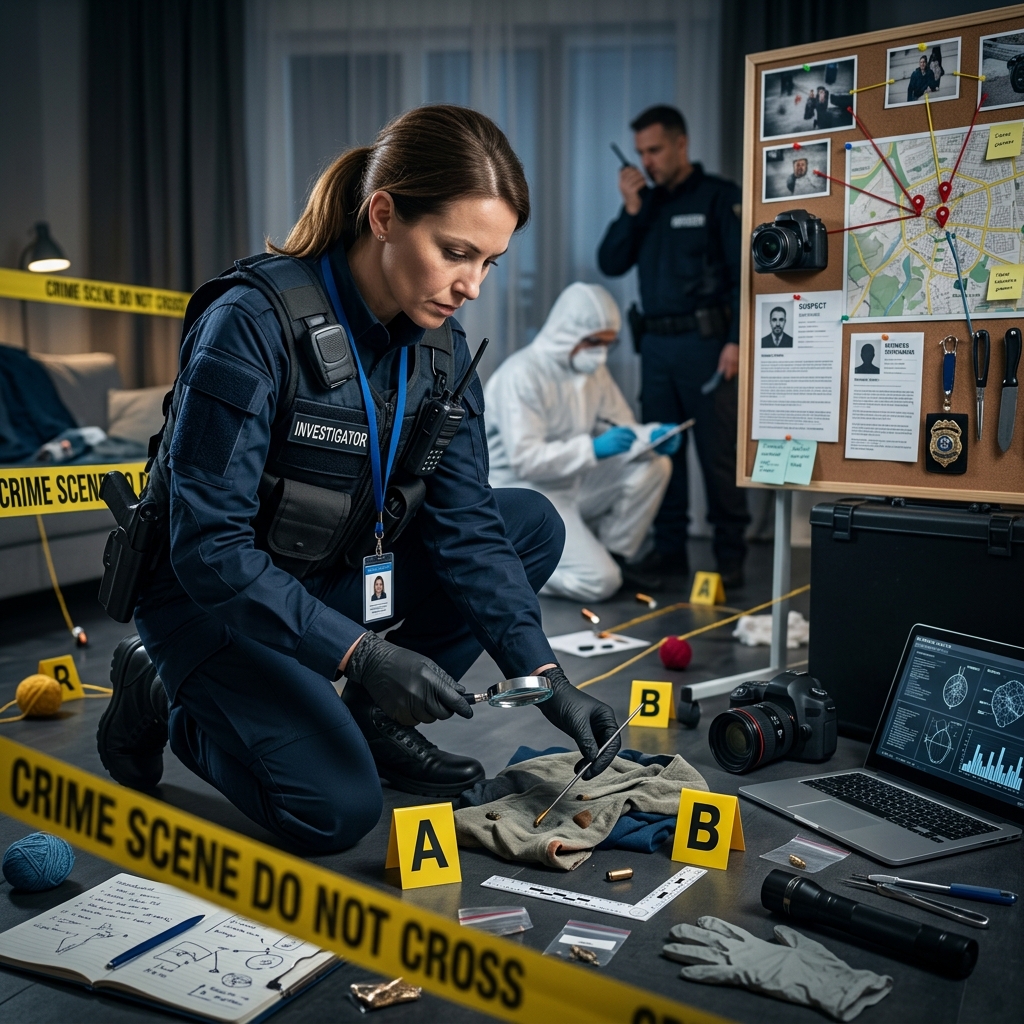
A criminal investigator is a trained professional who examines suspected crimes, gathers evidence, interviews people connected to the case, and helps determine what happened. In many cases, the investigator’s work supports law enforcement agencies and prosecutors as they decide whether a criminal charge can be proven in court.
The basic purpose of a criminal investigation
The main purpose of this work is not simply to collect facts. A criminal investigator must first decide whether an incident actually amounts to a crime, then identify the person or people responsible, and finally gather material that can support a prosecution. That process matters because a criminal case must be proven according to legal standards, not just suspicion or intuition.
Investigators often work on cases involving burglary, assault, homicide, fraud, theft, or other offenses. They may be employed by local police departments, state agencies, federal agencies, or, in some situations, private organizations that need specialized investigative services.
Typical responsibilities
The job can involve both fieldwork and office work. Some of the most common tasks include locating and preserving evidence, speaking with witnesses, reviewing records, and organizing case materials.
- Searching a crime scene for useful evidence
- Collecting physical items such as fingerprints, samples, or documents
- Analyzing evidence in a laboratory or through specialized tools
- Interviewing witnesses, victims, and suspects
- Reviewing photographs, videos, recordings, and other records
- Studying similar cases and relevant criminal laws
- Preparing reports and maintaining detailed records
- Assisting with warrants, arrests, or court testimony when needed
In practice, these responsibilities often overlap. A single interview may lead to a new piece of evidence, which then leads to another search request or a new line of inquiry. Criminal investigations are usually iterative rather than linear.
How investigators build a case
Investigation begins with information gathering. If a possible offense has occurred, the investigator tries to reconstruct the sequence of events and determine what evidence supports each part of that reconstruction.
| Stage | What the investigator tries to do |
|---|---|
| Initial assessment | Decide whether the facts suggest that a crime may have occurred |
| Identification | Determine who may have committed the offense |
| Evidence development | Collect facts that help prove the charges beyond a reasonable doubt |
| Case support | Organize information for prosecutors, reports, and testimony |
This structure reflects how criminal cases move from uncertainty to proof. The investigator’s role is to help convert scattered facts into a coherent case file that can withstand legal scrutiny.
Where criminal investigators work
Criminal investigators may work in a wide range of settings. Some are sworn law enforcement officers. Others are civilian specialists or private investigators with strong training in particular subject areas. Federal and state agencies may use investigators for highly complex matters, while local departments often rely on detectives or investigators to handle day-to-day criminal matters.
In some agencies, the term “detective” is used for an officer who investigates crimes, while “criminal investigator” may refer to a more specialized role or a civilian position. The exact title can vary by jurisdiction, agency, and job classification.
Skills that matter in the field
Success in this career depends on more than knowledge of criminal law. Investigators need the ability to observe carefully, think logically, communicate clearly, and remain organized under pressure.
- Attention to detail: Small facts can become crucial later
- Analytical thinking: Patterns and contradictions must be identified quickly
- Interviewing ability: People provide better information when questioned skillfully
- Documentation skills: Reports must be accurate and complete
- Legal awareness: Investigators must understand criminal procedure and evidentiary limits
- Persistence: Many cases require repeated follow-up and long hours
Investigators also benefit from knowledge of forensic methods, digital evidence, and the practical rules that govern searches, arrests, and courtroom use of evidence.
Evidence and forensic work
Evidence is at the center of criminal investigation. Some evidence is physical, such as fingerprints, biological samples, or items found at a scene. Other evidence may be digital, such as text messages, recordings, logs, or video files.
Forensic science can play a major role when investigators need to link a person, place, or object to a criminal event. In some cases, investigators work with specialists who analyze blood, trace materials, or other scientific evidence. Even when a laboratory is involved, the investigator remains responsible for understanding the significance of the results and placing them in the context of the case.
Witnesses, suspects, and interviews
Interviewing is one of the most important parts of the work. Investigators speak with witnesses to learn what they saw or heard, with victims to understand the impact and timeline of the offense, and with suspects to obtain statements or test explanations.
A strong interview can clarify events, expose inconsistencies, or uncover leads that were not obvious from the scene itself. The investigator must remain careful, however, because every statement may later become part of a report, a warrant application, or courtroom testimony.
How criminal investigators support prosecutors
The investigator’s work often continues after the initial scene response is complete. Prosecutors need evidence that proves each element of the offense, and investigators help collect, organize, and explain that evidence.
That support may include preparing case summaries, securing documents, verifying timelines, locating additional witnesses, and helping attorneys understand the investigative record. In some matters, the investigator may also testify in court about what was found, how evidence was handled, or how interviews were conducted.
Training and education
Requirements vary, but many positions expect at least some college education, and many employers prefer a bachelor’s degree in criminal justice, policing, or a related field. Experience in law enforcement or a related investigative role is often valuable as well.
Training may cover criminal law, crime scene procedure, report writing, firearms, safety, and investigative methods. Because the work can involve legal process as well as public safety concerns, investigators must understand how to collect information without violating constitutional or procedural rules.
Public and private investigation roles
Not every investigator works for the government. Some perform private investigative work for law firms, businesses, insurance companies, or private clients. These professionals may focus on fraud, background issues, asset tracing, or other fact-finding tasks rather than direct criminal prosecution.
Public investigators, by contrast, are usually part of an agency that enforces the law and contributes directly to criminal cases. Their authority, tools, and scope of work depend on the agency and the jurisdiction in which they operate.
Why the role is important
Criminal cases depend on proof, and proof depends on disciplined investigation. Without careful evidence collection and accurate fact-finding, prosecutors may not be able to establish what happened or who committed the offense.
That is why criminal investigators are often the bridge between a confusing incident and a legally usable case. They connect scene evidence, witness accounts, records, and expert findings into a form that investigators, attorneys, and juries can evaluate.
Frequently asked questions
What is the difference between a criminal investigator and a detective?
The titles are often used differently depending on the agency. In some places, a detective is a sworn officer assigned to investigations, while a criminal investigator may be a specialized or civilian position. In practice, the duties can overlap significantly.
Do criminal investigators always work for police departments?
No. They may work for local, state, or federal agencies, and some work in private settings. The exact employer depends on the type of case and the jurisdiction.
What kinds of cases do they handle?
They may work on violent crimes, property crimes, white-collar offenses, or specialized matters such as fraud and identity-related cases. Their assignment depends on agency needs and subject-matter focus.
Why is evidence so important in criminal investigations?
Evidence allows investigators and prosecutors to move from suspicion to proof. It helps establish what happened, who was involved, and whether the legal elements of the offense can be proven in court.
References
- What is a Criminal Investigator? – LegalMatch — LegalMatch. 2026-07-10. https://www.legalmatch.com/law-library/article/what-is-a-criminal-investigator.html
- What Does a Criminal Investigator Do? Solving Mysteries — American Public University System. 2026-07-10. https://www.amu.apus.edu/area-of-study/criminal-justice/resources/what-does-a-criminal-investigator-do/
- The Pros and Cons of Being a Criminal Investigator — Indeed. 2026-07-10. https://www.indeed.com/career-advice/finding-a-job/pros-cons-of-being-criminal-investigator
- How to Become a Criminal Investigator: A Comprehensive Guide — University of North Dakota. 2026-07-10. https://und.edu/blog/how-to-become-a-criminal-investigator.html
- How to Become a Criminal Investigator | Description & Salary — SkillPointe. 2026-07-10. https://skillpointe.com/careers/public-service/criminal-investigator
- Criminal Investigator Duties and Responsibilities — Evangeline Parish Sheriff. 2026-07-10. https://www.evangelineparishsheriff.org/section-700-criminal-investigator-duties-and-responsiblities
- Detectives & Criminal Investigators — My Next Move. 2026-07-10. https://www.mynextmove.org/profile/summary/33-3021.00
- Criminal Investigator — U.S. Customs and Border Protection Careers. 2026-07-10. https://careers.cbp.gov/s/career-paths/opr/criminal-investigator
Similar Articles








Read full bio of Sneha Tete




