
Uncontested Divorce In Colorado: 7 Essential Documents Guide
A practical guide to Colorado’s uncontested divorce process, filing steps, and key requirements.
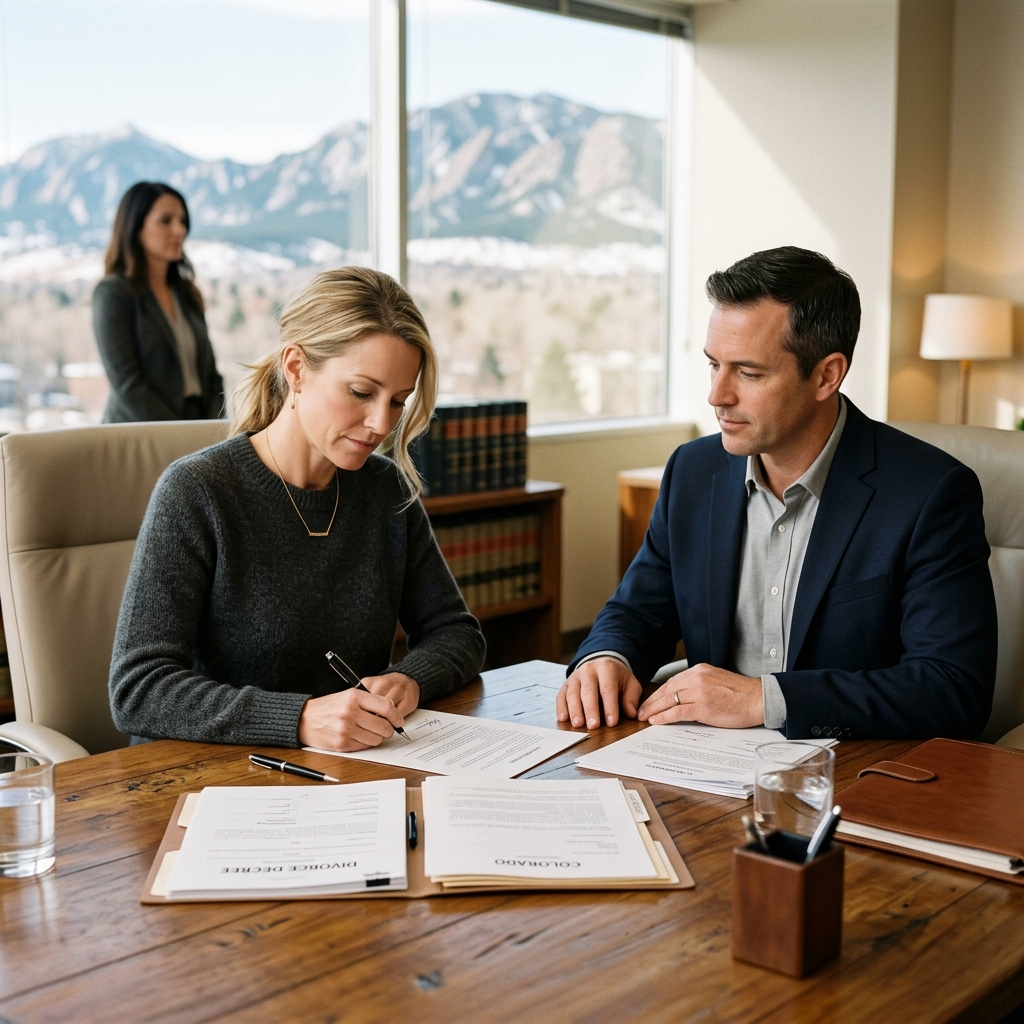
An uncontested divorce is often the simplest path for spouses who already agree on the main terms of ending a marriage. In Colorado, that means both people must be aligned on the legal basis for divorce and on every major issue the court must resolve, including property division, debt allocation, spousal support, and any arrangements affecting children.
Colorado still requires careful paperwork and a mandatory waiting period, even when both spouses cooperate. The process is streamlined compared with a contested case, but it is not automatic. The court will still review the filings to confirm that the case meets state requirements and that any agreement is complete and legally workable.
What makes a divorce uncontested?
A divorce is considered uncontested when neither spouse is asking the court to decide disputed issues. In practical terms, both parties should already have a full agreement on the terms of separation before asking for a final decree. That agreement typically covers the following:
- How marital property will be divided
- How debts will be assigned
- Whether either spouse will pay spousal maintenance
- How parenting responsibilities will be handled if children are involved
- How child support will be calculated and paid
If even one of those subjects remains unresolved, the case may shift into a contested track or require additional negotiation before the court can enter final orders.
Basic eligibility requirements in Colorado
Before filing, spouses must confirm that they qualify under Colorado law. One spouse must have lived in the state for at least 91 days before the case is filed. Colorado also recognizes only one ground for divorce: the marriage must be irretrievably broken.
For an uncontested case, both spouses should agree that the marriage cannot be repaired. That agreement matters because the court does not need to investigate fault or assign blame. Instead, it focuses on whether the legal requirements have been met and whether the parties’ settlement is complete.
The core documents you will usually need
Even in a cooperative case, the paperwork must be handled carefully. The exact forms can vary depending on whether the spouses file together, whether children are involved, and whether the case is handled with or without an appearance hearing. Common filings include:
- A petition for dissolution of marriage
- A case information sheet
- A sworn financial statement for each spouse
- Required financial disclosures exchanged between the parties
- A separation agreement
- A parenting plan, if minor children are involved
- A final decree of dissolution of marriage
Some cases may also require additional affidavits or certificates showing that disclosures were completed and exchanged. Missing or incomplete forms can delay the divorce even when both spouses agree on everything else.
Filing the case with the court
The process begins with filing the initial divorce papers in the district court for the county where either spouse lives. Colorado allows electronic filing in many situations, which can make the process more efficient. In other situations, the papers may need to be delivered directly to the court clerk.
If only one spouse files the petition, the other spouse must receive proper notice of the case. If the spouses file jointly, the process may move more smoothly because there is no need for a separate response and service process. Filing together does not eliminate the court’s review, but it can reduce conflict and paperwork.
Along with the filing, the petitioner must pay the required court fee unless a fee waiver is approved. Fee waivers may be available when a party can show financial hardship.
Financial disclosure is required even in simple cases
Many people assume financial disclosure is only for disputes over money. In Colorado, that is not the case. Both spouses must still provide detailed financial information, even when they agree on the final outcome. This protects both parties and helps the judge determine whether the settlement is fair and complete.
Financial disclosures may include income, expenses, assets, debts, and supporting documentation such as tax returns, pay stubs, account statements, insurance records, and property-related documents. A sworn financial statement is usually required as well, and it should be completed carefully and honestly.
Accuracy matters because the agreement may be questioned later if one spouse did not fully disclose assets or liabilities. Even a case that seems informal can become problematic if the financial information is incomplete.
The importance of a separation agreement
The separation agreement is the heart of an uncontested divorce. It is the document that turns a general understanding into enforceable terms. The court relies on it to see how the spouses resolved the practical consequences of ending the marriage.
A strong agreement should clearly address:
- Who keeps each major asset
- How bank accounts and retirement accounts are handled
- How credit cards, loans, and other debts are divided
- Whether one spouse will receive maintenance
- Any deadlines for transferring property or signing documents
If the agreement is vague, the court may reject it or require revisions. Precision is important because a divorce decree is meant to settle the issues, not create new uncertainty.
When children are part of the case
If the spouses have minor children, the uncontested process becomes more detailed. Colorado requires parenting-related terms that address both decision-making and parenting time. The court must also ensure that child support follows the applicable guidelines and that the arrangement serves the children’s best interests.
Parents should expect to include terms covering where the children live, how time is shared, how holidays are divided, and how major decisions are made. Support obligations must also be addressed, and the court may review the numbers to confirm that the guideline calculations are accurate.
When children are involved, the divorce is still possible by agreement, but the paperwork must be especially careful. Courts are less likely to accept a thin or unclear parenting arrangement because the law places heightened importance on the children’s welfare.
Understanding the waiting period
Colorado imposes a mandatory 91-day waiting period before a divorce can be finalized. That means the court cannot issue the final decree until at least 91 days have passed after the petition was filed, or after service in a non-joint filing. This rule applies even when every form is complete on day one.
The waiting period often shapes the overall timeline. A straightforward uncontested case may move faster than a disputed one, but no one should expect an immediate final order. The earliest possible resolution is usually just over three months, and practical delays can extend that period if any paperwork needs correction.
How the court reviews an uncontested divorce
Judges do not simply approve every agreement by default. The court checks that jurisdictional rules were satisfied, disclosures were made, and the settlement is properly documented. If children are involved, the court also reviews the parenting and support provisions more closely.
When the judge is satisfied, the court will enter a decree of dissolution of marriage. That decree legally ends the marriage and incorporates or approves the parties’ agreed terms. If the papers are incomplete or inconsistent, the judge may ask for corrections before entering final relief.
Common mistakes that slow down a cooperative case
Even simple divorces can stall when people overlook basic details. The most common problems include:
- Failing to meet the 91-day residency requirement
- Leaving out required financial documents
- Using vague language in the separation agreement
- Forgetting to address debt allocation
- Submitting parenting terms that do not fully cover decision-making or parenting time
- Assuming the court will finalize the case before the waiting period ends
A careful review before filing can prevent most of these delays. In many cases, the difference between a smooth process and a frustrating one is simply whether the forms were completed with enough detail.
Estimated timeline for an uncontested divorce
| Stage | Typical focus | Possible timing |
|---|---|---|
| Initial filing | Submit petition and supporting forms | Day 1 |
| Financial exchange | Exchange disclosures and sworn statements | Within the first several weeks |
| Agreement finalization | Sign separation agreement and parenting plan if needed | Before final review |
| Waiting period | Statutory 91-day minimum | At least 91 days |
| Final decree | Court enters the dissolution order | After requirements are satisfied |
This timeline is approximate rather than guaranteed. A clean case may move promptly, but corrections, incomplete disclosures, or court scheduling issues can extend the process.
When an uncontested divorce may not stay uncontested
Some couples begin with the idea that they agree on everything, but disagreements can arise before the case is finished. This often happens when one spouse reconsiders the property split, objects to a parenting term, or raises a concern about financial information that was not fully disclosed.
If that happens, the case may need additional negotiation or a different court process. An uncontested case works best when both spouses are committed to transparency and willing to resolve issues before asking the court to finalize the divorce.
Practical tips for a smoother filing
Careful preparation can make a major difference. Couples who want to keep the process efficient often benefit from the following habits:
- Gather tax returns, pay stubs, and account statements early
- List every asset and debt, even if it seems minor
- Use exact numbers rather than rough estimates whenever possible
- Put every major agreement in writing
- Review parenting terms with attention to holidays, transportation, and decision-making
- Check local court instructions before filing
These steps do not guarantee approval, but they reduce the chance of avoidable delays.
FAQs
Do both spouses have to file together?
No. A divorce can begin with one spouse filing a petition, although a joint filing may simplify the process in some cases. Either way, the court still requires proper paperwork and full compliance with state rules.
Can an uncontested divorce happen if children are involved?
Yes. Parents can still complete an uncontested divorce if they agree on parenting time, decision-making, and child support. The court will review those terms carefully because children are involved.
Does an uncontested divorce mean no court appearance?
Not always. Some cases may be finalized from paperwork alone, while others may still involve a hearing or additional court review depending on the filings and local procedure.
How long does an uncontested divorce take in Colorado?
The earliest possible finalization is after the 91-day waiting period, but the total time depends on how quickly the paperwork is completed, exchanged, and approved.
Is a written agreement really necessary?
Yes. A signed separation agreement is a central part of an uncontested divorce because it tells the court how the spouses resolved property, debt, support, and other issues.
Why preparation matters
An uncontested divorce is usually faster, less expensive, and less stressful than a litigated case, but it still requires discipline and attention to detail. The court needs a complete record showing that the spouses satisfy Colorado’s legal requirements and have fully resolved their issues.
When spouses prepare carefully, disclose finances honestly, and use clear written terms, they improve the chances of a clean final decree. When they rush or leave gaps in the paperwork, even a cooperative divorce can become delayed. The best approach is to treat the process as a legal project that deserves the same care as any other important financial or family decision.
References
- Divorce and Separation — Colorado Judicial Branch. 2026-07-09. https://www.coloradojudicial.gov/self-help/divorce-and-separation
- Divorce or Legal Separation — Colorado Judicial Branch. 2026-07-09. https://www.coloradojudicial.gov/self-help/divorce-and-separation/divorce-or-legal-separation
- Colorado Divorce — WomensLaw.org. 2026-07-09. https://www.womenslaw.org/laws/co/divorce
- How To File An Uncontested Divorce In Colorado — Ascent Legal Group. 2026-07-09. https://ascentlegalgroup.com/how-to-file-a-colorado-uncontested-divorce/
- Getting an Uncontested Divorce in Colorado — DivorceNet. 2026-07-09. https://www.divorcenet.com/resources/divorce/uncontested-divorce-colorado.htm
- Uncontested Divorce in Colorado — Griffiths Law PC. 2026-07-09. https://www.griffithslawpc.com/resources/uncontested-divorce-in-colorado/
Similar Articles








Read full bio of medha deb


