
Criminal Sentences 2025: 6 Common Types, Purpose, And Effects
A clear guide to how courts punish criminal conduct, from fines to prison terms.
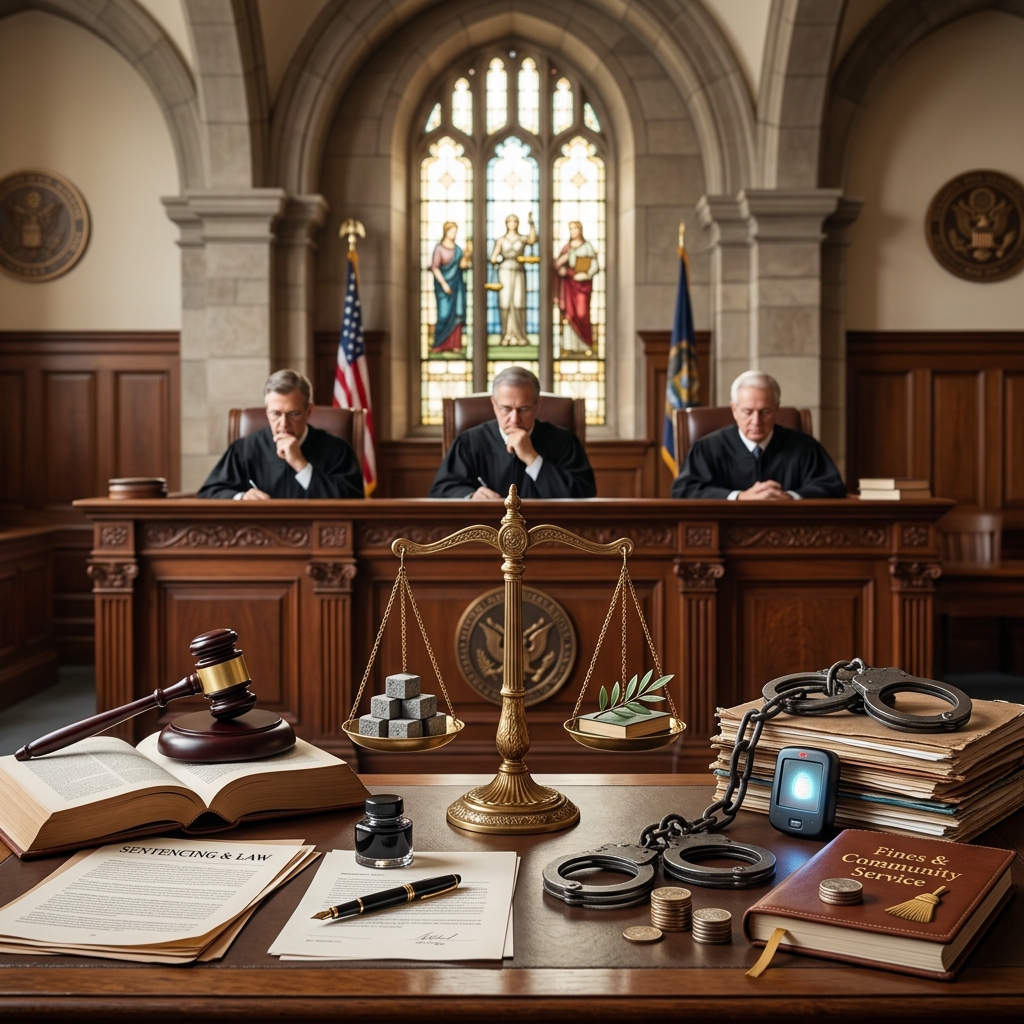
When a person is convicted of a crime, the court must decide what punishment is appropriate. In criminal cases, that decision is called sentencing, and it can range from a simple fine to a lengthy prison term depending on the offence and the law that applies. Courts generally use a structured set of sentencing options so that punishment reflects the seriousness of the crime, the offender’s history, and the goals of the justice system.
Although sentencing rules differ by jurisdiction, criminal sentences usually fall into two broad groups: custodial and non-custodial. Custodial sentences involve imprisonment, while non-custodial outcomes allow the person to remain in the community under conditions set by the court. Many systems also allow additional orders, such as restitution, disqualification, or supervision requirements, to support the sentence and protect the public.
The basic purpose of sentencing
Sentencing is not just about punishment. Courts use it to balance several objectives at once: deterrence, public protection, rehabilitation, accountability, and in some cases restitution to victims. A sentence may be designed to discourage the same person from reoffending, to warn others, or to manage a risk the offender poses to the community.
Judges also consider the legal limits set by statute. Some crimes carry mandatory minimum penalties, meaning the court cannot go below a certain level of punishment. Other offences come with maximum limits, which place a ceiling on the sentence a judge may impose. In some systems, sentencing ranges guide the court toward a presumptive or typical outcome, while still leaving room for individual circumstances.
Custodial sentences: when prison is on the table
A custodial sentence is the most serious common punishment because it involves sending the offender to prison. Courts usually reserve custody for serious offences, repeat offending, violence, or cases where community-based options would not be sufficient. Prison sentences may be fixed-term, indeterminate, mandatory, or life sentences depending on the law and the offence.
Custody is often used when the court believes that the offender needs to be separated from the public, or when the gravity of the crime requires a strong punitive response. In some jurisdictions, a person may later qualify for parole, which allows early release under supervision if legal conditions are met.
Fixed-term sentences
A fixed-term sentence, also called a determinate sentence, sets a specific period of imprisonment. For example, a court may impose two years or five years in prison. This kind of sentence is predictable and ends when the term is completed, subject to any rules about remission, release, or supervision in the relevant system.
Fixed-term sentences are common because they give courts a straightforward way to match punishment to the seriousness of the offence. The exact length may reflect aggravating factors, such as weapon use or prior convictions, and mitigating factors, such as guilty pleas or limited criminal history.
Indeterminate sentences
An indeterminate sentence sets a range rather than a single prison term. The offender may receive a minimum period before becoming eligible for review, parole, or release consideration. The actual time served depends on behaviour, risk assessment, and decisions made by the parole system or another review body.
This approach is often used where rehabilitation and public safety both matter. It gives authorities flexibility to keep a person in custody longer if the risk remains high, while still creating a pathway to release for those who make progress.
Life sentences and indefinite custody
A life sentence is used for the most serious crimes in many legal systems. It means the offender may remain under the control of the prison system for the rest of their life, although release rules vary. In some jurisdictions, life sentences include eligibility for parole after a minimum period; in others, the sentence may be effectively without a realistic release date.
Some systems also recognize indefinite sentences, which are reserved for especially dangerous offenders. These are designed for cases where the court concludes that release should depend entirely on later risk review rather than a fixed end date.
Mandatory prison terms
For certain offences, the law requires a specific custodial penalty. Mandatory minimum sentences are common in serious firearm or drug-related offences in some jurisdictions, where the legislature has decided that judges should not be able to impose a lower sentence below the statutory floor.
Mandatory sentencing removes or reduces judicial discretion. That can promote consistency, but it can also create tension when a case has unusual mitigating circumstances. For that reason, mandatory penalties are often debated in sentencing policy discussions.
Non-custodial sentences: punishment without prison
Non-custodial sentences do not involve imprisonment. They are often used for lower-level offences, first-time offenders, or cases where the court believes that the person can be held accountable while remaining in the community. Common non-custodial options include fines, probation, community service, suspended sentences, and other court orders.
Non-custodial penalties can still be serious. A person may be required to pay money, complete unpaid work, obey curfews, avoid certain places, or stay under supervision for a set period. Failing to comply can lead to harsher consequences, including activation of a suspended prison term.
Fines
A fine is a financial penalty imposed by the court. It is often used for less serious crimes or regulatory offences, especially when prison would be disproportionate. The amount may be fixed by statute or adjusted by the judge based on the circumstances of the case and the offender’s ability to pay.
Courts may choose fines when they believe a monetary penalty will deliver punishment without removing the person from work, family responsibilities, or the community. In many systems, failure to pay can lead to enforcement action or other sanctions.
Probation and supervision
Probation allows the offender to stay in the community while following conditions set by the court or probation authority. Typical conditions may include reporting to an officer, avoiding further offences, attending treatment, completing counselling, or staying away from certain people or places.
Probation is often used when the court believes that structured supervision can reduce the risk of reoffending. It allows the justice system to monitor behaviour without resorting to prison, but it still carries meaningful restrictions and consequences if the person breaches the rules.
Community service and unpaid work
Community service requires the offender to complete unpaid work for the benefit of the public. Courts may use it for offences that call for accountability but do not justify incarceration. The work may involve cleaning public spaces, supporting local services, or assisting charitable or civic programs.
This type of sentence is meant to be visible and practical. It can help the offender make amends while also reinforcing the idea that criminal conduct has consequences beyond a verbal warning.
Suspended sentences
A suspended sentence is a prison sentence that does not have to be served immediately, or at all, if the offender follows the court’s conditions. If the person commits another offence or fails to comply with the suspension terms, the court may order the prison term to be activated.
Suspended sentences are used when the court thinks custody is justified in principle but that actual imprisonment can be avoided if the offender proves compliance. They are often paired with supervision, treatment, or other conditions designed to support rehabilitation.
Other community-based restrictions
Courts can also impose restrictions such as curfews, exclusion orders, movement limits, disqualification from driving, or orders requiring treatment. These penalties are not always labeled as standalone sentences, but they play an important role in shaping how a sentence works in practice.
In serious cases, additional orders such as confiscation, forfeiture, or compensation may be attached to the sentence. These measures can protect the public, deprive the offender of crime-related gains, or make victims whole in part.
How judges decide which sentence fits
Judges do not choose a sentence at random. They consider the law, the type of offence, the harm caused, the offender’s role, prior convictions, and whether there are aggravating or mitigating factors. Aggravating circumstances can include planning, violence, use of weapons, abuse of trust, or repeat offending. Mitigating circumstances may include remorse, a guilty plea, cooperation, youth, or limited prior record.
The same offence can lead to different outcomes in different cases because sentencing is individualized within legal limits. Two people convicted of the same charge may receive different penalties if one has a long record and the other has no prior convictions or if one offense caused much greater harm.
| Sentence type | Typical use | Main feature |
|---|---|---|
| Fine | Lower-level offences | Financial penalty instead of custody |
| Probation | Community supervision cases | Conditions and monitoring |
| Community service | Non-violent or lower-risk cases | Unpaid work for public benefit |
| Suspended sentence | Cases where prison is held in reserve | Custody avoided if conditions are met |
| Fixed-term prison | Serious offences | Specific length of custody |
| Life or indefinite sentence | Most serious or dangerous cases | Long-term or open-ended custody |
Concurrent, consecutive, and deferred sentencing
When a person faces more than one conviction, the court may decide whether the sentences run at the same time or one after another. A concurrent sentence means the terms overlap, so the offender serves them together. A consecutive sentence means each term starts after the previous one ends, which increases total time served.
A deferred sentence works differently. In that model, the judge postpones the start of the sentence or delays final punishment while certain conditions are met. This can be used to encourage compliance, treatment, or further court review before a final penalty is imposed.
Why sentencing matters beyond the courtroom
The sentence can affect many parts of a person’s life, including employment, housing, immigration status, civil rights, and future sentencing exposure. A custodial term can interrupt family life and work, while a non-custodial sentence may still create lasting obligations and records.
Because sentencing carries such broad consequences, legal representation at the sentencing stage can matter greatly. Defence counsel may present mitigation, challenge inaccurate allegations, or argue for a community-based alternative. Prosecutors may seek harsher penalties where the facts justify them. The judge’s role is to weigh all of that within the framework set by law.
Common questions about criminal sentences
What is the difference between a custodial and a non-custodial sentence?
A custodial sentence involves imprisonment, while a non-custodial sentence allows the offender to remain in the community under conditions such as probation, fines, or community service.
Can a judge always choose any sentence?
No. Judges must follow statutory rules, including mandatory minimums, maximum penalties, and sentencing guidelines where they apply.
Is probation the same as being released without punishment?
No. Probation is a formal sentence with strict conditions. If the offender violates those conditions, the court may impose additional sanctions, including jail in some cases.
What does a suspended sentence mean?
A suspended sentence is a prison sentence that is delayed or not enforced immediately, usually on the condition that the offender complies with court-imposed requirements.
Why do some offenders get multiple sentences?
Multiple sentences may be imposed when a person is convicted of more than one offence. The court then decides whether the terms should run concurrently or consecutively.
What to remember about criminal punishment
Criminal sentencing covers a wide range of outcomes, from modest financial penalties to long prison terms. The court’s job is to select a punishment that fits the offence, respects legal limits, and addresses the wider goals of criminal justice. Whether the sentence is custody, probation, community service, or a fine, it reflects both the facts of the case and the law governing the offence.
References
- Types of sentences — Citizens Information. 2025-01-01. https://www.citizensinformation.ie/en/justice/criminal-law/criminal-trial/types-of-sentences/
- Types of sentence — Sentencing Council. 2025-01-01. https://sentencingcouncil.org.uk/about-sentencing/types-of-sentence/
- Types of criminal sentences — FindLaw. 2025-01-01. https://www.findlaw.com/criminal/criminal-procedure/types-of-sentences.html
- Sentencing — Federal Judicial Center, Judiciaries Worldwide. 2025-01-01. http://judiciariesworldwide.fjc.gov/sentencing
- Types of prison sentence — GOV.UK. 2025-01-01. https://www.gov.uk/types-of-prison-sentence
- Types of penalties and sentences — Sentencing Council Queensland. 2025-01-01. https://www.sentencingcouncil.qld.gov.au/about-sentencing/types-of-penalties
- The Four Major Types of Criminal Punishments — Hickey & Hull Law Partners. 2025-01-01. https://www.hickeyandhull.com/our-blog/the-four-major-types-of-criminal-punishments
- Types of Criminal Sentences: Potential Penalties for Convicted Persons — Sharp Criminal Attorney. 2025-01-01. https://sharpcriminalattorney.com/blog/criminal-law/types-of-criminal-sentences-potential-penalties-for-convicted-persons/
- Sentencing — GOV.UK. 2025-01-01. https://www.gov.uk/guidance/sentencing
Similar Articles








Read full bio of medha deb




