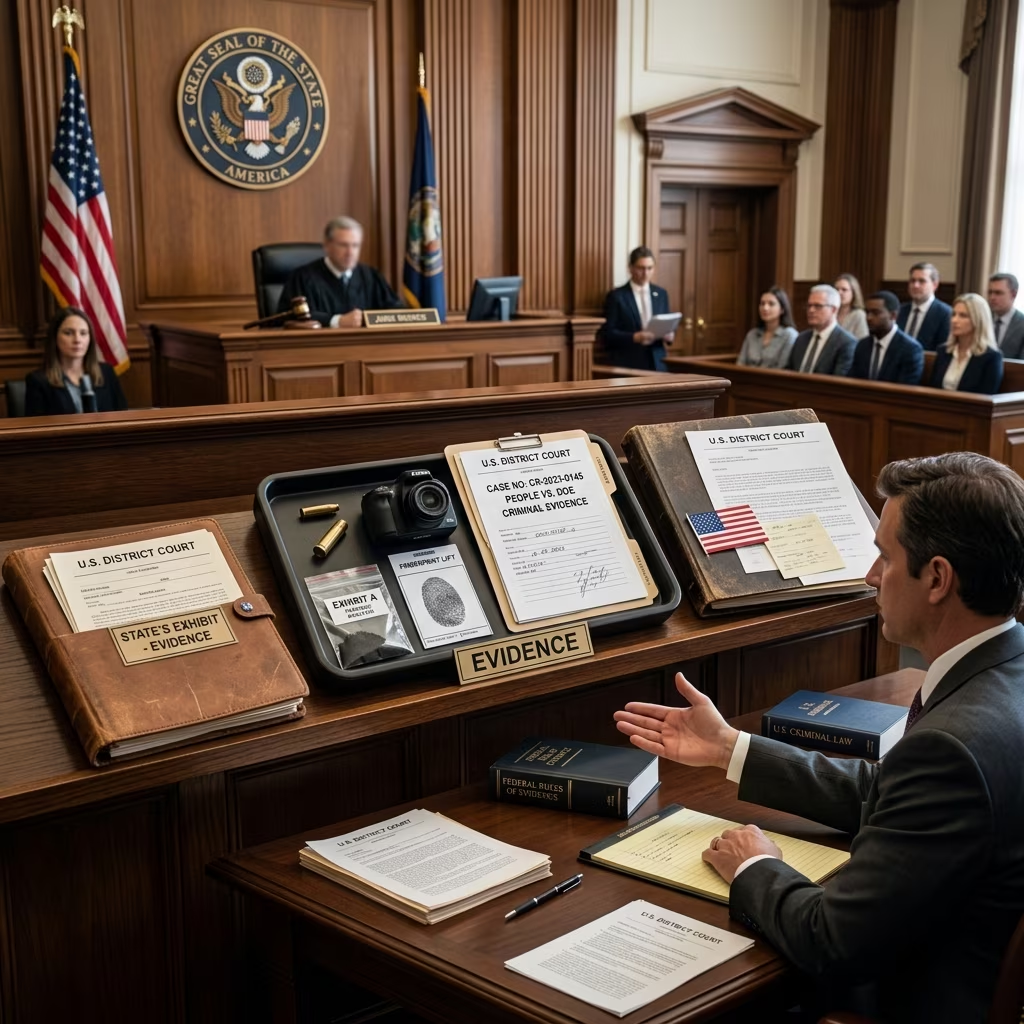
In every criminal trial, evidence is what connects the accusation to a verdict. It is the information presented in court to help the judge or jury decide whether the government has proved the defendant guilty beyond a reasonable doubt. But not every piece of information can be shown to a jury. Courts follow detailed rules of evidence that decide what evidence is allowed, how it may be used, and what must be kept out to ensure a fair trial.
This guide explains the essentials of criminal evidence in the United States, including the different types of evidence, the basic rules that control admissibility, constitutional limits on government proof, and what happens when evidence is improperly obtained.
1. What Counts as Evidence in a Criminal Case?
In a criminal courtroom, the term evidence is broader than most people think. It includes anything that can help prove or disprove a fact that matters to the case, provided it is legally admitted under the applicable rules.
Common forms of criminal evidence include:
- Statements from witnesses under oath
- Objects or physical items connected to the alleged crime
- Documents, records, and digital files
- Expert opinions on technical or scientific issues
- Photographs, videos, and audio recordings
Evidence law does not insist on any particular type of proof. The prosecution can rely on one witness, a combination of documents, or a mix of scientific and lay testimony. What matters is whether the evidence is admissible and whether, taken together, it convinces the fact-finder beyond a reasonable doubt.
2. Major Categories of Criminal Evidence
Lawyers and judges commonly describe evidence using several overlapping categories. Understanding these categories helps explain why some evidence is considered strong, why some is viewed as weaker, and why the same fact might be proved in multiple ways.
2.1 Direct vs. Circumstantial Evidence
Evidence can be classified by how directly it relates to a fact in dispute.
| Type of Evidence | How It Proves a Fact | Typical Examples |
|---|---|---|
| Direct evidence | Directly answers a question of fact without requiring inference. | Eyewitness testimony of the crime; a confession; clear video of the event. |
| Circumstantial evidence | Supports a fact by suggesting it, requiring the fact-finder to infer what happened. | Defendant’s fingerprints at the scene; being found with recently stolen property. |
Contrary to a common misunderstanding, courts do not automatically prefer direct evidence over circumstantial evidence. A case based entirely on circumstantial proof can support a conviction if the overall evidence is strong and credible.
2.2 Physical, Documentary, and Digital Evidence
Evidence is also classified by the form it takes in the real world.
- Physical (real) evidence – tangible objects or substances that may connect the defendant to the crime, such as weapons, clothing, tools, bullet casings, drugs, or biological samples.
- Documentary evidence – written or recorded materials, including contracts, letters, emails, text messages, financial records, and medical reports.
- Digital evidence – information stored in electronic form, such as server logs, GPS data, smartphone backups, and social media posts, often treated as a subset of documentary evidence.
Physical and documentary evidence frequently require additional testimony to explain how they were collected, how they have been stored, and what they mean in the context of the case.
2.3 Testimonial and Expert Evidence
Testimonial evidence is information provided by people under oath in court. It includes eyewitness accounts, statements by the defendant, and testimony from law enforcement officers. These witnesses are subject to cross-examination, which allows the opposing side to challenge their memory, perception, and honesty.
Expert evidence comes from witnesses with specialized education, training, or experience whose opinions can help the court understand technical or scientific issues. Examples include:
- Forensic scientists interpreting DNA results
- Ballistics experts analyzing bullets and firearms
- Medical professionals explaining injuries or cause of death
- Digital forensics experts reconstructing deleted data
Federal and state rules require judges to ensure that expert testimony is grounded in reliable methods and relevant to issues in the case, not simply speculative or misleading.
3. Basic Principles of Admissibility
Even if something looks relevant, it cannot be used at trial unless it passes the threshold requirements of the governing evidence rules. In U.S. federal courts, these rules are set out in the Federal Rules of Evidence, which apply to most criminal and civil proceedings. States have their own rules that often follow similar principles.
3.1 Relevance
The starting point is relevance. Evidence is considered relevant if it has any tendency to make a fact that matters in the case more or less probable than it would be without the evidence. If an item of evidence does not help prove or disprove a disputed issue, it is generally inadmissible because it wastes time or risks confusing the jury.
However, not all relevant evidence is admitted. Judges may exclude relevant evidence when its potential to mislead, cause unfair prejudice, or create undue delay substantially outweighs its value.
3.2 Competence and Reliability
Evidence must also be competent, meaning that it is not barred by specific exclusionary rules and is presented in an acceptable form. Competence requirements address questions such as:
- Is the witness legally capable of testifying (for example, understands the duty to tell the truth)?
- Is the document authentic?
- Was the scientific technique used by an expert generally accepted or otherwise reliable?
These safeguards are designed to keep speculation and unreliable science out of criminal trials.
3.3 The Judge’s Gatekeeping Role
In the adversarial system, the judge acts as a gatekeeper for evidence. The parties present arguments through motions and objections, and the judge decides what the jury will be allowed to hear.
Key aspects of this gatekeeping function include:
- Deciding relevance and balancing probative value against unfair prejudice
- Ruling on expert qualification and methodology
- Enforcing rules against hearsay and improper character evidence
- Ensuring that evidence was obtained in compliance with constitutional protections
These rulings shape the entire trial. In many cases, pretrial hearings on evidence decide what the jury will ultimately see or hear and can influence whether the parties choose to reach a plea agreement.
4. Character Evidence and Prior Bad Acts
One of the most restrictive areas of evidence law involves proof of a defendant’s character or prior misconduct. The general idea is simple: people should be judged for what they are charged with in this case, not for who they are or what they did in the past.
4.1 General Ban on Propensity Evidence
In federal courts, rules governing proof of character and prior acts state that evidence of a person’s character or of other crimes or wrings usually cannot be used to show that they acted “in accordance with” that character on the particular occasion being tried. In plain terms, the prosecution cannot simply argue:
- “The defendant has a history of theft, so they must have committed this theft.”
- “The defendant is a violent person, so they probably started this fight.”
Such “propensity” reasoning is considered unfairly prejudicial and risks a conviction based on past behavior rather than on the facts of the current case.
4.2 Limited Permitted Uses of Prior Acts
While prior acts cannot be used simply to show bad character, they may be admissible for other legitimate purposes, such as proving motive, intent, opportunity, knowledge, plan, identity, or absence of mistake. For example:
- Showing a prior scheme to demonstrate a distinctive pattern relevant to the current charges
- Proving that the defendant knew how a complex fraud worked because they had previously engaged in similar conduct
- Rebutting a claim that the alleged act was an accident by showing earlier, similar incidents
When prosecutors intend to use such evidence in a criminal case, they are typically required to give advance notice and explain the non-character purpose for which the evidence is offered, helping the defense prepare to challenge it.
4.3 When the Defendant Raises Character
Defendants may choose to present evidence of their own good character if it is directly related to the charges—for example, honesty in a fraud case or peacefulness in an assault case. When they do so, they “open the door,” and the prosecution may respond with its own character evidence to rebut the claimed trait. Strategic decisions about whether to introduce character evidence are therefore complex and can significantly affect the trial.
5. Constitutional Limits and the Exclusionary Rule
Even when evidence is relevant and might otherwise be admissible under ordinary rules, it can still be excluded if it was obtained in violation of the defendant’s constitutional rights. This is where the exclusionary rule comes into play.
5.1 The Exclusionary Rule
The exclusionary rule prevents the government from using evidence derived from unconstitutional searches, seizures, or interrogations, primarily under the Fourth, Fifth, and Sixth Amendments. If law enforcement officers obtain evidence by ignoring constitutional guarantees, courts may exclude that evidence from trial in order to deter future misconduct.
Examples include:
- Physical evidence seized without a required warrant or valid exception to the warrant requirement
- Statements obtained after a suspect has clearly invoked the right to remain silent or to an attorney
- Confessions produced by coercion or threats
Some courts also apply a “fruit of the poisonous tree” doctrine, which extends exclusion to additional evidence that was discovered only because of the original violation. However, there are exceptions, such as when the evidence would inevitably have been discovered by lawful means.
5.2 Balancing Rights and Truth-Seeking
The exclusionary rule reflects a deliberate policy choice: the justice system values constitutional rights so highly that it will sometimes give up reliable evidence rather than reward unlawful government conduct. This can have profound consequences, including the dismissal of charges if critical evidence is suppressed.
6. How Evidence Is Presented and Challenged
The rules of criminal evidence not only govern what is admissible, but also how evidence is introduced and tested in court.
6.1 Laying a Foundation
Before an item of evidence is admitted, the offering party must “lay a foundation,” usually by questioning a witness to show that the evidence is what it purports to be. Foundation questions might establish:
- How the witness knows what the item is
- Where it came from and who had access to it
- That it has not been altered or tampered with
For physical evidence, this often means showing a chain of custody—a documented history of who handled the item from collection to courtroom.
6.2 Objections and Motions
Opposing counsel can challenge evidence at several points:
- Pretrial motions – Requests to exclude evidence before trial, such as motions to suppress illegally obtained evidence or to bar prejudicial prior acts.
- Objections at trial – Real-time challenges when the other side asks a question, offers a document, or attempts to introduce testimony that may violate the rules.
- Requests for limiting instructions – Asking the judge to instruct the jury to consider a piece of evidence only for a specific, narrow purpose.
These tools ensure that the evidence presented is filtered through legal standards and that the record reflects any disputes for later appellate review.
7. State and Federal Evidence Rules
Although the core concepts of criminal evidence are broadly similar across the United States, the details can differ depending on whether the case is in federal or state court.
- Federal Rules of Evidence – Adopted in 1975 and regularly updated, these rules apply in most federal criminal and civil proceedings and provide a comprehensive, numbered structure for evidence law.
- State evidence codes and rules – Each state has its own rules, often influenced by the federal model but with specific variations reflecting local statutes and court decisions.
Because of these differences, lawyers must be familiar with the particular rules and interpretations that apply in their jurisdiction, including any state constitutional protections that go beyond the federal baseline.
8. Practical Tips for Defendants and Witnesses
For someone facing criminal charges, or even someone subpoenaed as a witness, the law of evidence can feel technical and intimidating. While only a trained attorney can give legal advice, a few general points are helpful to understand:
- The prosecution has the burden of proof and must build its case using admissible evidence. It is not the defendant’s job to prove innocence.
- Evidence that seems damaging at first glance may be vulnerable to legal challenges based on relevance, reliability, or constitutional violations.
- Conversations with counsel are confidential; what you tell your attorney typically cannot be used as evidence against you.
- Ignoring a subpoena or court order related to evidence can lead to contempt findings or other penalties.
- Because rules are complex and consequences serious, anyone charged with a crime should consult an experienced criminal defense lawyer.
9. Frequently Asked Questions About Criminal Evidence
9.1 Can someone be convicted based only on circumstantial evidence?
Yes. Courts routinely uphold convictions based solely on circumstantial evidence when, taken as a whole, that evidence convinces the jury beyond a reasonable doubt. The law does not rank circumstantial evidence as inherently inferior to direct evidence, although jurors may find direct evidence easier to understand.
9.2 Is illegally obtained evidence always excluded?
Not always. The exclusionary rule generally bars evidence obtained in violation of constitutional rights, but exceptions apply. For example, evidence may be admitted if officers acted in reasonable reliance on a defective warrant, or if the same evidence would inevitably have been discovered by lawful means. Whether a specific piece of evidence must be excluded depends on the facts and the governing case law.
9.3 Are confessions the most powerful kind of evidence?
Confessions can be extremely persuasive to juries, but they are also subject to strict constitutional and evidentiary safeguards. A confession obtained through coercion, threats, or failure to honor a suspect’s rights can be excluded. Furthermore, courts and scholars recognize that false confessions sometimes occur, so juries are instructed to consider the circumstances under which any confession was obtained.
9.4 What happens if the judge makes a mistake about evidence?
If a case results in a conviction, the defense may appeal, arguing that the trial judge wrongly admitted or excluded evidence. Appellate courts typically ask whether the error was “harmless” or whether it likely affected the outcome. Only errors that materially influence the verdict usually justify overturning a conviction.
9.5 Do the same rules apply in every type of criminal proceeding?
Many core rules apply broadly, but there are differences across federal and state systems, and certain proceedings—such as sentencing hearings or preliminary hearings—may use more relaxed evidentiary standards. It is important to distinguish between the strict rules used at a jury trial and the more flexible practices used at other stages.
References
- Federal Rules of Evidence — Legal Information Institute, Cornell Law School. Updated 2024-12-01. https://www.law.cornell.edu/rules/fre
- Rule 404. Character Evidence; Other Crimes, Wrongs, or Acts — Legal Information Institute, Cornell Law School. Accessed 2026. https://www.law.cornell.edu/rules/fre/rule_404
- Federal Rules of Evidence — United States Courts. Last amended 2024. https://www.uscourts.gov/forms-rules/current-rules-practice-procedure/federal-rules-evidence
- The Rules of Criminal Evidence: Background — FindLaw. Accessed 2026. https://www.findlaw.com/criminal/criminal-procedure/law-of-criminal-evidence-background.html
- What is evidence in criminal law? — Thomson Reuters. Accessed 2026. https://legal.thomsonreuters.com/blog/criminal-law-evidence/
- Rules of Evidence — EBSCO Research Starters. Accessed 2026. https://www.ebsco.com/research-starters/law/rules-evidence
- Florida Evidence Code (Chapter 90) — The 2025 Florida Statutes, Online Sunshine. Updated 2025. https://www.leg.state.fl.us/Statutes/index.cfm?App_mode=Display_Statute&URL=0000-0099/0090/0090.html