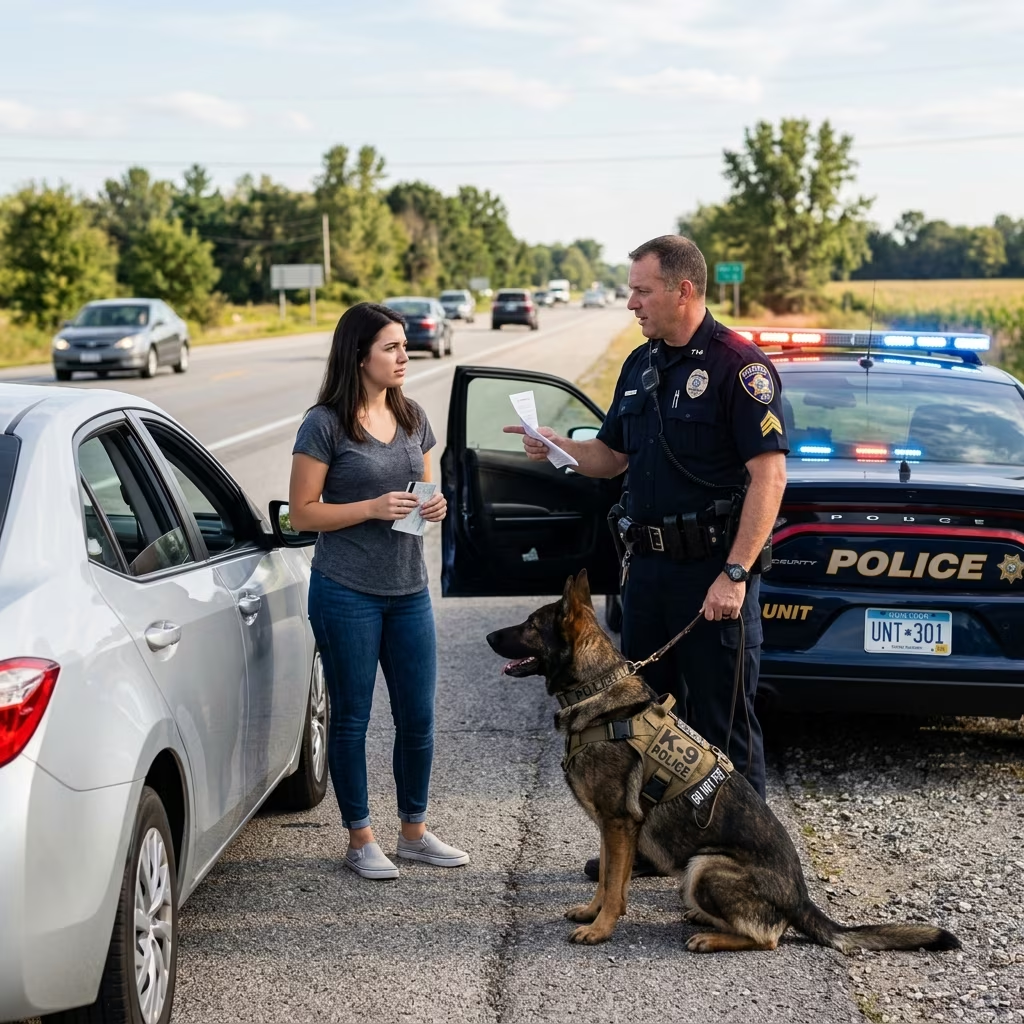
Police departments across the United States routinely deploy drug‑sniffing dogs during traffic stops to detect narcotics and other contraband. Understanding when officers can lawfully use a canine, how long they may hold you on the roadside, and what happens if a dog alerts is critical for protecting your Fourth Amendment rights against unreasonable searches and seizures. This article offers a practical, rights‑focused overview of canine sniffs during traffic stops, grounded in leading Supreme Court decisions and law enforcement standards.
Core Legal Principles Behind Canine Sniffs
The legal framework for canine sniffs at traffic stops rests on several core ideas developed by the U.S. Supreme Court and lower courts.
- Fourth Amendment protection: The Constitution guards against unreasonable searches and seizures by the government, including police.
- Seizure vs. search: A traffic stop is a seizure of you and your vehicle. Whether a canine sniff counts as a search has been a central issue in court cases.
- Reasonableness of duration: Even a lawful stop can become unconstitutional if officers prolong it beyond the time needed to address the traffic violation.
- Probable cause from alerts: A reliable canine alert can create probable cause to search a vehicle without a warrant under the automobile exception.
These principles shape what officers can legally do when they consider calling or using a dog at the roadside.
Are Canine Sniffs Considered Searches?
The Supreme Court has drawn a distinction between a typical physical search and a sniff by a trained drug‑detecting dog. In earlier decisions, the Court held that a sniff by a well‑trained canine during a lawful stop does not constitute a traditional Fourth Amendment search because it is narrowly focused on identifying contraband and reveals limited information. This reasoning allows officers to use dogs without the same level of justification they would need for a more intrusive search of your vehicle.
However, the sniff must occur while the underlying detention is valid. Courts have emphasized that the original stop must be supported by lawful grounds, such as a traffic violation, and the manner and length of the encounter must remain reasonable.
When Can Police Legally Use Dogs During a Traffic Stop?
In general, officers may bring a drug dog to the scene of a lawful traffic stop, but their power is constrained by the circumstances and duration of the detention.
Lawful basis for the stop
First, the stop itself must be justified. Officers must have at least reasonable suspicion or probable cause that a traffic law was violated, such as speeding, running a stop sign, or equipment violations. Once a vehicle is lawfully stopped, the officer may address the reason for the stop and perform certain routine tasks.
Routine tasks during a stop
Courts typically allow officers to:
- Request a driver’s license, registration, and proof of insurance.
- Verify identity and run computer checks for warrants.
- Ask limited questions related to the reason for the stop.
- Issue a citation or warning and take steps to safely conclude the encounter.
A dog may be used while these tasks are being performed, as long as the sniff does not add significant time to the stop.
Use of canine without separate probable cause
In many jurisdictions, officers do not need independent probable cause to walk a dog around the exterior of a car during a valid traffic stop, as long as the sniff occurs within the time reasonably necessary to complete the stop. Some states, however, impose additional requirements such as reasonable suspicion before summoning a dog, especially if the stop is extended beyond routine tasks.
How Long Can Police Keep You Waiting for a Dog?
The length of detention is one of the most contested aspects of canine traffic stops. The Supreme Court has held that officers may not prolong a traffic stop beyond the time reasonably needed to address the violation simply to conduct a dog sniff.
Key Supreme Court guidance
| Case | Core rule | Impact on dog sniffs |
|---|---|---|
| Illinois v. Caballes | Dog sniff during a lawful traffic stop is permissible if it does not unreasonably extend the duration. | Officers may use a dog as long as the stop remains within a reasonable time frame. |
| Rodriguez v. United States | Even a brief extension of a stop for a dog sniff, without additional justification, can violate the Fourth Amendment. | Officers cannot add time just to await a canine unless they have new reasonable suspicion. |
Based on these decisions, the timing rules can be summarized as:
- If the dog is already present, officers can usually conduct a quick sniff while finishing routine tasks.
- If a dog is not on scene, officers generally cannot extend the stop to wait for a canine unless they develop reasonable suspicion of criminal activity beyond the traffic violation.
- Once the purposes of the traffic stop are complete (e.g., citation issued and documents returned), continuing to detain you solely for a dog sniff usually requires a higher level of justification.
Law enforcement guidance often references approximate time frames for routine stops (for example, around 15 minutes in some training materials), but what is reasonable remains highly fact‑specific and depends on the circumstances.
Reasonable Suspicion and Extended Detention
To lawfully extend a stop beyond the time needed for normal traffic enforcement, officers typically must show reasonable suspicion of additional criminal activity, such as drug trafficking. Reasonable suspicion is a lower standard than probable cause; it requires specific, articulable facts that, taken together with rational inferences, suggest criminal conduct.
Courts have considered various factors in assessing reasonable suspicion for a drug‑dog deployment after a stop, including:
- Unusual nervousness or evasive behavior by the driver.
- Conflicting or implausible travel explanations.
- Indicators associated with drug trafficking, such as certain routes or source cities.
- Information from prior investigations or criminal history checks.
Absent such additional factors, keeping a driver roadside beyond a routine time frame simply to await a canine unit can lead to suppression of any evidence found as a result of an unlawful detention.
What a Canine Alert Legally Means
When a properly trained drug dog alerts on a vehicle, courts often treat that alert as strong evidence of contraband. Under the automobile exception to the warrant requirement, a positive alert typically establishes probable cause to search the entire vehicle without a warrant.
Once probable cause exists, officers may:
- Search the interior and trunk of the vehicle.
- Inspect containers and compartments that could reasonably hold contraband.
- Impound and tow the vehicle and continue the search at another location.
Some legal scholarship has noted that the reliability of dogs, handler cues, and false alerts can complicate whether an alert should always constitute probable cause. Nevertheless, many courts continue to treat certified, well‑trained dogs as sufficient to justify a warrantless search when they provide a clear alert.
Your Rights During a Canine Traffic Stop
Even though officers have authority to use dogs, you retain important rights during a traffic stop involving a canine.
Right to be free from unreasonable prolongation
You have the right not to be detained longer than necessary to handle the traffic violation, unless officers can articulate reasonable suspicion of additional criminal activity. Evidence obtained after an unlawful extension of the stop may be subject to suppression in court.
Right to refuse consent
You generally have the right to refuse consent to a search of your vehicle. While an officer may still use a dog during a lawful stop without your consent, clearly stating that you do not consent can be important if the legality of the search is later challenged.
Right to remain silent
You are not required to answer investigative questions beyond those necessary for identification and basic traffic enforcement. Remaining polite but limiting what you say can reduce the risk of inadvertently giving officers grounds to justify extending the stop.
Right to counsel after the encounter
If a search occurs or you are arrested, you have the right to consult an attorney and challenge the lawfulness of the stop, detention, and canine use. An attorney can evaluate whether the dog sniff complied with constitutional standards and seek exclusion of evidence obtained unlawfully.
Practical Tips if a Dog Is Used at Your Traffic Stop
The roadside is not the place to litigate constitutional law; it is the place to preserve your rights and avoid additional complications.
- Stay calm and courteous: Sudden movements, anger, or aggression can escalate the situation and lead to separate charges or safety concerns.
- Comply with lawful orders: Provide required documents and follow basic instructions, such as exiting the vehicle if lawfully directed.
- Clearly refuse consent to searches: If an officer mentions a search or dog sniff, calmly state that you do not consent to any search of your vehicle.
- Avoid volunteering information: Do not try to talk your way out of the situation or explain more than necessary. Over‑explaining can inadvertently create suspicion.
- Note the timeline and details: After the encounter, write down approximate times, the sequence of events, and the names or badge numbers of officers. This can be useful for an attorney reviewing the case.
Common Legal Issues in Canine Traffic Stops
Courts frequently examine certain recurring issues when defendants challenge canine‑based searches.
- Was the initial stop valid? If the traffic stop lacked legal justification, evidence derived from the canine sniff may be suppressed.
- Did officers unlawfully extend the stop? A key question is whether the canine sniff added time beyond what was reasonably needed to manage the traffic violation.
- Was there adequate reasonable suspicion to justify waiting for a dog? Courts analyze the specific facts to determine if the officer had enough objective basis to prolong the detention.
- Is the dog properly trained and reliable? Defendants may challenge the reliability of the canine’s training, certification, or performance history when contesting probable cause.
- Was the search’s scope lawful? Even with probable cause, there are limits on how invasive a search can be and where officers may look.
Frequently Asked Questions
Can police use a drug dog at every traffic stop?
Officers may generally deploy a drug dog during a lawful traffic stop, but they cannot prolong the stop solely to conduct a sniff without additional reasonable suspicion. If the dog is already on scene and the sniff does not add time, courts typically allow its use.
Do police need my consent to run a dog around the car?
In many jurisdictions, officers do not need your consent to conduct an exterior canine sniff during a lawful stop as long as they do not extend the encounter unreasonably. Consent is still required for broader, non‑canine searches absent probable cause.
What happens if the dog alerts but no drugs are found?
An alert may give officers probable cause to search, even if nothing is ultimately found. You can consult an attorney to explore whether the dog’s reliability or the legality of the detention can be challenged in court.
Can I leave once I get my ticket?
Generally, once the officer has finished tasks related to the traffic violation and returned your documents, the stop should be over unless there is new reasonable suspicion or probable cause. Detaining you further solely for a dog sniff may raise constitutional issues.
Should I argue with officers about my rights on the roadside?
Arguing or physically resisting is not advisable. The safer approach is to stay calm, refuse consent clearly, comply with lawful orders, and later consult counsel who can challenge the stop and canine use in court.
References
- Fourth Amendment to the United States Constitution — U.S. Government Publishing Office. 1789-12-15. https://www.govinfo.gov/content/pkg/GPO-CONAN-REV-2016/pdf/GPO-CONAN-REV-2016-9-2.pdf
- Illinois v. Caballes, 543 U.S. 405 — Supreme Court of the United States. 2005-01-24. https://supreme.justia.com/cases/federal/us/543/405/
- Rodriguez v. United States, 575 U.S. 348 — Supreme Court of the United States. 2015-04-21. https://supreme.justia.com/cases/federal/us/575/348/
- Vehicle Sniffs (Training Bulletin) — Chicago Police Department. 2011-06-01. https://directives.chicagopolice.org/forms/Vehicle%20Sniffs.pdf
- K-9 Traffic Stops in Florida: Know Your Rights — Attorney John Greene. 2021-03-15. https://www.destinattorneyjohngreene.com/k-9-traffic-stops-in-florida-know-your-rights/
- Deconstructing Dog Sniffs at Traffic Stops — Marquette Law Review. 2016-01-01. https://scholarship.law.marquette.edu/cgi/viewcontent.cgi?article=5537&context=mulr
- Drug Dog Sniff Searches & Reasonable Suspicion of Narcotics — Gambone Law. 2020-09-10. https://gambonelaw.com/drug-dog-sniff-searches-reasonable-suspicion-of-narcotics/