The Invisible Pathway to Incarceration
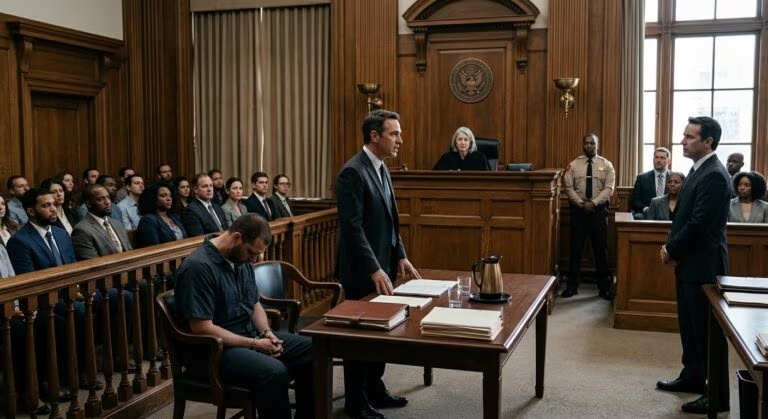
The child welfare system was ostensibly designed to serve as a critical safety net, a refuge meant to rescue, rehabilitate, and protect children who have endured unimaginable hardships. It is built on the promise of providing stability for youth facing severe abuse, neglect, and household dysfunction. However, across the United States, an alarming and tragic pattern has become institutionalized within this very framework. Rather than finding a safe haven, a significant portion of these vulnerable young people find themselves funneled directly into the juvenile and, ultimately, the adult justice systems. This devastating trajectory is widely recognized by sociologists, legal scholars, and advocates as the foster care to prison pipeline.
This pipeline is not the result of a single flaw, but rather a cascading series of systemic failures. When a child enters state care, they are immediately stripped of their familiar surroundings. Even if their home life was dangerous, the abrupt removal process inflicts its own deep psychological wounds. State agencies, frequently underfunded and operating with staggering caseloads, struggle to provide the comprehensive psychological support these displaced children require. Consequently, the behavioral manifestations of deep-seated trauma are often met with punitive measures rather than therapeutic interventions.
Understanding this crisis requires an unflinching look at the intersection of public policy, childhood psychology, and institutional bias. We must examine how behaviors rooted in survival instincts are criminalized, why certain demographics are disproportionately impacted, and what empirical data tells us about the lifelong consequences of system involvement. Only by dissecting the architecture of the foster care to prison pipeline can society begin to implement the sweeping reforms necessary to disrupt it.
Understanding "Crossover Youth"
In policy and academic circles, children who find themselves entangled in both the child welfare and juvenile justice systems are categorized as "crossover youth" or "dually-involved youth." This demographic represents one of the most vulnerable and marginalized populations in the country. The transition from a child in need of protection to a juvenile offender is rarely a sudden leap; instead, it is a gradual crossover characterized by missed opportunities for intervention.
Data compiled by major child advocacy organizations paints a sobering picture of this dual-system involvement. Crossover youth face compounded disadvantages that their non-foster peers rarely encounter. For example, research indicates that involvement in both systems is strongly associated with an exponentially higher risk for severe mental health crises, persistent educational disruptions, and long-term vocational challenges. Furthermore, these young individuals experience far poorer placement stability. They are frequently bounced between multiple foster homes, group facilities, and juvenile detention centers, preventing them from ever establishing a secure attachment or a sense of normalcy.
The distinction between a standard juvenile offender and a crossover youth is crucial for policy development. While the justice system traditionally focuses on accountability and rehabilitation for an offense, a crossover youth’s "offense" is inextricably linked to their prior victimization. The failure of the state to recognize and separate these two identities is a primary engine of the incarceration pipeline.
Comparative Risks for Crossover Youth
| Risk Factor | General Youth Population | Crossover Youth (Dually-Involved) |
|---|---|---|
| High School Dropout Rate | Relatively Low | Significantly Higher |
| Placement Instability | N/A (Stable Home Environment) | High (Frequent facility transfers) |
| Mental Health Diagnoses | Average | Disproportionately High (PTSD, Anxiety) |
| Adult Incarceration Risk | Baseline | Substantially Elevated |
The Root Cause: Unaddressed Trauma and ACES
To comprehend why children in state care are pipelined into detention centers, one must fundamentally understand the neurological and psychological impacts of Adverse Childhood Experiences (ACEs). ACEs encompass a wide range of traumatic events, including physical abuse, emotional neglect, household substance abuse, and abrupt separation from primary caregivers. For children in foster care, high ACE scores are virtually ubiquitous.
Trauma fundamentally alters a child’s brain development, specifically impacting the amygdala and prefrontal cortex—areas responsible for threat detection and impulse control. When a child experiences chronic instability and abuse, their nervous system is permanently rewired to remain in a state of hyper-vigilance, often referred to as the "fight, flight, or freeze" response. A child operating in survival mode lacks the neurological bandwidth to regulate their emotions in ways expected by neurotypical society.
Research conducted by leading welfare institutions highlights that children within the child welfare system are nearly four times more likely to have experienced severe, compounding traumatic events than youth outside the system. Unfortunately, the caregivers, educators, and institutional staff interacting with these children are rarely equipped with comprehensive trauma-informed training. As a result, a trauma response—such as an aggressive outburst, defiance, or running away from a group home—is disastrously misinterpreted as calculated delinquency. The child is punished for exhibiting the psychological symptoms of the very abuse the state stepped in to protect them from.
Structural Failures and Institutional Bias
The criminalization of traumatized youth is heavily exacerbated by the structural environment of the foster care system itself, particularly the reliance on congregate care settings, commonly known as group homes. While foster families provide a familial setting, group homes operate as institutions. They are characterized by strict regimentation, rotating shift staff, and zero-tolerance behavioral policies.
In a healthy family dynamic, a teenager acting out or throwing a tantrum might result in being grounded or having a serious discussion with a parent. In a group home, that same behavior frequently results in staff calling law enforcement. This practice introduces police officers into situations that are fundamentally clinical or behavioral in nature. When police arrive, the situation often escalates, leading to formal arrests for minor infractions such as property damage, disorderly conduct, or simple assault. This dynamic effectively transforms group homes into feeder systems for juvenile detention.
Intersectionality and Disproportionate Impact
The machinery of the foster care to prison pipeline does not impact all youth equally; it is deeply interwoven with systemic racism and institutional bias against marginalized identities. The data unequivocally shows that youth of color, particularly Black and Indigenous children, are removed from their homes at disproportionately higher rates than white children in similar socioeconomic circumstances. Once in the system, they are judged far more harshly for behavioral infractions.
- Racial Disparities: Black youth in foster care are significantly more likely to be placed in restrictive group homes rather than family settings, increasing their exposure to law enforcement.
- Gender and Sexual Orientation: Extensive demographic studies reveal a staggering overrepresentation of LGBTQ+ youth in both the child welfare and carceral systems. Lesbian, bisexual, and queer (LBQ) girls of color face profound systemic disadvantages, suffering from bias based on race, gender, and sexual orientation simultaneously.
- The Adultification Bias: Children of color in state care are frequently viewed by institutional staff and law enforcement as older, more aggressive, and more culpable than they actually are, leading to harsher punitive measures for standard adolescent behavior.
Empirical Evidence of the Pipeline
For years, the foster care to prison pipeline was discussed primarily through qualitative stories and observational data. However, robust economic and sociological research now provides concrete, causal evidence linking child welfare interventions to future criminal justice involvement.
Pioneering economic studies utilizing administrative data and the quasi-random assignment of child welfare investigators have isolated the specific impact of foster care placement. Researchers have found that placing a child on the margins of the welfare system into foster care can drastically alter their life trajectory. For older children in particular, entering the foster system frequently severs community ties and introduces them to the institutional hyper-surveillance of group homes, directly correlating with an increased probability of adult arrests, convictions, and incarceration.
This empirical evidence shatters the illusion that state removal is an inherent, unilateral good. It forces policymakers to grapple with the reality that, in many marginal cases involving neglect rooted in poverty, the trauma of family separation and institutionalization inflicts more long-term harm than remaining in the home with comprehensive family support services.
Disrupting the Cycle: Policy and Practice Reforms
Dismantling the foster care to prison pipeline requires a radical paradigm shift. It demands moving away from a punitive, compliance-based model toward a restorative, trauma-informed framework that prioritizes healing and family preservation.
One of the most promising frameworks currently being integrated into forward-thinking jurisdictions is the Crossover Youth Practice Model. This model mandates rigorous communication and data sharing between child welfare agencies, schools, and juvenile courts. Historically, these systems operate in isolated silos, leading to conflicting mandates and dual-system youth falling through the cracks. By requiring inter-agency collaboration, stakeholders can develop unified, therapeutic case plans that keep youth out of detention facilities.
In addition to collaborative models, specific legislative and policy reforms must be implemented on a national scale. These include:
- Banning the use of Law Enforcement for Behavioral Management: Group homes and foster facilities must be legally prohibited from calling the police for non-violent behavioral infractions. Conflict de-escalation must be handled by trained mental health professionals.
- Investing in Family Preservation: Reallocating funds from congregate care facilities toward community-based services that address the root causes of child neglect, such as housing instability, food insecurity, and parental substance abuse.
- Mandating Trauma-Informed Care: Implementing strict licensing requirements that mandate continuous, evidence-based trauma training for all foster parents, social workers, and judicial officers who interact with state-dependent youth.
- Reducing Congregate Care: Prioritizing kinship placements (placing children with extended family members) which significantly reduces the trauma of removal and the risk of subsequent institutionalization.
Frequently Asked Questions (FAQs)
What exactly is the foster care to prison pipeline?
The foster care to prison pipeline refers to the systemic policies, practices, and institutional biases that disproportionately channel children from the child welfare system into the juvenile and adult criminal justice systems, often by criminalizing trauma-induced behaviors.
Who are considered crossover youth?
Crossover youth, also known as dually-involved youth, are children who have concurrent or sequential involvement in both the child welfare system (due to abuse or neglect) and the juvenile justice system (due to delinquency charges).
How does trauma lead to juvenile justice involvement?
Unaddressed childhood trauma alters brain development, leading to a hyper-active threat response. Traumatized youth may exhibit defiance, aggression, or flee stressful environments. Without trauma-informed support, institutions often rely on law enforcement to manage these psychological symptoms, resulting in arrests.
Why are group homes particularly problematic?
Group homes operate as institutions with strict rules and rotating staff, lacking the stability of a family environment. Staff frequently utilize police to handle routine adolescent misbehavior, directly introducing vulnerable youth to the criminal justice system.
References
- Is There a Foster Care-To-Prison Pipeline? Evidence from Quasi-Randomly Assigned Investigators — E. Jason Baron, Max Gross (MIT Press / NBER). 2022-04-01. https://direct.mit.edu/rest/article-abstract/104/6/1231/109289/Is-There-a-Foster-Care-to-Prison-Pipeline-Evidence
- Crossover Youth Practice Model — Center for Juvenile Justice Reform – Georgetown University. 2024. https://cjjr.georgetown.edu/our-work/crossover-youth-practice-model/
- LBQ girls and women of color overrepresented in child welfare and criminalization systems — Williams Institute at UCLA School of Law. 2022-04-07. https://williamsinstitute.law.ucla.edu/press/lbq-woc-foster-criminal-press-release/
- Youth Trauma Experiences and the Path from Child Welfare to Juvenile Justice — Chapin Hall at the University of Chicago. 2018-12-01. https://www.chapinhall.org/research/trauma-a-contributing-factor-to-youth-moving-from-child-welfare-system-to-juvenile-justice-system/
- Crossover Youth — Casey Family Programs. 2022-11-22. https://www.casey.org/crossover-youth/