
Key Supreme Court Battles Over Obamacare
Explore the pivotal Supreme Court decisions that shaped the Affordable Care Act's survival and implementation across America.
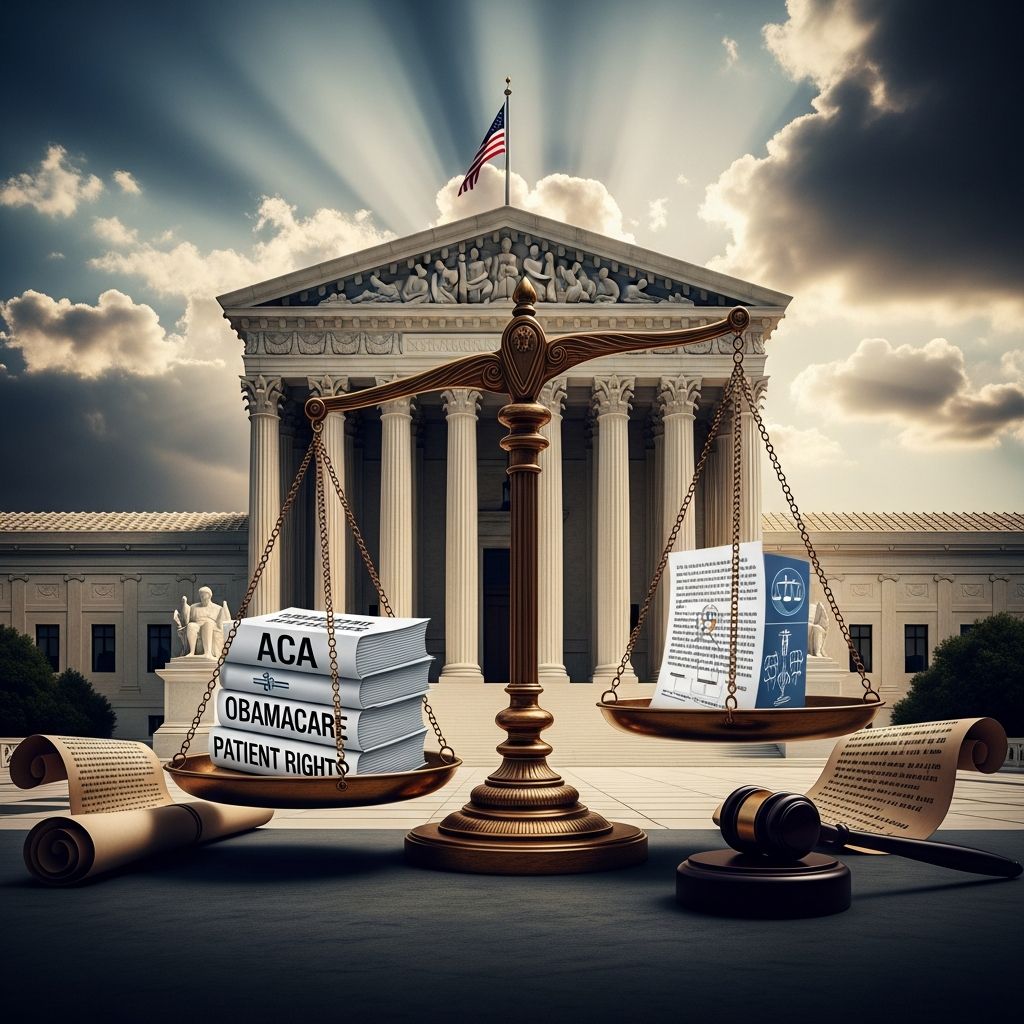
The Affordable Care Act (ACA), commonly known as Obamacare, has faced relentless legal scrutiny since its passage in 2010. Over the years, the U.S. Supreme Court has delivered several landmark decisions that have determined its core provisions’ fate. These rulings not only tested the boundaries of federal power but also reshaped healthcare access for millions. This article examines the most significant cases, their outcomes, and their lasting implications.
Foundational Challenge: Upholding the Individual Mandate
In 2012, the Supreme Court issued its first major verdict on the ACA in National Federation of Independent Business v. Sebelius. Challengers argued that the law’s individual mandate—requiring most Americans to purchase health insurance or face a penalty—exceeded Congress’s authority under the Commerce Clause. The Court, in a narrow 5-4 decision led by Chief Justice John Roberts, rejected this view but upheld the mandate by reclassifying the penalty as a tax, a power explicitly granted to Congress by the Constitution.
This ruling was pivotal. It preserved the ACA’s mechanism for expanding insurance coverage, ensuring that healthy individuals contributed to the risk pool. Without it, insurance markets could have collapsed due to adverse selection, where only sick people buy coverage. The decision affirmed that while Congress cannot compel commerce, it can incentivize participation through taxation.
Medicaid Expansion Limits: States Gain Leverage
A key aspect of the 2012 ruling addressed Medicaid expansion. The ACA originally coerced states into expanding eligibility to adults up to 133% of the federal poverty level by threatening to withhold all existing Medicaid funds for non-compliance. The Court, in a 7-2 vote, struck down this provision as unconstitutionally coercive under the Spending Clause.
States now have the option to expand Medicaid without losing current funding. As a result, while over 40 states have expanded by 2026, holdouts like Texas and Florida cite fiscal concerns. This federalism win empowered states but created a patchwork of coverage, leaving millions in expansion gap states uninsured.
| State Expansion Status | Year Adopted | Uninsured Reduction (%) |
|---|---|---|
| Expanded (e.g., California) | 2014 | ~50% |
| Non-Expanded (e.g., Texas) | N/A | ~20% |
| Partial/Debated | Varies | 30-40% |
The table above illustrates the divergent impacts, based on federal data tracking uninsured rates post-ACA.
Subsidies Under Fire: King v. Burwell
By 2015, opponents targeted the ACA’s premium tax credits, available through federally facilitated marketplaces. In King v. Burwell, plaintiffs claimed subsidies were only for state-run exchanges, per the law’s literal text: “established by the State.” A 6-3 Supreme Court decision disagreed, upholding subsidies nationwide to avoid destabilizing insurance markets.
Justice Roberts wrote that context matters; interpreting the phrase narrowly would collapse the ACA’s architecture. This preserved affordability for 8 million enrollees at the time, preventing premium spikes. Economists estimate it averted a 10-20% cost increase in federal exchange states.
Contraceptive Mandate and Religious Liberty
Religious employers challenged the ACA’s requirement for no-cost contraceptive coverage. In Burwell v. Hobby Lobby (2014), the Court ruled 5-4 that closely held for-profit corporations qualify for Religious Freedom Restoration Act (RFRA) exemptions. The mandate substantially burdened religious exercise by forcing coverage of objectionable items like certain contraceptives.
Later, Little Sisters of the Poor v. Pennsylvania (2020) upheld broader exemptions, criticizing administrative overreach. These cases balanced access to preventive care with First Amendment rights, leading to adjusted regulations allowing opt-outs via self-certification. Women still access most services, but nonprofits face fewer hurdles.
- Pro-access argument: Ensures preventive care without cost barriers.
- Religious freedom argument: Prevents government imposition on beliefs.
- Outcome: Hybrid accommodations minimize conflicts.
Recent Developments: DACA, Gender Identity, and Beyond
Post-2020, challenges persist. In 2024-2025, courts addressed DACA recipients’ Marketplace eligibility. A North Dakota district court injunction temporarily blocked coverage for DACA individuals in certain states, leading to enrollment cancellations and refunds. By December 2025, voluntary dismissal restored eligibility nationwide.
Section 1557 nondiscrimination rules faced scrutiny in cases like Florida v. HHS (2024), where courts stayed provisions interpreting “sex” to include gender identity, citing overreach under the ACA. Additionally, Medina v. Planned Parenthood (2025) ruled that Medicaid beneficiaries lack private rights to sue over provider exclusions, limiting challenges to state decisions.
These rulings highlight ongoing tensions between federal mandates and state autonomy, with immigration status and LGBTQ+ protections in flux.
Political and Societal Ripples
Each decision carried political weight. The 2012 ruling boosted President Obama’s reelection, validating ACA as a policy win despite conservative dissent. Media missteps, like premature strike-down reports by CNN and Fox, underscored high-stakes coverage pressures.
Beneficiaries, especially women and those with pre-existing conditions, gained protections against denial or lifetime caps—provisions upheld across rulings. Uninsured rates dropped from 16% in 2010 to under 8% by 2025, though disparities remain.
Future Horizons for ACA Litigation
With a conservative Supreme Court majority, future cases may test premium caps, public options, or drug pricing reforms. Recent decisions signal deference to textualism but wariness of market disruption. Policymakers must navigate this landscape amid expiring mandates and rising costs.
Stakeholders—from insurers to patients—monitor dockets closely. The ACA’s resilience stems from pragmatic judicial balancing, ensuring broad access while respecting federalism.
Frequently Asked Questions (FAQs)
Is the ACA still constitutional after all these challenges?
Yes, core provisions like the individual mandate (now a tax penalty) and protections for pre-existing conditions remain intact per Supreme Court precedents.
Can states opt out of Medicaid expansion without penalty?
Absolutely; the 2012 ruling made expansion voluntary, preserving existing funding.
Do religious employers have to provide contraceptive coverage?
Exemptions apply under RFRA for objecting entities, with alternative access mechanisms.
Are DACA recipients eligible for Marketplace subsidies?
As of late 2025, yes, following case dismissals, though subject to ongoing rules.
How has Obamacare impacted uninsured rates?
Dramatically reduced them, with expansions covering over 20 million, per federal data.
References
- Supreme Court decision on the Affordable Care Act — PMC/NCBI. 2017-12-01. https://pmc.ncbi.nlm.nih.gov/articles/PMC5765941/
- Affordable Care Act cases — Encyclopædia Britannica. 2023-05-15. https://www.britannica.com/event/Affordable-Care-Act-cases
- Winners and Losers of the Supreme Court’s Healthcare Ruling — Business Insider. 2012-06-28. https://www.businessinsider.com/winners-losers-affordable-care-act-supreme-court-obamacare-ruling-2012-6
- Health Care Supreme Court Cases — Justia. 2025-01-10. https://supreme.justia.com/cases-by-topic/healthcare/
- Recent court decisions impacting the Marketplace — HealthCare.gov (U.S. Gov). 2025-12-11. https://www.healthcare.gov/court-decisions/
- The Top 5 Ways the Supreme Court’s Ruling on Obamacare Helps Women — Center for American Progress. 2012-06-28. https://www.americanprogress.org/article/the-top-5-ways-the-supreme-courts-ruling-on-obamacare-helps-women/
Similar Articles








Read full bio of medha deb




