
Suggesting Mediation or Collaborative Divorce to Your Spouse
Learn how to introduce mediation or collaborative divorce to your spouse in a calm, practical, and legally informed way.
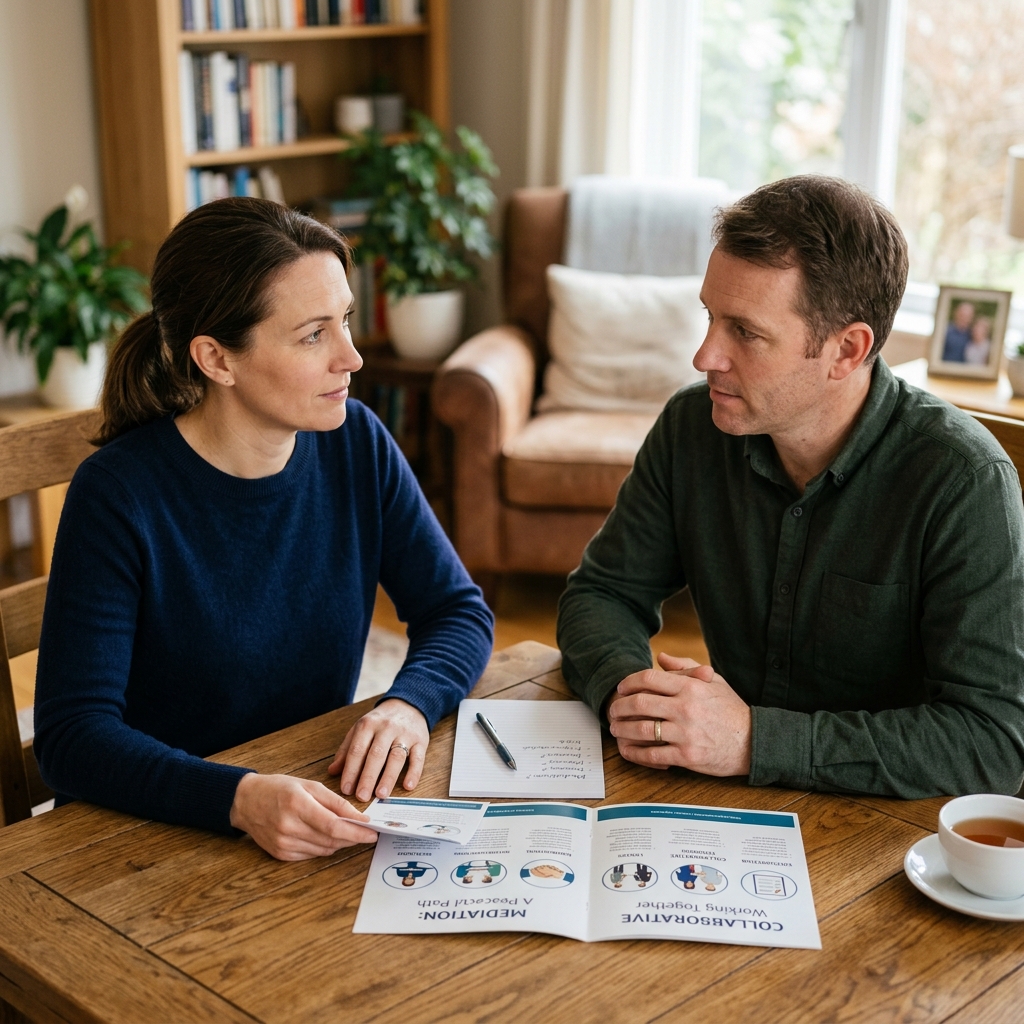
When a marriage is ending, one of the hardest steps is not the paperwork or court hearing, but the conversation where you say: “I think we should talk about how to end this respectfully.” Choosing mediation or a collaborative divorce can make that process less painful, but you and your spouse must agree to try it. This guide explains how these options work, why they might help your family, and how to propose them in a way that is calm, clear, and constructive.
Understanding Your Options: Mediation vs. Collaborative Divorce
Before raising the topic with your spouse, it helps to understand the basic differences between key settlement-focused approaches.
| Feature | Mediation | Collaborative Divorce |
|---|---|---|
| Primary professional involved | Neutral mediator helping both spouses communicate and negotiate. | Each spouse has their own collaborative attorney; other neutral professionals may join (e.g., financial specialists). |
| Decision-maker | Spouses make all decisions; mediator does not impose outcomes. | Spouses and their lawyers negotiate; no judge decides unless talks fail. |
| Role of the court | Court mainly approves the final agreement and issues the divorce decree. | Court involvement is limited until parties finalize and file their settlement. |
| Conflict level | Designed for constructive dialogue, but both spouses must be able to sit together or shuttle between rooms. | Structured negotiation teams can handle more complexity, but high hostility may still undermine the process. |
| Cost and time | Often lower cost and faster than contested litigation, with multiple short sessions. | Usually less expensive than trial, but may be higher than basic mediation due to more professionals. |
Both approaches share a core idea: you retain control over your divorce terms instead of having a judge decide for you. Understanding this helps you explain to your spouse why you’re suggesting these options.
Why Suggest Mediation or Collaborative Divorce?
Many couples are drawn to non-adversarial processes because they align better with their values and practical needs than a contested trial.
Key benefits for you and your family
- Greater control over outcomes: You decide how to divide property, share parenting time, and handle support instead of relying on court orders.
- Lower emotional strain: Joint problem-solving can reduce hostility, which is particularly important if you share children.
- Potentially lower costs: Fewer court appearances and streamlined negotiations often mean fewer billable hours compared with full litigation.
- Privacy: Most mediation or collaborative sessions occur in private settings, not public courtrooms.
- Flexibility: Session schedules and solutions can be tailored to your family’s routines rather than rigid court calendars.
When proposing mediation or collaborative divorce, emphasizing these shared benefits helps your spouse see that you are not trying to “win,” but to manage a difficult transition with as little damage as possible.
Preparing Yourself Before You Raise the Topic
A thoughtful proposal starts with preparation. Good preparation can also make the eventual mediation or collaborative process smoother.
Clarify your goals and boundaries
- Identify your top priorities, such as stability for children, staying in the home for a transition period, or financial security.
- Note issues where you can be flexible, such as holiday schedules or timing of asset transfers.
- Consider your non-negotiables, especially around safety, domestic violence, or severe substance abuse. In such cases, mediation might not be appropriate, and court intervention could be necessary.
Gather key information
Even before any formal process begins, having an overview of your finances and family arrangements will help you speak concretely about why a structured, problem-solving method makes sense.
- List major assets: home, vehicles, savings, investments, retirement accounts.
- List major debts: mortgages, loans, credit cards.
- Think about current child-related routines: school, activities, medical care, and caregiving responsibilities.
Get independent legal advice
Even if you hope to stay out of court, speaking briefly with a family law attorney or legal aid organization can clarify your rights and responsibilities before you talk to your spouse.
In many jurisdictions, bar associations, court self-help centers, or legal aid clinics provide basic guidance about divorce law, mediation programs, and required forms. Understanding that baseline can prevent misunderstandings later.
Choosing the Right Moment and Setting for the Conversation
How you raise the idea often matters as much as the idea itself. A well-chosen moment can reduce defensiveness and give you both space to think.
Consider timing carefully
- Avoid starting the discussion during heated arguments or immediately after a crisis.
- Choose a time when both of you are relatively calm and not rushed, such as an evening without other obligations.
- If direct conversation feels too volatile, consider beginning with a written message that expresses your intentions and suggests a time to talk.
Select a neutral, private place
- Choose a space where each of you can leave the conversation if needed without feeling trapped.
- Ensure children are not present; they should not witness or overhear early divorce discussions.
- If home feels unsafe or emotionally charged, you may suggest a conversation by video call or in a quiet public place, depending on comfort and safety.
How to Frame the Conversation Constructively
The words you use can strongly influence how your spouse reacts. Focusing on shared goals and respect rather than blame can open the door to mediation or collaborative work.
Lead with shared values and concerns
You might begin by acknowledging the difficulty of the situation and emphasizing mutual interests.
- Concern for children’s emotional wellbeing.
- Desire to avoid long, expensive court battles.
- Respect for each other’s future and ability to move on.
For example, you could say you want a process that gives both of you a voice, rather than having everything dictated by a judge.
Explain mediation and collaborative divorce in simple terms
Your spouse may be unfamiliar with these approaches or mistaken about what they involve. Be prepared to offer a neutral explanation.
- Mediation: “A neutral professional helps us talk through all the issues, like finances and parenting, and guides us toward an agreement. They don’t take sides or make decisions for us.”
- Collaborative divorce: “We each have a lawyer committed to settling the case without going to court. Everyone works together in meetings to reach solutions instead of preparing for trial.”
Reassure your spouse that both processes allow each of you to seek legal advice and do not force anyone to accept terms they consider unfair.
Use “I” statements rather than blame
To reduce defensiveness, avoid blaming language and focus on your own feelings and hopes. For instance:
- “I’m scared of what a long court fight could do to us and the kids.”
- “I would feel better if we had a neutral person helping us communicate.”
- “I want both of us to be able to move forward without feeling destroyed by this process.”
Addressing Common Concerns Your Spouse May Have
Even if your spouse sees some benefits, they may have worries that need to be heard and addressed honestly.
“Will I be at a disadvantage?”
Many people fear that mediation or collaborative divorce might favor the more confident or better-informed spouse. You can respond by explaining structural safeguards.
- In mediation, the mediator’s role is to ensure balanced participation, clarify misunderstandings, and address major power imbalances when possible.
- Both approaches allow each spouse to consult their own attorney about legal rights and options.
- If the imbalance is too severe or there is a history of serious abuse, you can explain that you are open to using the court system instead to ensure protection.
“Is this legally binding?”
Another common worry is whether any agreement reached through these methods will be enforceable. You can clarify that approved written agreements carry legal weight.
- In many jurisdictions, the final settlement agreement produced from mediation or collaborative talks is submitted to the court and, once approved, becomes part of the divorce decree.
- Courts generally require agreements to be written, signed by both parties, and formally incorporated into the judgment to be enforceable.
“What if we can’t agree?”
Your spouse may worry that trying mediation will waste time if you end up in litigation anyway.
- You can acknowledge that if you cannot reach agreement on some or all issues, you both still have the right to ask a court to decide those matters.
- Any areas where you do find consensus can reduce the scope of court disputes, saving time and cost.
- Explaining that mediation is generally a voluntary process may help: either of you can choose to stop if it is not working.
Practical Steps After Your Spouse Shows Interest
If your spouse is open to exploring mediation or collaborative divorce, the next step is to move from discussion to action with minimal pressure.
Research reputable local programs and professionals
- Check your state or provincial court website for information about court-connected mediation programs, orientation sessions, or referrals.
- Review profiles of mediators or collaborative lawyers, focusing on family law experience and professional training.
- Consider scheduling brief individual consultations so each spouse can ask questions before committing.
Agree on ground rules before you begin
Setting expectations in advance helps both of you feel safer entering joint sessions.
- Commit to speaking respectfully and allowing each person time to talk without interruption.
- Agree that major decisions will be made only after you have had a chance to review drafts and, if desired, consult your own lawyer.
- Discuss whether you are comfortable meeting in the same room or would prefer shuttle mediation, where the mediator meets with each of you separately and moves between rooms.
Prepare for the first session together
Once you choose a mediator or collaborative team, each of you can prepare for the first meeting by reflecting on key topics.
- List major issues you believe must be resolved: property division, support, child-related arrangements, and any special circumstances.
- Gather requested documents such as financial statements, tax records, and account information so conversations can be grounded in accurate data.
- Think about possible options and compromises, not just ideal outcomes.
When Mediation or Collaborative Divorce May Not Be Appropriate
While many couples benefit from these non-adversarial processes, they are not suitable for every situation. Understanding limits can prevent harm.
- Domestic violence or coercive control: If one spouse fears physical harm, feels unable to speak freely, or has been severely controlled, a structured court process or protective orders may be safer than joint negotiations.
- Severe substance abuse or mental health crises: Where one party is unable to participate reliably in sessions, court oversight may be necessary.
- Hidden assets or serious dishonesty: If you suspect significant financial concealment, discovery tools available in litigation might be required.
If any of these concerns apply, you can still aim for constructive communication with your spouse, but you may decide not to propose mediation or collaborative divorce as the primary method of resolving legal issues.
FAQs About Proposing Mediation or Collaborative Divorce
1. Do I need to tell my spouse I’ve seen a lawyer before suggesting mediation?
There is usually no legal requirement to disclose that you have spoken with an attorney. However, honesty can build trust. You might say that you sought information to understand your options and that your goal is still to settle amicably, not to attack.
2. Can we use court-connected mediation if we already filed for divorce?
In many jurisdictions, mediation can be used both before and after a divorce filing. Some courts actively encourage mediation to reduce case backlogs and help families reach settlements. Check local rules or ask a court self-help center for guidance.
3. What if my spouse refuses mediation but is open to a collaborative divorce?
You can respect that preference and explore collaborative options instead. The core idea is to choose a process where both of you feel comfortable negotiating in good faith, with clear legal support.
4. Will a mediator or collaborative lawyer force us to stay married?
No. These professionals focus on helping you resolve the terms of separation or divorce. They do not decide whether the marriage ends, and they do not have authority to block a legal divorce if statutory requirements are met.
5. Can we switch from mediation to litigation later?
Yes. Mediation is usually voluntary, and either party can choose to stop and pursue court resolution instead. However, many couples find that even partial agreements reached in mediation reduce the scale of later disputes.
References
- Divorce Mediation — The Maryland People’s Law Library. 2023-05-01. https://www.peoples-law.org/divorce-mediation
- Mediation Law & Divorce — Justia. 2022-11-10. https://www.justia.com/family/divorce/the-divorce-process/divorce-mediation/
- Divorce Mediation — New York State Unified Court System. 2024-04-15. https://www.nycourts.gov/alternative-dispute-resolution/divorce-mediation
- Law Facts: Divorce Mediation — Ohio State Bar Association. 2023-03-01. https://www.ohiobar.org/public-resources/commonly-asked-law-questions-results/law-facts/law-facts-divorce-mediation/
- Divorce Mediation in New York: Process & Outcomes — Clark & Peshkin. 2022-08-18. https://clarkpeshkin.com/how-divorce-mediation-works-in-new-york-eligibility-preparation-and-outcomes/
Similar Articles








Read full bio of Sneha Tete


