
Student Loan Wage Garnishment: What Defaulted Borrowers Need to Know
A practical legal and financial guide for federal student loan borrowers facing or fearing wage garnishment after default.
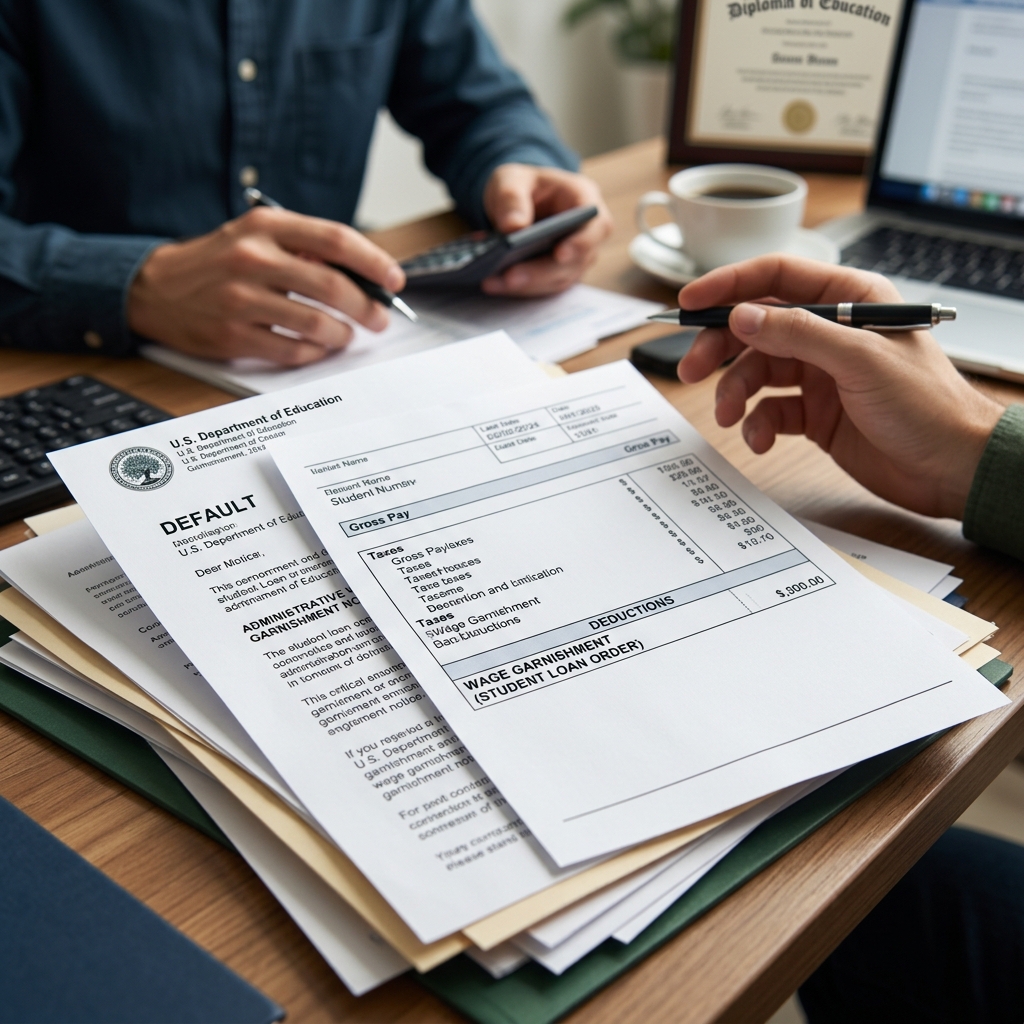
Federal student loan borrowers who fall seriously behind on payments may face a powerful collection tool: administrative wage garnishment, where the U.S. Department of Education can take part of their paycheck without going to court. Understanding how this process works, what notices you will receive, and the options available to you is essential if you are already in default or worried that you might end up there.
This guide explains the legal framework behind wage garnishment, outlines the rights of borrowers, and walks through practical steps to avoid, challenge, or end garnishment. It focuses on federal student loans, which follow different rules than private student loans.
How Federal Student Loan Wage Garnishment Works
Federal law allows the Department of Education (ED) to collect on defaulted loans by directly withholding a portion of a borrower’s wages through their employer. This tool, known as Administrative Wage Garnishment (AWG), does not require a traditional court judgment.
| Key Feature | What It Means for Borrowers |
|---|---|
| Type of Loan | Applies to most federal student loans in default (not generally to private loans). |
| Authority | Permitted under the Higher Education Act and related regulations, enforced by ED or its collection contractors. |
| Court Order | Not required; ED can initiate AWG administratively after giving required notice and an opportunity to contest. |
| Maximum Amount | Up to 15% of disposable pay (after mandatory deductions), subject to certain protections. |
What “Default” Means for Federal Student Loans
For most federal student loans, you are considered in default when you are at least 270 days (about nine months) past due on required payments. Once you reach default, the entire balance can become immediately due, and powerful collection tools, including wage garnishment and tax refund offsets, may come into play.
- Delinquency: Missing payments or paying less than the required amount.
- Default: Typically 270 days of non-payment for most federal loans.
- Consequences: Damage to credit, loss of access to new federal aid, and exposure to involuntary collections like AWG.
Notice Requirements Before Your Wages Can Be Garnished
Before ED can start taking money from your paycheck, it must provide written notice and an opportunity to respond. Federal borrowers must receive a notice at least 30 days before garnishment begins. This is your critical window to take action.
What the Garnishment Notice Typically Includes
While the exact language can vary, a garnishment notice from ED or its contractor usually includes:
- The amount of debt you owe and the type of loan (Direct Loan, FFEL, Perkins, etc.).
- A statement that ED intends to begin wage garnishment and the percentage it plans to take.
- Information about your right to request a hearing or review, including deadlines.
- Instructions on how to submit evidence of financial hardship or dispute the debt.
- Contact details for the agency or contractor handling your case.
Ignoring this notice almost guarantees that garnishment will go forward. Acting promptly—before the 30-day window closes—gives you the best chance to prevent or modify garnishment.
How Much of Your Paycheck Can Be Garnished?
The Higher Education Act authorizes ED to withhold up to 15% of a borrower’s disposable income through administrative wage garnishment. Disposable income generally means what is left after legally required deductions such as federal and state taxes and Social Security.
Important aspects of this limit include:
- The 15% cap applies per federal garnishment order, but other garnishments (e.g., child support, court judgments) may also reduce your pay.
- Borrowers can argue that this amount would cause extreme financial hardship and ask to reduce it through an administrative hearing.
- Certain minimum-income protections ensure that garnishment does not push a borrower below basic subsistence thresholds, although these protections can be limited.
Other Federal Collection Tools Besides Wage Garnishment
Wage garnishment is just one tool ED can use when loans default. The Department may also employ other methods, often in combination, to recover amounts owed.
- Tax Refund Offsets: The Treasury Offset Program (TOP) can seize federal tax refunds to pay defaulted student loans.
- Social Security Offsets: In some cases, a portion of Social Security benefits may be taken for defaulted student loans, subject to statutory limits.
- Collection Fees: Additional fees and costs may be added to the balance when loans enter collections.
- Credit Reporting: Default can be reported to credit bureaus, significantly affecting access to housing, credit, and some jobs.
Because these tools can operate together, staying out of default—or exiting it quickly—is usually more effective than trying to manage the fallout once multiple collection mechanisms are in place.
Recent Policy Context: Restart of Post-Pandemic Collections
During the COVID-19 emergency, federal student loan collections, including wage garnishment, were broadly paused. That meant many borrowers in default did not experience garnishment even though they owed money. As emergency protections wind down and repayment systems are adjusted, ED is planning to resume various involuntary collections.
For example, advocacy and industry sources report that federal student loan wage garnishment will resume in January 2026 for certain borrowers in default. At the same time, ED has announced a temporary delay of some involuntary collections to implement new repayment reforms and give borrowers more options. This evolving policy landscape underscores why borrowers should monitor official communications from ED rather than relying on assumptions from earlier pandemic-era rules.
Options to Avoid Reaching Default
If you have not yet defaulted, you still have several tools to bring your loan back to a manageable status and avoid garnishment entirely.
Income-Driven Repayment Plans
Income-Driven Repayment (IDR) plans adjust monthly payments based on your income and family size, often dramatically reducing required payments for low-income borrowers. ED has recently updated IDR options to provide more affordable payments and pathways to forgiveness.
- Payments can be as low as $0 per month for borrowers with very low incomes.
- Remaining balances can be forgiven after a set number of years of qualifying payments.
- Enrolling in IDR before default can prevent delinquency from turning into default and keep you eligible for other benefits, like Public Service Loan Forgiveness.
Temporary Relief: Deferment and Forbearance
Borrowers experiencing short-term hardship may be eligible for deferment or forbearance, which temporarily pause payments under specific circumstances.
- Deferment: May be available for unemployment, economic hardship, returning to school, or military service; interest treatment varies by loan type.
- Forbearance: Allows temporary payment suspension or reduction, but interest usually continues to accrue.
These are best used as short-term tools, not long-term solutions. Overuse can increase your total costs, but they can be useful to avoid slipping into default during a rough patch.
Strategies for Borrowers Already in Default
If your loan has already defaulted, wage garnishment is a real risk, but you still have options. Two of the most important are loan rehabilitation and loan consolidation.
Loan Rehabilitation
Loan rehabilitation is a process that allows you to work out a reasonable payment plan on your defaulted federal loans. After you make a required number of on-time, voluntary payments, the default notation can be removed from your credit history and the loan returns to normal servicing.
- You typically must make nine on-time payments within ten months, with the amount based on your income.
- Once rehabilitation is complete, wage garnishment generally stops because the loan is no longer in default.
- Rehabilitation is usually available only once per loan, so using it wisely is important.
Loan Consolidation out of Default
Direct Consolidation Loans can be used to pay off certain defaulted loans and create a new loan that is back in good standing, provided you agree to an income-driven repayment plan or make a set number of payments.
- Consolidation can be faster than rehabilitation but may not remove the default from your credit in the same way.
- It can stop collections, including wage garnishment, once the defaulted loans are paid off through the new consolidation loan.
Borrowers should weigh the pros and cons of rehabilitation versus consolidation, considering credit impacts, timing, and long-term affordability.
Your Right to Request a Hearing or Review
Borrowers facing wage garnishment have the right to challenge the action through an administrative hearing. This hearing is usually conducted by phone or in writing rather than in a courtroom.
Reasons You Can Raise at a Hearing
- Debt is not yours: Errors in identity, loan assignments, or records.
- Amount is incorrect: Disputes over the balance, interest, or fees.
- Financial hardship: Garnishment at the proposed rate would prevent you from meeting basic living needs.
- Already in a repayment plan: You are making payments under a negotiated plan that should preclude garnishment.
To use this right effectively, you must generally submit your request by the deadline in the notice, often within 30 days. You may be asked for documentation such as pay stubs, household bills, or tax returns to support a hardship claim.
Checking Your Loan Status and Getting Help
Many borrowers are unsure whether their loans are in good standing, delinquent, or in default. The safest way to check is through official federal resources.
- Federal Student Aid (FSA) Website: Logging into your account shows loan types, servicer information, and status, including whether loans are in default.
- Your Loan Servicer: Contact your servicer directly to ask about status, options for repayment, and steps to avoid default.
- Legal and Advocacy Organizations: Nonprofit consumer or legal aid groups may provide free or low-cost help, especially if you believe your rights are being violated.
: Constituents can request assistance from congressional offices if they have trouble resolving issues with federal agencies, including ED.
Because student loan policy has changed repeatedly over the last several years, relying on up-to-date information from ED and reputable organizations is critical.
Common Mistakes That Increase Garnishment Risk
Certain patterns of behavior make it more likely that a borrower will end up facing garnishment. Knowing these can help you avoid them.
- Ignoring mail from servicers or ED: Many borrowers miss key notices because they are afraid to open them or assume they are purely informational.
- Changing jobs or addresses without updating contact information: This can lead to missed notices and lost opportunities to contest garnishment.
- Assuming pandemic-era pauses are permanent: Some borrowers mistakenly believe collections are still suspended.
- Relying only on forbearance: Long-term reliance on forbearance, without a plan, can lead to ballooning balances and greater risk of default.
Frequently Asked Questions (FAQs)
Will my employer be notified before garnishment starts?
Yes. Once ED initiates administrative wage garnishment, it sends a notice to your employer directing them to withhold a specified percentage of your disposable earnings. Your employer must comply with this federal order and remit payments as instructed.
Can I be fired because my wages are garnished?
Federal law generally prohibits employers from firing employees solely because their wages are garnished for a single debt. However, multiple garnishments can complicate employment situations. If you fear retaliation, consider speaking with an employment or consumer rights attorney.
If I start an income-driven repayment plan, will garnishment stop?
Entering an income-driven repayment plan is often part of the process of exiting default through rehabilitation or consolidation. Once your loan is no longer in default and a new payment plan is in place, wage garnishment is typically stopped. The exact timing depends on the status of your collections case.
Can private student loans use wage garnishment in the same way?
Private student loans usually cannot use administrative wage garnishment. Instead, private lenders generally must sue in court, obtain a judgment, and then seek wage garnishment under state law. This makes the process different and often slower than federal AWG.
Is there any way to have my federal student loans completely discharged?
Certain circumstances—such as total and permanent disability, school closure, borrower defense to repayment, or eligibility for Public Service Loan Forgiveness—may qualify for discharge or forgiveness of federal loans. Eligibility rules are complex, and borrowers should review official ED guidance or consult qualified advisors.
What should I do immediately if I receive a garnishment notice?
First, read the notice carefully and note all deadlines. Then:
- Verify your loan status using the Federal Student Aid website.
- Contact the agency or contractor listed on the notice to ask about options.
- Consider requesting a hearing if you believe the debt is wrong or garnishment would cause hardship.
- Explore rehabilitation or consolidation to remove your loans from default.
References
- Federal Student Loan Wage Garnishment Resumes January 2026 — ACA International. 2025-12-23. https://www.acainternational.org/news/federal-student-loan-wage-garnishment-resumes-january-2026/
- U.S. Department of Education Delays Involuntary Collections Amid Ongoing Student Loan Repayment Improvements — U.S. Department of Education. 2024-04-19. https://www.ed.gov/about/news/press-release/us-department-education-delays-involuntary-collections-amid-ongoing-student-loan-repayment-improvements
- Trump Admin Decision to Garnish Wages from Defaulted Student Loan Borrowers is Cruel, Unnecessary, and Irresponsible — Student Borrower Protection Center. 2025-12-23. https://protectborrowers.org/trump-admin-decision-to-garnish-wages-from-defaulted-student-loan-borrowers-is-cruel-unnecessary-and-irresponsible/
- Some Student Loan Borrowers Could See Wages Garnished Starting in January 2026 — ABC11 / WTVD. 2025-12-24. https://abc11.com/post/student-loans-payback-2026-borrowers-will-see-wage-garnishments-start-january-defaulted-education/18313030/
- Student Loan Borrowers in Default May See Wages Garnished in 2026 — ABC7 New York. 2025-12-24. https://abc7ny.com/post/trump-administration-says-federal-student-loan-borrowers-default-may-see-wages-garnished-2026/18311706/
Similar Articles








Read full bio of medha deb




