
Business And Personal Taxes: 5 Entity Types Every Owner Needs
Learn when business income belongs on a personal return and when separate filings are required.
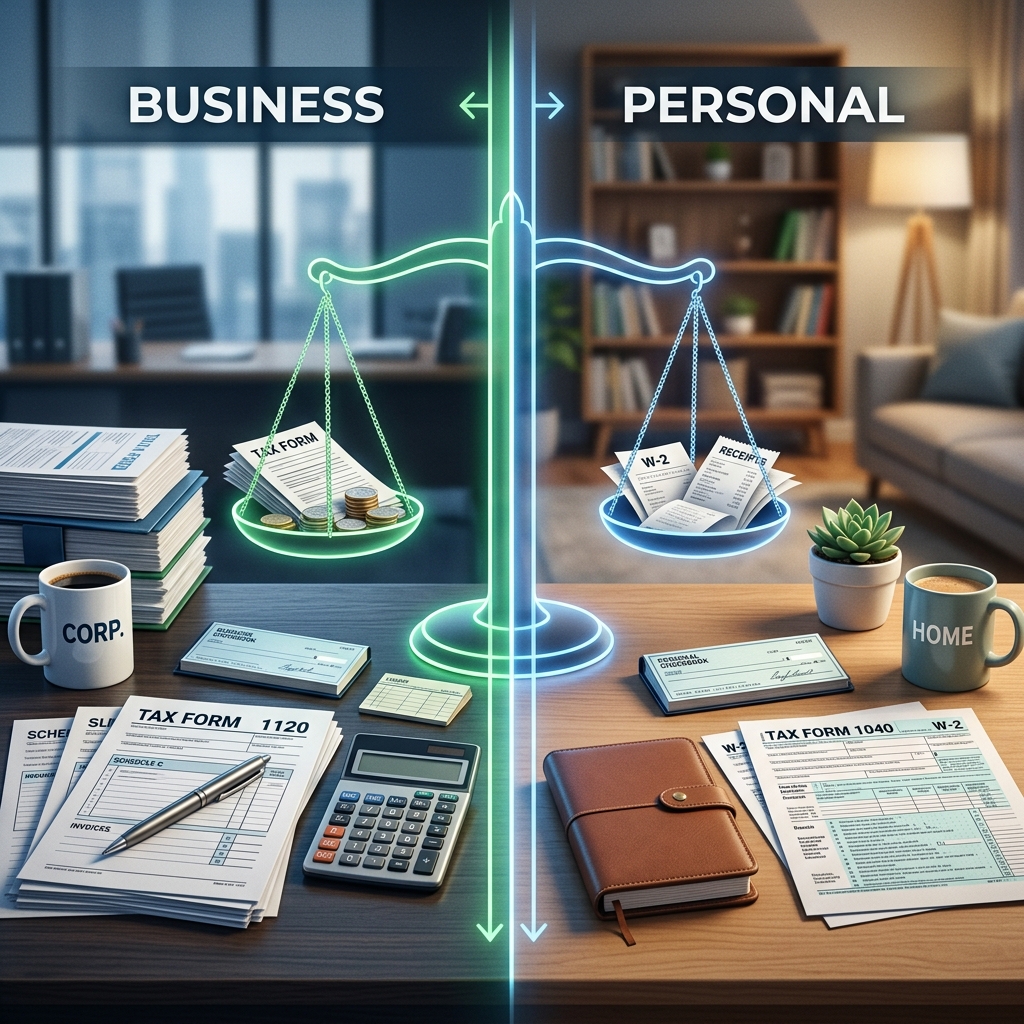
Why the line between business and personal taxes matters
Many new owners assume that if a business account is small, informal, or run from home, the tax filing process can also stay simple. In reality, the way a business is organized determines whether profits and losses are reported on a personal return or on a separate business return. The difference is not just administrative. It affects tax forms, payment timing, recordkeeping, and the risk of errors that can trigger notices or missed deductions.
The basic rule is straightforward: some businesses are treated as part of the owner for tax purposes, while others are treated as separate taxpayers. The legal structure you choose often decides which path applies. In general, sole proprietorships and many LLCs taxed as pass-through entities report business results through the owner’s individual return, while corporations file separately. The IRS explains that sole proprietors use Form 1040 with Schedule C, while corporations generally file their own returns such as Form 1120.
How entity type controls filing responsibilities
Business form is the starting point for tax treatment, but it is not the only factor. A company can be formed under state law as an LLC, yet still choose a tax classification that changes how it files. That is why owners need to look at both the legal entity and the tax election attached to it.
| Business type | Typical federal tax treatment | How income is reported |
|---|---|---|
| Sole proprietorship | Pass-through | Owner reports business income on Form 1040, usually with Schedule C |
| Single-member LLC | Usually disregarded entity | Commonly reported on the owner’s Form 1040 with Schedule C |
| Partnership / multi-member LLC | Pass-through | Business files an informational return; owners report their shares |
| S corporation | Pass-through with separate filing | Business files its own return, but income flows to owners |
| C corporation | Separate taxpayer | Business files its own corporate return |
This table is a simplified overview. The exact filing outcome can vary depending on elections, ownership changes, and state tax rules. The Small Business Administration notes that business structure affects liability and taxes, and that corporations and LLCs can be taxed differently depending on classification.
When business income goes on a personal return
In many small businesses, the owner does not file a standalone business income tax return. Instead, the business results become part of the owner’s individual filing. This is common for sole proprietors and for single-member LLCs that have not elected corporate taxation. FreshBooks explains that these structures are generally taxed together with the owner, rather than as separate taxpayers.
For these businesses, the owner typically uses Schedule C to report profit or loss from the business, and then carries that result into the individual Form 1040. If the business has net earnings, self-employment tax may also apply, which is why Schedule SE can become part of the filing package.
This arrangement has practical advantages. The owner may have a simpler filing process than a corporation, and the business’s tax result is directly reflected on the personal return. But simplicity should not be confused with informality. Separate accounting records are still important because the IRS expects accurate reporting of business income and expenses even when the filing is combined with personal taxes.
When separate business returns are required
Some entities must file their own returns because the law treats them as distinct from their owners. Corporations are the clearest example. FreshBooks states that corporations file business taxes separately, and TurboTax similarly notes that corporations and S corporations prepare separate corporate tax returns.
C corporations are taxed at the entity level, meaning the company itself is the taxpayer. Corporate income is reported on Form 1120, and owners generally report wages or dividends separately on their own returns. Bank of America’s tax overview explains that a corporation owes federal income tax on its taxable income as a separate entity, while shareholders are taxed again on wages, dividends, or other distributions as applicable.
S corporations are different from C corporations because they generally avoid entity-level income tax, but they still file a separate return. The business reports income on Form 1120-S and passes items through to shareholders. That means the filing is separate even though the tax burden often reaches the owners personally.
Partnerships and multi-member LLCs also file business-level informational returns, usually Form 1065, and then provide each owner with a Schedule K-1 showing their share of income, deductions, and credits. The owners then include those amounts on their own returns.
The special case of LLCs
LLCs are often misunderstood because the legal entity and tax treatment are not the same thing. An LLC can be owned by one person or by many people, and it can usually choose among tax classifications. That flexibility is useful, but it also creates confusion for owners who assume the LLC itself always determines the filing method.
A single-member LLC is often taxed like a sole proprietorship unless it elects to be treated as a corporation. In that common default setup, the business is not filing a separate federal income tax return. Instead, the owner reports the activity on the personal return, typically using Schedule C.
A multi-member LLC is usually treated like a partnership unless it elects corporate treatment. In that case, the LLC files Form 1065 and provides K-1 forms to the members. If the LLC elects C corporation treatment, it becomes separate for income tax purposes and files a corporate return. If it elects S corporation treatment and qualifies, it files a separate return but generally passes income through to owners.
That means LLC owners should not ask only whether the business is an LLC. They should ask how the LLC is taxed. That answer determines whether the business and personal filings are combined or kept apart.
Why keeping finances separate still matters
Even when the tax return is combined, the finances should not be. Clean separation between business and personal money makes it easier to track deductions, document income, and prepare accurate returns. It also supports better business management because the owner can see what the business is truly earning and spending.
- Use a dedicated business bank account for all business deposits and payments.
- Keep separate records for mileage, home office use, supplies, subscriptions, and equipment.
- Do not pay personal bills from a business account unless you document the transfer properly.
- Retain receipts and invoices so deductions can be substantiated if questioned.
- Reconcile accounts regularly to catch errors before tax season.
These habits are useful whether the business files separately or not. They also reduce the chance of mixing deductible business costs with personal spending, which can create problems during an audit or when preparing financial statements for lenders or investors.
Common tax forms owners should recognize
Knowing the right form helps owners understand the difference between a separate filing and a pass-through filing. The IRS provides a basic list of forms used by sole proprietors, including Form 1040 and Schedule C for income tax, Schedule SE for self-employment tax, and Form 1040-ES for estimated tax payments.
Businesses that file separately may use different forms depending on the entity type. C corporations generally use Form 1120. S corporations generally use Form 1120-S. Partnerships and many multi-member LLCs generally use Form 1065, along with Schedule K-1s issued to owners.
Understanding these forms matters because a business can be organized one way in state records and treated another way for federal tax reporting. An owner who chooses the wrong form may delay filing or misreport income. For this reason, tax classification should be confirmed before the filing season begins.
How owners can reduce filing confusion
Tax problems are often caused less by the tax rules themselves and more by poor preparation. A few disciplined routines can make filing more predictable and help owners avoid mixing business and personal activity.
- Confirm the business tax classification every year, especially after ownership changes or tax elections.
- Track income and expenses in bookkeeping software or a dedicated ledger.
- Set aside money for taxes throughout the year if the business produces income that will flow through to the owner.
- Review whether estimated tax payments are required.
- Check whether any state filing rules differ from federal treatment.
Businesses that operate as pass-through entities often need estimated tax payments because income is taxed to the owner even if no cash is distributed. That is one reason owners should not wait until year-end to think about tax obligations. Quarterly planning can help avoid penalties and cash-flow surprises.
Frequently asked questions
Can a business and personal tax return ever be filed together?
Yes, in many cases. Sole proprietorships and many single-member LLCs report business activity on the owner’s personal return, usually through Schedule C.
Which businesses usually file separately?
Corporations generally file separate tax returns. S corporations also file separate returns even though income often passes through to owners. Partnerships and many multi-member LLCs file informational returns and issue K-1s.
Does an LLC always file separately from the owner?
No. An LLC’s filing method depends on its tax classification. A single-member LLC is often reported on the owner’s personal return unless it elects corporate taxation.
Why is separating bank accounts important if taxes are filed together?
Separate accounts help distinguish business activity from personal spending, making deductions easier to support and records easier to reconcile. This is useful even when the IRS treats the business and owner as one taxpayer for reporting purposes.
Do owners of pass-through entities pay self-employment tax?
Often yes, depending on the business type and the nature of the income. The IRS notes that sole proprietors may owe self-employment tax in addition to income tax, which is why Schedule SE may be required.
A practical approach for small business owners
The safest way to think about business and personal taxes is not in terms of what feels separate, but in terms of how the IRS classifies the business. That classification drives the forms, deadlines, and reporting method. If the entity is taxed as a pass-through, the owner may report the business on a personal return. If the entity is taxed as a corporation, a separate business return is usually required.
Owners who keep good books, preserve receipts, and confirm their entity classification before filing season are far less likely to make costly mistakes. Good tax habits also make it easier to claim valid deductions and explain reported figures if questions arise later. For many businesses, the best results come from treating bookkeeping as a year-round process rather than a once-a-year task.
References
- Filing Business and Personal Taxes Separately — FreshBooks. 2025-10-01. https://www.freshbooks.com/hub/taxes/file-my-personal-and-business-taxes-separately
- Should I file my business and personal taxes together? — TurboTax Support. 2025-10-01. https://ttlc.intuit.com/turbotax-support/en-us/help-article/sole-proprietorship/file-business-personal-taxes-together/L0GTsGE9R_US_en_US
- Choose a business structure — U.S. Small Business Administration. 2025-10-01. https://www.sba.gov/business-guide/launch-your-business/choose-business-structure
- How your business structure can affect taxes — Bank of America Business. 2025-10-01. https://business.bankofamerica.com/en/resources/how-your-business-structure-can-affect-the-business-owners-taxes
- Sole proprietorships — Internal Revenue Service. 2025-10-01. https://www.irs.gov/businesses/small-businesses-self-employed/sole-proprietorships
Similar Articles








Read full bio of medha deb




