The concept of a Terry stop sits at the intersection of public safety and individual liberty. Police officers are allowed to briefly detain people when they suspect criminal activity, yet the Fourth Amendment prohibits unreasonable searches and seizures. A common point of controversy is whether simply standing near a dumpster in a high-crime neighborhood, late at night, can justify an investigative stop.
This article explains what a Terry stop is, how reasonable suspicion works, and why location and behavior both matter when courts decide if a stop was lawful. It uses the familiar scenario of officers confronting someone near a dumpster in a so-called “bad neighborhood” to explore the line between legitimate policing and unconstitutional intrusion.
Foundations: What Is a Terry Stop?
A Terry stop is a brief, on-the-street detention by law enforcement based on reasonable suspicion that a person has committed, is committing, or is about to commit a crime. The term comes from the U.S. Supreme Court case Terry v. Ohio (1968), which approved limited stops and pat-downs when supported by specific facts rather than mere hunches.
In Terry, an officer observed men repeatedly pacing and peering into a store window, suspecting they were planning a robbery. The Court held that stopping and frisking them for weapons did not violate the Fourth Amendment, so long as the officer could point to clear, articulable observations that justified the intrusion.
Key characteristics of a Terry stop include:
- Short duration: The encounter must be brief and limited to investigating the officer’s suspicions.
- Investigative purpose: The goal is to quickly confirm or dispel suspicion, not to conduct a full-scale investigation or arrest.
- Lower standard than probable cause: The officer needs reasonable suspicion, which is less demanding than probable cause for arrest.
- Possible frisk: If the officer reasonably believes the person is armed and dangerous, they may conduct a limited pat-down of outer clothing for weapons.
Reasonable Suspicion vs. Probable Cause
Understanding reasonable suspicion is crucial when analyzing whether standing near a dumpster justifies a stop. Courts distinguish between:
| Standard | Definition | Used For |
|---|---|---|
| Reasonable Suspicion | Specific, objective facts that suggest criminal activity may be happening, more than a hunch but less than probable cause. | Justifies a brief Terry stop or investigatory detention. |
| Probable Cause | Facts and circumstances that would lead a reasonable person to believe a crime has been, is being, or will be committed. | Required for arrests and more intrusive searches. |
Reasonable suspicion must be supported by specific and articulable facts, not vague feelings. For example, an officer might rely on:
- Repeated, suspicious movements around a closed business.
- Visible exchanges of small packages with multiple people in quick succession.
- A person fleeing headlong at the sight of police in an area known for shootings.
By contrast, simply being in a high-crime area, standing near a dumpster, or looking nervous is rarely enough on its own. Courts evaluate the totality of the circumstances, weighing all facts together rather than isolating any single detail.
Fourth Amendment Limits on Stops and Seizures
The Fourth Amendment protects people against unreasonable searches and seizures. A person is considered “seized” when an officer restrains their freedom to walk away through physical force or a show of authority. The Supreme Court has indicated that a seizure occurs when, considering all circumstances, a reasonable person would not feel free to leave.
In the context of Terry stops:
- Lawful seizure: An officer with reasonable suspicion may briefly detain someone and ask questions.
- Unlawful seizure: If the officer lacks reasonable suspicion or prolongs the stop beyond what is needed to investigate, the seizure may violate the Fourth Amendment.
- Consequences: Evidence obtained from an unlawful stop can be excluded from trial under the exclusionary rule.
These limits aim to balance effective policing against the risk of arbitrary or discriminatory enforcement. When a court reviews a stop, it asks whether a reasonably prudent officer in the same situation would have suspected criminal activity, considering the officer’s training and the surrounding environment.
Location, Timing, and Context: The “Dumpster in a Bad Neighborhood” Scenario
One recurring issue is how much weight courts give to location and timing. Officers frequently cite factors such as:
- Presence in a neighborhood known for drug trafficking or gun violence.
- Loitering near alleys, dumpsters, or behind buildings late at night.
- Unusual behavior when police approach, such as evasive movement or attempts to hide objects.
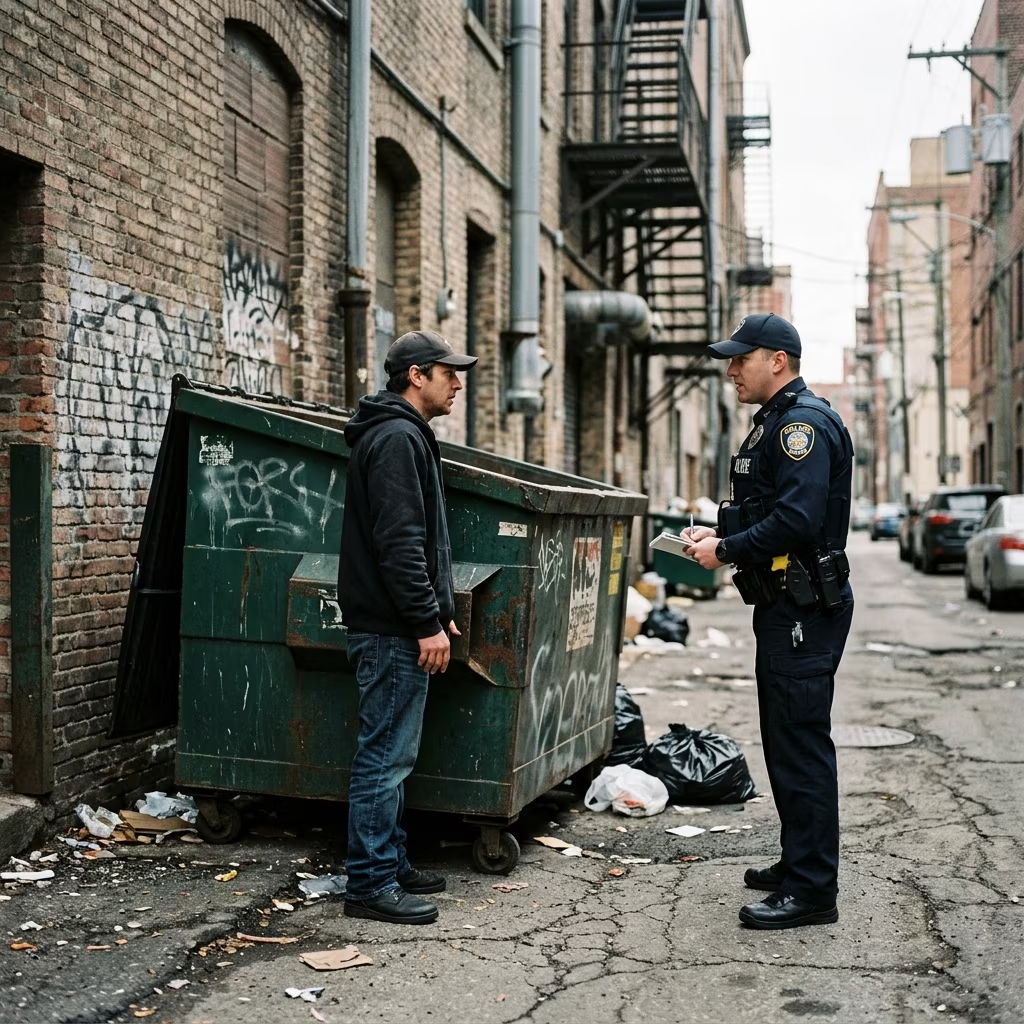
In a typical scenario, an officer on patrol sees someone standing near a dumpster in a poorly lit alley behind a closed store in a high-crime area after midnight. The officer might suspect drug use, illegal dumping, or burglary preparation. The key legal question is whether these observations, taken together, establish reasonable suspicion.
Courts generally approach this scenario using several guiding principles:
- High-crime area is a factor, not a conclusion: Being in a neighborhood with elevated crime rates can support reasonable suspicion, but it cannot by itself justify a stop.
- Specific conduct matters: The officer must describe concrete behaviors—such as repeatedly checking doors, exchanging items, or concealing something in the dumpster—rather than relying solely on the person’s presence.
- Time of day and setting: Late-night presence in an area with closed businesses can strengthen suspicion, especially if combined with other suspicious actions.
Standing near a dumpster may be perfectly innocent; people discard trash, wait for rides, or cut through alleys. Courts are wary of treating ordinary behavior as inherently suspicious simply because it occurs in a disadvantaged community. Reasonable suspicion must be grounded in observable indicators of crime, not stereotypes about people or neighborhoods.
Behavioral Clues: When Innocent Acts Become Part of a Suspicious Pattern
Behavior is often the deciding factor in whether a stop is lawful. Police training materials emphasize certain observable patterns, such as:
- Headlong flight: Running away at the sight of police can justify pursuit and a Terry stop in many jurisdictions.
- Repetitive short-term contacts: Frequent brief meetings with different individuals, accompanied by furtive exchanges, may indicate street-level drug sales.
- Audible or visible signs of crime: Sounds like breaking glass, shouted threats, or gunshots give officers strong grounds to investigate nearby individuals.
In the dumpster example, consider how the facts might change the legal analysis:
- If the person is calmly talking on the phone and drops a bag into the dumpster, this may look routine.
- If the person repeatedly reaches into the dumpster, looks around nervously, and passes items to others, suspicion grows.
- If, upon noticing officers, the person abruptly runs away or tries to conceal something in the dumpster, that behavior heavily influences the reasonable suspicion assessment.
Courts look at the entire behavioral pattern rather than single isolated actions. Innocent explanations are possible, but if facts collectively point toward criminal activity, an officer may be justified in initiating a Terry stop.
Frisks, Weapons, and Officer Safety
A critical distinction within Terry doctrine is between the stop itself and the frisk or pat-down for weapons. Officers do not automatically have the right to frisk everyone they stop. Instead, they must have a separate, reasonable belief that the person is armed and dangerous.
Under Terry v. Ohio and subsequent Fourth Amendment jurisprudence:
- The frisk is limited to a pat-down of outer clothing, designed solely to locate weapons.
- If, during the lawful pat-down, the officer feels an object whose identity as contraband is immediately apparent by touch, they may lawfully seize it (often referred to as “plain touch”).
- Any search beyond what is needed to identify weapons may require probable cause and, in some circumstances, a warrant.
In the dumpster scenario, an officer might justify a frisk if they see the person making movements consistent with hiding a gun, learn of recent armed robberies in the area, or receive a report matching the person’s description as armed. Absent such facts, a pat-down may be harder to defend.
Vehicles, Dumpsters, and Investigative Stops
Terry principles apply not only to pedestrians but also to vehicle stops. A routine traffic stop is considered a form of investigative detention where the driver and passengers are “seized” under the Fourth Amendment.
Courts have held that:
- Officers may stop a vehicle for observed traffic violations or other legitimate reasons.
- Once stopped, they may order occupants out of the vehicle if they reasonably believe they may be armed and dangerous, again to protect officer safety.
- Further questioning or searches must remain reasonably related in scope and duration to the reasons for the stop, unless new facts create independent reasonable suspicion or probable cause.
Near a dumpster, officers might encounter people sitting in parked cars, idling for long periods while others come and go. If that conduct, combined with area crime patterns and specific observations, supports reasonable suspicion, an investigative stop and brief questioning can be lawful.
Duration and Scope: When a Terry Stop Goes Too Far
Even if a Terry stop is justified at the outset, it must remain time-limited and focused. Courts examine whether officers:
- Stopped the person no longer than necessary to address the suspected crime.
- Used questions and actions reasonably related to the basis for the stop.
- Avoided converting the stop into a de facto arrest without probable cause.
For instance, if officers approach someone near a dumpster, briefly ask what they are doing, and quickly determine there is no crime, they should allow the person to proceed. Prolonged detention, extensive searching, or handcuffing without sufficient justification could transform the encounter into an unlawful seizure.
Any evidence or statements obtained during an overlong or overly intrusive stop may be subject to suppression, meaning prosecutors cannot use them in court. This remedy is intended to deter violations and uphold Fourth Amendment standards.
Practical Tips: Knowing Your Rights During a Terry Stop
People often encounter Terry stops without knowing the legal terminology. Having a basic understanding of your rights can help you navigate these encounters more safely and effectively.
If you are stopped while near a dumpster, or anywhere else, consider the following:
- Ask if you are free to leave: If the officer says yes, you may calmly walk away.
- Stay calm and respectful: Sudden movements or confrontational behavior can escalate the situation and increase perceived risk.
- Exercise your right to remain silent: You generally do not have to answer investigatory questions beyond providing basic identifying information where required by law.
- Do not resist physically: If you believe the stop or frisk is unlawful, challenge it later through legal channels rather than during the encounter.
- Document the incident: As soon as you can, write down the officers’ names, badge numbers, location, time, and what was said; this can be crucial if you later contest the stop.
FAQs About Terry Stops and Suspicious Locations
Does standing near a dumpster in a high-crime area automatically allow police to stop me?
No. Being in a high-crime area and near a dumpster can be part of the context, but officers still need specific, articulable facts suggesting criminal activity. Location alone is not enough for reasonable suspicion.
Can officers frisk me just because they stopped me?
No. A frisk requires an additional reasonable belief that you are armed and dangerous. A Terry stop does not automatically authorise a pat-down search.
How long can a Terry stop last?
The stop must be temporary and no longer than reasonably necessary to confirm or dispel the officer’s suspicion. Extended detentions may violate the Fourth Amendment and lead to exclusion of evidence.
Is running away from police always suspicious?
Headlong flight at the sight of officers can be a significant factor supporting reasonable suspicion, especially in a high-crime area, though courts still consider all the circumstances.
What should I do if I believe a Terry stop was unlawful?
Document everything you remember, consider consulting an attorney, and explore whether the stop or any search can be challenged in court. Unlawfully obtained evidence may be excluded.
References
- Terry stop / stop and frisk — Legal Information Institute, Cornell Law School. 2023-01-01. https://www.law.cornell.edu/wex/terry_stop/stop_and_frisk
- Know Your Rights: Terry Stops — Melms Law. 2022-05-10. https://www.melmslaw.com/know-your-rights-terry-stops/
- Terry stop — EBSCO Research Starters (Law). 2021-09-01. https://www.ebsco.com/research-starters/law/terry-stop
- Terry Stop and Frisks: Doctrine and Practice — Constitution Annotated, U.S. Congress. 2020-08-15. https://constitution.congress.gov/browse/essay/amdt4-6-5-1/ALDE_00000797/
- Mastering the Terry stop: Proactive policing for crime prevention — Police1. 2023-03-20. https://www.police1.com/patrol-issues/mastering-the-terry-stop-proactive-policing-for-crime-prevention
- Investigative Car Stops: When Are They Legal? — Aida Law. 2019-11-01. https://aidalalaw.com/investigative-car-stops-when-are-they-legal/