
Protective Sweeps and Felony Possession: Understanding the Law
How the Fourth Amendment shapes police safety searches, protective sweeps, and felony possession appeals in modern criminal practice.
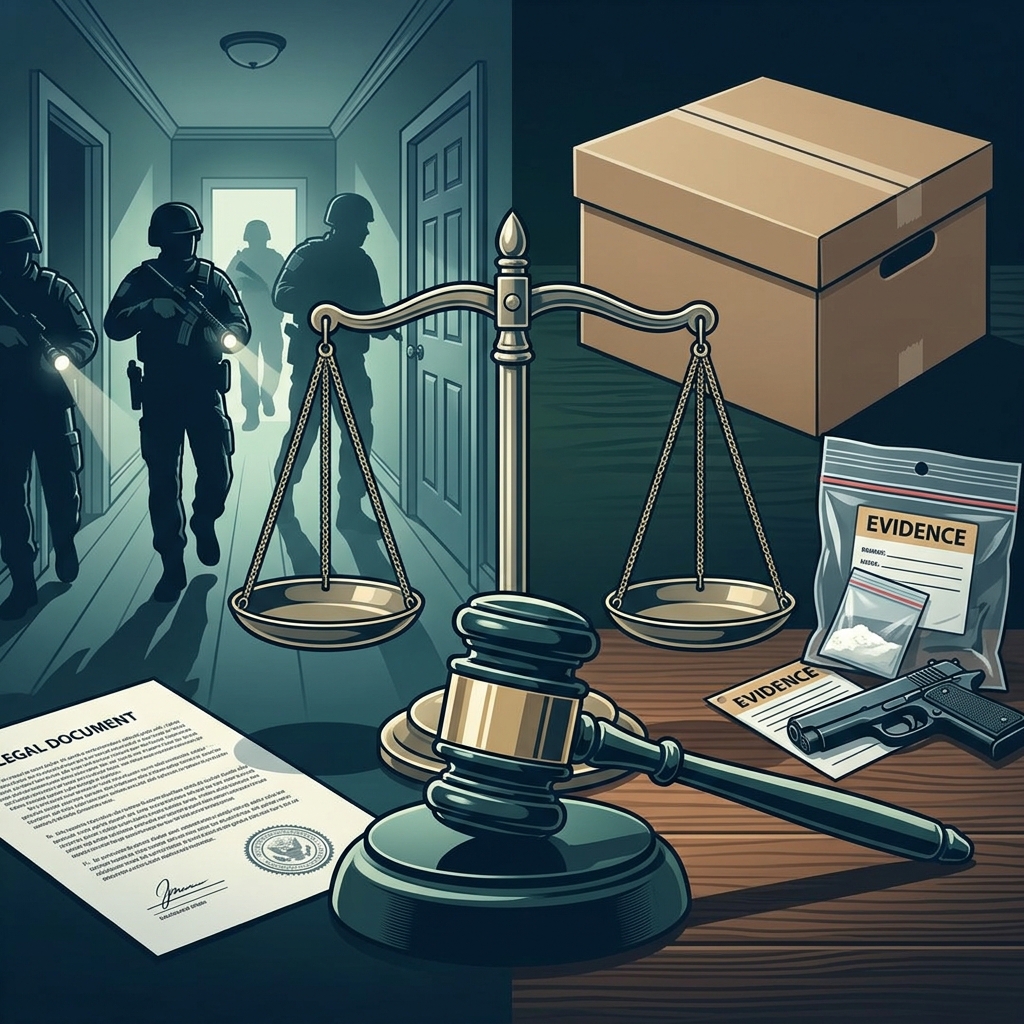
Protective sweeps sit at a crucial intersection between officer safety and Fourth Amendment privacy rights. When police arrest someone in or near a home and then briefly search for dangerous individuals without a warrant, courts must decide whether that search was justified. Those decisions often shape the outcome of felony possession cases, especially where contraband is found during the sweep and later challenged on appeal.
This article explains the legal framework for protective sweeps, focuses on how courts evaluate these searches in felony possession appeals, and offers practical insights for lawyers, defendants, and anyone concerned about the limits of police authority in the home.
1. What Is a Protective Sweep?
A protective sweep is a narrow, quick search that officers conduct during or immediately after an arrest to ensure no other person is present who could pose a danger to them or others on the scene.
- Purpose: To locate people, not evidence.
- Scope: Limited to places where a person could reasonably hide.
- Timing: Conducted incident to an arrest and lasting only as long as necessary to dispel reasonable suspicion of danger.
Courts repeatedly emphasize that protective sweeps are an exception to the warrant requirement and must remain tightly connected to genuine safety concerns rather than used as a pretext for searching for contraband.
2. Fourth Amendment Foundations
The Fourth Amendment protects against unreasonable searches and seizures, generally requiring that police get a warrant before entering and searching a home. Warrantless searches of the home are considered presumptively unreasonable.
Protective sweeps are recognized as a limited exception, rooted in several key principles:
- Reasonable suspicion, not probable cause: The U.S. Supreme Court has allowed protective sweeps based on specific and articulable facts indicating a potential danger, a standard lower than probable cause.
- Incident to arrest: The sweep must be closely tied to a lawful arrest in or around the premises.
- Safety-driven: Because sweeps are motivated by safety and not evidence-gathering, their scope and duration must be strictly constrained.
In the leading Supreme Court case on protective sweeps, the Court explained that officers may perform a quick visual inspection of spaces immediately adjoining the place of arrest, and may extend the sweep further only when they have a reasonable belief based on specific facts that a dangerous person might be present.
3. When Are Protective Sweeps Allowed?
Courts look for concrete, objective indicators that a protective sweep is necessary. Several common scenarios justify such a search:
- Arrest inside a home: When officers arrest a suspect in a residence, they may automatically inspect spaces immediately adjoining the arrest location for hidden individuals.
- Reasonable suspicion of another person present: If officers have specific facts suggesting another person is in the home who may pose a danger, they may conduct a broader but still limited sweep.
- Hot pursuit into a residence: When officers chase a suspect into a home under exigent circumstances, courts often permit a protective sweep as part of securing the premises and ensuring no ambush.
However, the mere possibility that someone might be present is not enough. Courts demand specific and articulable facts, such as seeing movement inside, hearing voices, or receiving information that associates or accomplices are on site.
3.1 Sweeps After Arrest Outside the Home
Protective sweeps are more tightly scrutinized when the arrest occurs outside the home. Some courts allow a limited sweep of the residence only if officers reasonably suspect that:
- Other individuals are inside, and
- Those individuals are aware of the arrest and may destroy evidence, escape, or jeopardize safety.
Absent these conditions, entering the home for a sweep after an outside arrest can be viewed as an unjustified warrantless search, and evidence discovered may be suppressed.
4. Legal Limits on Protective Sweeps
Even when a protective sweep is justified, courts impose strict limits on how far officers may go. These limits are central to many suppression motions and appeals in felony possession cases.
4.1 Scope: Only Places Where People Can Hide
A sweep must be confined to areas where a person could reasonably be located, such as closets, behind doors, or under beds.
- Officers may open a closet door or look behind furniture.
- They may not search inside small containers, drawers, or spaces that clearly cannot conceal a person.
Courts have invalidated sweeps where officers manipulated objects that could not reasonably contain a human body, such as lifting mattresses without any facts suggesting someone was hiding underneath.
4.2 Duration: Only Long Enough to Eliminate Danger
The sweep must last no longer than necessary to dispel the reasonable suspicion of danger and complete the arrest.
- Once officers have checked areas where a person could realistically be lying in wait, the sweep must end.
- Extended searching after the arrest is secured and the scene is calm may be viewed as an impermissible evidence-gathering search.
4.3 No Fishing Expeditions
Courts expressly reject sweeps that function as a disguised search for evidence. A lawful protective sweep:
- Is based on an articulable, particularized, and objective basis for officer danger.
- Does not involve rummaging through containers, drawers, or boxes.
- Is limited to a visual inspection of potential hiding places, not a detailed inventory of the home.
When officers exceed those limits, defendants may move to suppress any evidence found, including firearms, drugs, or other contraband.
5. Protective Sweeps and Felony Possession Charges
Protective sweeps regularly intersect with felony possession prosecutions, particularly cases involving firearms or controlled substances found during a sweep. The legality of the sweep can determine whether key evidence remains in the case.
5.1 Typical Fact Patterns
Common scenarios in felony possession cases include:
- Felon in possession of a firearm: Officers arrest a suspect in a residence and conduct a sweep; a firearm is discovered in a bedroom or closet. If the sweep was outside the lawful scope, the weapon may be suppressed.
- Drug possession or trafficking: During a sweep, officers observe drugs in plain view on a table or shelf. The visibility and location of the drugs, combined with the lawfulness of the sweep, are crucial.
- Mixed contraband: Officers find both weapons and narcotics while checking hiding spots. Defense attorneys may challenge whether each area searched could truly have contained a person.
5.2 Plain View Doctrine During Sweeps
When a protective sweep is lawful, officers may seize evidence that is in plain view in the areas they are permitted to inspect.
| Situation | Plain View Likely Valid? |
|---|---|
| Gun visible on a bed while checking if someone is hiding beside it | Yes, if sweep itself is lawful and area checked can hide a person |
| Drugs found inside a closed drawer opened during sweep | No, drawer cannot hide a person and opening it exceeds sweep scope |
| Narcotics on a table seen while looking in a nearby closet | Yes, if officer is lawfully in the room and contraband is plainly visible |
| Evidence discovered after lifting a mattress without safety justification | Often no, because search exceeded a legitimate protective sweep |
The admissibility of evidence discovered during a sweep therefore depends on two linked questions: whether the sweep itself was lawful, and whether the evidence was truly in plain view within the permissible search area.
6. Appeals and Suppression Issues in Felony Possession Cases
Defendants convicted of felony possession frequently challenge their convictions on appeal by arguing that the trial court wrongly admitted evidence obtained during a protective sweep. Appellate courts then review the circumstances of the sweep under the Fourth Amendment.
6.1 Key Issues on Appeal
Appellate courts typically examine:
- Lawfulness of the initial arrest: Was the arrest valid and supported by probable cause?
- Connection to the sweep: Was the sweep conducted incident to that arrest or unreasonably delayed?
- Objective basis for danger: Did officers have specific and articulable facts suggesting another dangerous person was present?
- Scope and duration: Did the sweep stay within areas where people could hide and end once danger was dispelled?
If the court finds the sweep unlawful, it then considers whether the evidence should be suppressed under the exclusionary rule or saved by exceptions such as attenuation or good faith. Some courts have refused to apply these exceptions where officers clearly exceeded the protective sweep doctrine.
6.2 Consent After an Illegal Sweep
A recurring appellate issue is whether a suspect or homeowner’s consent to search, given after a protective sweep, is truly voluntary or tainted by prior illegality.
- Where the sweep is unlawful, any subsequent consent may be presumed invalid unless the government shows the taint was dissipated.
- Courts look at factors such as time elapsed, intervening circumstances, and the presence of warnings about the right to refuse consent.
In some cases, courts have held that consent given immediately after an unjustified sweep—especially when officers assert authority and control over the home—does not remove the prior constitutional violation, requiring suppression of evidence found during the later search.
7. Practical Guidance: Rights and Responsibilities
Understanding protective sweeps is important not only for attorneys and judges but also for individuals interacting with law enforcement. While this article is not legal advice, it highlights several practical points.
7.1 For Defendants and Homeowners
- Know that home searches are exceptional: Warrantless searches of homes are presumed unreasonable unless a recognized exception applies.
- Protective sweeps are limited: Officers may only look in places where a person can hide and must have specific reasons to fear another person is present.
- Consent matters: Granting permission to search can greatly expand what officers may lawfully do. Courts may later scrutinize whether consent was voluntary, but prevention is better than litigation.
- Document what happened: If you believe a sweep exceeded its lawful bounds, details about rooms searched, items moved, and officer statements can be critical in court.
7.2 For Defense Attorneys
- Scrutinize the factual basis for danger: Compare officers’ testimony with objective circumstances to challenge whether reasonable suspicion existed.
- Analyze scope carefully: Identify areas searched that plainly could not conceal a person and argue that evidence from those locations should be suppressed.
- Evaluate consent and attenuation: Examine whether later consent or other events truly dissipated any taint from an unlawful sweep.
- Use case law strategically: Cite controlling precedents defining the limits of protective sweeps and distinguishing them from evidence-gathering searches.
8. Frequently Asked Questions (FAQ)
8.1 Can police always perform a protective sweep after an arrest in a home?
No. While courts generally permit a cursory inspection of spaces immediately adjoining the arrest location inside a home, broader sweeps require specific and articulable facts suggesting another dangerous person is present.
8.2 Do officers need probable cause to justify a protective sweep?
Officers typically need only reasonable suspicion, based on specific facts, that the area to be swept harbors an individual posing a danger. This is a lower standard than probable cause, but it must be grounded in objective evidence, not mere hunches.
8.3 Can police open drawers or small containers during a protective sweep?
Generally no. Protective sweeps are limited to places where a person could hide. Opening drawers, boxes, or other small containers that cannot conceal a person is beyond the appropriate scope and may result in suppression of any evidence found.
8.4 What happens if evidence of felony possession is found during an unlawful sweep?
If a court determines the sweep violated the Fourth Amendment, evidence obtained as a direct result of that sweep may be suppressed under the exclusionary rule, which can weaken or even eliminate the prosecution’s case for felony possession.
8.5 Is consent to search valid if given after an improper sweep?
Not automatically. Courts evaluate whether consent was voluntary and whether it was sufficiently separate from the unlawful sweep to remove the taint. Immediate consent given under the apparent authority of officers who have already conducted an illegal sweep may be ruled invalid.
References
- Lifting mattress during protective sweep was not OK — Police1. 2019-06-26. https://www.police1.com/legal/lifting-mattress-during-protective-sweep-was-not-ok
- In the Court of Criminal Appeals of Texas (protective sweep analysis) — Texas Court of Criminal Appeals. 1999-11-03. https://www.txcourts.gov/All_Archived_Documents/ccaInformation/opinions/068199.htm
- Protective Sweeps — Alameda County District Attorney, Point of View Publication. 2014-01-01. https://le.alcoda.org/publications/point_of_view/files/sweeps.pdf
- What is a “protective sweep”? — Law Office of Brian H. Mallonee. 2013-05-10. https://stluciecriminallaw.com/what-is-a-protective-sweep/
- How far can police go? Protective warrantless sweeps — Gambone Law. 2017-08-15. https://gambonelaw.com/how-far-can-police-go-protective-warrantless-sweeps/
- What Are the Limits of a Warrantless “Protective Sweep”? — Greg Hill & Associates. 2016-09-22. https://www.greghillassociates.com/what-are-the-limits-of-a-warrantless-protective-sweep.html
- Fourth Amendment—Protective Sweep Doctrine — Journal of Criminal Law and Criminology, Northwestern University. 1991-01-01. https://scholarlycommons.law.northwestern.edu/cgi/viewcontent.cgi?article=6679&context=jclc
- What Is A Protective Sweep? — Salcido Law Firm. 2012-04-10. https://www.salcidolawfirm.com/what-is-a-protective-sweep/
Similar Articles








Read full bio of Sneha Tete




