Profanity is a routine part of everyday speech, yet people are still arrested, cited, or disciplined for using words that many consider offensive. This raises an important legal question: when does cursing count as protected free speech, and when can the government punish it? Modern U.S. constitutional law overwhelmingly protects offensive language, including profanity, but that protection is not absolute and depends heavily on context.
Understanding the Legal Status of Profanity
Under the First Amendment, the government generally cannot punish people simply for using profane or offensive words. Courts have repeatedly held that the mere fact that speech is vulgar, rude, or upsetting does not make it illegal. However, profanity can be restricted in certain narrow situations, such as when it becomes a direct threat, a type of fighting words, or falls into specific regulated categories like broadcast indecency.
- Profanity itself is usually protected, especially in public spaces and political contexts.
- Profanity may be restricted when it crosses into unprotected categories of speech, such as true threats or targeted, face-to-face verbal assaults likely to provoke violence.
- Context matters: courts look at who is speaking, to whom, where, and in what manner before deciding if punishment is constitutional.
The First Amendment: Basic Framework
The First Amendment to the U.S. Constitution prohibits the government from abridging freedom of speech. This protection primarily limits laws, police actions, and government regulations. It does not control what private employers, platforms, or property owners do.
| Protected Speech (Generally) | Unprotected or Less Protected Speech |
|---|---|
| Offensive or profane political expression in public. | “Fighting words” directed at a specific person likely to provoke immediate violence. |
| Symbolic speech such as flag burning or wearing protest armbands. | True threats of serious harm, such as threats to kill or assault someone. |
| General swearing that does not incite crime or violence. | Incitement to imminent lawless action (e.g., urging a crowd to immediately riot). |
| Most pornography and sexually explicit material that is not legally obscene. | Obscenity as defined by the Supreme Court’s three-part test. |
Profanity usually falls on the protected side of this table, unless additional elements transform it into one of the recognized categories of unprotected speech.
Why Courts Protect Offensive Language
Modern First Amendment doctrine recognizes that protecting only polite or inoffensive speech would undermine the core purpose of free expression. Many important political, social, and artistic messages are conveyed using strong or provocative language.
Several key principles explain why profanity is widely protected:
- Viewpoint neutrality — The government cannot favor certain viewpoints or suppress unpopular opinions simply because they offend listeners.
- Fear of censorship creep — Allowing officials to ban specific words risks broader suppression of the ideas expressed using those words.
- Public discourse — Robust political debate often involves anger, passion, and language that some people consider profane.
As a result, courts have held that the government may not punish speech merely because it is “profane, vulgar, or opprobrious” unless it fits within a narrow exception such as fighting words.
Fighting Words: The Narrow Exception
The concept of fighting words comes from Supreme Court decisions recognizing that certain direct, face-to-face insults may be punished without violating the First Amendment. Fighting words are typically defined as personally abusive epithets addressed to a specific individual, in circumstances where the words have a direct tendency to provoke immediate violence from the person hearing them.
Important points about fighting words:
- They must be directed at an individual in a personal, confrontational manner.
- They must be likely to cause a swift physical reaction, not just annoyance or anger.
- Most general profanity, even loud or public, does not meet this standard.
- Modern case law has significantly limited the reach of the fighting words doctrine, protecting speech that merely stirs anger or resentment.
Consequently, laws that broadly criminalize “offensive” or “derisive” language are often unconstitutional unless they are tightly confined to true fighting words.
Profanity Directed at Police Officers
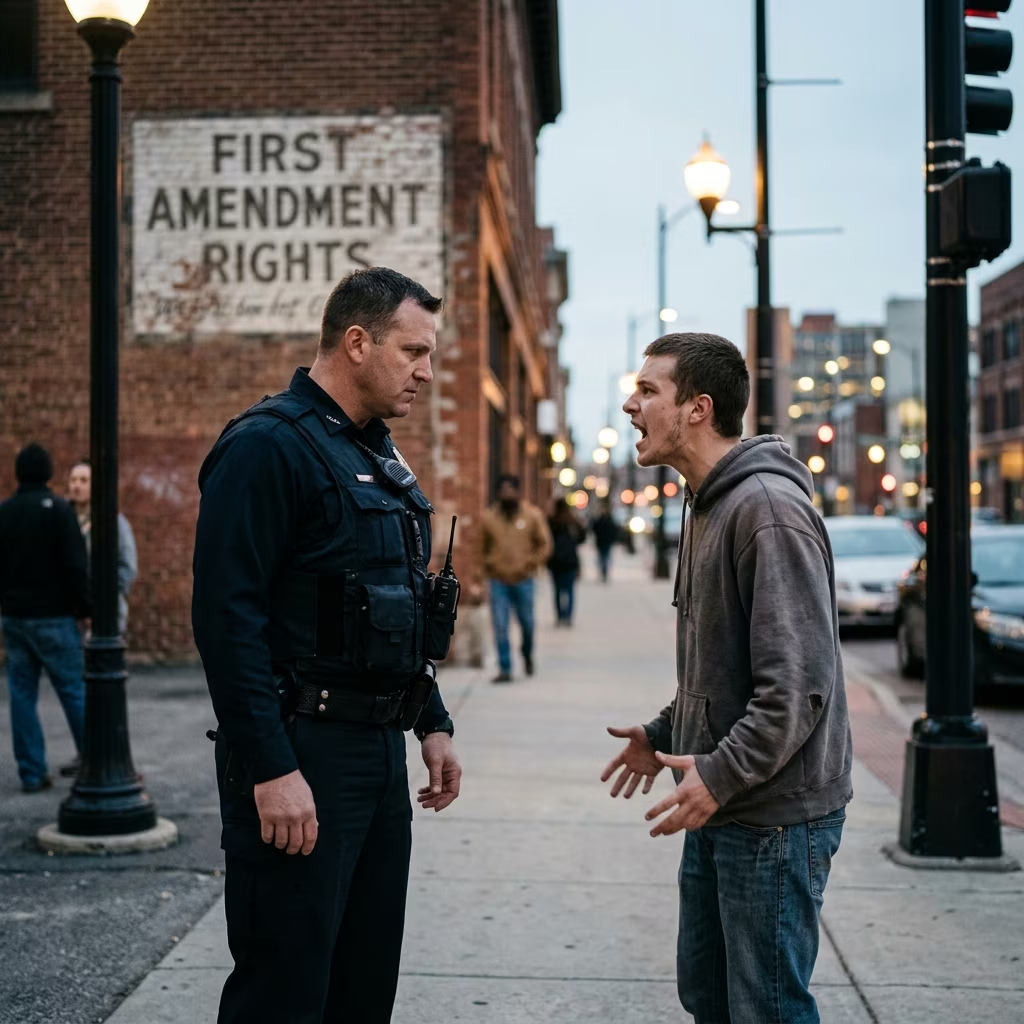
Many arrests involving profanity occur in encounters with law enforcement. People might curse during a traffic stop, shout insults at police in public, or use profane language while being detained. The fact that officers are offended or irritated is not, by itself, enough to justify arrest under the First Amendment.
Court decisions and constitutional commentary indicate that:
- Verbal criticism and challenge to police conduct, including profanity, is generally protected.
- Officers cannot use broad “disorderly conduct” or “breach of the peace” statutes to punish peaceful expression that simply stirs anger or contempt.
- However, if profane speech includes true threats or attempts to incite immediate unlawful action, it may be punishable.
In practice, this means that saying “This ticket is ridiculous, this is damn unfair” or even using stronger expletives about the situation will typically be protected, while statements that clearly threaten harm or attempt to provoke a fight will not.
Profanity in Schools, Broadcasting, and Special Settings
Although profanity is broadly protected in public discourse, the Supreme Court has recognized that certain environments permit more regulation, such as schools and broadcast media.
- Public schools — Courts allow school officials to discipline students for lewd or profane speech that conflicts with the school’s basic educational mission. The standard is lower than in general public spaces.
- Broadcast media — The federal government can regulate indecent or profane material on public airwaves, particularly at times when children are likely to be listening. This is treated as a special case due to the pervasive and intrusive nature of broadcasting.
- Workplaces and private property — The First Amendment does not restrict private employers or business owners. They may ban profanity, set speech rules, or remove people who do not follow their policies, as long as they are not acting as government entities.
Therefore, someone can legally be fired from a private job or refused service in a private business for cursing, even though a police officer generally cannot arrest them for the same words spoken on a public sidewalk.
Profanity vs. Obscenity and Indecency
Profanity is often confused with obscenity, but legally they are distinct concepts. Obscenity is a narrow category of sexual material that meets a three-part test established by the Supreme Court, involving prurient appeal, patently offensive depiction of sexual conduct, and lack of serious value. Profanity, by contrast, usually refers to strong, vulgar language that may or may not involve sexual references, but does not necessarily meet the obscenity standard.
Key differences:
- Most swearing, even sexually explicit, is not legally obscene and remains protected speech.
- Indecency standards in broadcasting address profanity and certain non-obscene sexual content, but do not automatically criminalize these words in other settings.
- Government attempts to treat ordinary profanity as obscenity have generally failed under modern First Amendment analysis.
Government vs. Private Consequences for Profane Speech
It is critical to separate government sanctions (such as arrest, prosecution, fines imposed by law) from private consequences (like being fired, banned, or criticized).
- The First Amendment applies to government action, not to private employers, private websites, or privately owned venues.
- Private entities can set speech policies that prohibit profanity and remove or discipline people who violate those rules, subject to other applicable laws (such as anti-discrimination statutes).
- Online platforms, radio stations, and television networks may restrict profanity under their terms of service or regulatory obligations, even when the language would be constitutionally protected from government punishment.
This distinction explains why someone might avoid arrest for swearing at a rally but still be banned from a social media platform or lose their job for the same remarks.
Practical Guidance: When Profanity Risks Arrest
From a legal perspective, simply saying “damn” or “hell” in a public space, even directed at a government official, almost never justifies arrest. But certain behaviors involving profanity can still lead to legal trouble. Courts and constitutional analyses highlight several risk factors:
- Direct, targeted verbal abuse that qualifies as fighting words toward a specific person, in an intense confrontational setting.
- True threats expressed in profane language, such as stating an intention to cause serious bodily harm.
- Profanity combined with unlawful conduct, like blocking traffic, refusing lawful orders, or inciting a crowd to immediate violence.
- Profane speech in special regulated contexts, including broadcast indecency or school disciplinary settings.
In disputes with police, courts generally protect non-violent verbal expression, including cursing, but officers may still arrest in the moment, leaving courts to later decide whether the arrest and any charges violated the First Amendment.
Frequently Asked Questions (FAQ)
Is profanity always protected by the First Amendment?
No. Profanity is usually protected, but it can be punished when it constitutes fighting words, a true threat, or incitement to imminent lawless action. It may also be regulated in schools and broadcasting under special legal standards.
Can I be arrested just for saying “damn” or “hell” to a police officer?
As a general rule, no. Courts have held that government may not punish speech simply because it is offensive or profane. Verbal criticism and even profane complaints directed at police are typically protected, as long as they do not amount to threats, incitement, or physical interference with official duties.
What are fighting words, and how do they affect profanity cases?
Fighting words are personally abusive, face-to-face remarks directed at an individual that are likely to provoke immediate violence. Only profanity that fits this narrow category can be punished on that basis. Modern case law has sharply limited the situations in which speech can be classified as fighting words.
Can my employer fire me for using profanity?
Yes, if your employer is a private entity. The First Amendment restricts government action, not private workplace policies. Private employers generally may prohibit profanity at work and discipline employees who violate those rules, subject to other employment laws.
Is profanity on the radio or TV treated differently?
Yes. The federal government can regulate indecent and profane content on public airwaves, particularly during hours when children are likely to be listening. This does not mean the words are criminal everywhere, but broadcasting them can trigger regulatory consequences that would not apply to ordinary street speech.
Key Takeaways for Speakers and Officials
From the perspective of both citizens and law enforcement, the modern legal landscape provides several clear lessons:
- Profanity alone is not a crime under the First Amendment; context determines legality.
- Government power over speech is limited — officials cannot rely on broad disorderly conduct statutes to silence peaceful but offensive expression.
- Private rules still matter — workplaces, platforms, and businesses can lawfully prohibit profanity even when the government cannot.
- Cautious enforcement benefits everyone — understanding constitutional boundaries helps avoid unlawful arrests and protects robust public discourse.
Ultimately, U.S. law treats profanity as part of the messy reality of free expression. People are largely free to speak in ways that others dislike or find offensive, and the government’s role is tightly constrained. At the same time, clear exceptions exist for genuine threats, targeted escalation toward violence, and special regulated settings, leaving a carefully balanced system that protects speech without abandoning public safety.
References
- First Amendment: Fighting Words — Constitution Annotated, Library of Congress. 2024-01-10. https://constitution.congress.gov/browse/essay/amdt1-7-5-5/
- Profanity and the First Amendment — Free Speech Center, Middle Tennessee State University. 2021-06-15. https://firstamendment.mtsu.edu/article/profanity/
- Freedom of Speech: What it is and What it is not — Law for Seniors (Arizona Bar Foundation). 2019-05-01. https://lawforseniors.org/lifelong-legal-learning/freedom-of-speech-what-it-is-and-what-it-is-not
- WTF? First Amendment Implications of Profane Speech — North Carolina First Amendment Law Review. 2017-01-01. https://scholarship.law.unc.edu/cgi/viewcontent.cgi?article=1264&context=falr