
Driving In New Hampshire: Essential Traffic Rules & Tips 2025
A practical guide to New Hampshire road rules, penalties, and everyday driving duties.
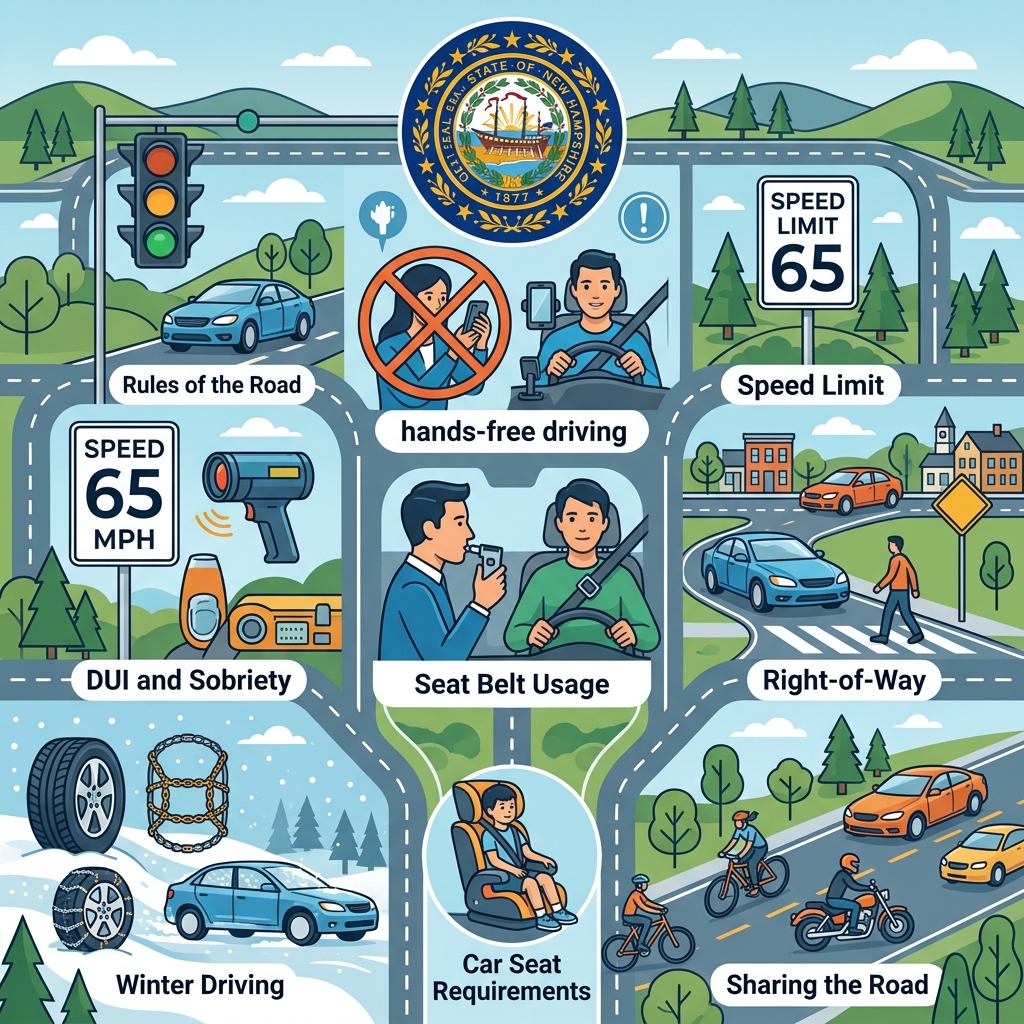
Driving in New Hampshire requires more than basic vehicle control. Motorists must follow a set of state rules that govern speed, lane use, signaling, passing, parking, and conduct after a crash. The state also uses a points system and other penalties to discourage dangerous driving and repeat violations.
This guide offers a clear overview of the traffic laws that matter most to everyday drivers. It is written for general understanding and is not a substitute for the official driver manual or the state statutes.
Why New Hampshire road rules matter
Traffic laws are designed to keep vehicles moving safely and predictably. When drivers understand the rules, they are less likely to cause collisions, block traffic, or face fines and license consequences. In New Hampshire, many of the most important rules are tied to common driving behaviors such as speeding, improper passing, ignoring signals, and driving without required equipment or documentation.
Some violations may seem minor at first, but repeated infractions can add up quickly. A driver who builds too many points in too short a period may face suspension, which can disrupt work, school, and daily responsibilities.
Speed limits are not suggestions
New Hampshire uses posted limits in many areas, but drivers should also know the general baseline limits described in the state driving materials. These limits can change based on road type, traffic conditions, and local posting. School zones, business districts, rural areas, and interstate highways may all carry different standards.
| Common road setting | Typical limit or rule |
|---|---|
| Business or urban residential district | 30 mph |
| Rural residential district | 35 mph |
| Towing a house trailer | 45 mph |
| Other areas, including many interstate stretches not otherwise posted | 55 mph |
| Posted interstate sections | 65 mph |
Drivers should also slow down for conditions even when they are technically within the limit. A curve, heavy traffic, limited visibility, rain, ice, or a school zone can require a lower speed than the sign alone suggests.
Right-of-way rules reduce confusion
Right-of-way does not mean the right to force another vehicle to yield. It means the driver with the duty to yield should do so when a collision would otherwise be likely. New Hampshire drivers should be especially careful at intersections, crosswalks, and turns.
- Pedestrians in crosswalks generally have priority.
- Drivers should yield when entering traffic from a side road, driveway, or parking area.
- Traffic already in an intersection generally should not be cut off.
- Funeral processions and emergency vehicles may have special movement rights depending on the circumstances.
At busy intersections, the safest approach is to slow down early, watch for movement from other vehicles and pedestrians, and avoid assuming that another driver will stop.
Signals, lane changes, and passing
Clear communication helps traffic flow safely. Drivers are expected to signal before turning, merging, changing lanes, or pulling back into traffic after passing. The state driving materials emphasize signaling before moving over, especially when returning to the right lane after overtaking another vehicle.
Passing also has limits. A driver should not pass when there is not enough distance, sightline, or legal space to do so safely. Improper passing can lead to head-on crashes, sideswipes, and serious penalties.
- Check mirrors and blind spots before moving.
- Signal before changing lanes.
- Pass only when the lane and road markings permit it.
- Return to the lane safely without forcing another driver to slow down or brake suddenly.
Slow driving can also create danger
Most people think of speeding as the main traffic threat, but driving too slowly can also cause problems. When a vehicle travels far below the normal flow of traffic, it can trigger dangerous passing maneuvers and rear-end crashes. In New Hampshire, drivers who are moving slowly should either speed up to match traffic or move as far right as practical.
If a driver cannot maintain the pace of surrounding traffic, using the shoulder only when lawful and safe, or pulling off where appropriate, can help prevent congestion and frustration behind the vehicle.
Seat belts, child restraints, and occupant safety
Safety equipment laws are a central part of traffic enforcement. Seat belts reduce injury risk in crashes and help keep occupants in position when a vehicle stops abruptly or overturns. New Hampshire also places responsibility on drivers to make sure children are properly secured in age- and size-appropriate restraints.
- Passengers under 18 must be properly restrained.
- Children under 6 must be seated in a properly sized safety seat.
- Drivers should confirm that belts and child seats are correctly fastened before the vehicle moves.
Because child restraint mistakes can be serious, parents and caregivers should check both the child seat instructions and the vehicle manual when installing restraints.
Distracted driving and handheld devices
New Hampshire’s hands-free rules reflect a broader national concern: even brief distraction can lead to crashes. Using a handheld device while driving, or while stopped temporarily in traffic, can take attention away from the road and delay a driver’s reaction to changing conditions.
The safest practice is to keep the phone out of reach while driving, use hands-free features only when lawful, and complete calls or texts only after the vehicle is parked in a safe place. Distracted driving enforcement may also involve fines and additional assessments.
Parking rules protect intersections and access points
Parking is not allowed everywhere a driver can fit a vehicle. New Hampshire parking rules are designed to keep sightlines open, preserve access for emergency services, and prevent traffic bottlenecks. A vehicle parked in the wrong place can create the same safety risk as a moving violation.
| Parking restriction | Common distance or rule |
|---|---|
| Crosswalk | Do not park within 20 feet |
| Fire hydrant | Do not park within 15 feet |
| Railroad crossing | Do not park within 50 feet |
| Fire station driveway on the same side | Do not park within 20 feet |
Drivers should also avoid double parking, blocking crosswalks, and stopping where a vehicle would interfere with the normal movement of traffic.
Alcohol, drugs, and reckless conduct
Serious violations carry steeper consequences than routine traffic tickets. Operating a vehicle while impaired by alcohol or drugs can lead to criminal charges, license consequences, and long-term financial impact. Reckless driving, racing, and refusal to follow a police officer’s lawful direction are also treated seriously.
Because these offenses put multiple people at risk, penalties may include fines, suspension, and in some cases additional criminal exposure beyond the normal traffic system.
Points can lead to suspension
New Hampshire uses a point system to respond to repeated violations. Not every offense carries the same number of points, and the total can affect a driver’s standing over time. A higher-point offense usually reflects behavior that creates a greater safety risk.
| Examples of violations | Typical point level |
|---|---|
| Driving without a license, speeding 25 mph or more over the limit, improper passing, driving without required insurance | 4 points |
| Improper use of a registration certificate, false report of theft | 6 points |
| Failure to stop immediately after a crash, disobeying a police officer, racing, reckless driving, DUI-related offenses | Higher-severity violations |
Accumulating too many points within a set period can lead to suspension. That is why even modest tickets matter: two or three small violations can create a much larger problem if they happen close together.
License consequences build over time
Point totals are tracked across consecutive calendar years, so a driver’s record does not reset immediately after one bad month. If the total reaches the state threshold, the result can be a temporary suspension. That interruption may affect commuting, family travel, and employment.
The practical lesson is simple: every citation should be treated as a warning to correct driving habits before more serious consequences follow.
Common habits that prevent tickets
Many traffic violations can be avoided through routine discipline behind the wheel. Drivers who build consistent habits are less likely to be involved in a crash or cited by law enforcement.
- Obey posted speed limits and slow down when conditions worsen.
- Use turn signals early and consistently.
- Keep a safe following distance.
- Check that all passengers are buckled before driving.
- Put the phone away and avoid handheld distractions.
- Yield when the law or safety requires it, especially at crossings and intersections.
Frequently asked questions
Do I have to obey the posted speed limit if traffic is moving faster?
Yes. The speed limit still applies even if other drivers are traveling above it. A driver should not assume that surrounding traffic changes the law.
Can I be ticketed for going too slowly?
Yes. Driving far below the normal flow of traffic can create a hazard, especially on faster roads, and a driver may need to move right or speed up if safe and lawful to do so.
Are seat belts really required for everyone?
New Hampshire requires proper restraint for passengers under 18, and children under 6 must use an appropriate child safety seat. Seat belt compliance remains an important part of safe driving for all occupants.
What happens if I ignore a traffic stop or crash?
Failing to stop after a crash or disobeying a police officer can lead to more severe penalties than a basic moving violation, including higher points and possible suspension.
Where can I confirm the official rules?
Drivers should review the official New Hampshire driver manual and state motor vehicle laws for the most current and exact requirements.
Driving smart in New Hampshire
Safe driving is mostly about consistency. A driver who watches speed, respects right-of-way, signals properly, avoids distraction, and parks responsibly is already reducing most everyday risks. The state’s rules are meant to make those behaviors predictable for everyone on the road.
Whether you are a new driver or simply refreshing your knowledge, understanding these basic traffic laws can help you avoid citations and travel more confidently across New Hampshire.
References
- New Hampshire Traffic Laws – FindLaw — FindLaw. 2026-07-09. https://www.findlaw.com/state/new-hampshire-law/new-hampshire-traffic-laws.html
- Drivers Manual — Town of Seabrook, NH. n.d. https://seabrooknh.info/wp-content/uploads/nhdm.pdf
- New Hampshire Revised Statutes Title XXI, Chapter 265 — Justia. 2025. https://law.justia.com/codes/new-hampshire/title-xxi/chapter-265/
- Rules and Laws — New Hampshire Division of Motor Vehicles. n.d. https://www.dmv.nh.gov/rules-and-laws
- Driving in New Hampshire | Road Rules & Driving Tips — SIXT Magazine. n.d. https://www.sixt.com/magazine/tips/driving-tips-new-hampshire/
Similar Articles








Read full bio of medha deb


