
Unpacking the Material Support Statute: The FARC Example
How overly broad anti-terrorism laws chill free speech and global peacebuilding efforts.
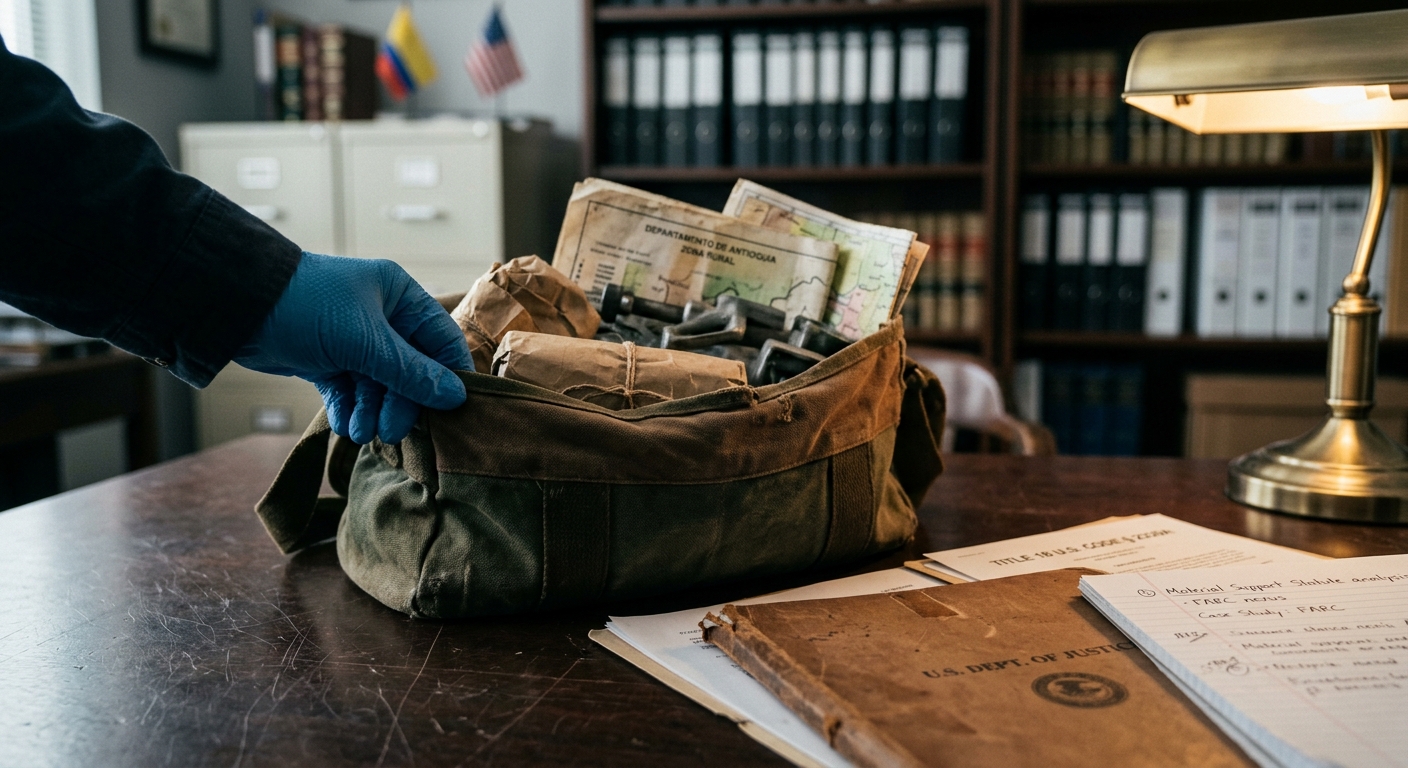
The Delicate Balance Between Security and Civil Liberties
The intersection of national security policy and constitutional rights often creates a complex legal battleground. At the heart of this tension in the United States is the “material support” statute, formally known as 18 U.S.C. § 2339B. Originally designed to choke off the financial and logistical lifelines of violent extremist groups, the law has steadily expanded over the past few decades, drawing sharp criticism from civil liberties advocates. Critics argue that the statute’s broad language inherently criminalizes constitutionally protected speech, severely hampers humanitarian aid delivery, and paradoxically obstructs international peacebuilding efforts.
Nowhere is this contradiction more evident than in the case of the Revolutionary Armed Forces of Colombia (FARC). The trajectory of the FARC—from a heavily armed, designated Foreign Terrorist Organization (FTO) to a demobilized political entity participating in a fragile democratic process—exposes the profound limitations of a legal framework that treats peace negotiations and conflict resolution training as federal crimes. This article delves into the intricate mechanics of the U.S. material support law, the landmark Supreme Court decision that solidified its expansive reach, and the vital lessons learned from the Colombian peace process.
The Origins and Evolution of the Material Support Statute
The modern framework for criminalizing assistance to international terrorist groups took shape with the passage of the Antiterrorism and Effective Death Penalty Act (AEDPA) of 1996. Under 18 U.S.C. § 2339B, it became a federal crime to “knowingly provide material support or resources to a foreign terrorist organization.” Initially, the concept of material support was widely understood to encompass tangible assets: military-grade weapons, sophisticated financial services, safe houses, and false documentation. The underlying legislative logic was straightforward and compelling: money and physical resources are fungible. Even if a donor intends to fund only the charitable, educational, or social wing of a designated group, those contributions free up the organization’s other resources to carry out violent attacks.
However, following the tragic events of September 11, 2001, the USA PATRIOT Act significantly broadened the statutory definition, changing the landscape of counterterrorism law. The amendments expanded “material support” to include intangible forms of assistance, most notably “expert advice or assistance,” “training,” and “personnel.” This expansion blurred the once-clear line between funding physical violence and engaging in protected speech. Under the revised legal standard, an individual does not need to share the terrorist organization’s violent goals or intend to further their illicit activities to be prosecuted; they merely need to know that the group is designated as an FTO or engages in terrorism. Violations carry severe consequences, with penalties of up to 20 years in federal prison. This sweeping criminalization set the stage for a monumental legal clash over the First Amendment.
Holder v. Humanitarian Law Project: A Turning Point for Free Speech
The constitutional boundaries of the material support statute were ultimately tested in the 2010 United States Supreme Court case, Holder v. Humanitarian Law Project. The plaintiffs—a collection of U.S. citizens and domestic organizations—sought to provide training and support to the Kurdistan Workers’ Party (PKK) in Turkey and the Liberation Tigers of Tamil Eelam (LTTE) in Sri Lanka. Crucially, the plaintiffs did not seek to provide weapons, cash, or lethal training. Instead, their explicit goal was to teach these armed groups how to peacefully resolve disputes, use international law to petition the United Nations for human rights relief, and negotiate lasting peace agreements.
Because both the PKK and LTTE were designated FTOs, the U.S. government argued that providing them with such educational training constituted illegal “expert advice or assistance.” The plaintiffs countered that the statute violated their First Amendment rights to free speech and freedom of association, arguing that peaceful advocacy and conflict-resolution training should be constitutionally protected, regardless of the recipient’s identity.
In a contentious 6-3 decision, the Supreme Court upheld the constitutionality of the statute. Chief Justice John Roberts, writing for the majority, concluded that even peaceful, educational support could legitimize a terrorist organization, enhance its capacity to negotiate from a position of strength, and ultimately free up other resources for illicit activities. The Court ruled that the government’s compelling interest in national security outweighed the plaintiffs’ First Amendment claims. For civil liberties advocates, the ruling was a devastating blow. It established a legal precedent wherein speech, when coordinated with an FTO—even for the express purpose of ending violence and transitioning to democracy—could be prosecuted as a federal crime.
The FARC and the Paradox of Peacemaking
The chilling effect of the Holder decision is vividly illustrated by the Colombian peace process involving the FARC. For over five decades, the FARC engaged in a brutal armed conflict against the Colombian government, a war that claimed over 200,000 lives and displaced millions. The insurgency was funded largely by illicit activities, including drug trafficking, widespread extortion, and kidnapping. Consequently, in 1997, the U.S. State Department officially designated the FARC as an FTO.
However, in 2016, after years of grueling negotiations in Havana, the Colombian government and the FARC signed a historic Peace Accord. Under the comprehensive agreement, the FARC agreed to formally dissolve its military structure, disarm under United Nations supervision, and transition into a legitimate, non-violent political party. This transition required massive logistical, legal, and educational support. Former combatants needed to be reintegrated into civil society, educated on democratic electoral processes, and trained in human rights compliance and truth commission proceedings.
Herein lay the paradox of the material support statute. U.S.-based peacebuilding organizations, conflict resolution experts, and humanitarian workers were uniquely positioned to assist in this delicate transition. Yet, because the FARC remained on the U.S. FTO list long after the ink dried on the accord, any American organization that offered “expert advice” on how to build a political platform, or provided “training” on human rights to demobilizing FARC members, risked prosecution under 18 U.S.C. § 2339B. The law essentially forced peacebuilders to choose between abandoning a fragile post-conflict society and risking decades in federal prison. It created an environment where advocating for peace and teaching democracy was legally equated with facilitating terrorism.
Delisting FARC: A Bureaucratic Fix to a Structural Problem
The legal paralysis surrounding the Colombian peace process was not formally resolved until November 30, 2021—a full five years after the Peace Accord was signed. On that date, the Biden administration’s State Department officially revoked the FARC’s designation as a Foreign Terrorist Organization. In its announcement, the State Department acknowledged that the FARC had formally dissolved, disarmed, and no longer existed as a unified organization capable of terrorism. Simultaneously, the U.S. designated two splinter groups—Segunda Marquetalia and FARC-EP (Ejército del Pueblo), which had rejected the peace deal and returned to armed conflict—as new FTOs.
While the delisting was a welcome and necessary development for NGOs and diplomats, it highlighted a severe structural flaw in U.S. counterterrorism policy. The revocation was a delayed bureaucratic fix that cost peacebuilders five critical years of potential engagement. During the most vulnerable window of the peace process—the immediate aftermath of the ceasefire—U.S. organizations were legally barred from lending their expertise to ensure the disarmament succeeded. Relying on the slow-moving apparatus of the State Department to delist organizations after they have fully reformed ignores the reality of conflict resolution: armed groups need the most support and guidance during the messy, transitional phase of demobilization, not years after it concludes.
The Broader Civil Liberties Implications
Beyond the immediate consequences for international diplomacy, the material support statute continues to pose profound threats to domestic civil liberties. By criminalizing the nature of the association rather than the intent behind the action, the law relies heavily on a standard of guilt by association. This framework disproportionately impacts marginalized communities, particularly diaspora groups in the United States, who may wish to provide humanitarian relief to war-torn regions controlled by designated organizations.
When a charity cannot send medicine, food, or educational materials to a disaster zone for fear that local FTOs might incidentally benefit or intercept a fraction of the aid, the humanitarian cost is immeasurable. Organizations are forced to implement extreme vetting procedures that delay life-saving assistance in places like Syria, Afghanistan, and Somalia. Furthermore, the statute creates a surveillance state dynamic, where federal agencies monitor the political speech, advocacy, and associations of citizens to ensure they are not inadvertently providing “intangible” support to blacklisted groups. Civil liberties organizations continue to argue that a healthy democracy must tolerate a higher threshold of free speech, ensuring that individuals can advocate for human rights and conflict resolution without the overarching threat of a terrorism enhancement charge.
Frequently Asked Questions (FAQs)
- What constitutes “material support” under U.S. federal law?
Under 18 U.S.C. § 2339B, material support is broadly defined to include any property, tangible or intangible, or service. This encompasses currency, financial services, lodging, safe houses, false documentation, weapons, and personnel. Controversially, following the USA PATRIOT Act, it also includes “training” and “expert advice or assistance,” meaning that even teaching an armed group about international human rights law can be prosecuted as a federal crime. - Why was the FARC removed from the Foreign Terrorist Organization (FTO) list?
The U.S. Department of State officially revoked the FARC’s FTO designation in November 2021. This decision acknowledged that following the historic 2016 Peace Accord with the Colombian government, the FARC had formally dissolved, disarmed, and transitioned into a civilian political movement. Removing the designation allowed U.S. agencies and peacebuilding organizations to legally provide assistance to demobilized combatants. - How does the material support statute impact First Amendment rights?
Civil liberties advocates argue that the statute infringes on the First Amendment by criminalizing pure speech and association. While the Supreme Court ruled in Holder v. Humanitarian Law Project that the government can prohibit political speech and expressive conduct when coordinated with an FTO, critics maintain that this creates a severe chilling effect. It punishes peacebuilders who seek to use speech to transition groups away from violence.
Conclusion
The intersection of the material support statute and international peacebuilding remains a heavily contested legal domain. As demonstrated by the FARC’s long and arduous path to demobilization, a rigid legal architecture that penalizes conflict resolution and humanitarian engagement ultimately undermines its own stated goal: global stability and the reduction of violence. While the government has a legitimate and compelling interest in preventing the financing and arming of terrorism, the current application of 18 U.S.C. § 2339B casts an unnecessarily wide net, chilling constitutionally protected speech and hindering vital peace processes. Reevaluating this statute is essential not just for preserving First Amendment liberties, but for empowering the diplomats, non-governmental organizations, and human rights defenders working tirelessly to safely transition armed conflicts into lasting democratic peace.
References
- 18 U.S.C. § 2339B – Providing material support or resources to designated foreign terrorist organizations — U.S. Government Publishing Office (GovInfo). https://www.govinfo.gov/app/details/USCODE-2011-title18/USCODE-2011-title18-partI-chap113B-sec2339B
- Holder v. Humanitarian Law Project, 561 U.S. 1 — Supreme Court of the United States. 2010-06-21. https://supreme.justia.com/cases/federal/us/561/1/
- Revocation of the Terrorist Designations of the Revolutionary Armed Forces of Colombia (FARC) and Additional Terrorist Designations — U.S. Department of State. 2021-11-30. https://www.state.gov/revocation-of-the-terrorist-designations-of-the-revolutionary-armed-forces-of-colombia-farc-and-additional-terrorist-designations/
Similar Articles








Read full bio of medha deb


