
Marijuana Odor in Cars: When Police Can and Cannot Search
Understanding how cannabis legalization has changed when the smell of marijuana in a car allows police to stop, search, or arrest drivers and passengers.
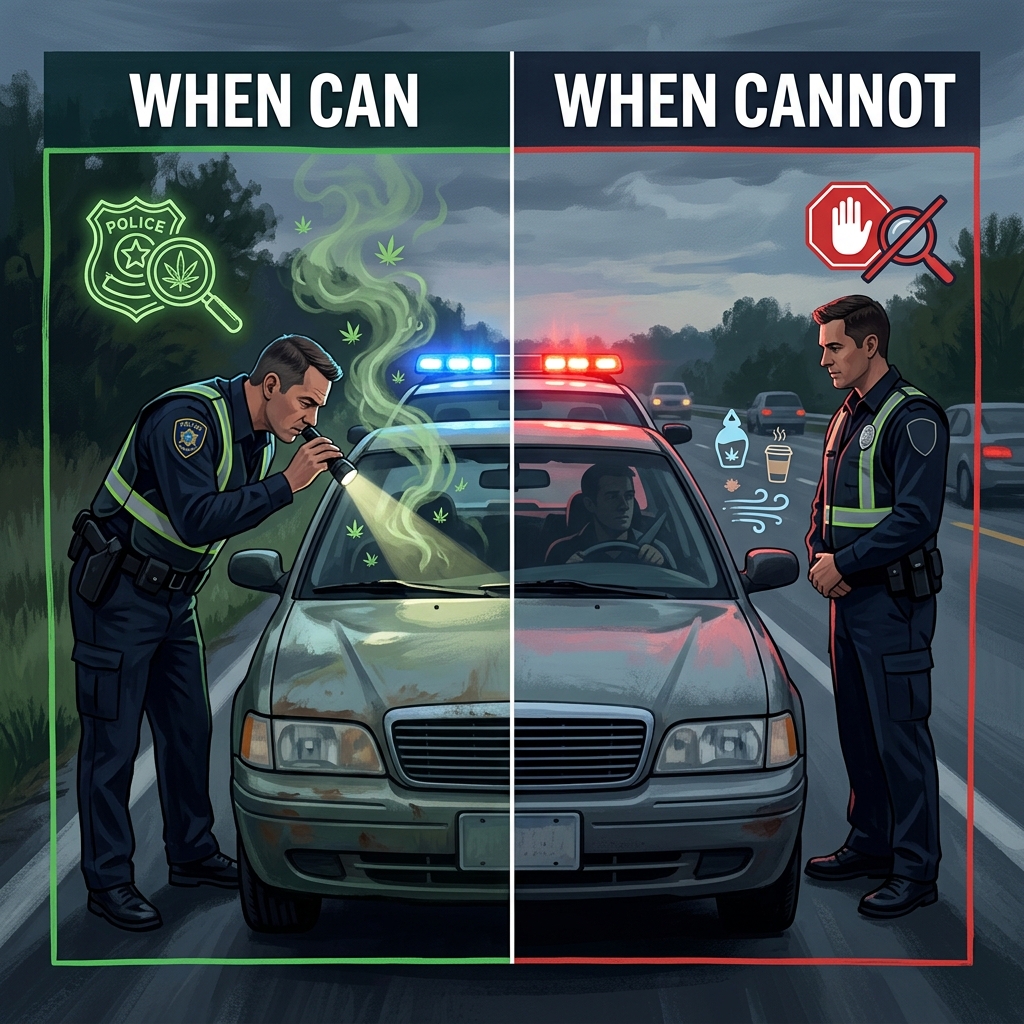
The legalization and decriminalization of cannabis in many states has dramatically altered what the odor of marijuana in a vehicle means for police searches. In jurisdictions where some possession of cannabis is lawful, the smell of marijuana no longer automatically signals criminal activity, and courts are increasingly rejecting searches based solely on odor. Understanding these changes is critical for drivers, passengers, and attorneys navigating modern traffic stops.
From Automatic Suspicion to Legal Ambiguity
For decades, courts routinely held that the smell of marijuana emanating from a car provided police with probable cause to search the vehicle without a warrant. Probable cause is the constitutional standard that allows officers to conduct searches when they have reasonable grounds to believe a crime is being committed.
Historically:
- Marijuana possession was categorically illegal in most states.
- Courts treated the odor of cannabis as direct evidence of unlawful possession.
- Police could often search the entire vehicle and sometimes its occupants based purely on smell, without additional facts.
As more states legalized medical and recreational cannabis, this automatic link between marijuana odor and illegality began to break down. If adults may lawfully possess a limited amount of cannabis, the fact that a car smells like marijuana no longer necessarily indicates criminal behavior.
Legal Concepts That Shape Odor-Based Searches
To understand when marijuana odor still matters, it helps to distinguish several core legal concepts used in search-and-seizure law.
| Legal Concept | Basic Definition | Role in Marijuana-Odor Cases |
|---|---|---|
| Reasonable suspicion | A specific, articulable basis to suspect criminal activity, allowing brief stops and limited investigation. | Odor may contribute to reasonable suspicion for further questions or checks, depending on state law. |
| Probable cause | Facts and circumstances that would lead a reasonable person to believe a crime is likely occurring. | In many states, odor alone no longer provides probable cause once some cannabis possession is legal. |
| Automobile exception | A doctrine allowing warrantless vehicle searches when officers have probable cause, due to mobility of cars. | Previously allowed full searches based on smell; now more limited where cannabis is legal. |
| Plain smell / plain view | Permits officers to rely on what they lawfully observe or detect (including odors) to establish probable cause. | Still relevant, but courts increasingly demand more than odor when possession of small quantities is lawful. |
Why Legal Cannabis Weakens Odor as Evidence
When marijuana was universally illegal, smelling cannabis strongly suggested that someone possessed contraband. Legalization disrupts this inference because odor may now stem from lawful activity. Courts and legislatures have identified several reasons why smell alone is inadequate in states that permit cannabis possession.
- The odor is consistent with legal possession by adults over a certain age.
- Smell may linger from prior lawful use even when no cannabis is currently present.
- Multiple people may have used cannabis in or near the vehicle; odor does not identify who, if anyone, is breaking the law.
- States often set quantity limits; odor does not reveal whether the amount exceeds legal thresholds.
Because of these factors, several state courts and legislatures have concluded that marijuana odor alone does not create probable cause for a search in a legal-cannabis regime.
Examples of States Limiting Odor-Based Searches
States have taken different approaches, but a clear trend is emerging: where cannabis is legal in some form, odor alone is increasingly insufficient to justify vehicle searches.
Maryland: Statutory Protection Against Odor-Only Searches
Maryland legalized adult-use cannabis and subsequently enacted a law in 2023 that explicitly bars police from stopping or searching vehicles solely based on the smell of cannabis. Under this statute:
- Officers may not use cannabis odor alone as probable cause to search a vehicle.
- Police must identify additional facts suggesting criminal activity or possession above legal limits.
- The law applies going forward but does not retroactively invalidate older convictions based on prior standards.
Maryland’s highest court had already signaled this direction in Lewis v. State, holding that more than odor is required to establish probable cause in a vehicle search when possession of small amounts is decriminalized.
Illinois: Ongoing Debate and Legislative Proposals
Illinois presents a more complex picture. Historically, the Illinois Supreme Court ruled that marijuana odor from a car provided probable cause for a search if officers were trained to recognize the smell. After recreational cannabis legalization, lower courts and commentators have questioned whether that precedent remains sound.
Recent developments include:
- Discussions of amending vehicle code provisions that once required cannabis to be transported in odor-proof containers.
- Proposed language stating that the smell of burnt or raw cannabis by itself shall not constitute probable cause for vehicle or occupant searches when the driver or passenger is 21 or older.
- Trial-level decisions recognizing that odor alone may stem from lawful possession and therefore cannot automatically support probable cause.
Illinois law is still evolving, and defense lawyers increasingly argue that odor-alone searches in legal-cannabis settings violate constitutional protections.
Broader National Trend
Across the United States, courts are reassessing prior doctrines that treated marijuana odor as a reliable indicator of crime. State-level analyses note that in many jurisdictions, “the smell of marijuana, on its own, is no longer considered to be evidence of criminal activity.” Legislatures in multiple states have advanced bills or adopted rules restricting police reliance on odor-only searches for vehicles.
What Police Can Still Do When They Smell Marijuana
Even in states that limit odor-based probable cause, the smell of marijuana may still matter. It can contribute to a broader set of facts that, taken together, justify additional investigation or a search.
Odor Combined With Other Indicators
Courts focus on the totality of the circumstances, rather than any single fact. Odor may be one piece of the puzzle when combined with other evidence such as:
- Visible marijuana or paraphernalia in the car (plain view).
- Admissions by the driver or passengers about possessing illegal quantities.
- Signs of impairment suggesting driving under the influence.
- Information from prior investigations or reliable tips.
In such situations, the odor contributes to probable cause but is not the sole basis for a vehicle search.
Smell and Impaired Driving
States continue to treat driving while impaired by cannabis as unlawful, even where possession is legal. If an officer smells burnt marijuana and observes behavior consistent with intoxication—such as erratic driving, slurred speech, or delayed responses—those combined facts may justify sobriety testing and, in some cases, a search.
However, the mere presence of odor without signs of impairment typically does not justify a full search in states that have legalized possession.
How Drivers and Passengers Can Respond During a Stop
While laws differ by state, there are general principles that can help individuals respond appropriately if police mention smelling marijuana in the car.
- Stay calm and be respectful. Aggressive or confrontational behavior can escalate the encounter.
- Know that you may decline consent to search. In many cases, officers ask for permission even when they lack probable cause; you are usually allowed to say no.
- Ask if you are free to leave. This can clarify whether the encounter is voluntary or a formal detention.
- Do not lie. False statements can create additional legal problems, though you generally have the right to remain silent.
- Document the encounter afterwards. If you believe your rights were violated, writing down details promptly can assist a lawyer later.
Because state laws vary significantly, legal advice specific to the jurisdiction is essential, especially when searches based on marijuana odor are involved.
Key Differences Among States
One of the biggest challenges is that the legal effect of marijuana odor in cars differs from state to state. Factors that shape these differences include:
- Whether cannabis is fully legal, medically legal, decriminalized, or still entirely prohibited.
- Age thresholds for lawful possession (often 21+ for recreational use).
- Quantity limits for flower, concentrates, and edible products.
- Specific statutory provisions that address odor and probable cause.
- Recent appellate decisions interpreting the interaction between cannabis laws and search-and-seizure doctrine.
In prohibition states, courts may still treat marijuana odor as strong evidence of criminal activity. In contrast, states with mature legalization frameworks increasingly require more concrete proof that a law is being violated before allowing police to search vehicles based on smell.
FAQs: Marijuana Odor and Vehicle Searches
Does the smell of marijuana always give police probable cause to search my car?
No. In many states where cannabis is legal in some form, courts and legislatures have concluded that odor alone does not provide probable cause, because it may stem from lawful possession. In states where cannabis remains illegal, however, odor may still be treated as sufficient evidence to justify a search.
Can police stop my car just because they say they smell marijuana?
Several states, such as Maryland, have enacted laws that forbid officers from stopping or searching vehicles solely based on cannabis odor. In those jurisdictions, officers need another lawful reason for the stop, such as a traffic violation or a separate suspicion of crime.
If cannabis is legal, why does smell matter at all?
Legalization typically allows only certain amounts of cannabis, for specific uses, and often only for adults over a particular age. Odor can still signal potential violations, such as possession above legal limits or impaired driving. However, it is now just one factor among many and often cannot stand alone as the basis for a search.
Are my past convictions based on odor-only searches affected by new laws?
Not necessarily. For example, Maryland’s 2023 law restricting odor-based searches does not apply retroactively, meaning that prior convictions based on earlier standards generally remain in place. Whether older cases can be challenged depends on specific state statutes and court rulings.
What should I do if I believe a search based on odor violated my rights?
It is important to consult a qualified criminal defense attorney familiar with your state’s cannabis and search-and-seizure laws. The lawyer can evaluate whether evidence might be suppressed due to an unlawful search or whether recent legal developments support a challenge to the search.
References
- State Legalization of Marijuana Is Changing Search and Seizure Jurisprudence — Brennan Center for Justice. 2022-03-24. https://statecourtreport.org/our-work/analysis-opinion/state-legalization-marijuana-changing-search-and-seizure-jurisprudence
- Using Marijuana Odor to Establish Probable Cause in Illinois Post-Legalization — University of Chicago Law Review Online. 2021-01-12. https://lawreview.uchicago.edu/online-archive/failing-sniff-test-using-marijuana-odor-establish-probable-cause-illinois-post
- The Odor of Cannabis and Probable Cause — DuPage County Bar Association. 2022-01-01. https://www.dcba.org/mpage/v36-Emmet-C-Fairfield
- Officers can’t use marijuana odor as probable cause to search vehicle — ASAP. 2023-06-30. https://go2asap.com/blog/probable-cause-to-search/
- Maryland Law on Cannabis Odor Searches and Its Non-Retroactivity — Kadish & Kadish Law Firm. 2024-02-10. https://www.kadishlawfirm.com/blog/new-maryland-law-cannabis-odor-searches-non-retroactivity
- A bill clarifying that law enforcement cannot search a car based on the smell of marijuana alone has passed through the Senate — WCIA3 News. 2025-04-12. https://www.facebook.com/WCIA3News/posts/a-bill-clarifying-that-law-enforcement-cannot-search-a-car-based-on-the-smell-of/1093556919476678/
Similar Articles








Read full bio of medha deb




