
Lost Airline Baggage: Your Legal Rights and Compensation
Understand your legal options, compensation limits, and step‑by‑step actions when airlines lose, delay, or damage your checked luggage.
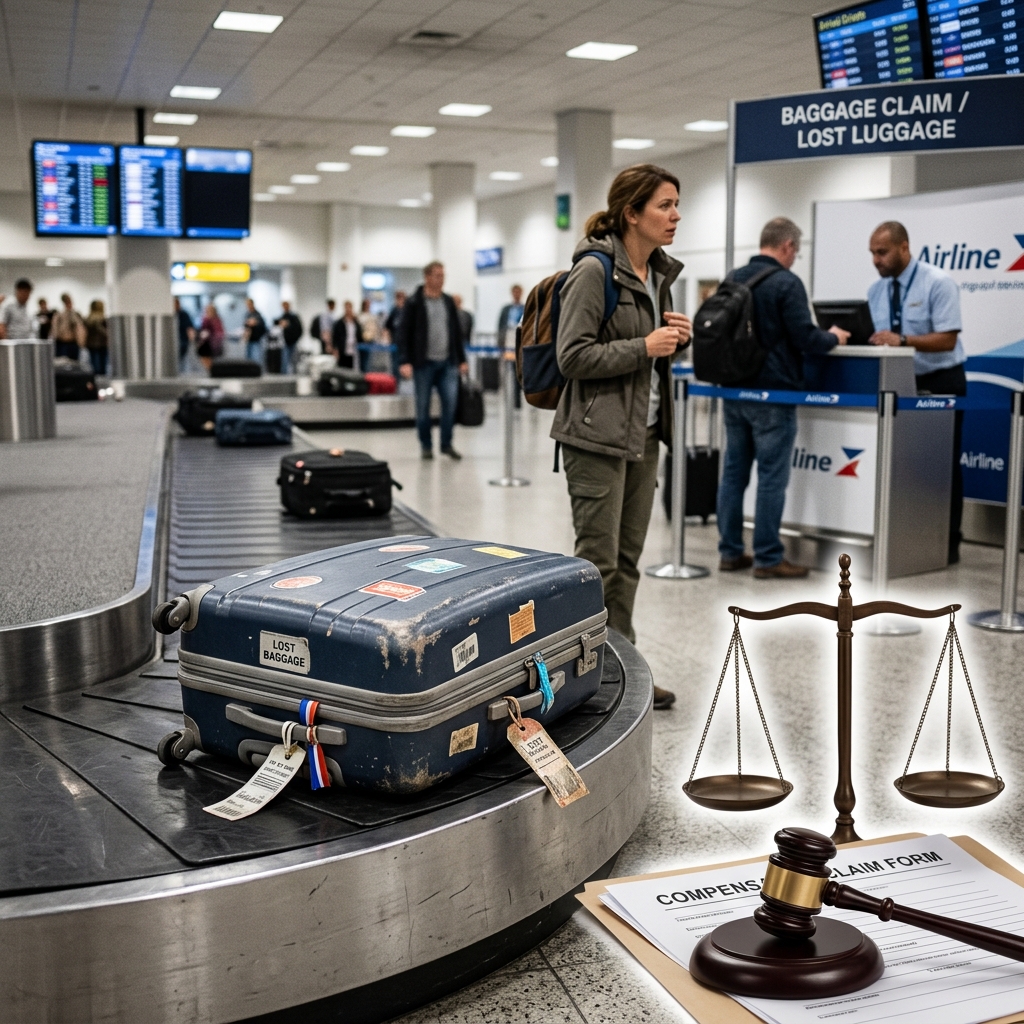
Having a suitcase vanish somewhere between check-in and the baggage carousel is more than an inconvenience. It can leave you without clothes, medications, work equipment, or other essentials and raise complicated questions about what the airline must do to fix the situation. This guide explains your core legal rights when baggage is lost, delayed, or damaged, how compensation typically works in different regions, and the practical steps to take to protect your claims.
Key Legal Frameworks Governing Baggage Claims
Your rights do not depend only on the airline’s internal policy. They are shaped by a combination of national regulations and international treaties that set minimum standards for compensation and liability.
Domestic Rules: United States and Canada
On flights that begin and end within the same country, domestic laws and regulatory guidance usually control how much compensation you can receive and under what conditions.
- United States: The U.S. Department of Transportation (DOT) allows airlines on domestic flights to limit their liability for lost, damaged, or delayed baggage. The maximum liability is currently set at about $4,700 per passenger for checked baggage.
- Canada: For flights within Canada, the Canadian Transportation Agency requires airlines to accept claims for baggage problems within deadlines specified in their tariffs (official policies). Claims for damaged baggage generally must be filed within 7 days, and delayed international baggage claims within 21 days of receiving the bag.
Domestic rules also usually distinguish between checked baggage (bags transferred to the airline’s custody) and carry-on items, which are more often treated as the passenger’s responsibility unless airline staff directly cause the damage.
International Rules: The Montreal Convention
Most international flights are governed by the Montreal Convention, an international treaty that standardizes airline liability for baggage across many countries.
- The Convention sets a maximum liability per passenger for lost, damaged, or delayed baggage, expressed in Special Drawing Rights (SDRs), a monetary unit used by the International Monetary Fund.
- As of recent updates, this limit is about 1,519 SDRs, which translates to roughly $2,000–$2,200 USD, depending on exchange rates.
- The limit applies regardless of how many bags you checked; it is per passenger, not per suitcase.
Many jurisdictions, including EU member states and the UK, rely on the Montreal Convention as the basis for compensation claims for international flights, although local guidance explains the process in more detail.
When Is Baggage Considered Lost, Delayed, or Damaged?
Understanding the legal classification of your baggage problem is critical, because it affects both your rights and your deadlines for making a claim.
Delayed Baggage
Delayed baggage is luggage that fails to arrive with you, but is eventually delivered. Regulators and airlines often set specific time thresholds to define when a delay is legally significant.
- Under U.S. DOT guidance, for domestic flights, a bag is considered significantly delayed if it is not delivered within 12 hours of your flight’s arrival.
- For international flights involving the U.S., a bag is significantly delayed if not delivered:
- within 15 hours after arrival for flights of 12 hours or less, or
- within 30 hours for longer flights.
- Under Canadian rules, delayed baggage on international flights must generally be claimed within 21 days of receiving the bag.
- Consumer guidance in Europe notes that if luggage is returned within 21 days, it is treated as delayed rather than lost, and you may claim for both inconvenience and necessary purchases.
During the delay, airlines are usually responsible for compensating you for reasonable, verifiable, and actual incidental expenses, such as buying essential clothing or toiletries, provided you keep receipts.
Lost Baggage
Baggage is classified as lost when it fails to reappear within a defined period or the airline admits it cannot locate the bag.
- The Montreal Convention and EU guidance commonly treat baggage as officially lost if it has not been returned within 21 days after arrival.
- The U.S. DOT notes that airlines may have different internal policies, but most will declare a bag lost between approximately 5 and 14 days after the flight, depending on the carrier.
- Once a bag is considered lost, the airline becomes responsible for compensating the value of the bag and its contents, subject to depreciation and the applicable liability limits.
Importantly, when a bag is declared lost, you are generally entitled to a refund of any baggage fees you paid for that bag, in addition to compensation for its contents.
Damaged Baggage
Damaged baggage covers both harm to the suitcase itself and injury to the items inside.
- Under EU and Montreal-based rules, you can claim compensation if your baggage is damaged or destroyed, up to roughly €1,800, depending on the value of the contents and proof you can provide.
- In Canada, damaged baggage claims must be filed within 7 days of receiving the bag, and you should document damage with photographs and invoices for repairs or replacements.
- Airlines often exclude certain types of fragile or high-value items (like jewelry or electronics) from coverage unless declared and insured separately.[10]
How Compensation Is Calculated
Compensation for baggage issues is not simply a full refund of everything in your suitcase. Airlines use liability limits and depreciation to determine what they will pay.
Liability Limits by Region
| Type of Flight | Key Legal Framework | Typical Maximum Liability |
|---|---|---|
| Domestic flight within U.S. | U.S. DOT regulation | Up to about $4,700 per passenger for lost, delayed, or damaged checked baggage. |
| International flight covered by Montreal Convention | Montreal Convention | Up to 1,519 SDRs (about $2,000–$2,200 USD) per passenger. |
| International flights to/from EU/UK | Montreal Convention & local guidance | Commonly described as up to about €1,800, depending on exchange rates and documented value. |
| Flights within Canada | Air Passenger Protection Regs & airline tariffs | Limits typically align with Montreal Convention for international segments; domestic limits depend on airline tariffs but must be reasonable. |
Depreciation and Exclusions
Airlines rarely pay the full original purchase price of lost items. Instead, they usually apply depreciation, reducing the value based on age and wear.
- Older clothing or electronics may be valued at less than their purchase price.
- Receipts or other proof of value significantly strengthen your claim.
- Most airlines exclude or strictly limit compensation for certain items packed in checked bags, such as jewelry, cash, antiques, or business documents, unless special arrangements were made.[10]
Incidental Expenses for Delayed Bags
When your bag is delayed, you can often claim reimbursement for essential purchases made while waiting for your luggage.
- U.S. regulations require airlines to compensate for reasonable, verifiable, actual incidental expenses, such as toiletries, replacement undergarments, or basic clothing needed for the short term.
- EU consumer guidance recommends keeping receipts for any items purchased because of the delay and adding these to your claim.
- Canadian rules similarly instruct passengers to keep receipts for any costs related to baggage issues to ensure reimbursement.
Luxury shopping or non-essential items are unlikely to be covered, and each airline may impose daily caps or restrict reimbursement to specific categories of goods.
Step‑by‑Step: What to Do When Your Bag Is Missing or Damaged
The actions you take in the hours and days after discovering a baggage problem can make the difference between a successful claim and a denied one. Here is a structured approach you can follow on most airlines and in most jurisdictions.
1. Report the Issue Before Leaving the Airport
- Go immediately to the airline’s baggage service desk or customer service counter.
- File a Property Irregularity Report (PIR) or equivalent form. This creates an official record of the problem and generates a reference number you can use for tracking and later claims.
- Describe the bag clearly: color, brand, size, distinguishing features, and attach your baggage tag if available.
2. Keep All Travel Documents
- Boarding passes.
- Checked baggage receipts and tag stubs.
- Written reports (PIR and airline correspondence).
These documents are routinely requested when you submit formal claims or escalate disputes.
3. Document the Contents and Any Damage
- Create a detailed list of items in the missing bag, focusing on higher-value objects and essential belongings.
- Gather receipts, bank statements, or order confirmations that show purchase prices for valuable items where possible.
- For damaged baggage, take clear photographs of:
- the exterior damage to the suitcase, and
- any damaged items inside.
4. Track Your Bag and Communicate in Writing
- Use the airline’s online baggage tracking tools, entering your PIR number or baggage tag.
- Follow up in written form (email or web portal) reaffirming that your baggage has not been found, especially if it remains missing several days after arrival.
Written communication creates a clear timeline and written record, which is vital if you later need to show that you acted quickly.
5. Buy Only Essential Items and Keep Receipts
- Purchase items that are reasonably necessary: toiletries, basic clothing, undergarments, and work- or weather-related necessities.
- Save all receipts and note that these expenses were incurred due to baggage delay.
- Include these receipts when filing your delayed baggage claim.
6. File Your Claim Within the Deadline
Most legal frameworks impose strict deadlines for submitting formal baggage claims. Missing these deadlines can bar you from compensation, even when the airline is clearly at fault.
- Damaged baggage: Commonly, file within 7 days of receiving the bag (EU/Montreal-based rules, Canada).
- Delayed baggage (international): File within 21 days of receiving the bag.
- Lost baggage: File as soon as the airline considers the bag lost, and no later than the deadlines in its tariff or relevant regulations.
European guidance notes that acting quickly improves your chances of compensation; some airlines shorten the time limit in their contracts, especially for domestic segments.
Using Insurance and Legal Remedies
Airline compensation is often not enough to cover high-value items or the full cost of replacement. Additional avenues can help fill the gap.
Travel Insurance and Credit Card Coverage
- Many travel insurance policies include benefits for lost, delayed, or damaged baggage, often with separate limits for essential purchases and full loss.
- Credit cards used to purchase the ticket may offer baggage protection, reimbursing certain costs beyond what the airline pays.
- Make sure your insurance claim aligns with the documentation you submitted to the airline: PIR, receipts, and correspondence.
Regulators and Ombuds Services
- In the UK and EU, passengers may escalate complaints to bodies like the Civil Aviation Authority or national consumer agencies if the airline refuses compensation under the Montreal Convention.
- In Canada, the Canadian Transportation Agency provides guidance and can investigate systemic non-compliance with passenger protection rules.
- In the U.S., serious or systemic issues can be reported to the DOT’s Aviation Consumer Protection office.
Court Actions and Time Limits
If administrative channels fail, passengers may pursue court claims, usually in small claims or equivalent forums.
- Under the Montreal Convention, actions must typically be brought within two years from the date the aircraft arrived or should have arrived.
- Local laws may set different procedures for claims arising purely from domestic flights, but time limits are often similarly strict.
Practical Strategies to Reduce Risk
While no traveler can eliminate the possibility of lost baggage, a few planning steps can significantly reduce potential loss and make claims smoother.
- Keep essentials in carry-on bags: Medications, travel documents, electronics, and valuables should not be checked, as airlines often exclude liability for them.[10]
- Photograph your packed bag: Before leaving home, take a quick photo of your open suitcase; this helps prove contents later.
- Use distinctive luggage and tags: Bright colors or custom tags reduce the risk of another passenger taking your bag by mistake.
- Review airline tariffs and conditions of carriage: Each carrier’s published policy describes exclusions, liability limits, and claim procedures.[10]
- Consider declaring higher value: On some airlines, you can pay a supplemental fee to increase liability limits for particularly valuable baggage.[10]
Frequently Asked Questions
Can I be compensated if my luggage is delayed but eventually returned?
Yes. Under Montreal Convention rules and guidance in regions like the EU and Canada, you can claim for delayed baggage, including reasonable, documented expenses for essential purchases made while your bag was missing, as long as you file your claim within 21 days of receiving the bag.
What happens if the airline never finds my bag?
Once the airline determines your bag is lost—often around 21 days after arrival or earlier if they admit the loss—it must compensate you for the bag and its contents, subject to depreciation and legal liability limits. You are also entitled to a refund of any fee paid to check that bag.
Is there a difference between domestic and international compensation?
Yes. Domestic flights are governed primarily by national regulators and airline tariffs. In the U.S., for example, airlines may limit liability to about $4,700 per passenger for domestic itineraries. International flights are generally governed by the Montreal Convention, which sets a lower global limit of around 1,519 SDRs (approximately $2,000–$2,200 USD).
Do I need receipts for everything in my suitcase?
Receipts are not always mandatory but strongly recommended. They help substantiate the value of items in your claim and reduce disputes about depreciation. Where receipts are unavailable, detailed descriptions, photos, and approximate dates of purchase can support your claim, but the airline has more latitude to challenge valuations.
Can I claim for emotional distress or inconvenience?
Most legal frameworks for baggage compensation focus on economic loss—replacement costs, value of lost items, and reasonable incidental expenses. Claims for emotional distress or inconvenience alone are generally not compensated under the Montreal Convention or typical domestic regulations, although serious mishandling might form part of a broader legal claim in rare cases.
References
- Lost, Delayed, or Damaged Baggage — U.S. Department of Transportation. 2023-10-24. https://www.transportation.gov/lost-delayed-or-damaged-baggage
- Damaged and Missing Baggage — European Consumer Centre Network. 2023-05-10. https://www.eccnet.eu/consumer-rights/what-are-my-consumer-rights/travel-and-passenger-rights/air-passenger-rights-1
- Lost, damaged or delayed baggage — Canadian Transportation Agency. 2024-02-15. https://protection-passager-passenger.otc-cta.gc.ca/en/when-an-issue-happens/lost-damaged-or-delayed-baggage
- Get airline compensation for lost or delayed luggage — Citizens Advice. 2023-08-01. https://www.citizensadvice.org.uk/consumer/holiday-cancellations-and-compensation/get-airline-compensation-for-lost-or-delayed-luggage/
- Liability limitations − Travel information — American Airlines. 2024-01-10. https://www.aa.com/i18n/travel-info/baggage/liability-limitations.jsp
- Can You Sue an Airline for Lost Luggage? — LawInfo. 2022-09-14. https://www.lawinfo.com/resources/aviation/can-you-sue-for-lost-luggage.html
Similar Articles








Read full bio of Sneha Tete


