
Key Legal Defenses to a Breach of Contract Claim
Understand the major defenses that can defeat or reduce breach of contract liability in civil disputes.
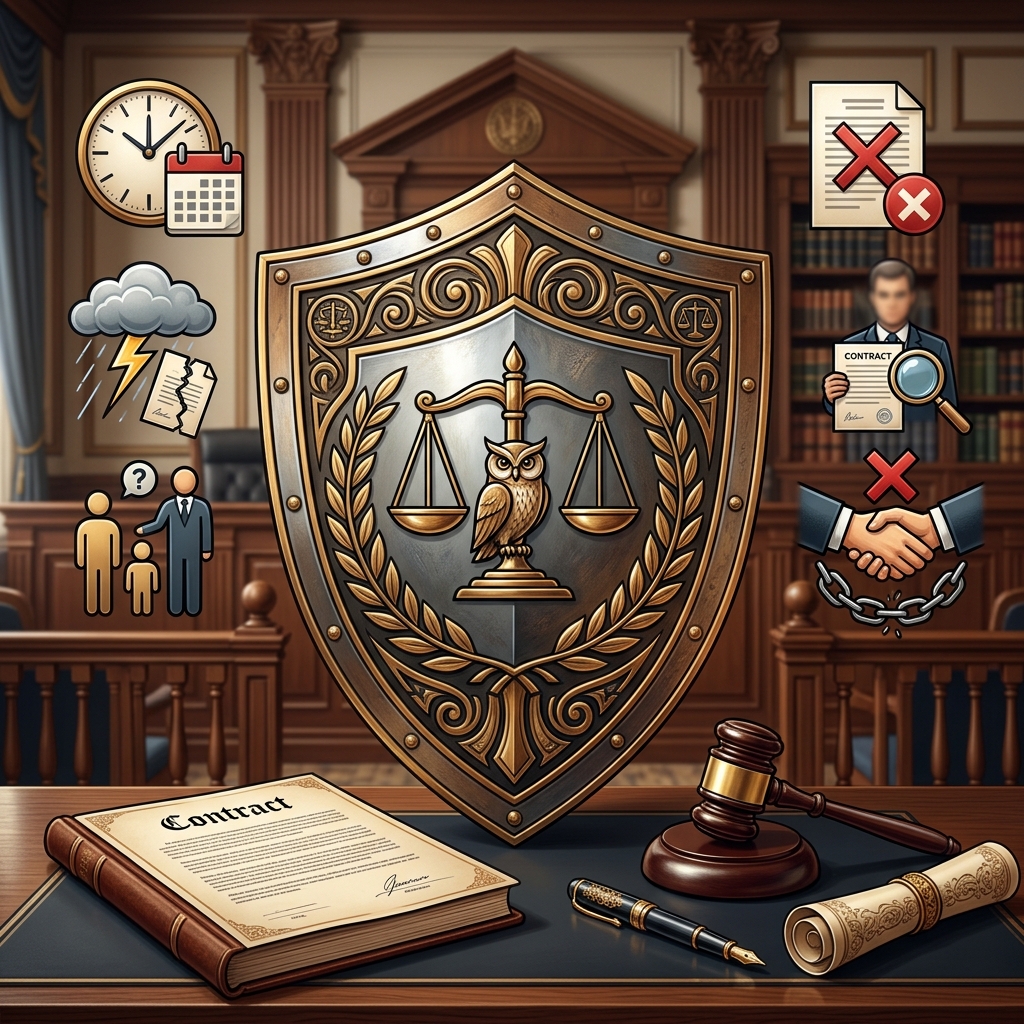
Breach of contract lawsuits are among the most common civil cases, but not every alleged breach leads to liability or damages. Defendants often have powerful legal defenses that can defeat the claim entirely or significantly limit their exposure. Understanding these defenses is crucial whether you are the party bringing the claim or the one being sued.
This article explains major categories of breach of contract defenses, how they work, and the practical issues courts consider. It is a general overview and not jurisdiction-specific; contract law varies by state, so always consult a qualified attorney for advice about your particular situation.
How Courts Analyze Defenses in Contract Disputes
In most U.S. jurisdictions, a plaintiff must prove several basic elements to win a breach of contract case, such as a valid contract, a material breach by the defendant, and resulting damages. A defense attacks one or more of these elements or raises an independent legal reason why the claim should fail even if a breach occurred.
- Formation defenses dispute whether a valid, enforceable contract ever existed.
- Performance defenses argue the defendant complied, was excused, or that the plaintiff breached first.
- Fairness and policy defenses focus on illegality, unconscionability, or similar issues.
- Procedural defenses challenge timing, standing, or other technical requirements.
Many defenses are “affirmative,” meaning the defendant bears the burden of raising and proving them. Failure to raise an affirmative defense in time can result in waiver, so early legal evaluation is critical.
Defenses Targeting Contract Formation
Some of the most powerful defenses aim at the foundation of the plaintiff’s claim: the existence of a valid contract. If there was no enforceable agreement, there can be no breach.
No Valid Contract Was Formed
To form a contract, parties typically must have offer, acceptance, mutual assent, and consideration (something of value exchanged). If any element is missing, the defendant may argue that no contract ever came into existence.
- Indefinite or vague terms: If key terms (price, subject matter, duration, or obligations) are too uncertain, a court might find no enforceable agreement.
- Lack of consideration: A promise given without any exchange of value often is not enforceable.
- Preliminary negotiations: Emails, letters of intent, or memoranda may be treated as negotiations rather than binding contracts.
Statute of Frauds: When Agreements Must Be in Writing
The statute of frauds is an historic legal doctrine requiring certain types of contracts—such as those for real estate, agreements that cannot be performed within one year, or guarantees of another’s debt—to be in writing and signed in order to be enforceable. If the plaintiff tries to enforce an oral agreement that falls within the statute of frauds, the defendant can argue the contract is unenforceable.
| Typical Contract Type | Statute of Frauds Issue |
|---|---|
| Real estate sale | Usually must be in writing and signed to be enforceable. |
| Long-term service agreement | If performance cannot be completed within a year, writing may be required. |
| Guarantee of another’s debt | Frequently must be documented in a signed writing. |
Lack of Capacity to Contract
Contract law generally requires parties to have legal and mental capacity to understand the nature and consequences of the agreement. If a defendant lacked capacity, they may avoid the contract or limit liability.
- Minors: Many jurisdictions allow people under the age of majority to disaffirm certain contracts, especially non-essential ones.
- Mental incapacity: A person who cannot comprehend the transaction may not be bound. Courts look at medical evidence, cognitive functioning, and contemporaneous behavior.
- Intoxication: Extreme intoxication may be relevant, but this defense is typically difficult to prove.
Defenses Based on Misconduct or Unfair Pressure
Even when formal requirements for a contract are met, a defendant may argue that the agreement is tainted by unfair conduct that undermines genuine consent.
Fraud and Misrepresentation
Misrepresentation involves a false statement of fact that induces the other party to enter the contract, while fraud typically requires intentional deception. If the plaintiff engaged in fraud or misrepresentation, the defendant may seek to rescind the contract or use it as a defense to a breach claim.
- False statements about critical details such as quality, pricing, or performance capabilities.
- Concealment or failure to disclose material information when there is a duty to speak.
- Reliance: The defendant must usually show they relied on the misrepresentation when agreeing to the contract.
Courts often distinguish between innocent misrepresentation and fraud; remedies and the strength of the defense can vary accordingly.
Duress and Undue Influence
Duress occurs when a party uses wrongful threats or pressure to coerce agreement, such as threats of unlawful violence or serious economic harm. Undue influence involves exploiting a position of trust or dominance to push another party into an unfair transaction.
- Evidence of severe threats, blackmail, or coercion when signing.
- Situations where a caregiver, advisor, or family member exerts overwhelming pressure on a vulnerable person.
- Contracts that strongly favor the dominant party and appear inconsistent with the weaker party’s interests.
If proved, duress or undue influence can make a contract voidable, allowing the defendant to avoid obligations or defeat a breach claim.
Unconscionability and Public Policy
A contract may be unenforceable if it is unconscionable—so one-sided and oppressive that it shocks the conscience—or if it violates public policy. Courts often look at both procedural factors (how the contract was formed) and substantive factors (the fairness of the terms).
- Procedural unconscionability: Hidden fine print, high-pressure sales tactics, or lack of meaningful choice.
- Substantive unconscionability: Extremely harsh terms, gross disparity in value, or penalties far exceeding any reasonable estimate of damages.
- Public policy violations: Contracts requiring illegal activity or undermining important regulatory objectives are often void.
Defenses Relating to Performance and Breach
Even where there is a valid contract, the defendant may argue that they complied with the agreement, that their performance was excused, or that the plaintiff’s own conduct bars recovery.
No Breach or Only a Minor Breach
One straightforward defense is that the defendant did not breach the contract at all or that any deviation from strict terms was immaterial.
- Full performance: The defendant can show they completed all required obligations.
- Substantial performance: Courts often treat minor defects as insufficient to justify major remedies such as termination.
- Compliance with industry standards: If the contract refers to professional norms, evidence of compliance can support this defense.
Prior Material Breach by the Plaintiff
If the plaintiff significantly violated the contract first, the defendant may be excused from further performance. Many jurisdictions recognize that a prior material breach by one party can discharge the other party’s obligations.
- Failure to pay invoices when due.
- Refusal to provide necessary information or access.
- Interference with the defendant’s ability to perform.
Evidence of the plaintiff’s breach can support defenses such as failure of consideration or prevention of performance.
Impossibility, Impracticability, and Frustration
Unexpected events sometimes make performance impossible or extremely difficult. Doctrines such as impossibility, commercial impracticability, and frustration of purpose may excuse nonperformance under certain conditions.
- Objective impossibility: The thing promised cannot be done (e.g., destruction of a unique item).
- Impracticability: Performance is possible but extraordinarily burdensome due to unforeseen events like natural disasters or major supply chain breakdowns.
- Frustration of purpose: The contract’s core purpose is destroyed by events beyond the parties’ control.
Courts apply these doctrines cautiously and examine whether the risk of the event was allocated in the contract itself.
Modification, Waiver, or Cancellation
Contracts are not static. Parties frequently modify terms, waive certain rights, or mutually cancel the agreement. A defendant can argue that later changes altered the obligations the plaintiff seeks to enforce.
- Written amendments changing deadlines, prices, or scope of work.
- Waiver where a party knowingly gives up a contractual right, sometimes by consistent conduct.
- Mutual rescission where both parties agree to terminate the contract.
Evidence such as emails, purchase orders, and course-of-dealing can be critical to proving modification or waiver.
Procedural and Technical Defenses
Even a strong underlying claim can fail if the plaintiff does not satisfy procedural requirements. These defenses often turn on timing and legal standing.
Statute of Limitations
The statute of limitations sets the maximum period after a breach within which a lawsuit must be filed. If the plaintiff sues too late, the defendant can invoke this defense and seek dismissal.
- Limitations periods vary by state and by type of contract (written, oral, or governed by the Uniform Commercial Code).
- The clock typically starts when the breach occurs, not when the plaintiff discovers it, although discovery rules may apply in some contexts.
- Parties sometimes agree to shortened limitation periods in the contract itself, subject to legal constraints.
Courts enforce limitation statutes strictly, so late filing can be fatal to an otherwise valid claim.
Standing and Privity of Contract
Generally, only parties to a contract (or recognized third-party beneficiaries) have the right—known as standing—to enforce it. A defendant can argue that the plaintiff is a “stranger” to the contract and therefore cannot sue.
- Privity of contract: A direct contractual relationship between plaintiff and defendant.
- Third-party beneficiaries: Some outsiders may enforce contracts if they were clearly intended to benefit from the agreement.
- Assignment and delegation: Rights and duties may be transferred, but documentation is important to prove standing.
Bankruptcy and Automatic Stay
A defendant who files for bankruptcy protection in federal court may benefit from the automatic stay, which halts most collection efforts and litigation against the debtor. Contract debts may be discharged in bankruptcy, reducing or eliminating liability, although fraud-related claims can sometimes survive discharge.
Strategic Use of Defenses in Litigation
In practice, parties rarely rely on a single defense. Lawyers often assert multiple complementary defenses, then refine the strategy as evidence develops.
- Early case assessment to identify formation issues, misrepresentations, or performance problems.
- Preservation of affirmative defenses by raising them in initial pleadings where required by procedural rules.
- Evidence gathering, including contracts, amendments, communications, financial records, and witness testimony.
- Settlement leverage: Demonstrating strong defenses can encourage reasonable settlement discussions.
Because contract law is state-specific and highly fact-dependent, tailored advice from experienced counsel is essential before deciding whether to assert particular defenses or pursue litigation.
Frequently Asked Questions About Breach of Contract Defenses
Can I rely on both “no contract” and “no breach” defenses at the same time?
Yes. Defendants often argue in the alternative—for example, that no enforceable contract existed, and that even if it did, they performed or were excused from performing. Courts frequently allow these kinds of layered defenses, especially at the early stages of a case.
Is an oral agreement ever enforceable?
Many oral agreements are enforceable, but certain types of contracts must be in writing under the statute of frauds. Problems of proof also make oral contracts riskier. If the dispute involves real estate, long-term obligations, or guarantees, written documentation is particularly important.
What kind of evidence helps prove fraud or misrepresentation?
Helpful evidence can include emails, marketing materials, contracts, internal documents, and witness testimony showing false statements or omissions. Expert testimony may be used to explain technical misstatements, and financial records can demonstrate how the defendant relied on the misinformation.
Does economic hardship alone make performance “impracticable”?
Typically, mere financial difficulty is not enough. Courts look for truly extraordinary circumstances outside the party’s control, such as major natural disasters, government shutdowns, or severe supply disruptions, coupled with a lack of risk allocation in the contract.
How can I find out which defenses apply in my state?
The specific rules and terminology for contract defenses can vary considerably by jurisdiction. Reviewing state statutes, relevant case law, and authoritative secondary sources, and consulting with a local attorney experienced in contract litigation, is the best way to identify which defenses are available and how courts apply them.
References
- 10.5: Defenses to Contracts — Randall et al., Fundamentals of Business Law (LibreTexts). 2022-08-15. https://biz.libretexts.org/Bookshelves/Civil_Law/Fundamentals_of_Business_Law_(Randall_et_al.)/10:_Contracts/10.05:_Defenses_to_Contracts
- Top 30 Contract Defenses — Washington Global Law Group PLLC. 2023-05-01. https://washglobal-law.com/top-30-contract-defenses/
- 8 Powerful Defenses to Breach of Contract Claims in Texas — Vastine Law Firm. 2023-04-10. https://vastinelaw.com/8-powerful-defenses-to-breach-of-contract-claims-in-texas/
- Common Defenses in Breach of Contract Cases — New York City Bar Association. 2021-11-30. https://www.nycbar.org/get-legal-help/article/business-and-corporate-law/contract-litigation/common-defenses-breach-contract-cases/
- Common Defenses to a New York Breach of Contract Claim — Abramson Labor Group. 2020-09-14. https://abramsonlegal.com/common-defenses-to-a-new-york-breach-of-contract-claim
- Effective Defenses to Breach of Contract Claims — Teller, Levit & Silvertrust, P.C. 2022-03-18. https://tellerlevit.com/blog/effective-defenses-to-breach-of-contract-claims/
Similar Articles








Read full bio of medha deb


