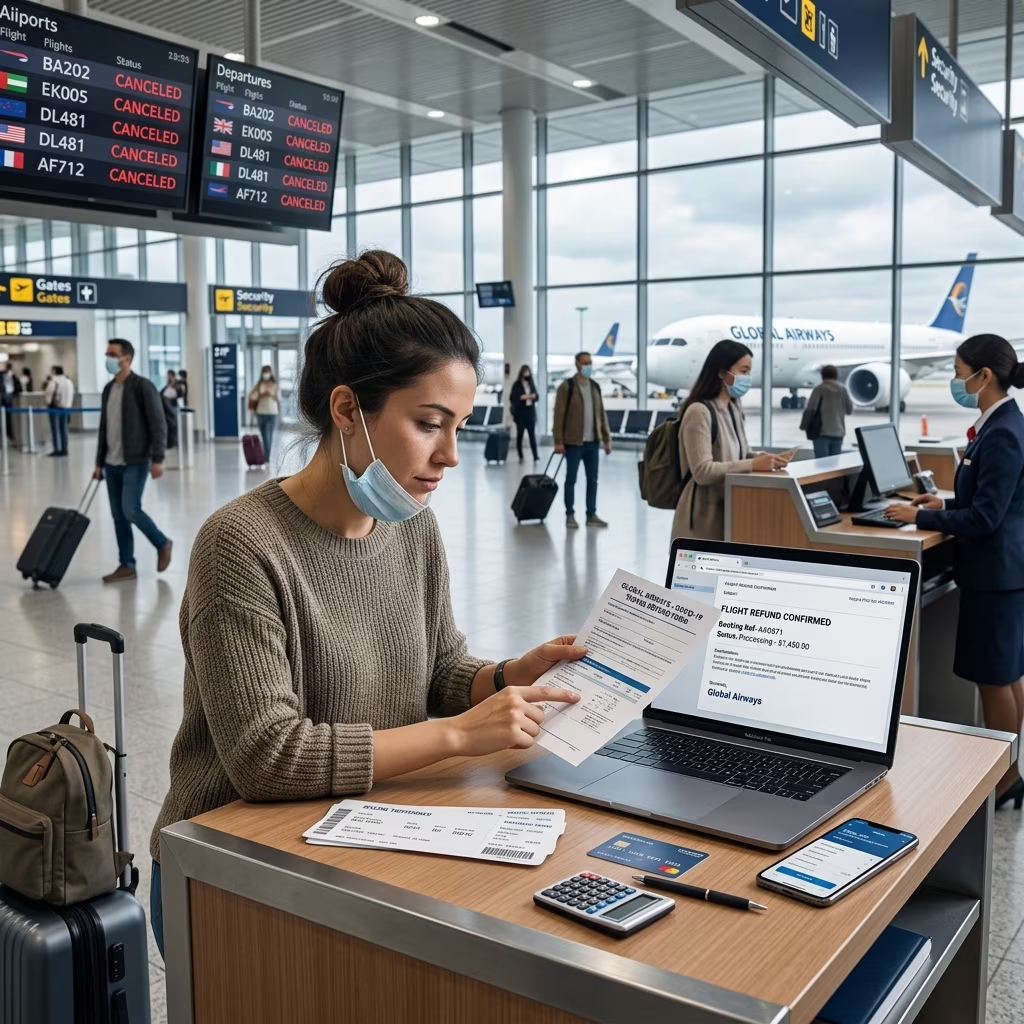
COVID-19 disrupted global air travel on an unprecedented scale, leaving many passengers with canceled flights, unusable tickets, and confusing offers of vouchers instead of cash. Understanding when you are entitled to a refund, what airlines are legally required to provide, and how to enforce your rights is essential to recovering your money in the post-pandemic environment.
1. Why Flight Refunds Became a Major Issue During COVID-19
As borders closed and public health measures tightened, airlines canceled huge numbers of flights, often with little notice. Carriers scrambled to preserve liquidity and frequently tried to push passengers toward travel credits or rebooking instead of issuing cash refunds.
Passengers suddenly had to navigate:
- Rapidly changing schedules and mass cancellations
- Complex and sometimes inconsistent airline refund policies
- Distinctions between refunds, compensation, and vouchers
- Different rules depending on the country of departure or arrival
Governments and regulators responded by clarifying that, even in a public health emergency, basic refund rights for canceled flights still apply.
2. The Legal Foundation of Your Refund Rights
When you buy an airline ticket, you enter into a contract of carriage with the airline. If the airline cancels your flight or makes a significant schedule change you do not accept, you generally have a right to get your money back.
2.1 U.S. Department of Transportation Requirements
In the United States, the Department of Transportation (DOT) has made clear that airlines must provide prompt refunds for flights that they cancel or significantly delay, regardless of the reason for the disruption.
- Refunds must cover the ticket price and any optional fees (such as seat selection or baggage) you paid for that flight.
- The obligation applies to U.S. and foreign airlines for flights to, from, or within the United States.
- DOT guidance emphasizes that extraordinary circumstances like COVID-19 do not erase refund obligations when the airline itself cancels.
These rules focus on refunds when the airline cancels or significantly changes the flight. They do not automatically grant refunds when passengers voluntarily cancel out of caution.
2.2 Refunds vs. Compensation: Key Distinction
Many passengers confuse refunds with compensation. A refund simply returns the money you paid for a service you did not receive. Compensation is an additional payment for inconvenience or legal damages.
During COVID-19, refunds remained available in many jurisdictions when a flight was canceled, but additional compensation was often not available because the pandemic was treated as an extraordinary circumstance outside the airline’s control.
- Refund: Return of the ticket cost and eligible fees when the flight is not operated.
- Compensation: Extra payment (often in regions governed by specific passenger regulations) which may be excluded when the cause is extraordinary, such as a pandemic or government border closure.
3. Vouchers, Credits, and Cash: Choosing the Best Option
When COVID-19 hit, airlines widely promoted vouchers or travel credits instead of refunds. While these options can be useful in some situations, they are not always the best choice.
3.1 Common Options Offered by Airlines
| Option | What It Provides | Pros | Cons |
|---|---|---|---|
| Cash Refund | Return of the ticket price and eligible fees to your original payment method. |
|
|
| Voucher / Travel Credit | A credit usable on future bookings with the same airline. |
|
|
| Rebooking / Alternate Flight | Placement on another flight at a later date. |
|
|
3.2 When You Can Insist on a Cash Refund
Under DOT guidance and many other consumer protection regimes, when the airline cancels or significantly changes your flight and you decline the alternative offered, you can insist on a cash refund rather than a voucher.
Key circumstances where you can typically demand a refund:
- The airline cancels the flight outright.
- A major schedule change makes the new flight unacceptable to you.
- The flight cannot operate due to government restrictions and the airline does not provide a suitable alternative.
Airlines may still offer vouchers as their default solution, but regulators expect them to provide a refund option when required by law.
4. Practical Steps to Secure Your Refund
While the law may be clear, getting your money back can require careful organization and persistence. Many travelers have successfully obtained refunds by methodically working through the process.
4.1 Prepare Your Documentation
Before contacting the airline, gather all relevant information so you can clearly demonstrate your claim.
- Booking confirmation numbers and e-tickets
- Receipts for ticket purchases and ancillary fees
- Written notices of cancellation or schedule change
- Copies or screenshots of airline refund policies in place when you booked
4.2 Contact the Airline Directly
Most regulators advise that your first step should be to contact the company you booked with, whether that is the airline itself or a travel agency platform.
Best practices when you call or write:
- Clearly state that the airline canceled or significantly changed the flight, and that you are requesting a cash refund.
- Cite the DOT requirement that airlines must provide a prompt refund when they cancel or significantly delay flights to, from, or within the U.S.
- Keep notes of dates, names of representatives, and what is promised.
- Follow up in writing (email or secure message) to create a record.
4.3 Escalating When the Airline Refuses
If the airline declines to provide a refund you believe you are legally entitled to, you have several escalation options.
- File a complaint with the U.S. DOT: Passengers can report airlines that fail to issue refunds for canceled or significantly changed flights, prompting regulatory review.
- Contact your state Attorney General: State consumer protection agencies may pursue patterns of unfair conduct.
- Engage the Federal Trade Commission (FTC): For general travel-related unfair or deceptive practices, you can submit a complaint to the FTC.
Regulatory pressure has led many airlines to adjust their practices and proactively issue refunds for COVID-19–related cancellations.
4.4 Using Credit Card Disputes
If the airline or travel provider refuses to refund, and you paid by credit card, you may be able to file a dispute (chargeback) asserting that the service was not provided.
- Credit card issuers often temporarily credit your account while they investigate.
- You will need evidence that the flight was canceled and that you attempted to resolve the issue with the airline.
- Successful disputes can secure a refund even when direct negotiations fail.
5. How Travel Insurance Interacts with COVID-19 Cancellations
Travel insurance played a significant role in some COVID-19 cancellation scenarios, especially where passengers canceled trips due to illness or heightened risk rather than airline decisions.
5.1 Standard Trip Cancellation Coverage
Typical trip cancellation benefits can reimburse non-refundable prepaid travel expenses when a covered event prevents you from traveling.
Covered reasons often include:
- Serious illness or injury affecting you or a family member
- Severe weather that prevents travel
- Other specified events like terrorism or natural disasters, depending on the policy
Many policies explicitly state that canceling solely due to fear or worry about an outbreak is not a covered reason.
5.2 Policies That Cover COVID-19 Illness
Some travel insurance providers offer benefits when a traveler contracts COVID-19 before or during the trip.
- If you test positive before departure and cannot travel, certain policies can reimburse up to 100% of prepaid, non-refundable costs.
- If you become ill during the trip, trip interruption coverage may repay unused trip portions and additional transport costs to return home.
5.3 Cancel for Any Reason (CFAR) Coverage
For travelers concerned about unpredictable developments, some insurers offer Cancel for Any Reason (CFAR) coverage, which can reimburse a portion of trip costs when you cancel even without a traditional covered reason.
- CFAR typically must be purchased soon after the initial trip payment (often within 1–3 weeks).
- Cancellations usually must occur a set time before departure, such as at least 48 hours.
- Reimbursement is often capped at a percentage (for example, up to about 75% of prepaid, nonrefundable expenses).
CFAR can be useful where there is uncertainty about future restrictions or personal comfort with travel, but it is not a full substitute for statutory refund rights when airlines cancel flights.
6. Special Situations: Border Closures and Entry Restrictions
COVID-19 led many countries to close borders or impose entry bans. These government actions complicate the question of refunds and compensation.
When cancellations result directly from government restrictions that make operating the flight impossible, they are generally considered extraordinary circumstances. Passengers may still be entitled to refunds of the ticket cost, but not additional compensation for inconvenience.
6.1 Your Rights When Borders Close
In many legal systems, including those governing flights in and out of Europe, closure of borders or official travel bans is treated as an exceptional situation:
- The airline must usually refund the ticket or provide an alternate flight when operations resume.
- Compensation beyond the refund is not owed because the cause is outside the airline’s control.
- Passengers may need to coordinate with tour operators, embassies, or consulates to arrange return travel if stranded.
7. Working With Lawyers and Legal Remedies
Most passengers can secure refunds through negotiation, regulatory complaints, and credit card disputes. However, in complex situations or when large amounts of money are involved, legal assistance can be helpful.
A lawyer experienced in aviation or consumer law can:
- Review the contract of carriage and identify specific legal rights
- Advise on whether the airline’s practices violate statutory or regulatory obligations
- Help draft demand letters or negotiate settlements
- Evaluate whether small claims court or other litigation options are appropriate
Legal support is particularly useful when multiple flights, tour packages, or complex international itineraries are involved.
8. Practical Tips for Future Bookings
While the acute phase of the pandemic has passed, health emergencies and other large-scale disruptions may occur again. Applying lessons learned from COVID-19 can make future travel more resilient.
- Review refund rules before purchase: Check whether your fare is refundable, what change fees apply, and how the airline handles schedule changes.
- Consider flexible fares: Slightly more expensive tickets may offer better refund and change conditions.
- Evaluate travel insurance: Decide whether standard trip cancellation or CFAR coverage aligns with your risk tolerance.
- Keep records organized: Save booking confirmations, policy snapshots, and communications with travel providers.
- Monitor regulatory updates: Government agencies periodically refine guidance on refunds and consumer protections.
9. Frequently Asked Questions (FAQs)
9.1 If my airline cancels my flight due to COVID-19, do I always get a refund?
If the airline cancels your flight and you choose not to accept an alternative, U.S. DOT guidance requires a prompt refund of the ticket price and certain fees for flights to, from, or within the United States. Other jurisdictions have similar rules, though details vary.
9.2 What if I cancel the flight myself because I am worried about COVID-19?
Voluntary cancellations are treated differently. You are usually bound by the fare conditions and the airline’s standard cancellation policies. A refund may not be guaranteed unless your ticket is refundable or you have insurance coverage for your specific reason.
9.3 Are airlines required to offer compensation for COVID-19 cancellations?
Most legal frameworks treat the pandemic and related restrictions as extraordinary circumstances. Airlines generally must refund the ticket or provide an alternative flight but are not required to pay additional compensation beyond the refund.
9.4 How long should a refund take to appear?
Regulators expect airlines to provide prompt refunds, typically within a reasonable timeframe, though exact deadlines can vary. If delays become excessive, you can escalate the issue to the DOT, credit card issuer, or consumer protection agencies.
9.5 Can I use a credit card dispute if the airline refuses to refund?
Yes. When you paid with a credit card and did not receive the service purchased, you can often file a dispute. Card issuers commonly investigate and may credit your account while the matter is resolved.
References
- Enforcement Notice Regarding Refunds by Carriers for Canceled Flights — U.S. Department of Transportation. 2020-04-03. https://www.transportation.gov/airconsumer/enforcement_notice_refunds_canceled_flights
- Consumer Protections for Travelers – COVID-19 — County of Los Angeles. 2020-05-01. https://covid19.lacounty.gov/covid19-2-2/consumers-businesses/for-travelers/
- COVID-19 ruined my travel plans. Now what? — Federal Trade Commission. 2020-05-13. https://consumer.ftc.gov/consumer-alerts/2020/05/covid-19-ruined-my-travel-plans-now-what
- Airline Regulations Post-COVID-19: Refunds and Passenger Rights — Super Lawyers. 2020-04-20. https://www.superlawyers.com/resources/aviation-and-aerospace/landing-a-refund-for-flights-cancelled-from-covid-19/
- Coronavirus Flight Cancellation: Your Air Passenger Rights — AirHelp. 2022-01-10. https://www.airhelp.com/en/coronavirus-and-your-air-passenger-rights/
- Coronavirus Flight Cancellation. Claim a Compensation — Flightright. 2022-02-01. https://www.flightright.com/coronavirus-cancellations
- Trip Cancellation Coverage for COVID-19 Sickness — Squaremouth. 2023-03-15. https://www.squaremouth.com/travel-insurance-benefits/virus-cancellation