
Indiana Criminal Trespass: Rights, Risks, and Penalties
Understand how Indiana defines criminal trespass, when entering property becomes a crime, and what penalties and defenses may apply.
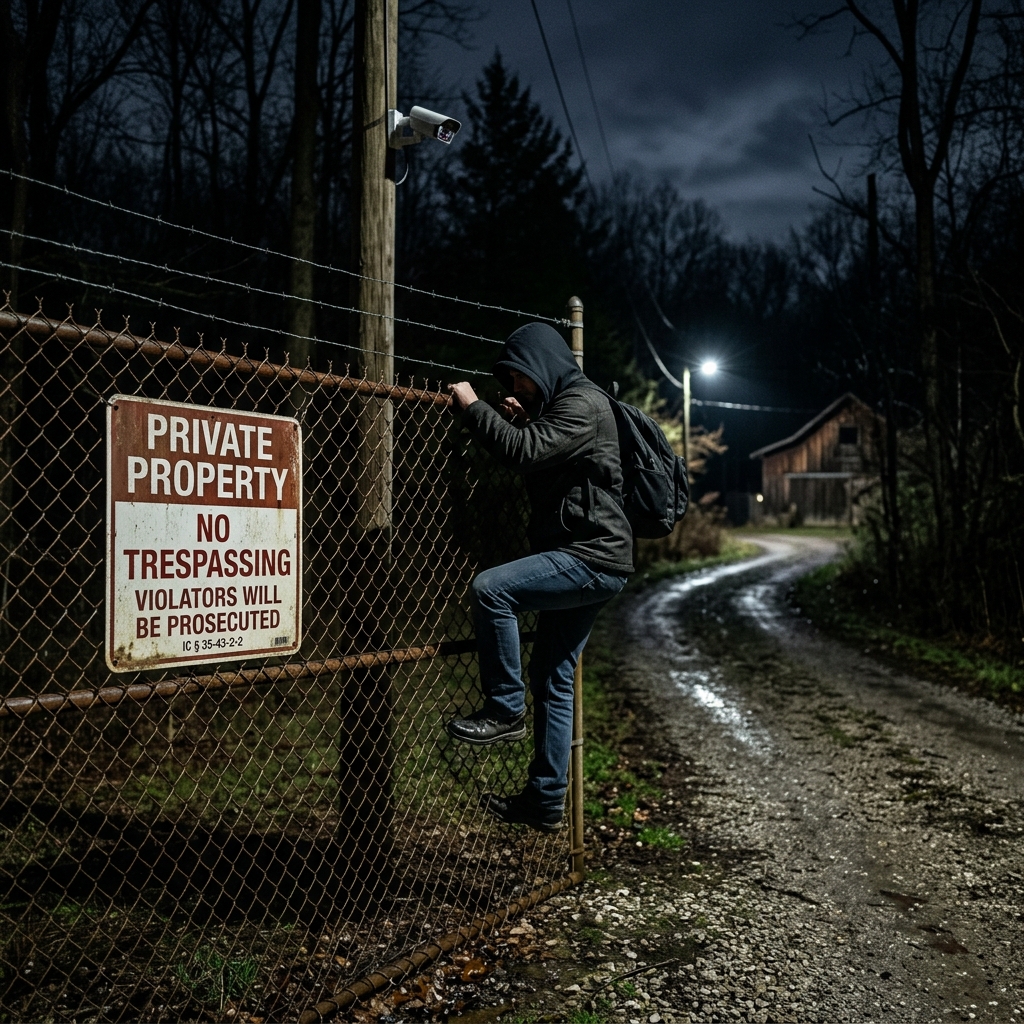
Indiana takes unauthorized entry onto property seriously. Under Indiana’s criminal code, entering or remaining on land, buildings, or certain facilities without proper permission can result in a criminal trespass charge, which may be a Class A misdemeanor or, in more serious situations, a Level 6 or Level 5 felony. Understanding the law can help both property owners and visitors avoid unintended violations.
This guide explains how Indiana defines criminal trespass, what counts as notice, how penalties are structured, and what defenses may be available if you are accused of trespassing.
1. How Indiana Law Defines Criminal Trespass
Indiana’s primary trespass law is found in Indiana Code § 35-43-2-2, which sets out several ways a person can commit criminal trespass. In general terms, a person commits criminal trespass when they knowingly or intentionally enter or remain on property where they have no legal right to be after being denied entry or told to leave.
1.1 Key elements prosecutors must prove
Although the statute lists multiple scenarios, most criminal trespass charges share four core elements:
- No contractual interest in the property (for example, you are not a tenant, owner, or licensee who has a recognized legal right to be there).
- Knowingly or intentionally entering or remaining on the property (not by accident or mistake).
- Lack of permission from the person or entity that controls the property.
- Denial of entry or a request to leave that you ignore, or entry into an area clearly marked or restricted.
If any one of these elements is missing—for example, if you reasonably believed you had permission—criminal liability may not be established.
1.2 Common ways trespass occurs under Indiana law
Indiana Code § 35-43-2-2 covers a broad range of conduct. Examples include:
- Entering someone’s land after being explicitly told not to enter by the owner, their agent, or a law enforcement officer acting on their behalf.
- Refusing to leave property after being asked to leave by the owner, a person with authority (such as a manager or security guard), or an officer.
- Going into areas of a business or facility that are marked “employees only” or otherwise restricted from public access.
- Entering certain sensitive locations, such as utilities or scientific research facilities, without authorization.
- Damaging property while on it without permission, in amounts that can elevate the charge to a felony.
Because the statute lists several specific subsections, behavior that might not look like traditional trespassing (such as interfering with another person’s possession or use of property) can still fall under the criminal trespass law.
2. Notice and Warning: How You Are Told to Stay Off Property
To be criminally liable, you generally must be on notice that you are not allowed on the property. Indiana law recognizes several ways that notice can be given, including spoken warnings, posted signs, and a unique “purple paint” rule.
2.1 Verbal and written warnings
In many trespass cases, a person is either:
- Denied entry before stepping onto the property, or
- Asked to leave after entering.
Under Indiana Code, such warnings can be issued by:
- The property owner;
- An authorized agent (such as a property manager or security guard); or
- A law enforcement officer acting on behalf of the owner or agent.
Refusing to comply with these warnings—either by entering anyway or by staying after being told to leave—can result in a Class A misdemeanor trespass charge.
2.2 Posted signs and other markings
Indiana recognizes that property owners may indicate denial of entry through signs or visible markings, especially in rural or wooded areas where fencing every boundary is impractical. Signs such as:
- “No Trespassing”
- “Private Property”
- “Keep Out”
can serve as clear notice that entry is not allowed. Entering after seeing such signs may satisfy the notice element of the offense.
2.3 The “purple paint” rule for landowners
Indiana law also allows property owners to mark boundaries using purple paint on trees or posts, which operates similarly to “No Trespassing” signs. The statute sets specific requirements for how these marks must be applied, including height from the ground, length of the mark, and spacing between marked trees or posts.
Key requirements include:
- Purple marks must be clearly visible to anyone approaching the property.
- On trees, marks must be vertical lines of a minimum length, placed between specified heights from the ground.
- On posts, the top portion must be painted, with marks placed at set intervals.
- Where fences are shared, all owners or lessees must agree before marks visible from both sides are applied.
These rules are detailed in the statute because they are intended to be a legally recognized substitute for traditional signage on larger or rural properties.
3. Misdemeanor vs. Felony Trespass in Indiana
Criminal trespass in Indiana is not always charged at the same level. The seriousness of the location, any prior history, and the amount of damage (if any) can elevate the offense from a misdemeanor to a felony.
3.1 Class A misdemeanor criminal trespass
Most basic trespass situations are prosecuted as a Class A misdemeanor. This generally includes:
- Entering or remaining on another person’s real property after being denied entry or asked to leave;
- Ignoring clearly posted warnings or marked boundaries; and
- Entering non-public areas of a property without permission.
Under Indiana’s sentencing laws, a Class A misdemeanor can be punished by up to one year in jail and a fine of up to $5,000. These penalty ranges are set by the general misdemeanor sentencing statute, not the trespass statute itself.
3.2 When trespass becomes a Level 6 felony
Certain circumstances automatically elevate criminal trespass to a Level 6 felony. Indiana Code specifies felony treatment when, for example, trespass occurs:
- On school property or a school bus;
- At a scientific research facility;
- At a facility belonging to a public utility; or
- By a person with a prior unrelated conviction for trespassing on the same property.
Under Indiana’s sentencing rules, a Level 6 felony is punishable by six months to 2.5 years in prison, with an advisory sentence of one year. While a judge can sometimes reduce a Level 6 felony to a Class A misdemeanor at sentencing, a felony conviction can still carry severe long-term consequences.
3.3 Level 5 felony trespass based on property damage
Indiana law also ties felony levels to the amount of property damage caused during a trespass.
| Damage Amount | Offense Level |
|---|---|
| More than $750 and less than $50,000 | Level 6 felony |
| $50,000 or more | Level 5 felony |
A Level 5 felony in Indiana can carry a sentence of one to six years in prison, with an advisory sentence of three years. Because these thresholds are defined by statute, the value of the damage can be a critical issue in contested cases.
4. Typical Penalties and Collateral Consequences
Beyond the classification of the offense, a criminal trespass conviction can lead to a range of penalties that affect more than just short-term freedom.
4.1 Direct criminal penalties
Depending on the level of the charge, potential penalties include:
- Class A misdemeanor: Up to one year in jail and a fine up to $5,000.
- Level 6 felony: Six months to 2.5 years in prison, with an advisory sentence of one year.
- Level 5 felony: One to six years in prison, with an advisory sentence of three years.
Court supervision may also involve probation conditions such as staying away from the property, community service, or restitution for damage.
4.2 Collateral impacts beyond the courtroom
A trespass conviction can have long-lasting effects beyond jail, fines, or probation. Defendants may face:
- Criminal record issues, showing a property-related offense that may concern future employers or landlords.
- Immigration consequences in some cases, particularly for non-citizens with multiple or more serious convictions (individual circumstances vary and require specialist advice).
- Professional licensing problems for certain regulated occupations that require background checks.
- Civil liability, since property owners can potentially bring civil claims for damage or interference separate from criminal charges.
Because of these potential consequences, even a misdemeanor trespass charge deserves careful attention.
5. Defenses and Legal Issues in Trespass Cases
Not every entry onto another person’s property is criminal. Indiana law is concerned with knowing and intentional violations of someone else’s rights; misunderstanding or lack of clear notice can be crucial factors.
5.1 Possible defenses
Common defenses that an attorney may explore in a criminal trespass case include:
- Lack of intent: You did not knowingly or intentionally enter or stay where you were not allowed (for instance, you got lost or reasonably believed the land was open to the public).
- Permission or consent: You had the owner’s or occupant’s permission—either expressed directly or implied by conduct—for example, a long-standing practice of allowing people to use a path.
- Insufficient notice: The property was not properly posted, marked, or fenced, and you had not been specifically warned to stay away.
- Mistaken identity or inaccurate report: The police or property owner misidentified the person involved.
- Constitutional issues: In some situations, the way evidence was collected or the scope of police authority to order someone to leave may be challenged (for example, whether there was reasonable suspicion to ask someone to leave in certain cases).
Each case is highly fact-specific, so the exact defenses that apply will depend on what happened, who owns or controls the property, and what notice was given.
5.2 Lawful presence and statutory exceptions
Indiana’s trespass laws include specific exceptions. Some individuals—such as certain railroad passengers or authorized workers—are exempt from criminal liability under particular subsections of the law. In addition, other state and federal laws can sometimes grant rights of entry, such as easements, emergency responder authority, or law enforcement duties.
Those exceptions are detailed in the statute and often require legal interpretation. Someone who is on property for official duties, or who has court or administrative authorization to enter, may fall within these exceptions and avoid criminal liability.
6. Practical Guidance for Property Owners and Visitors
Understanding criminal trespass is useful not only for people facing charges but also for landowners, businesses, and anyone who frequently enters others’ property.
6.1 Tips for property owners
Owners who want to reduce trespassing and strengthen enforcement options can consider the following:
- Post clear signs at entrances and commonly used access points, especially where the boundary might otherwise be unclear.
- Use purple paint markings in compliance with Indiana Code requirements on larger or wooded tracts where signs may be impractical.
- Communicate boundaries to neighbors and others who regularly access nearby areas, such as hunters or recreational users.
- Document prior warnings with dates, names, and details when you have told specific individuals not to enter.
- Call law enforcement when a person refuses to leave or continues to return after being warned, rather than confronting potentially dangerous situations alone.
6.2 Tips for individuals to avoid trespass charges
People who hunt, hike, deliver goods, or visit unfamiliar locations can lower their risk of trespassing accusations by:
- Paying attention to signs and markings, including purple paint on trees or posts.
- Asking permission in advance before hunting, fishing, or crossing private land, and keeping that permission in written form if possible.
- Leaving immediately if asked by a property owner, manager, or law enforcement officer, even if you believe the request is mistaken.
- Staying in areas open to the public when visiting businesses or facilities, and avoiding clearly restricted or “employees only” zones.
- Using maps or property records when the boundary between public and private land is unclear.
Being proactive about permission and respectful of boundaries can prevent misunderstandings from escalating into criminal matters.
7. Frequently Asked Questions About Indiana Criminal Trespass
7.1 Is every unauthorized entry onto property a crime?
No. To be criminal, trespass usually requires that you knowingly or intentionally entered or remained without authorization, and that you had some form of notice that you were not allowed there. Innocent mistakes, unclear boundaries, or implied permission may undermine the prosecution’s case, although these issues are often disputed in court.
7.2 Can I be charged if I leave as soon as I’m asked?
Generally, the most common criminal trespass scenario involves refusing to leave after being asked by the owner, an authorized agent, or law enforcement. If you immediately comply and depart, the chances of criminal charges are significantly lower, although prior conduct and property-specific rules can still matter.
7.3 What if I did not see any signs or purple paint?
Whether you had adequate notice is a factual question. Indiana’s purple paint statute and rules on posting are designed to create clear, visible warnings. If signs or markings were missing, hidden, or ambiguous, that may form part of a defense, but it does not automatically prevent charges.
7.4 Are school grounds treated differently?
Yes. Trespassing on school property or a school bus can elevate the offense to a Level 6 felony under Indiana Code § 35-43-2-2, reflecting heightened concerns about student safety. Penalties can therefore be much more severe than for trespassing on ordinary private property.
7.5 Can property owners always have someone removed by police?
Property owners and their agents usually have the right to ask someone without a legal right to be there to leave. However, in specific contexts—such as certain public spaces or when constitutional rights are implicated—police authority to order a person to leave or to arrest for trespass may be limited by requirements for reasonable suspicion or other legal safeguards. These issues can be complex and often depend on whether the property is public or private and what the person is doing there.
8. When to Seek Legal Advice
Because Indiana criminal trespass law covers many different types of property and conduct, and because penalties can escalate to felony levels, anyone facing an accusation or charge should consider speaking with a qualified Indiana criminal defense attorney. A lawyer can:
- Review whether each element of the statute has been met, including notice and intent;
- Assess whether the location or damage level truly supports a felony enhancement;
- Identify potential statutory exceptions or constitutional issues; and
- Negotiate with prosecutors or present defenses at trial.
Likewise, property owners with recurring trespass problems may benefit from legal advice on how best to document warnings, post or mark land in compliance with state law, and coordinate with law enforcement.
References
- Indiana Code § 35-43-2-2, Criminal Trespass — Indiana General Assembly / Justia. 2024-01-01. https://law.justia.com/codes/indiana/title-35/article-43/chapter-2/section-35-43-2-2/
- Indiana Code Title 35. Criminal Law and Procedure § 35-43-2-2 — FindLaw Codes. 2024-01-01. https://codes.findlaw.com/in/title-35-criminal-law-and-procedure/in-code-sect-35-43-2-2/
- Indiana Criminal Trespass Law Update — Indiana Office of Judicial Administration, Legislative Update. 2025-05-16. https://legislativeupdate.courts.in.gov/2025/05/16/trespass-5/
- Facing Criminal Trespass Charges in Indiana? — Banks & Brower, Attorneys at Law. 2025-09-22. https://banksbrower.com/2025/09/22/facing-criminal-trespass-charges-in-indiana/
- Defending Trespass Charges in Indiana: A Comprehensive Guide — BBGibson. 2024-06-01. https://www.bbgibson.com/blog/defending-trespass-charges-in-indiana
- What Are Trespassing Laws in Indiana? — O’Flaherty Law. 2023-08-10. https://www.oflaherty-law.com/learn-about-law/what-are-trespassing-laws-in-indiana
Similar Articles








Read full bio of Sneha Tete




