
Implied Contracts and Idea Theft in Hollywood
How writers can protect their pitches when studios reject the idea but later turn it into a successful show or film.
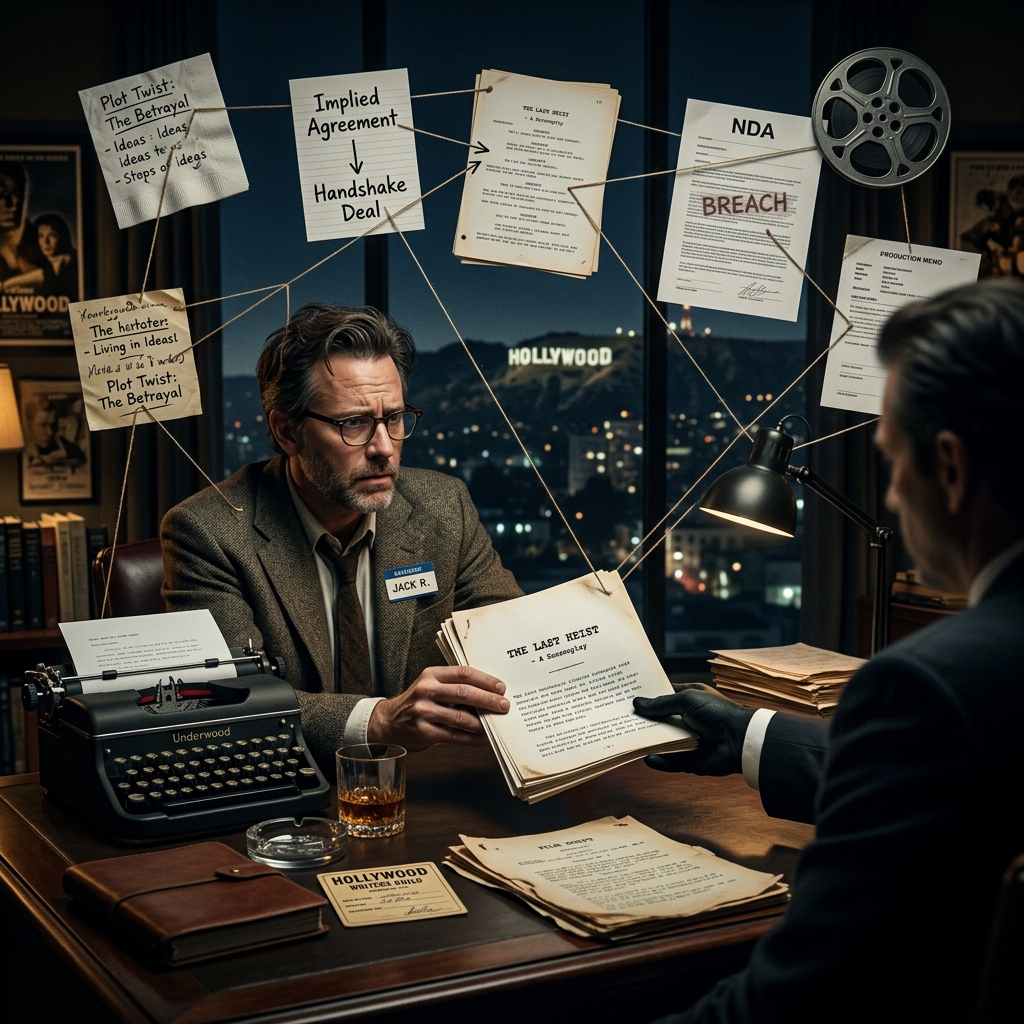
In the entertainment industry, the distance between pitching a concept in a conference room and seeing a similar show on television can be uncomfortably short. When a writer presents an idea to a studio or network and the company later uses that idea without paying, the writer often cannot rely on copyright law alone, because copyright does not protect mere ideas. Instead, many of these disputes turn on the doctrine of the implied-in-fact contract, sometimes called an “idea theft” claim under state contract law.
This article explains how implied contracts work in the context of Hollywood pitches, why these claims are not necessarily preempted by the federal Copyright Act, and what writers and producers should understand about the legal framework governing idea submissions.
Ideas, Expressions, and Why Copyright Is Not Enough
U.S. copyright law draws a sharp line between ideas and the expression of those ideas. Section 102 of the Copyright Act protects original works of authorship, but explicitly states that copyright protection does not extend to any idea, concept, or principle, even if that idea is embodied in a copyrighted work.
- Protected: Screenplays, teleplays, dialogue, character descriptions, and completed episodes as expressive works.
- Not protected: General premises, plot ideas, concepts for reality shows, or high-level formats when discussed only at the level of ideas.
Because television and film development often begins with high-level pitches — for example, an outline for a series, a concept for a reality show, or a brief synopsis — many disputes over “stolen” ideas occur at a stage where federal copyright does not apply directly. Courts have recognized that while copyright cannot protect ideas, state law contract doctrines can regulate how those ideas are bought, sold, and used in business relationships.
The Core Concept: Implied-in-Fact Contracts for Pitches
An implied-in-fact contract arises not from explicit written or spoken promises, but from the conduct of the parties and the circumstances of their interaction. In the idea submission context, courts have held that when a writer offers an idea to a producer under circumstances suggesting that the idea is being disclosed in exchange for possible payment, an implied promise to pay can arise if the idea is later used.
Under cases applying California law, the typical elements of such a claim include:
- The writer disclosed a concrete, sufficiently developed idea to the defendant.
- The defendant voluntarily accepted the disclosure, often in an industry setting where pitches are customarily evaluated.
- Both parties understood that compensation could be expected if the idea was used.
- The defendant ultimately used the idea in developing a program or other entertainment product.
- The idea had commercial value and contributed to the final work.
When these conditions are present, courts infer a contract in fact — a bargain formed through behavior rather than formal words — obligating the producer to pay reasonable compensation if the idea translates into a successful project.
How Courts Distinguish Contract Claims from Copyright Claims
One critical issue in idea theft litigation is copyright preemption. Federal law preempts state law claims that fall within the subject matter of copyright and assert rights equivalent to those protected by the Copyright Act. The question becomes whether a state-law implied contract claim is essentially just a repackaged copyright claim, or whether it protects a distinct interest.
Appellate courts, including the Second and Ninth Circuits, have emphasized two key distinctions:
- Different rights: Copyright protects exclusive rights to reproduce, distribute, and display expressive works. Contract claims protect the agreed obligation to pay or otherwise compensate for use of an idea.
- Additional elements: Implied-in-fact contract claims require proof of mutual understanding regarding payment and the parties’ conduct in a business relationship, which are qualitatively different from the elements of copyright infringement.
In cases involving television pitches, courts have held that the presence of a bilateral expectation of compensation — a shared understanding that the writer is offering the idea for sale — adds an extra element beyond mere use or copying. That extra element can render the claim not preempted by federal copyright law.
Novelty and the Value of Ideas in Different States
States differ on whether the idea must be novel to support an implied contract claim. This affects both the viability of lawsuits and how writers should frame their submissions.
California’s Approach
California courts, building on decisions such as Desny v. Wilder, recognize legal protection for ideas under implied-in-fact contracts in circumstances where an idea is furnished to a producer with an expectation of payment if used. While early doctrine emphasized novelty, modern California decisions focus heavily on the parties’ conduct and the concreteness of the idea rather than requiring absolute newness.
Important points under California law include:
- An express contract to pay for a non-novel idea can be enforceable.
- Implied contracts generally require that the idea be sufficiently concrete and specific, not a vague notion.
- Courts look at industry custom: in Hollywood, pitches are often understood as offers of ideas in exchange for possible compensation.
New York’s Approach
New York courts have traditionally imposed a stronger novelty requirement for idea theft claims. Writers may not recover if the idea was already in use in the industry at the time of submission, or if it lacks a significant degree of originality compared to existing concepts.
Under New York law:
- Implied contract claims still arise from conduct and presumed intention, similar to California.
- However, a plaintiff must show the idea was novel — not generally known or widely used in the relevant field.
- If the idea resembles commonplace formats or genre conventions, courts may find it too familiar to support recovery.
Elements Commonly Evaluated in Idea Theft Cases
Courts across jurisdictions examine a cluster of factors to decide whether an implied contract exists and whether the defendant actually stole and used the idea. While formulations differ, certain themes recur.
| Element | Typical Question | Why It Matters |
|---|---|---|
| Submission / Access | Did the writer present the idea directly or through someone connected to the production? | Establishes privity and ensures the defendant had access to the idea. |
| Voluntary Acceptance | Did the producer agree to hear the pitch or review the materials? | Supports inference of an implied promise to evaluate and possibly compensate. |
| Expectation of Payment | Were the circumstances such that both sides understood that payment could be expected if the idea was used? | Creates the contractual obligation distinct from copyright rights. |
| Use of the Idea | Is the subsequent work substantially similar to the pitched concept in concrete aspects? | Shows the idea was exploited, not merely heard and rejected. |
| Value / Novelty | Did the idea contribute significant value, and was it novel in relevant jurisdictions? | Supports damages and, in some states, is a prerequisite for recovery. |
Substantial Similarity and the Role of Expert Analysis
Even though these cases are grounded in contract, courts often borrow analytical tools from copyright law to assess whether the defendant actually used the idea. Modern California decisions suggest that more than one overlapping idea may be necessary, and they frequently refer to substantial similarity between the pitched concept and the final work.
Experts in screenwriting or literary analysis may compare:
- Plot structure and overall narrative arc
- Characters and their roles or relationships
- Themes and core conflicts
- Setting and unique contextual elements
- Mood, tone, and pacing
- Sequence of events and key turning points
When these concrete elements align in significant ways between the pitch and the produced show, courts are more likely to find that the defendant used the idea rather than independently creating a similar concept.
Statutes of Limitations and Practical Timing Issues
Idea theft claims are subject to state statutes of limitations, which place a time limit on filing suit. These deadlines differ across jurisdictions and can be triggered in various ways.
- In California, an implied contract claim for idea theft typically must be filed within about two years from the public release of the allegedly stolen work, which can include promotional campaigns leading up to release.
- In New York, similar claims often carry a six-year limitations period, giving plaintiffs a longer window to act.
Writers who suspect their ideas have been appropriated should pay attention to when the show or film first becomes publicly visible, because waiting too long may bar the claim even if the underlying facts are strong.
Why These Cases Matter for the Entertainment Industry
Implied contract claims sit at the intersection of creative collaboration and legal risk management. For studios and networks, they shape how pitches are solicited, documented, and evaluated. For writers, they offer a pathway to compensation in scenarios where copyright protection is unavailable but industry custom supports an expectation of payment.
Key implications include:
- Risk to producers: When companies invite pitches, they potentially create implied promises to pay for ideas they later use. Adopting clear submission policies and written agreements can reduce uncertainty.
- Protection for writers: The doctrine acknowledges the economic reality that ideas are valuable and often exchanged in structured ways, even when not yet reduced to fully copyrighted scripts.
- Balance between innovation and litigation: Courts attempt to distinguish genuine theft from ordinary creative overlap, relying on detailed factual analysis rather than automatically rewarding anyone who once pitched a vaguely similar concept.
Best Practices for Writers Pitching Ideas
While legal outcomes turn on specific facts and jurisdiction, writers can take practical steps to strengthen their position if disputes arise.
- Document the pitch: Keep dated copies of written outlines, treatments, and emails confirming meetings and submissions.
- Clarify expectations: When possible, use simple written language stating that the idea is submitted with the expectation of compensation if used.
- Know your audience: Pitch to individuals or entities who are directly involved in production; closer “privity” helps establish that the idea reached the relevant decision-makers.
- Avoid overly generic concepts: Concrete, distinctive elements are more likely to be recognized as protectable under implied contract law and less likely to be dismissed as common genre features.
- Monitor release announcements: Track upcoming projects from companies you pitched to, so you can spot potential overlaps early and evaluate legal options before limitations periods expire.
Considerations for Studios and Networks
Producers and networks also face legal and operational challenges. To reduce exposure to idea theft claims, many companies adopt policies governing unsolicited submissions and pitch meetings.
- Submission releases: Some companies require writers to sign forms acknowledging that similar ideas may already exist internally and waiving certain claims. These releases must be drafted carefully to remain enforceable and fair.
- Controlled solicitation: Studios can limit who within the organization is authorized to receive pitches, helping track submissions and document the circumstances of disclosure.
- Internal recordkeeping: Maintaining records of pre-existing projects and development timelines can help demonstrate independent creation when disputes arise.
- Training for executives: Educating development staff about the legal implications of pitch meetings reduces the risk that casual conversations lead to unintended contractual obligations.
Frequently Asked Questions
Can I sue a network just because its show looks like my idea?
Not automatically. Courts require proof that you submitted your idea to the network (or someone closely connected to the production), that the network voluntarily accepted the disclosure, and that both sides understood your idea was offered in exchange for possible payment. You must also show the network actually used your idea, typically demonstrated through substantial similarity.
Does my idea have to be completely original?
It depends on the state. In New York, novelty is a more explicit requirement, and courts may deny recovery if the idea was already in use in the industry. In California, the focus is more on the concreteness of the idea and the parties’ conduct, though novel and distinctive concepts generally make stronger cases.
What if I never signed anything with the studio?
You may still have an implied-in-fact contract if the circumstances show that the studio voluntarily received your pitch knowing that you expected compensation if your idea was used. Courts infer the promise to pay from behavior and industry custom rather than written words alone.
Why isn’t copyright enough to protect my pitch?
Copyright law does not extend to mere ideas, only to their specific expression. High-level concepts, formats, and premises are typically outside the scope of copyright protection. Implied contract law fills that gap by recognizing that ideas can be valuable economic assets traded under understood conditions.
How long do I have to bring an idea theft claim?
Time limits vary by jurisdiction. In California, the window is often around two years from the public release of the allegedly stolen work, while New York provides up to six years. Consulting legal counsel promptly after discovering potential theft is crucial.
References
- 17 U.S.C. § 102 — Subject matter of copyright — United States Code. 2018-01-01. https://www.govinfo.gov/app/details/USCODE-2018-title17/USCODE-2018-title17-chap1-sec102
- Claim for Breach of Implied Contract Not Preempted by Federal Copyright Act — Campolo, Middleton & McCormick, LLP. 2013-07-29. https://cmmllp.com/claim-breach-implied-contract-not-preempted-federal-copyright-act/
- An Idea Doesn’t Have to be Novel to be Stolen (In California) — Weintraub Tobin. 2022-03-29. https://www.weintraub.com/2022/03/an-idea-doesnt-have-to-be-novel-to-be-stolen-in-california/
- New Trade Secret Treatise Addresses Idea Protection — Jones Day. 2009-12-01. https://www.jonesday.com/-/media/files/publications/2009/12/new-trade-secret-treatise-addresses-idea-protectio/fileattachment/new_trade_secret_treatise_article_by_kay1.pdf
- Is it Worth Suing for Idea Theft/Breach of Implied in fact Contract? — Lowe & Associates. 2017-05-15. https://lowelaw.com/is-it-worth-suing-for-idea-theft-breach-of-implied-in-fact-contract/
Similar Articles








Read full bio of medha deb


