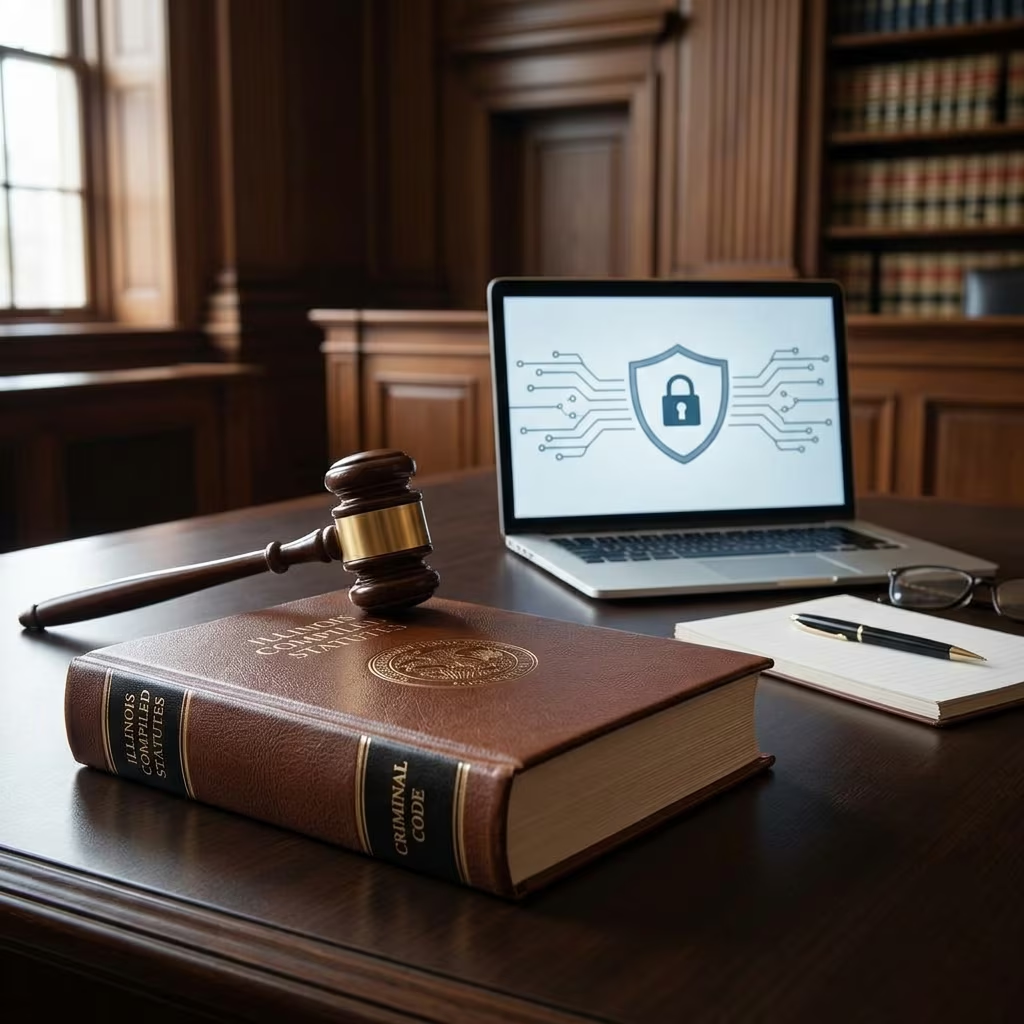
The State of Illinois has enacted detailed laws to address crimes involving computers, digital devices, and networks, collectively known as the Computer Crime Prevention Law under Article 16D of the Illinois Criminal Code. These statutes define what counts as a computer crime, categorize specific offenses, and establish penalties that range from misdemeanors to serious felonies.
This guide explains how Illinois approaches computer crime, highlights major offenses like computer tampering and computer fraud, and offers practical context for individuals, employees, and businesses operating in the digital environment.
1. Legal Framework for Computer Crimes in Illinois
Illinois regulates cyber-related offenses through a combination of state and federal laws. At the state level, the key source is Article 16D of the Illinois Criminal Code, officially cited as the Computer Crime Prevention Law. At the federal level, serious cyber offenses may also be prosecuted under the Computer Fraud and Abuse Act (CFAA), codified at 18 U.S.C. § 1030.
- State law: Illinois Computer Crime Prevention Law (Article 16D, 720 ILCS 5).
- Related Illinois provisions:
- Federal law: Computer Fraud and Abuse Act, applicable when conduct affects interstate or foreign communication, federal interests, or large-scale criminal schemes.
In many situations, conduct may violate both state and federal law, allowing prosecutors to bring charges in either or both forums.
2. What Counts as a Computer Crime?
Illinois computer crime statutes are intended to protect the integrity, confidentiality, and availability of computer systems and data. The law generally focuses on three types of wrongful conduct:
- Unauthorized access: Using or entering a computer, program, or data without permission.
- Interference or damage: Introducing viruses, malware, or altering, deleting, or destroying digital information.
- Fraud and deception: Using computers to intentionally deceive others to obtain money, property, services, or other benefits.
These legal categories do not require sophisticated hacking skills. Simple misuse of an employer database, accessing someone else’s email without consent, or manipulating electronic records can fall within the scope of computer crime statutes.
3. Core Offenses Under Illinois Computer Crime Law
Illinois computer crime law focuses on three primary categories of offenses:
3.1 Computer Tampering
Computer tampering typically refers to knowingly accessing or using a computer, computer program, or data without authorization, or introducing harmful code such as viruses into a system. Acts covered by this concept can include:
- Logging into someone else’s account without permission.
- Accessing a work database outside the scope of job duties.
- Attempting to alter digital records without authorization.
- Distributing or installing spyware, malware, or viruses on another person’s or entity’s computer.
Depending on the presence and extent of damage, computer tampering can be charged as a misdemeanor or a felony. Unauthorized access with no resulting damage is often treated as a lower-level offense, while tampering that causes financial loss, data destruction, or service disruption can trigger more serious felony charges.
3.2 Aggravated Computer Tampering
Aggravated computer tampering encompasses more dangerous forms of tampering where the purpose or predictable result is especially harmful. Illinois law recognizes aggravated tampering when, for example:
- The conduct is intended to disrupt the operations of state or local government.
- The activity creates a probability of death or serious bodily harm to individuals.
- Critical infrastructure, public utilities, or medical systems are impacted in a way that threatens public safety.
Because the potential consequences are severe, aggravated computer tampering is prosecuted as a felony, with enhanced penalties when there is a foreseeable risk of physical harm or death.
3.3 Computer Fraud
Computer fraud involves using a computer, network, program, or data as a tool to commit defrauding behavior. Fraud in this context typically includes intentional deception of a person or organization aimed at obtaining money, property, services, or other benefits.
- Running online scams to trick victims into transferring funds.
- Using stolen login credentials to move money from accounts.
- Manipulating digital records to unlawfully gain financial advantage.
- Phishing schemes designed to collect sensitive information, later used for fraudulent transactions.
Under Illinois law, computer fraud is generally charged as a felony, with the severity depending on the monetary value associated with the alleged offense.
4. Penalties and Classification of Computer Crimes
Illinois computer crimes are classified based on several factors: the type of conduct, the amount of financial loss, whether public systems were affected, and whether there was a risk of physical harm. Sanctions range from misdemeanors to higher-level felonies.
4.1 General Approach to Sentencing
When determining the charge level and potential penalties, Illinois authorities consider:
- Whether the defendant knowingly acted without authorization.
- The presence or absence of actual damage to data or systems.
- Any intent to defraud, steal, or commit another criminal offense.
- The involvement of government agencies, public utilities, or medical providers.
- Repeat offending or previous computer crime convictions.
4.2 Illustrative Classifications
While exact classification depends on the specific statute and factual circumstances, the following table illustrates typical charging ranges for certain conduct noted by Illinois practitioners:
| Type of Conduct | Typical Illinois Classification | Indicative Penalty Range |
|---|---|---|
| Unauthorized access with no damage | Often Class B misdemeanor (state level) | Up to six months in jail and fine (e.g., up to $1,500). |
| Unauthorized access with attempted data alteration | Often Class A misdemeanor | Up to one year in jail and higher fines (e.g., up to $2,500). |
| Computer tampering causing data damage or fraud-related harm | Class 4 or Class 3 felony depending on scope | Approximately one to five years in prison and fines up to $25,000. |
| Computer fraud with low monetary value (e.g., $1,000 or less) | Class 4 felony | Prison exposure typical of Class 4 felonies and potential forfeiture of property used in the offense. |
| Computer fraud with substantial monetary loss | Class 3 or higher felony depending on value | Longer prison terms; penalties increase as alleged loss exceeds thresholds such as $50,000. |
| Aggravated tampering affecting government, utilities, or causing risk of death | Class 3 or Class 2 felony | Significant prison exposure; Class 2 felonies carry higher maximums due to public safety concerns. |
Federal charges under the CFAA can result in additional prison exposure, particularly for large-scale offenses or repeat offenders, with potential penalties reaching ten or twenty years in some circumstances.
5. Relationship Between Computer Crimes and Other Offenses
Computer crime statutes frequently overlap with other criminal provisions. Many traditional offenses—such as theft, identity theft, harassment, and exploitation—can be committed through computers and networks, and when they are, they may be treated as cyber crimes.
- Identity theft: Using stolen personal information obtained online to open accounts or make purchases.
- Money laundering and fraud schemes: Moving funds through digital channels as part of broader illegal activities.
- Harassment and cyberstalking: Using email, social media, or messaging platforms to threaten or intimidate others.
- Child exploitation: Possessing, producing, or distributing sexual abuse material involving minors, or using technology to lure or exploit children.
Illinois responds to child-related online crimes with specialized initiatives such as the Internet Crimes Against Children Task Force, which coordinates investigations and prosecutions of online child exploitation cases and provides education and training to communities.
6. Practical Implications for Individuals and Businesses
Illinois computer crime laws have practical consequences for everyday technology users, employees, and organizations that rely on digital systems. Even seemingly minor misuse of IT resources can trigger legal consequences when it involves unauthorized access or alteration of data.
6.1 For Individual Users
Everyday internet and device users should be aware that:
- Accessing another person’s email, social media account, or cloud storage without permission may be treated as computer tampering.
- Using someone else’s login credentials obtained through sharing or guessing can still implicate unauthorized access.
- Installing software on another person’s computer without consent, particularly if it collects data or affects performance, may be considered tampering or spyware deployment.
- Participating in phishing or scam campaigns that use computers or networks to deceive victims may fall under computer fraud provisions.
6.2 For Employees and Internal Users
Employees with access to workplace systems must recognize that computer crime laws apply in organizational settings:
- Exceeding authorized access, such as viewing or modifying records outside job responsibilities, can be treated as unauthorized use.
- Copying proprietary data for personal benefit or for a competitor may implicate computer fraud or other theft-related statutes.
- Manipulating digital records (for example, payroll or accounting entries) to gain monetary advantage can trigger felony-level charges.
6.3 For Businesses and Institutions
Organizations operating in Illinois should treat computer crime risk as both a legal and operational concern:
- Implement clear acceptable use policies for employees and contractors.
- Maintain access controls that designate who may view, change, or export sensitive data.
- Establish logging and monitoring to detect unauthorized activity.
- Develop incident response plans that address potential data breaches, tampering, or fraud.
Because computer crime statutes can attach liability to conduct that occurs within corporate systems, organizations may also be victims, witnesses, or, in rare cases, subjects of investigations. Proactive compliance helps reduce the likelihood and impact of incidents.
7. Common Examples of Illinois Computer Crimes
To illustrate how Illinois computer crime laws operate in practice, consider several common scenarios:
- Unauthorized account access: An individual logs into a roommate’s email using a saved password to read private messages. There is no damage, but the access is unauthorized; this could be charged as basic computer tampering.
- Database misuse by an employee: An employee with legitimate login credentials retrieves customer credit card numbers from an internal database for personal use. Their access is within the system but goes beyond authorized purposes, potentially implicating computer fraud and other financial crimes.
- Phishing campaign: A person sends mass emails imitating a bank website to capture usernames and passwords, then uses those credentials to transfer funds. This activity blends elements of computer fraud and computer tampering.
- Disruption of public services: A perpetrator introduces malware into a municipal network, disrupting bill payment systems and record access. If done intentionally to impair government operations, this may constitute aggravated computer tampering and related offenses.
8. Frequently Asked Questions (FAQs)
8.1 Is simply guessing a password and logging in a computer crime in Illinois?
If you access a computer, account, or data without authorization, Illinois law may treat that conduct as computer tampering, regardless of how you obtained the password. What matters is the lack of permission and the nature of any subsequent actions involving the system.
8.2 Can I be charged if I did not cause any damage?
Yes. Unauthorized access alone—without actual damage—can be sufficient for a lower-level computer tampering charge. Damage, fraud, or disruption typically increase the severity of the offense and the potential penalties.
8.3 How do federal computer crime laws relate to Illinois statutes?
Federal laws like the Computer Fraud and Abuse Act apply when conduct impacts interstate or foreign communications, federal interests, or significant multi-state activity. A single incident can violate both federal and Illinois law, allowing parallel or alternative prosecution depending on the facts.
8.4 Are employers automatically liable for computer crimes committed by employees?
Liability depends on the circumstances. In most cases, employees who misuse their authorized access are personally subject to criminal charges. However, organizations may face civil or regulatory consequences if they fail to implement reasonable safeguards or if their policies encourage or ignore unlawful practices, particularly when sensitive personal data is involved.
8.5 Are online child exploitation offenses treated differently?
Yes. Illinois treats online child exploitation, including possession and distribution of child sexual abuse material and grooming of minors, as serious offenses subject to dedicated investigative resources. The Illinois Internet Crimes Against Children Task Force coordinates investigations, prosecutions, and public education to combat these crimes.
9. Compliance and Risk Reduction Strategies
While computer crime statutes are primarily punitive, understanding them helps individuals and organizations adopt preventive measures. Some practical strategies include:
- Education: Provide regular training on acceptable use of technology, data handling, and awareness of cybercrime risks.
- Access governance: Use role-based access controls to ensure users only see and modify data necessary for their roles.
- Technical safeguards: Deploy firewalls, intrusion detection systems, antivirus solutions, and patch management to limit opportunities for tampering and malware deployment.
- Policy and documentation: Write clear IT policies and incident response procedures so that users know what is permissible and how to report suspicious activity.
- Collaboration with authorities: In suspected cases of serious cybercrime or child exploitation, promptly contact law enforcement or relevant units such as the Internet Crimes Against Children Task Force.
By combining legal awareness with practical safeguards, Illinois residents and businesses can better protect digital systems from misuse while reducing exposure to criminal liability.
References
- 720 ILCS 5/ Art. 16D – Computer Crime Prevention Law — State of Illinois, General Assembly. 2010-01-01. https://law.justia.com/codes/illinois/2010/chapter720/072000050HArt_16D.html
- Illinois Computer Crime Defense Lawyer — Dolci & Weiland. 2023-05-01. https://www.dolciandweiland.com/criminal-defense/computer-crimes/
- Computer Tampering in Illinois: Surprising Ways it Applies — Stephen A. Brundage, Attorney at Law. 2026-01-01. https://www.stephenbrundagelaw.com/dupage-criminal-attorney/computer-tampering-in-illinois-surprising-ways-it-applies
- Your Guide to Federal and Illinois State Cyber Crimes — Azhari LLC. 2022-09-15. https://azharillc.com/blog/your-guide-to-federal-and-illinois-state-cyber-crimes/
- Computer Crime Statutes — National Conference of State Legislatures (NCSL). 2016-01-01. https://www.ncsl.org/technology-and-communication/computer-crime-statutes
- Illinois Internet Crimes Against Children Task Force — Illinois Attorney General. 2024-01-01. https://illinoisattorneygeneral.gov/safer-communities/safeguarding-children/Internet-Crimes-Against-Children-Task-Force/