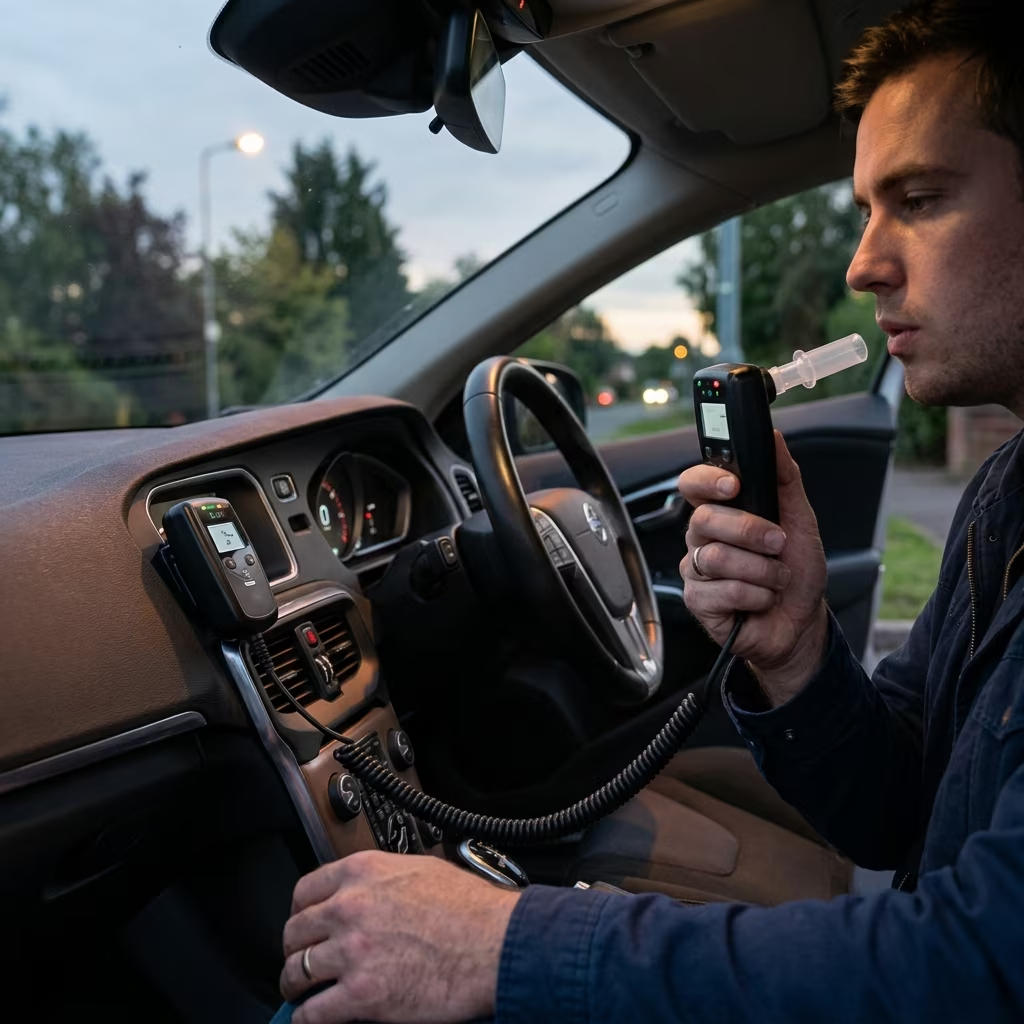
Across the United States, policymakers and safety advocates are examining whether ignition interlock devices should be mandatory for first-time DUI offenders, not just repeat drunk drivers. The debate sits at the intersection of public safety, criminal justice, individual rights, and practical affordability, and it has intensified as evidence shows these devices can significantly reduce alcohol-impaired driving while they are installed.
Understanding Ignition Interlock Devices
An ignition interlock is a small, electronic breath-testing device wired into a vehicle’s starting system. Before the engine starts, the driver must blow into a mouthpiece; if the device detects alcohol above a preset threshold, the vehicle will not start.
- Breath sample required: Drivers must provide a breath sample each time they want to start the vehicle.
- Preset alcohol limit: The typical cutoff is a breath alcohol concentration (BrAC) of about 0.02, far below most legal per se limits.
- Continuous monitoring: Data recorders log every test result, start attempt, and sometimes rolling retests while driving.
- Engine lockout: If alcohol is above the threshold, the ignition system is disabled and the car will not start.
These devices are commonly required as a condition of probation or license reinstatement for drunk driving offenders, allowing them to drive legally while sharply limiting the ability to drive after drinking.
Why Safety Officials Focus on First-Time DUI Offenders
Historically, ignition interlocks were used mostly for repeat DUI offenders, on the assumption that first-time offenders would be less likely to reoffend. However, multiple studies and national crash statistics suggest that limiting interlocks to repeat offenders leaves a significant safety gap.
- First-time offenders as risk indicators: A first drunk driving arrest often reflects a pattern of risky behavior, not a single isolated event.
- Preventive logic: Installing an interlock after the first conviction may interrupt a dangerous trajectory before a repeat offense or serious crash occurs.
- All-offender strategies: Organizations like the National Transportation Safety Board (NTSB) and several state legislatures have supported or adopted “all-offender” ignition interlock laws that apply to every convicted drunk driver, including first-time offenders.
Safety agencies argue that treating first-time offenders differently from repeat offenders ignores the reality that any impaired driver significantly increases crash risk the moment they choose to drive drunk.
Evidence: Do Ignition Interlocks Reduce Drunk Driving?
One of the strongest arguments for expanding interlock use is the growing body of research demonstrating that these devices reduce repeat drunk driving while in place. Reviews of multiple studies show that offenders with interlocks have substantially lower rates of arrest for impaired driving compared to similar offenders without interlocks.
| Outcome Measure | With Ignition Interlock | Without Ignition Interlock |
|---|---|---|
| Repeat DUI arrests while device installed | Up to 75% lower recidivism compared to no interlock. | Higher repeat offense rates among similar offenders. |
| Repeat offenses across studies | Approximate 67% reduction in repeat offenses reported in meta-analyses. | No comparable reduction without device. |
| Alcohol-related crashes and fatalities | Studies show reductions in crashes and deaths while interlocks are installed. | Higher risk of alcohol-related incidents. |
Importantly, researchers have observed that once the devices are removed, differences in recidivism between interlock and non-interlock groups largely fade, suggesting the main benefit is incapacitation and behavior control while the device is in place.
Based on crash data and modeling, analysts estimate that if every state required ignition interlocks for all DUI offenders, including first-time offenders, thousands of lives could be saved annually.
Current Landscape of State Ignition Interlock Laws
Across the country, states have taken different approaches to ignition interlock requirements. Some states restrict interlocks to repeat offenders or very high blood alcohol concentration (BAC) cases, while others mandate interlocks for all convictions.
- All-offender states: More than 30 states plus Washington, D.C., now require ignition interlock devices for all convicted drunk drivers, including first-time offenders.
- Conditional requirements: Other states tie interlock use to higher BAC levels, refusals to take a chemical test, or prior convictions.
- Administrative license suspension & interlock: Some safety recommendations emphasize automatic license suspension coupled with an interlock requirement before driving privileges are restored.
- Program design differences: States vary in how long interlocks must be used, how compliance is monitored, and whether financial assistance is available for low-income offenders.
The NTSB and other safety bodies have promoted adoption of comprehensive, all-offender ignition interlock laws, arguing that partial approaches miss opportunities to prevent crashes and fatalities.
Costs, Access, and Practical Barriers
While ignition interlocks are far less expensive than many other vehicle technologies, cost remains a significant concern. Installation typically involves a one-time fee and ongoing monthly charges for calibration, data downloads, and program oversight.
- Installation cost: Commonly around $70–$150 per device.
- Monthly fees: About $60–$80 per month for monitoring and calibration services.
- Additional court-related costs: Offenders may already be responsible for fines, court costs, license reinstatement fees, and DUI education programs, making total financial burden substantial.
For many offenders, these combined expenses create a practical barrier to compliance. Some state programs and policy proposals include:
- Sliding-scale or subsidized interlock fees for low-income drivers.
- Waivers or partial cost coverage funded through crime victim funds or traffic safety grants.
- Streamlined processes to ensure offenders can access approved interlock providers quickly after conviction.
Without attention to affordability, interlock requirements risk exacerbating inequities by making compliance much easier for higher-income offenders than for those with limited financial resources.
Legal and Civil Liberties Concerns
Expanding ignition interlocks to first-time offenders raises several legal and civil liberties questions. These concerns do not negate safety benefits, but they shape the debate over when and how interlocks should be required.
- Scope of punishment: Some argue that mandatory interlocks for first-time offenders represent an overly punitive response, especially in cases with no crash or injury.
- Privacy and data: Interlock devices record breath test results and device usage. The handling of this data and its potential use in court or administrative proceedings raises privacy questions.
- Proportionality: Critics worry that treating a first conviction the same as multiple offenses may blur distinctions between different levels of culpability.
- Access to work and family obligations: Proponents counter that interlocks can allow offenders to keep working and caring for family, compared to complete license revocation, which can be more disruptive.
Courts and legislatures continue to balance these concerns against evidence that interlocks restrain dangerous behavior without fully removing the ability to drive for lawful purposes.
Public Safety Benefits vs. Burdens on Offenders
Debates about first-time interlock mandates often center on the tradeoff between community safety and burdens imposed on individual offenders. Several arguments recur in policy discussions and legislative hearings.
Arguments Supporting Mandatory Interlocks for First-Time Offenders
- Strong safety impact: Empirical studies show substantial reductions in repeat drunk driving and crashes while devices are installed.
- Targeted control: Interlocks address the specific behavior—driving after drinking—without broadly banning driving.
- Immediate effect: Devices can be installed quickly after conviction, limiting risk during a high-danger period.
- Consistency: Applying interlocks to all convicted offenders reduces ambiguity and limits reliance on subjective case-by-case decisions.
Arguments Raising Concerns or Opposing Broad Mandates
- Cost burden: Installation and monthly fees can be difficult for low-income offenders, potentially leading to non-compliance or illegal driving.
- Limited long-term behavior change: Evidence suggests benefits diminish after devices are removed, indicating the primary effect is incapacitation rather than lasting rehabilitation.
- One-size-fits-all policy: Some legal advocates favor individualized sentencing decisions based on the facts of each case.
- Program administration complexity: States must build robust monitoring systems, certify providers, and manage data, which requires resources and technical capacity.
Policymakers often look for compromise solutions, such as requiring interlocks for a minimum period for first-time offenders, then transitioning to other forms of supervision or treatment.
Designing Effective Ignition Interlock Programs
For states that choose to expand ignition interlocks to first-time DUI offenders, program design is critical. Research and safety guidance highlight several best practices for maximizing effectiveness and fairness.
- Clear eligibility and triggers: Laws should specify when interlocks are required, such as after any DUI conviction or only above certain BAC thresholds.
- Integration with license suspension: Administrative license suspension regimes can be paired with interlock requirements as a condition for early or full reinstatement.
- Reliable compliance monitoring: Regular data downloads, violation reports, and communication with courts or probation officers help ensure devices are used properly.
- Access and equity measures: Fee waivers, partial subsidies, and geographic access to certified installers can reduce disparities.
- Supportive treatment components: Combining interlocks with alcohol education, counseling, or treatment may encourage longer-term behavior change beyond the device’s removal.
Well-designed programs recognize that technology alone cannot solve impaired driving, but interlocks can play a central role when integrated into broader criminal justice and public health strategies.
Frequently Asked Questions (FAQs)
1. How long must a first-time DUI offender use an ignition interlock?
The required duration varies by state law and case specifics. Many states mandate several months to a year of interlock use for first-time offenders, often tied to license reinstatement. Some states allow shorter or longer periods depending on BAC level, presence of injuries, or prior record.
2. Are ignition interlocks only for alcohol-related offenses?
Ignition interlocks are designed to detect alcohol, not other substances. They do not measure drug impairment. However, they are typically imposed in cases involving alcohol-impaired driving and may be part of broader supervision even when other substances are involved.
3. What happens if an offender tries to tamper with or bypass the device?
Tampering, attempting to bypass, or failing to comply with device rules can trigger violation reports, additional criminal charges, extended interlock periods, or revocation of driving privileges. Program rules and sanctions differ by jurisdiction, but enforcement is generally strict to maintain integrity.
4. Do ignition interlocks stop all drunk driving?
No technology is perfect. Interlocks significantly reduce the likelihood that a supervised offender will drive while above the set alcohol limit, but they cannot stop all impaired driving, especially once the device is removed or if an offender has access to another vehicle. Nonetheless, research indicates major reductions in repeat offenses and crashes while interlocks are installed.
5. Are ignition interlocks ever required before conviction?
Some jurisdictions allow or encourage voluntary interlock installation while a case is pending, or as a condition of pretrial release. Policy proposals also suggest early installation for arrested offenders to minimize risk while they await trial.
Looking Ahead: Policy Trends and Future Debates
As more states adopt or expand ignition interlock programs, the conversation about first-time DUI offenders continues to evolve. Research increasingly supports the safety benefits of all-offender laws, while advocates and courts work to ensure that implementation remains fair, proportionate, and sensitive to cost and privacy concerns.
Key issues likely to shape future debates include:
- Whether all states will adopt mandatory interlocks for first-time DUI convictions.
- How to integrate interlocks with treatment, education, and broader rehabilitation efforts.
- What financial assistance or sliding-scale models best promote equal access and compliance.
- How emerging vehicle technologies and telematics might complement or evolve beyond current interlock designs.
For now, ignition interlock devices stand as one of the most empirically supported tools to reduce drunk driving recidivism, and their growing use for first-time offenders reflects a strong policy shift toward prevention-oriented, technology-based safety measures.
References
- Countermeasures That Work: Alcohol Ignition Interlocks — National Highway Traffic Safety Administration (NHTSA). 2023-08-01. https://www.nhtsa.gov/book/countermeasures-that-work/alcohol-impaired-driving/countermeasures/other-strategies-behavior-2
- Ignition Interlocks — Mothers Against Drunk Driving (MADD). 2023-05-01. https://madd.org/ignition-interlocks/
- The Government in Your Dashboard — UNC School of Government. 2013-01-10. https://www.sog.unc.edu/blogs/nc-criminal-law/government-your-dashboard
- Effective Ignition Interlock Countermeasures to Fight DUIs — National Conference of State Legislatures / Ackerman. 2024-01-01. https://documents.ncsl.org/wwwncsl/Transportation/2024-precon/Ackerman_effectiveignitionpp2024.pdf
- NTSB Wants Ignition Locks for 1st-Time DUIs — FindLaw Criminal Defense Blog (Archive). 2013-12-18. https://archive.findlaw.com/legalblogs/criminal-defense/ntsb-wants-ignition-locks-for-1st-time-duis/
- Help Us Reach Zero: Adopt All-Offender Ignition Interlock Laws — Safety Compass. 2022-09-07. https://safetycompass.wordpress.com/2022/09/07/help-us-reach-zero-adopt-all-offender-ignition-interlock-laws/
- Ignition Interlock Program Best Practices — American Association of Motor Vehicle Administrators (AAMVA). 2013-09-01. https://www.aamva.org/getmedia/49e316ed-9b42-4770-aefa-a3ce80717826/Ignition-Interlock-Program-Best-Practices.pdf