
How Wage Discrimination Claims Are Tested
A practical guide to proving unequal pay, reading the evidence, and understanding how courts assess discrimination claims.
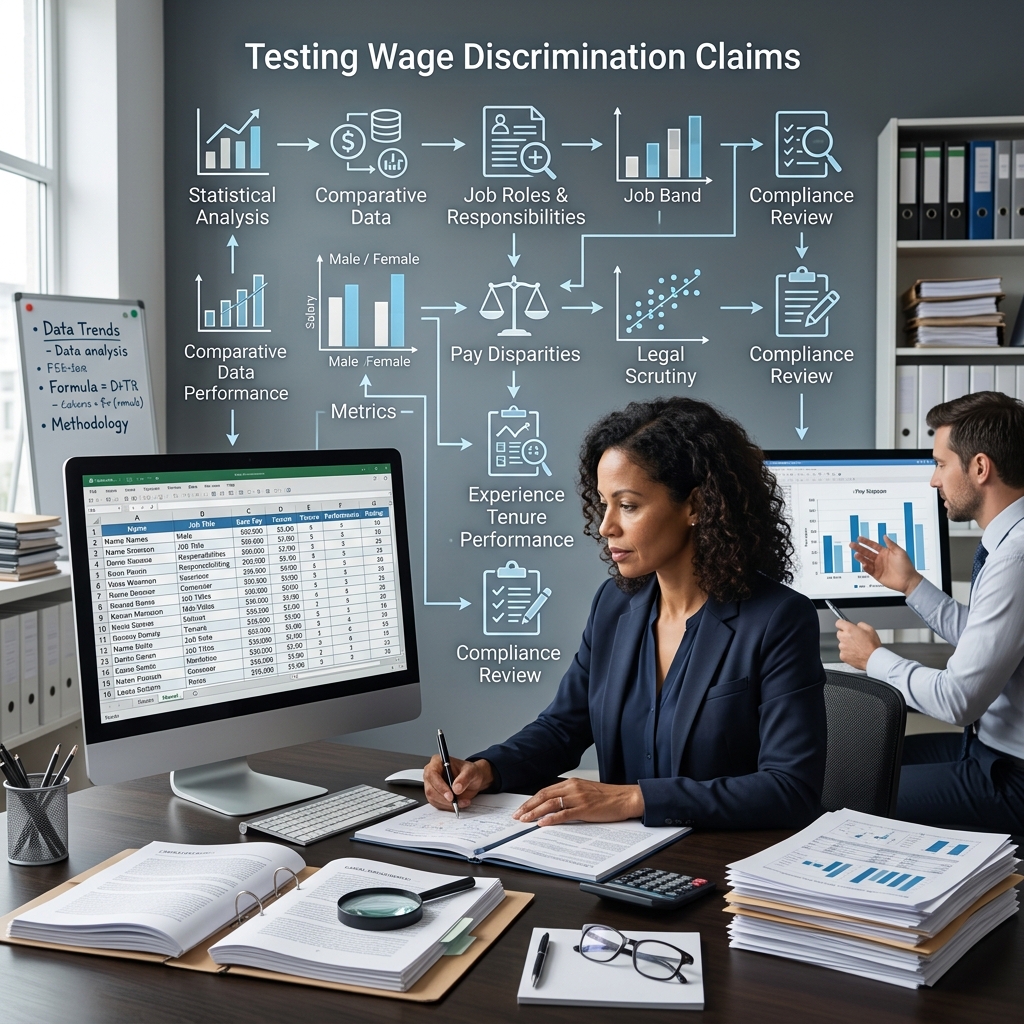
Disputes over unequal pay often turn on more than a simple comparison of salaries. Courts look closely at the job duties, the employer’s explanations, the quality of the evidence, and whether the pay difference can reasonably be tied to sex or another protected trait. In employment cases, workers frequently rely on Title VII and the Equal Pay Act, while employers often defend pay decisions by pointing to experience, performance, market conditions, or other non-discriminatory reasons.
This article explains how wage discrimination claims are analyzed, what makes a claim stronger, where many cases fail, and how the legal framework shapes the evidence on both sides. It is written as a practical overview for employees, employers, and anyone trying to understand how courts evaluate unequal-pay allegations.
What a wage discrimination case is really about
A wage discrimination claim is not just an argument that one person earns less than another. The legal question is whether the lower pay is connected to unlawful discrimination rather than a legitimate business decision. In many cases, the plaintiff must show that the work was similar enough to support an inference of unequal treatment and then respond to the employer’s stated reasons for the pay gap.
That means the court may examine the entire employment context, including job classifications, reporting structure, seniority, performance history, and the employer’s pay-setting process. A plaintiff who only shows a pay difference will usually need more to survive summary judgment.
Why the comparison group matters
One of the first issues in a wage case is choosing the right comparator. The comparison employee or employees must be similar enough to make the salary difference meaningful. Courts often look at whether the jobs required similar skills, effort, and responsibility, and whether the work was performed under similar conditions.
If the proposed comparator had different duties, broader responsibilities, a distinct work location, or a stronger performance record, the employer may argue that the comparison is not valid. That does not automatically defeat the claim, but it can weaken the inference of discrimination if the positions are not truly alike.
- Comparable title alone is not enough.
- Different responsibilities can justify different pay.
- Performance, seniority, and specialized experience often matter.
- Market-based hiring decisions may also be relevant if supported by evidence.
The evidence plaintiffs usually need
Successful wage discrimination claims typically depend on a combination of salary records, job descriptions, testimony, and internal documents. Plaintiffs often try to show that they were paid less than a similarly situated coworker outside the protected group and that the gap cannot be explained by neutral factors.
Direct evidence of discriminatory intent is not always available, so courts often rely on indirect proof. Under that model, a plaintiff may start with a prima facie showing, after which the employer gives a legitimate explanation for the pay difference. The plaintiff then must present evidence that the explanation is false or incomplete and that discrimination is the more likely reason.
- Pay stubs, W-2s, and payroll records
- Job descriptions and organizational charts
- Performance reviews and disciplinary records
- Emails or statements suggesting bias
- Evidence of inconsistent pay practices
How the burden of proof shifts
Courts generally use a burden-shifting structure in employment discrimination cases when there is no direct proof of bias. The employee must first present evidence that supports an inference of unlawful pay discrimination. Once that threshold is met, the employer must identify a lawful reason for the wage difference.
After the employer offers its explanation, the plaintiff must show pretext, meaning the reason offered is not the true reason for the pay decision. Evidence of pretext may include shifting explanations, inconsistent application of pay policies, unexplained departures from normal practice, or proof that similarly situated workers were treated more favorably.
This is why many cases rise or fall at the summary judgment stage. If the employee cannot create a genuine factual dispute on discriminatory intent, the court may end the case before trial.
Common employer defenses
Employers frequently defend pay differences by pointing to lawful factors unrelated to protected status. These explanations may be persuasive if they are documented and applied consistently. Courts do not require perfect pay uniformity, but they do expect employers to connect compensation decisions to legitimate criteria.
| Defense | What it means | Why it can matter |
|---|---|---|
| Experience | The higher-paid worker brought more years of relevant background. | More experience can justify higher starting pay or raises. |
| Performance | The worker had stronger evaluations or better results. | Merit-based systems can support pay differences if applied fairly. |
| Seniority | The wage gap reflects length of service. | Longer tenure is often a recognized lawful factor. |
| Market demand | The employer paid more to recruit or retain a worker in a competitive labor market. | Market conditions may explain pay, but the employer should be able to support the claim. |
| Different duties | The employees did not actually perform the same work. | Meaningful job differences can defeat a comparison. |
Why summary judgment is such a major hurdle
Many wage discrimination cases end before trial because the court decides that the evidence is not strong enough to let a jury infer unlawful intent. The Eighth Circuit, like other federal courts, has emphasized that the employee must produce enough evidence for a reasonable factfinder to conclude that discrimination, not just unfairness, caused the pay difference.
That standard matters because employment disputes often involve messy business judgments. A plaintiff cannot usually win by showing only that another employee earned more. The evidence must suggest that the employer’s stated reasons are not credible or that they were used as a cover for bias.
In practice, this means the record should be built early. Discovery, document preservation, and carefully framed comparator evidence are often decisive in whether the case survives dispositive motions.
The role of retaliation claims
Wage discrimination disputes often include retaliation allegations as well. If an employee complains about unequal pay and then experiences a materially adverse action, such as discipline, termination, or a demotion, the employee may argue retaliation. But the employee still needs evidence of causation and harm.
Courts look for a real connection between the protected complaint and the employer’s action. The anti-retaliation rules do not protect every unpleasant workplace response; they focus on actions serious enough to discourage a reasonable worker from making a complaint.
How employees can strengthen a claim
Workers who suspect pay discrimination can improve their position by collecting information carefully and consistently. The strongest cases usually show a clear comparator, documentation of similar responsibilities, and evidence that the employer’s explanations do not fit the facts.
- Request and preserve pay records where lawful.
- Track job duties in detail, not just titles.
- Save performance reviews and written feedback.
- Document who made pay decisions and when.
- Record any comments or emails that suggest bias.
Employees should also be aware that timing matters. The sooner the evidence is gathered, the easier it is to show how the pay structure worked and whether it changed over time.
How employers reduce exposure
Employers can lower the risk of wage discrimination claims by using clear compensation criteria and applying them consistently. Written pay policies, objective salary bands, and regular audits can help show that compensation decisions are based on legitimate business factors rather than unlawful bias.
It also helps to keep records explaining starting salary decisions, promotions, and discretionary bonuses. When those decisions are documented, an employer is in a better position to explain why one worker earns more than another.
- Use standardized job descriptions.
- Document reasons for salary offers and raises.
- Review pay decisions for unexplained gaps.
- Train managers on discrimination and retaliation risks.
- Apply performance criteria consistently across teams.
Frequently asked questions
Does a pay gap automatically prove discrimination? No. Courts usually require more than a salary difference; the plaintiff must connect the gap to unlawful discrimination through comparator evidence, inconsistencies, or other proof.
Do employees need identical jobs to compare pay? No, but the jobs must be similar enough in duties and responsibility to make the comparison meaningful.
Can an employer pay more for experience or performance? Yes, if those reasons are real, documented, and applied consistently.
What happens if the employer changes its explanation? Changing explanations can support an argument that the stated reason is pretext, especially if the record shows inconsistency or uncertainty.
Can retaliation be part of a wage discrimination case? Yes. If the employee complains about unequal pay and then suffers a materially adverse action, retaliation may be a separate claim.
What courts are looking for in the end
At bottom, wage discrimination cases are about proof. A court wants to know whether the lower pay can be explained by neutral business factors or whether the surrounding facts support a reasonable inference of discrimination. Plaintiffs need credible comparator evidence and a way to challenge the employer’s stated reasons. Employers need consistent, documented pay practices that can be defended under scrutiny.
Because these cases often turn on the details, small inconsistencies can matter a great deal. A strong record, clear pay logic, and disciplined documentation are often the difference between a viable claim and one that fails at summary judgment.
References
- Eighth Circuit joins the majority of Federal Circuit courts holding claims of employment-based discrimination do not arise under Title II of the ADA — Baker Sterchi Cowden & Rice LLC. 2024-??-??. https://www.bakersterchi.com/eighth-circuit-joins-the-majority-of-federal-circuit-courts-holding-claims-of-employmentbased-discrimination-do-not-arise-under-title-ii-of-the-ada
- Ryther v. KARE II and the Eighth Circuit Standard for Summary Judgment in Employment Discrimination Cases — Mitchell Hamline Open Access. 1997-01-01. https://open.mitchellhamline.edu/cgi/viewcontent.cgi?article=1867&context=wmlr
- Proof of Discrimination at Summary Judgment — Boston College Law Review. 2011-01-01. https://bclawreview.bc.edu/articles/810/files/63b42527b1071.pdf
- Opinions by Case — United States Court of Appeals for the Eighth Circuit. 2007-01-01. https://ecf.ca8.uscourts.gov/cgi-bin/opnByCase.pl?getOpn=1&caseno=06-1689
- Litigating Gender-Based Wage Discrimination Claims Under the Equal Pay Act and Title VII — University of South Dakota Law Review. 2010-01-01. https://red.library.usd.edu/cgi/viewcontent.cgi?article=4170&context=sdlrev
Similar Articles








Read full bio of Sneha Tete




